
The survey came back clean. “Price” ranked first. “Features” second. “Brand reputation” third. Neat. Tidy. Useless.
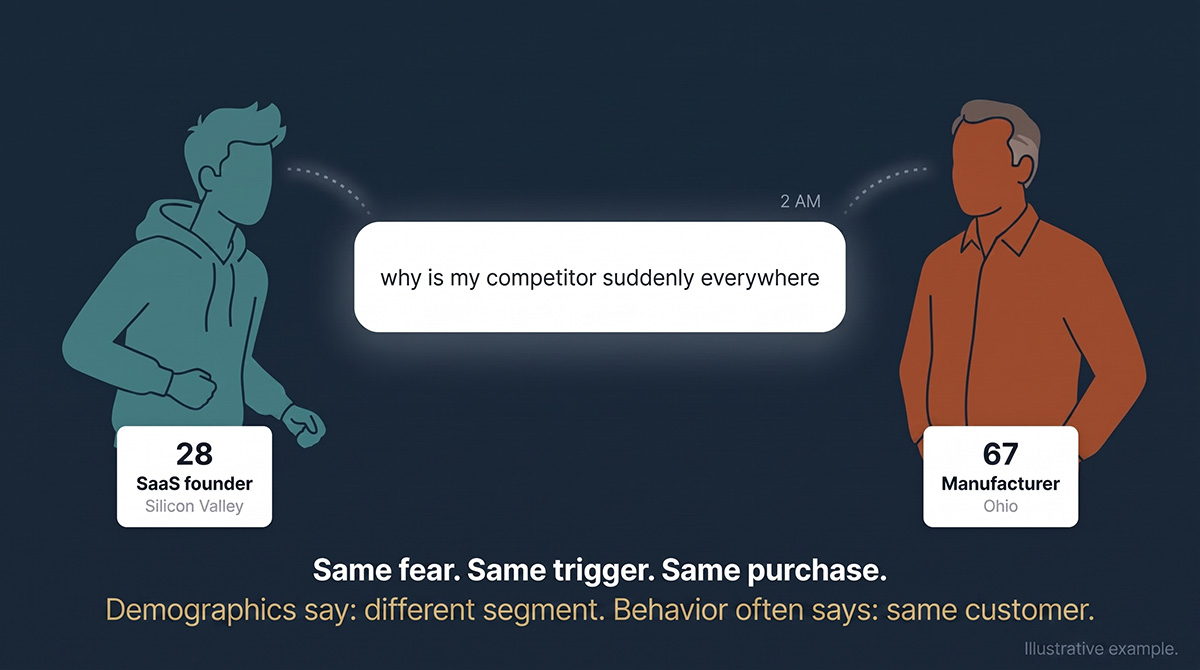
Now picture the same week from the other side. Your best customer is awake at 2 AM, and what they are typing into Google has nothing to do with your pricing page. It is closer to “why is my competitor suddenly everywhere.” A fear they would never admit to your face, your focus group, or your annual satisfaction survey.
I cannot show you that search history. Neither can anyone else. That is the problem.
This is the gap that is bleeding you dry. Not the gap between your product and theirs. The gap between what customers say they want and what actually makes them reach for a credit card.
The data on that gap is brutal.
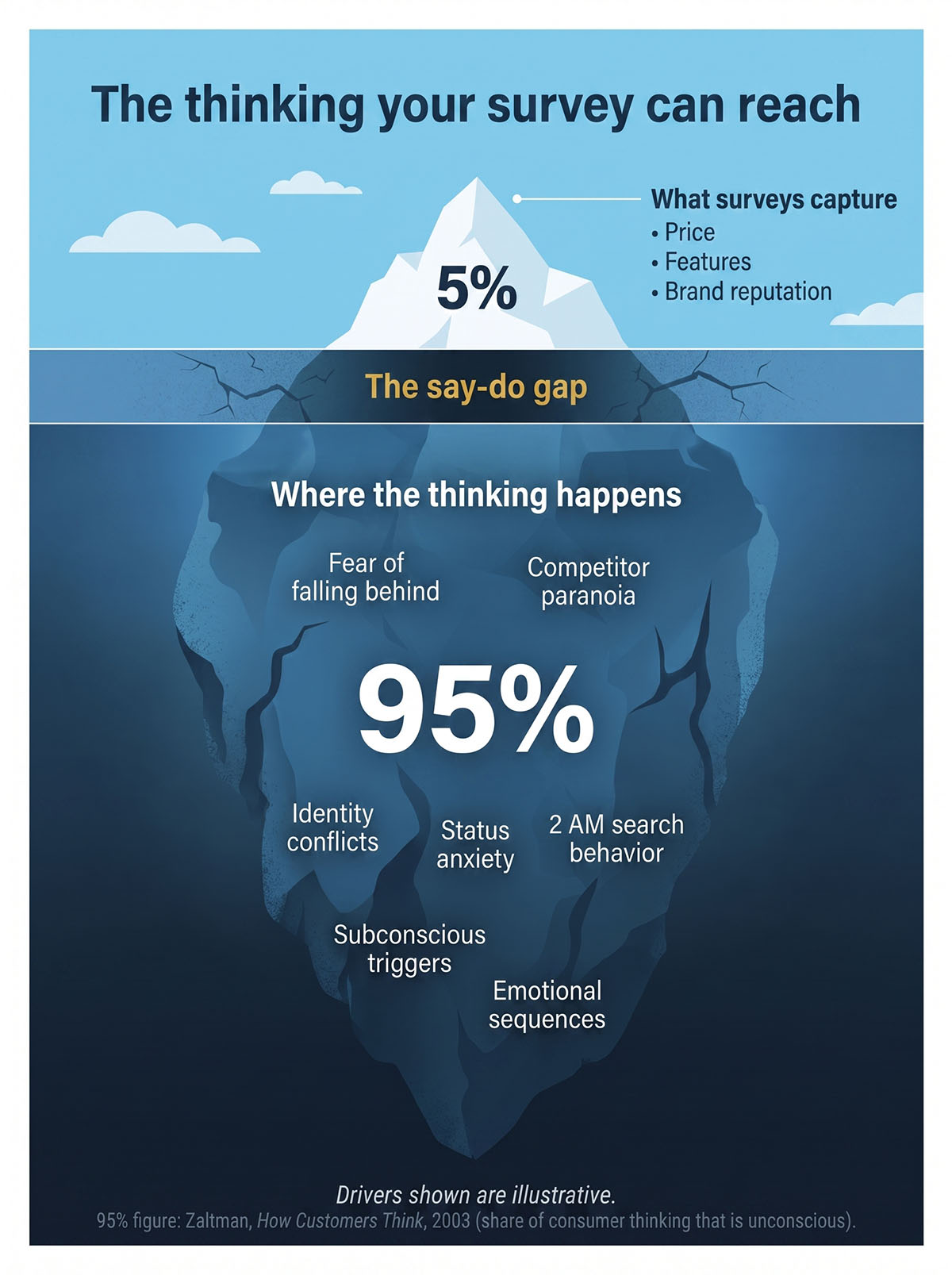
95% of thinking happens where surveys can't reach
Harvard Business School professor Gerald Zaltman spent years studying how people make buying decisions. His claim: as much as 95% of consumers’ thinking happens in the unconscious mind. That is territory surveys, focus groups and customer interviews cannot reach (How Customers Think, Harvard Business School Press, 2003).
Not a rounding error. The whole game.
Think about your own buying. You tell yourself you chose the restaurant because of the reviews. But it was the way the menu looked on Instagram three weeks ago that planted the seed. You decided before you ever checked a rating. Your customers do the same thing, then rationalize it afterward in language that makes them sound logical on your NPS survey.
An HBR essay put a number on the gap. It cites a survey in which 65% of consumers said they want to buy purpose-driven brands that advocate sustainability. Only 26% actually do (White, Hardisty & Habib, The Elusive Green Consumer, HBR, July 2019). Thirty-nine points between what people say and what they buy. Your surveys capture the performance. The purchase happens backstage.
AI research doesn't ask. It watches.
Researchers at Columbia, Stanford, Wharton and Cambridge ran three Facebook field experiments reaching more than 3.5 million people. No survey. No panel. No persona workshop. They took the Facebook Likes that scored highest and lowest for extraversion, built ad audiences out of those Likes, and served creative written to match or deliberately mismatch the trait.
Ads matched to the trait produced up to 50% more purchases than ads deliberately mismatched to it (Matz, Kosinski, Nave & Stillwell, PNAS, 2017).
Not clicks. Not engagement. Purchases.
One caveat, because it matters. The purchase result comes from the first of the three experiments and rests on 390 purchases. One study, not a law of physics. But nobody asked those buyers a single question, and the targeting still beat the version built to miss them.
Your own account runs on the same principle. A 28-year-old SaaS founder and a 67-year-old manufacturer sit in different segments on every demographic sheet you own. Behavior will cheerfully drop them in the same one, because the thing that moves both of them is watching a rival move faster while they sit in coordination meetings.
That is a hypothesis, not a finding. Which is exactly why you test it instead of surveying it.
Now imagine that insight hitting five different inboxes.
Here is where the whole thing falls apart.
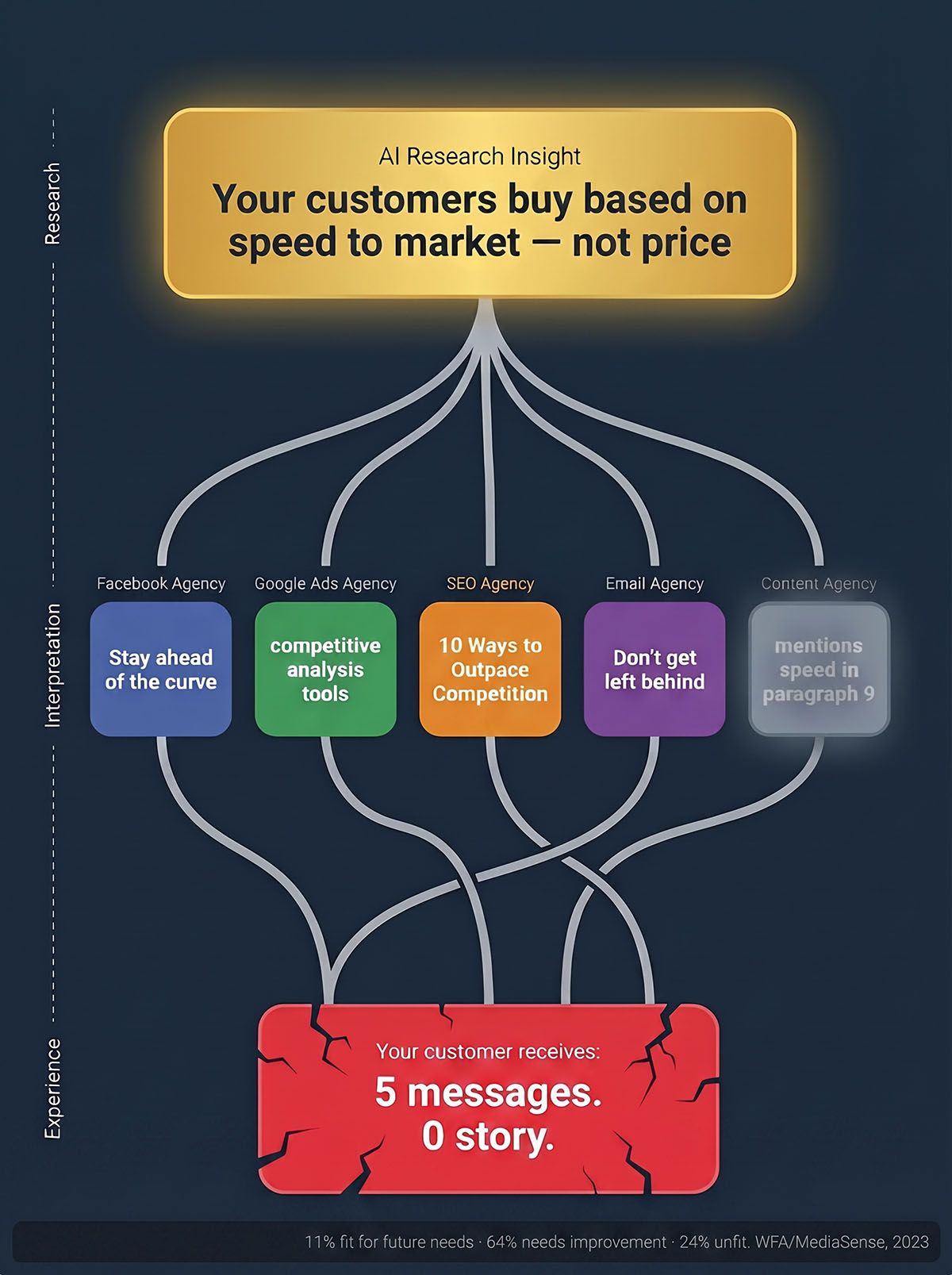
The research surfaces something real. A fear, a trigger phrase, an identity conflict your customer would never say out loud in a boardroom. Gold. The kind of insight that changes positioning overnight.
Then it lands on five agency desks.
Your Facebook agency reads “speed to market” and writes ad copy about “staying ahead.” Your Google Ads team targets keywords around “competitive analysis tools.” Your SEO agency produces a listicle: “10 Ways to Outpace Your Competition.” Your email team writes a nurture sequence about “not getting left behind.” Your content agency publishes a trends report that mentions speed once, in paragraph nine.
Same insight. Five interpretations. Zero coherence. Your customer gets five versions of a message that should have been one story told across five chapters.
The World Federation of Advertisers surveyed more than 70 multinationals representing $50 billion in media spend. Only 11% said their agency model is fit for future needs. Another 64% called it fit for purpose but in need of improvement. 24% called it unfit (WFA/MediaSense, October 2023). One company in nine will defend the model as it stands.
The usual answer is to consolidate five agencies into one full-service shop, which moves the seams inside someone else’s building rather than removing them.
"But my agencies communicate."
No. They report. To you. Separately. On different timelines, in different formats, measuring different metrics.
Communication would mean your Google Ads data reshaping your Facebook creative within days. It would mean your email engagement deciding which landing pages get built next week. It would mean one team learning which phrase converts and which one dies, then every channel moving on that overnight.
That does not happen when five vendors optimize five dashboards. Each one wins their game. You lose yours.
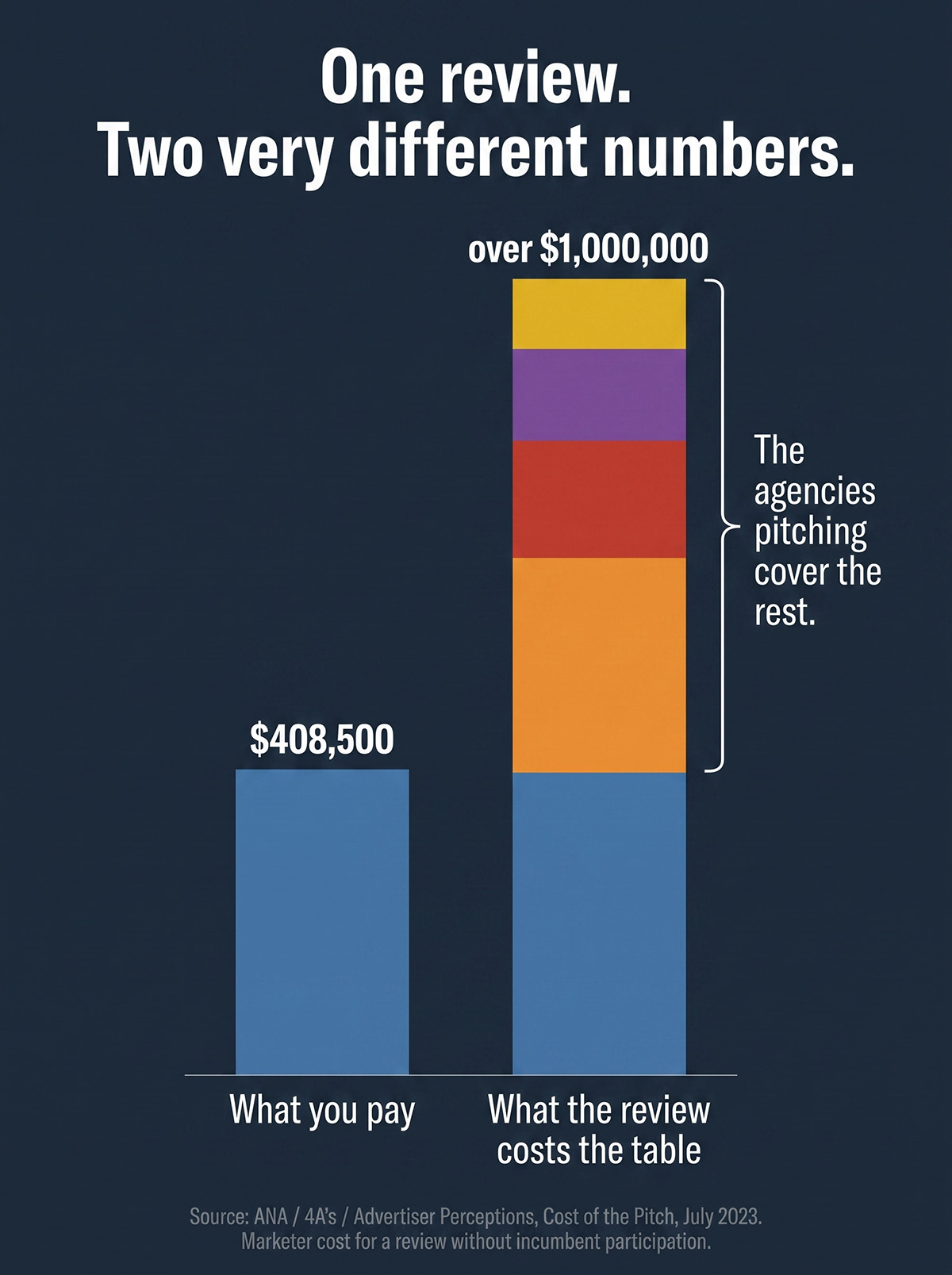
The cost of holding it together runs past the retainers. The ANA and the 4A’s put a single agency review at $408,500 for the marketer, and over $1 million once you count the agencies pitching for it (Cost of the Pitch, July 2023). You spend $408,500. The table burns a million. And the shortest relationships in the business are the media ones, averaging 44 months (ANA/4A’s, April 2025). Every turn of that wheel, a team that had finally started to understand your customer walks out, and the replacement starts at zero.
P&G did the math. They cut their roster from 6,000 agencies to 2,500 and saved $750 million in agency fees and production costs (Jon Moeller, Q2 FY2018 earnings call, January 2018). Unilever’s CFO doubled the company’s brand and marketing efficiency target from €1 billion to €2 billion, and halved the agency roster from roughly 3,000 to 1,500 (Graeme Pitkethly, April 2017).
That is not a management tweak. That is two of the largest advertisers on earth treating the model itself as the tax.
The same survey. A different Monday.
Imagine running that customer survey again. “Price” still ranks first. “Features” second. You nod. Tidy.
But this time you have what sits underneath it. The search behavior. The threads. The language your customers use when they think nobody is watching. And instead of five agencies pulling that intelligence in five directions, one brain turns it into one story, told differently on each channel, building to the same point.
Facebook introduces the fear. Google catches the search it creates. Email answers it directly. Every touchpoint compounds the last.
The gap between what your customers say and what they do is still there. It always has been. The only question is whether anyone in your marketing operation is watching the right side of it, and whether they can act on what they see without five competing translations.
Gartner’s 2025 CMO Spend Survey found that 39% of CMOs plan to cut back on agency budgets. As of ANA’s 2023 study, 82% of ANA members run an in-house agency of some kind, up from 42% in 2008. The market worked out that the survey was lying. The question is whether your marketing model is still taking it at its word.
That clean survey is still sitting in your inbox. Neat. Tidy.
Now what are you going to do about the 95% it never touched?
Your marketing, looked at properly
Thirty minutes on your current setup — what’s working, what’s quietly leaking budget, and what I’d fix first. You’ll leave with a clearer picture whether we work together or not.
Got something specific bugging you? Flag it when you book and I’ll have it looked at before we talk.

AboutBruce Marjoribanks
Bruce Marjoribanks has spent 27 years in marketing, including building, running and selling his own agency before going independent. He now runs every channel - paid, organic, social, email, creative and automation - as one integrated system, with AI ehancing production and the judgment staying human.