
Open YouTube right now and search “AI ad creation.” You’ll find a guru in a rented office telling you how 7–9 figure brands produce 1,000+ ads a month. Scroll down and there’s another one promising 100 ad variations in a day. A third is selling a course on “scaling creative output with AI” for $997.
They’re all saying the same thing: more ads, faster. Volume is the game. Let the algorithm sort the winners from the losers.
It’s terrible advice. And I can prove it.
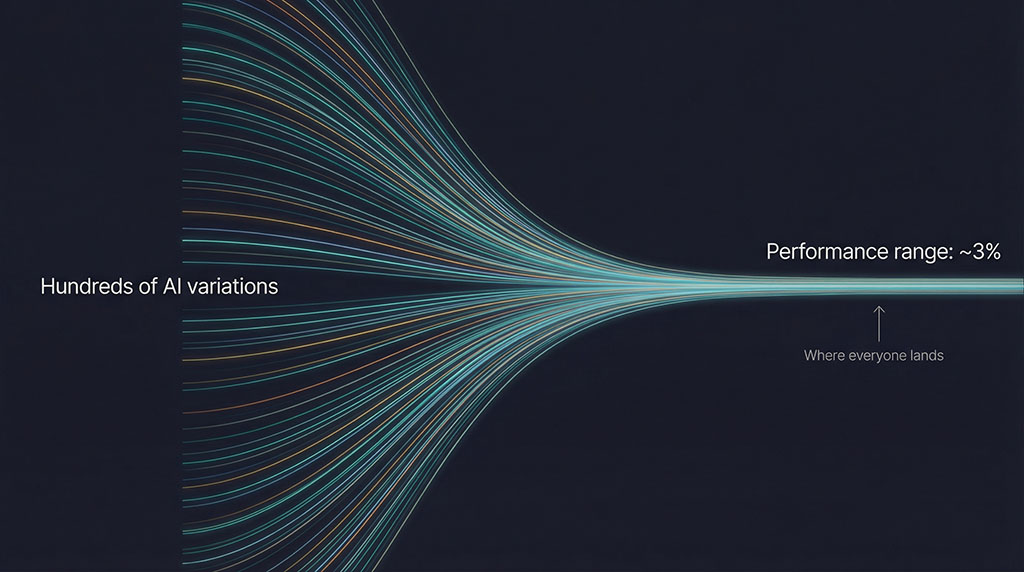
Last year I watched a client take this approach seriously. Four months. $38,000 in ad spend. Hundreds of AI-generated variations—headlines, images, body copy, all produced in minutes by tools that would have cost a creative team six figures and half a year to match in volume.
Every single variation performed within 3% of the others.
Those figures are from my own client account. Unaudited, and one business’s results — not a benchmark, and not a promise.
Not because the AI was bad. Because it was too good—at producing the same kind of thing everyone else’s AI was also producing. Same training data, same best-practice frameworks, same pattern libraries. What came out was competent, polished, and completely invisible in a feed full of competent, polished, and completely invisible content.
The gurus were right about one thing: the client had more creative output than ever. They were wrong about everything else. Because the problem was never production speed. It was that nobody had decided what to say.
The execution layer collapsed (and the gurus are celebrating)
Two years ago, creating a decent Facebook ad took a copywriter, a designer, a media buyer, and a project manager to keep them all talking. That’s four invoices, four onboarding calls, and four people who each think the other three are the bottleneck.
Now a single person with the right AI stack can produce the same output before lunch. Copy generated, images created, variations tested, audience segments built—all within hours. The “1,000 ads a month” crowd isn’t lying about the capability. The tools really can do that.
Which is exactly why the advice is so dangerous.
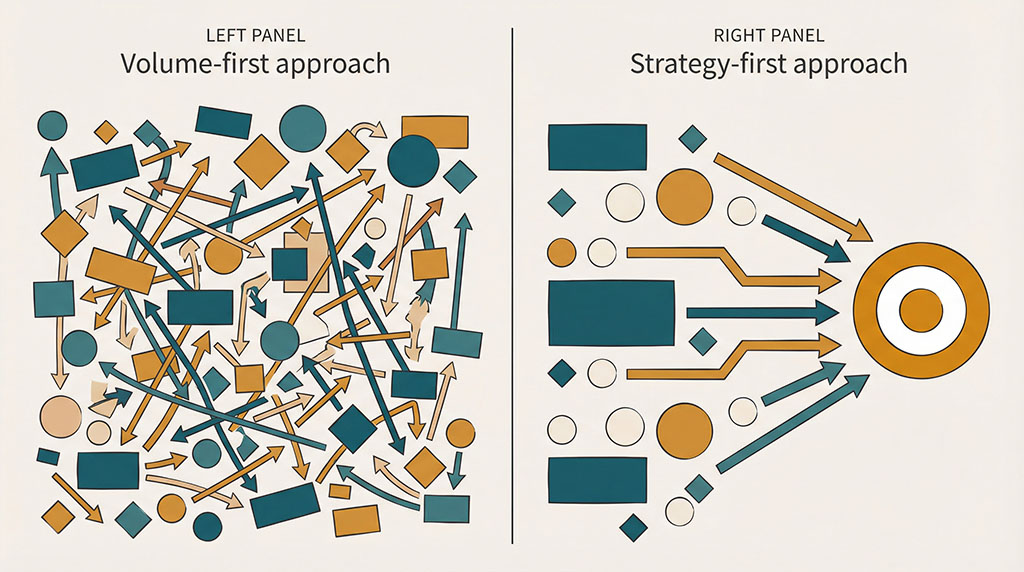
Because when everyone can execute at the same speed and quality, execution stops being the advantage. You know what happens when a whole industry gets access to the same production capability at the same time? You get a race to the middle. Faster, cheaper, more efficient—and all arriving at the same destination.
The bottleneck moved. Most people haven’t noticed yet.
Where the bottleneck actually sits now
Here’s a question nobody’s asking at their Monday marketing meeting: of all the things we could say and all the audiences we could target, how do we know we’re choosing the right ones?
That’s a creative strategy question. Not a creative execution question.
The distinction matters. Execution is “write a compelling headline for this audience about this offer.” AI crushes that. Strategy is “should we be talking to this audience about this offer at all, or is there a completely different angle that would change the economics of the whole campaign?”
AI can’t answer that second question. Not well, anyway. It can generate plausible-sounding marketing plans—ask ChatGPT for one and you’ll get something that looks like it came from a mid-tier agency’s pitch deck. Structured, professional, and built entirely from patterns in its training data. Which means it’s built from what already worked for other people in other contexts with other constraints.
Your competitors are feeding the same tools the same briefs. The outputs converge. The only thing that doesn’t converge is the thinking that happens before someone opens the tool.
The "Think Inside the Box" problem
There’s an old idea in creativity research that most people get backwards. The instinct when you need a breakthrough idea is to think bigger—more brainstorming, more options, wider scope. But the people who consistently produce strong ideas do the opposite. They shrink the problem space first. They figure out where the answer is most likely hiding before they start searching.
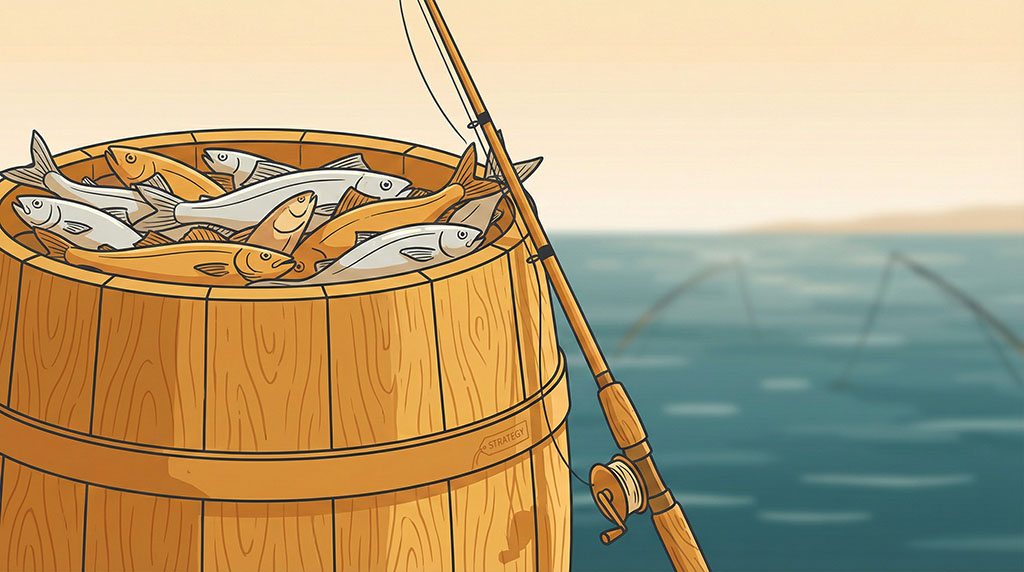
David Deutsch, one of the better direct-response copywriters of the last few decades, built a whole framework around this. He called it “thinking inside the box”—the argument being that trying to search the ocean for fish is exhausting, but scooping them from a barrel is easy. You just need to know which barrel.
This maps onto AI-powered marketing almost perfectly.
The businesses getting the best results from AI aren’t the ones generating the most variations. They’re the ones who narrow the field before the AI touches anything. They know which customer segment is under-served. They know which emotional angle competitors haven’t claimed. They know which stage of the funnel is leaking. Then they point the AI at a specific, constrained problem—and the output is dramatically better because the input was smarter.
An open prompt produces average work. A constrained prompt produces sharp work. And the constraint comes from strategic thinking, not from the tool.
What this looks like in practice
I’m not going to give you a twelve-step creativity framework. But there are a few patterns I keep seeing separate the businesses where AI is actually moving the needle from the ones generating expensive noise.
They start with the data, not the brief. Before anyone writes a word of copy or generates an image, they look at what’s already working—and more importantly, what’s already failing. Which audiences are clicking but not converting? Which messages get engagement but no action? The AI tools are brilliant at surfacing these patterns. But someone has to ask the right question and interpret what comes back.
They kill ideas faster than they create them. The old marketing problem was not having enough ideas. The new problem is having too many. AI can generate fifty headline variations in seconds. The strategic skill is knowing which forty-seven to throw away—and having a reason beyond “I don’t like it.” The reason should come from data, from customer insight, or from a deliberate positioning choice. If you can’t explain why one direction over another, you’re just guessing with better production values.
They make the AI argue with itself. One of the more effective things I’ve seen is using AI to stress-test your own strategy before spending a dollar. Generate the best possible argument against your campaign angle. Have it find weaknesses in your positioning. Use it to simulate how your message lands with different audience segments. This is strategic work that used to require an expensive planning team. Now it requires someone who knows which questions to ask.
They treat the tools as amplifiers, not authors. The difference is subtle but it changes everything. An amplifier makes your signal stronger. An author creates its own signal. When you let AI author your strategy, you get the average of everything it’s been trained on. When you use it to amplify a specific strategic choice you’ve already made, you get something that sounds like you and hits harder than you could produce alone.
The objection you're already forming
Right about now, you’re thinking: this sounds great, but I don’t have time to be a creative strategist. I’m running a business. That’s why I hire people.
Fair. And that’s exactly the problem.
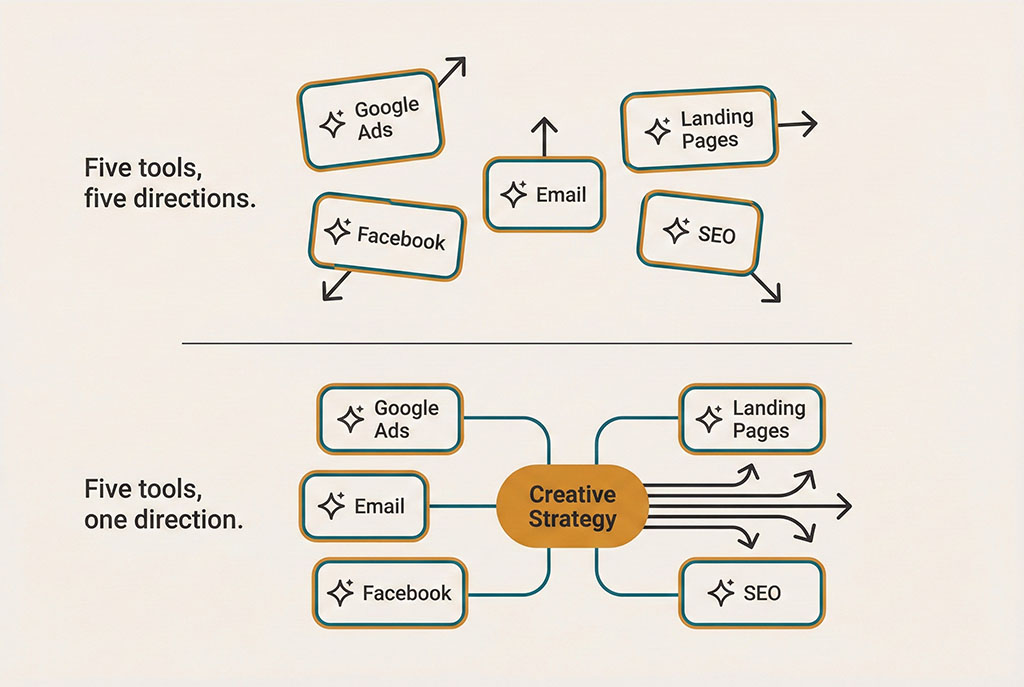
You’re probably hiring people to execute—a Google Ads person, a Facebook person, an email person, maybe a designer and a copywriter on top. Each one is executing inside their own channel, with their own tools, making their own creative decisions. None of them are making strategic decisions, because none of them can see the whole picture. They’re catching fish in their own little corner of the ocean without anyone telling them which barrel to focus on.
So you end up with five people executing five different creative directions, each one plausible, none of them connected. Your Google Ads are saying one thing. Your emails are saying another. Your landing page matches neither. And you—the only person who could see the whole picture—are too busy managing all of them to actually think about what the picture should look like.
That’s not a staffing problem. It’s a structure problem. And throwing more AI tools at a broken structure just makes it produce the wrong things faster.
What actually needs to change
The businesses I see winning with AI right now share one structural trait: someone owns the creative strategy across all channels. Not the execution—the thinking. The decision about what to say, to whom, and why. The execution can be distributed across tools, freelancers, even agencies. But the strategic direction comes from one place.
That might be an in-house marketing director who genuinely understands the AI tools. It might be a fractional CMO. It might be an integrated partner who runs everything through a single strategic lens.
The shape of the solution matters less than the principle: one brain directing the creative decisions, with AI multiplying the output of those decisions across every channel.
Because the irony of the AI revolution in marketing is this—the technology that was supposed to make creativity automatic actually made strategic thinking the scarcest and most valuable resource in the building. The machines handle production. But someone still needs to decide what’s worth producing.
And that decision is where every dollar of ROI lives now.
The barrel, not the ocean
Remember the fish metaphor? Barrels are small. Finite. You can see what’s inside them.
That’s what good creative strategy does in an AI world. It takes the infinite possibility space—every audience, every message, every channel, every angle—and shrinks it to a defined container where the right answers are concentrated. Then AI does what it’s actually good at: exploring every corner of that small space at inhuman speed.
The businesses still searching the ocean are the ones generating hundreds of AI variations that all perform within 3% of each other. They’ve got the most powerful fishing equipment ever invented, pointed in no particular direction.
The ones fishing from the barrel? They decided where to look before they picked up the rod. That decision—that one, unglamorous, deeply human decision—is the whole game now.
Your AI tools are only as good as the strategy feeding them. And no tool is going to build that strategy for you.
Not yet, anyway.
Your marketing, looked at properly
Thirty minutes on your current setup — what’s working, what’s quietly leaking budget, and what I’d fix first. You’ll leave with a clearer picture whether we work together or not.
Got something specific bugging you? Flag it when you book and I’ll have it looked at before we talk.

AboutBruce Marjoribanks
Bruce Marjoribanks has spent 27 years in marketing, including building, running and selling his own agency before going independent. He now runs every channel - paid, organic, social, email, creative and automation - as one integrated system, with AI ehancing production and the judgment staying human.