
Dan Kennedy’s most famous line might be the most ignored advice in advertising: “He who can spend the most to acquire a customer wins.” It gets head-nods at every conference. People quote it on LinkedIn. They put it in slide decks. Then they go back to their agency and say four words that guarantee they’ll lose: “Get me cheap leads.”
Every agency relationship starts with the same conversation. The agency asks, “How much can you afford to pay per lead?” The business owner answers, “As cheap as possible.” And right there — before a single ad runs — both sides have agreed to play a game the business owner will eventually lose.
That answer feels sensible. Rational, even. Why would anyone volunteer to pay more for a customer?
But “as cheap as possible” isn’t a strategy. It’s a constraint disguised as one. And the moment market conditions shift — a new competitor enters the auction, platform costs rise, an algorithm changes — that constraint becomes a noose.
I watched it happen to a beauty education company we worked with. They’d built their entire acquisition model around a $60 cost-per-lead target. Courses ranged from $500 to $2,500, the sales team closed at a decent rate, and at $60 the math worked. Barely.
Then their market got crowded. CPCs rose. The same landing page, the same ads, the same offer — but leads now cost $80. Twenty dollars shouldn’t rattle a business selling $2,500 programs. But it was enough to make the owners walk away.
And that’s what stings — they weren’t bad operators. They were fast, responsive, switched on. The kind of clients any agency would want. They just never nailed down their advertising economics.
So when the market shifted, they didn’t have the structure to absorb it. They sold the business — probably to someone more aggressive with their acquisition model — and moved on.
The $60 target didn’t protect them. It was the ceiling that trapped them.
Those figures are from my own client account. Unaudited, and one business’s results — not a benchmark, and not a promise.
Everyone agrees with Kennedy. Nobody acts like it.
The standard playbook makes intuitive sense. You have a product at a given price, a rough margin, and a conversion rate from your sales process. Work backwards from those numbers and you get a maximum cost-per-lead. Stay under that number, and you’re profitable. Go over it, and you’re not.
Every media buyer, every agency, every marketing course teaches some version of this. Set your target CPA. Test creatives until you hit it. Scale what works, kill what doesn’t. If costs rise, find cheaper traffic sources or improve your click-through rates.
The entire model is oriented around one goal: acquire customers for less.
And there’s genuine logic behind it. You can’t spend money you don’t have. Margins are real. Cash flow matters, especially for small businesses without a war chest. Nobody’s arguing you should light money on fire.
The problem isn’t that cost discipline is wrong. The problem is that most businesses treat their CPA target as a fixed law of physics rather than what it actually is — a reflection of how their offer is currently structured. When costs rise, they try to push the market back down to fit their economics. That almost never works.
Kennedy wasn’t saying “be reckless with ad spend.” He was saying that the capacity to spend more is the advantage. And that capacity isn’t about having a bigger bank account. It’s about engineering your business so that every customer is worth enough to fund the next one.
The irony is brutal. The people who quote him most are often the same people running offers that can only survive on cheap traffic.
The flaw nobody talks about in the "cheap leads" conversation
When an agency asks what you can afford per lead, they’re asking about your current offer. Your one product, at its current price, with its current close rate. That’s it. They’re engineering campaigns around a snapshot of your business that was probably never designed with paid acquisition economics in mind.
Most small business offers were built to be sold, not to fund advertising. The owner created something valuable, priced it based on the market or their gut, and then later bolted paid ads onto a structure that was never stress-tested for rising costs.
So when CPCs go up — and they always go up — the business doesn’t have room to absorb it. The offer can’t flex. And the owner blames the ads, the agency, the platform, the algorithm. Anything but the offer itself.
Here’s what’s actually happening: your CPA target isn’t a market number. It’s an offer architecture number. Two businesses in the same niche, bidding on the same keywords, can have radically different CPA tolerances — not because one has better ads, but because one built an offer ecosystem that extracts more value per customer.
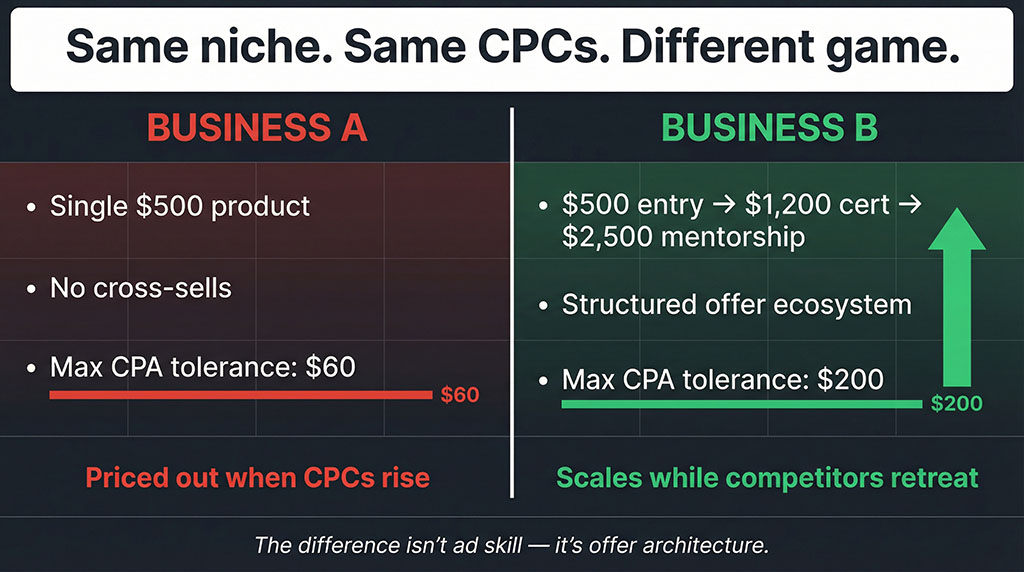
The business that can afford $150 per lead will always beat the business that caps out at $60. Not because they’re richer. Because they engineered their offers to fund it.
But hang on — I can't just "decide" to afford more expensive leads
This is where most people push back. And fair enough.
You’re running a real business with real margins. You set a $60 target because that’s what the numbers allow. You can’t magically afford $80 leads tomorrow just because some article told you to rethink your offer economics. Payroll is due on Friday.
That’s a real constraint. I’m not dismissing it.
But here’s the question nobody’s asking you: what’s a customer worth over twelve months? Not the first transaction. All of them. If you’re selling a $500 course and that’s the only thing you ever sell that student, then yes — $60 might be your ceiling and you’re stuck. But if you could sell a $500 course, then a $1,200 advanced certification, then a $200 annual membership, then a $2,500 mentorship placement — suddenly a customer who cost $80 to acquire is the best investment you’ll make all year.
The owners who sold that beauty education company never ran that calculation. They had a product range from $500 to $2,500 but treated each sale as a terminal event. No cross-sells structured into the journey. No back-end economics mapped out. No idea what a student was actually worth beyond invoice one.
And this is the critical shift: it is almost always easier to build a better offer than to build a better ad.
Improving conversion rates on your current offer means grinding through landing page tweaks, headline tests, and marginal gains that might shift results two percent over three months. Improving your economics by creating a new, better-structured offer — one with logical next steps, complementary products, and increasing commitment levels — can transform what you’re able to pay for a customer almost overnight.
When your offer ecosystem supports it, a lead that costs $80, $120, even $200 isn’t a loss. It’s a competitive moat. Because your competitor who’s still capped at $60? They’ll get priced out of the auction while you’re scaling.
That’s what Kennedy actually meant. Not “spend recklessly.” Build the business that can afford to win.
Where this doesn't apply
If your business genuinely has a single product with a fixed margin and no logical path to a second sale, your options are more limited. Commoditised products with razor-thin margins and no repeat purchase cycle really are constrained by acquisition cost. I’m not going to pretend every business can simply build their way out of expensive traffic.
But most service businesses, education companies, and professional service firms? They’re sitting on back-end revenue they’ve never structured. The lifetime value exists — they just haven’t built the mechanism to capture it.
The question you should be asking instead
Next time an agency — or a voice in your head — asks what you can afford per lead, try a different answer.
Instead of “as cheap as possible,” ask: “What would I need to change about my offer so I could afford to pay twice what my competitors pay?”
That question changes everything. It stops you optimising for survival and starts you engineering for dominance.
Because there’s a hierarchy to this that most businesses have upside down. Think of it as four layers, each one with more leverage than the one below it.
Economics → Market → Offer → Persuasion
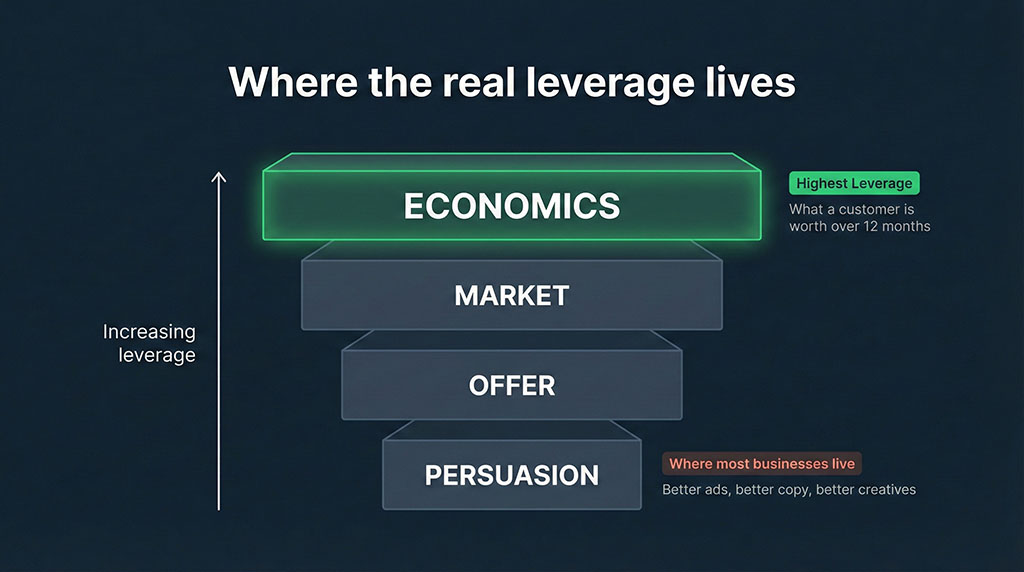
Most businesses spend all their energy at the bottom. Better ads. Better copy. Better creatives. That’s persuasion — the lowest-leverage layer. When that stops working, they move up one notch and tweak the offer. Maybe add a bonus or adjust the price.
Almost nobody starts at the top. But that’s where the real power sits. Get your economics right — understand what a customer is actually worth, structure your offers to capture that value, build the back end — and the persuasion layer almost takes care of itself. You can afford to outbid, outlast, and outscale everyone fighting over scraps at the bottom of the stack.
The beauty education company started and ended at persuasion. New creatives. Cheaper lead sources. Shared lists. They never looked up.
The market doesn’t care about your CPA target. Competitors don’t check what you can afford before they bid. The auction is indifferent to your margins. The only variable you fully control is how much value you extract from each customer who walks through the door.
Fix the economics first. Then worry about the ads.
Your marketing, looked at properly
Thirty minutes on your current setup — what’s working, what’s quietly leaking budget, and what I’d fix first. You’ll leave with a clearer picture whether we work together or not.
Got something specific bugging you? Flag it when you book and I’ll have it looked at before we talk.

AboutBruce Marjoribanks
Bruce Marjoribanks has spent 27 years in marketing, including building, running and selling his own agency before going independent. He now runs every channel - paid, organic, social, email, creative and automation - as one integrated system, with AI ehancing production and the judgment staying human.