
Three agencies on a Zoom call. Your Google Ads manager kicks things off: “Facebook is cannibalising our conversions.” Your Meta rep fires back: “The landing page doesn’t match our creative.” Your email team, who’ve been on mute this whole time, unmutes just long enough to say: “The ad traffic you’re sending us is garbage.”
You’re sitting there, staring at three confident faces, and you can’t tell which one is lying. Maybe all of them. Maybe none of them. You genuinely don’t know.
That knot in your stomach? That’s not frustration. It’s the absence of something specific — something most business owners never think to look for when they’re evaluating agencies, comparing proposals, or deciding where to spend their next marketing dollar.
It’s not “results.” It’s not “expertise.” It’s not even “ROI.”
It’s certainty.
The invisible thing you're actually paying for
When you hire a marketing agency, you think you’re buying deliverables. Ads. Emails. Landing pages. Campaigns with projected returns and optimistic timelines.
You’re not. You’re buying the ability to sleep at night.
You’ve felt the difference, even if you never named it. That one contractor who made you stop checking your phone every twenty minutes — not because the results were perfect, but because you trusted their judgment. You knew that when something broke, they’d see it, understand it, and fix it. No finger-pointing. No ambiguity.
That feeling? That’s certainty. And the absence of it explains nearly every marketing frustration you’ve ever had.
The procrastination before approving a campaign you’re not sure about. The low-grade anxiety of a launch week. The way you keep asking for “just one more round of revisions” — not because the work is bad, but because you can’t tell if it’s good.
That’s not you being difficult. That’s you operating without certainty. And it costs more than you think.
The maths nobody shows you
Most business owners evaluate agencies like they’re hiring for a single position. “Who’s the best Google Ads person? Who’s the best email copywriter?” The logic feels sound: get the best specialist for each job, and you’ll end up with the best marketing.
Here’s what that logic misses. The maths isn’t new — Fred Brooks worked it out in 1975, writing about software teams in The Mythical Man-Month. Communication links between n independent parties scale as n(n−1)/2. Two agencies create one pathway between them. Three create three. Four create six. Five create ten. The overhead doesn’t multiply. It compounds. And every one of those pathways is a place where your brief gets misinterpreted, your budget gets double-counted, and your results get disputed.
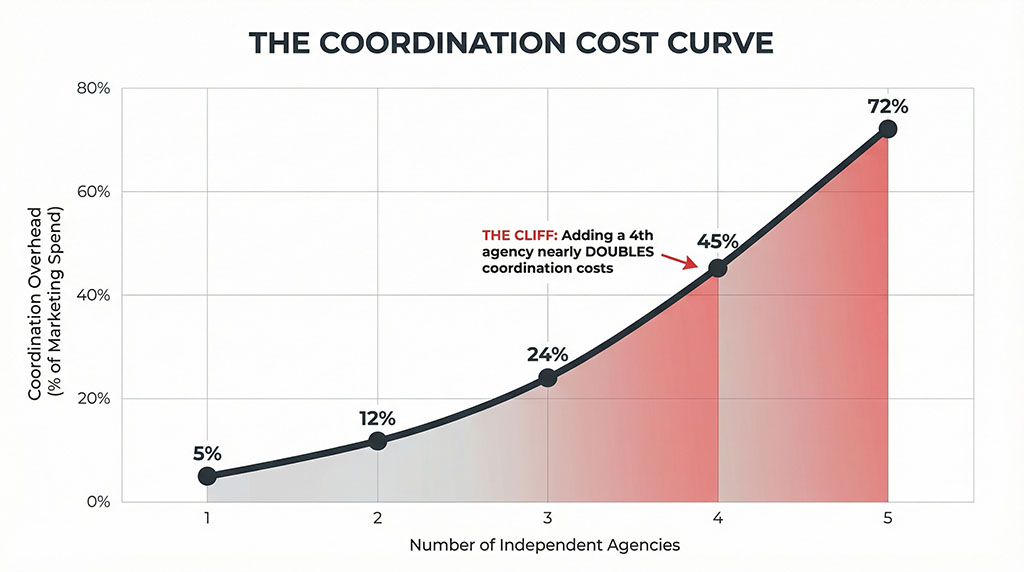
I’ve seen it play out the same way with dozens of clients over the past decade. One business I started working with in 2023 was paying $14,200 a month across four separate providers: a Google Ads agency, a Meta specialist, a Klaviyo email team, and a freelance landing page designer. They’d been running this setup for eighteen months. Revenue was flat.
The problem wasn’t that any single provider was bad. Several were genuinely good at their slice. The problem was that nobody owned the outcome. Each agency optimised their channel in isolation. The Google Ads team drove traffic to a page the designer hadn’t updated for the latest offer. The email team wrote sequences promoting benefits that contradicted the ad messaging. Meta retargeting ran against cold traffic campaigns on Google, inflating costs on both sides.
Four competent specialists. Zero certainty about what was actually working.
Within sixty days of consolidating everything under one strategy — one dashboard, one decision-maker, one feedback loop — their cost per acquisition dropped 31%. Not because the tactics changed dramatically. Because the coordination did.
Those figures are from my own client account. Unaudited, and one business’s results — not a benchmark, and not a promise.
That’s the certainty gap. And fragmentation is what creates it.
Why fragmentation feels safe but isn't
Here’s the thing nobody wants to admit: hiring multiple specialist agencies feels like the responsible move. It feels like you’re reducing risk. You’re diversifying. You’ve got the “best” person on each channel. If one underperforms, the others pick up the slack.
It’s the same logic that makes people feel safer holding thirty random stocks than five carefully chosen ones. Diversification as security blanket.
But marketing channels aren’t independent investments. They’re interconnected systems. Your Google Ads don’t exist in a vacuum — they feed landing pages, which feed email sequences, which feed retargeting, which feeds back into search. It’s a loop. And when five different teams control different sections of that loop without talking to each other, the system doesn’t diversify. It fragments.
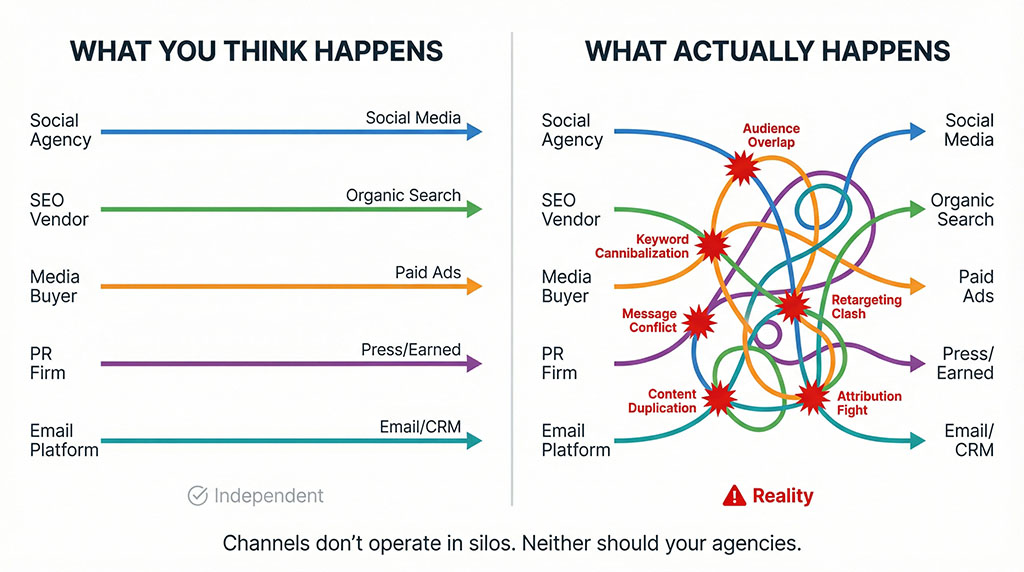
And fragmentation doesn’t reduce risk. It makes risk invisible.
You can’t identify what’s failing because nobody has the complete picture. Your Google Ads agency reports a 4.2x ROAS, but they’re counting conversions that your email team also claims. Your Meta specialist says CPAs are down, but they’re excluding the retargeting budget that another team controls. Everyone’s dashboard looks green. Your bank account says otherwise.
That’s the real cost: not the overlapping fees (though those hurt), but the fact that you cannot know what’s true. You’ve lost the ability to make confident decisions about your own marketing. You’re guessing. Every approval, every budget allocation, every “let’s try this” — it’s all guesswork dressed up in agency jargon.
That’s the opposite of certainty. And it’s why you lie awake at night.
"But a single provider can't match five specialists"
I know what you’re thinking. And ten years ago, you’d have been right.
The entire case for fragmentation rested on one assumption: that one person, or one small team, physically couldn’t match the output and expertise of five separate agencies. Capacity was the bottleneck. You needed five teams because the work literally required five teams’ worth of hours.
That assumption died somewhere around 2023.
The capacity argument is gone. AI hasn’t replaced strategic thinking — but it has obliterated the production bottleneck that used to justify the specialist-for-every-channel model. Research that took a team two weeks now takes an afternoon. Creative variations that required a designer, a copywriter, and three rounds of feedback can be produced, tested, and iterated in hours. Campaign builds that used to eat forty hours of billable agency time now take a fraction of that.
So the old trade-off — “you can have coordination OR capacity, pick one” — no longer exists.
What still can’t be automated is the thing that actually matters: strategic judgment. The ability to look at a business, its audience, its competitive position, and its numbers — and make a call about what to do next. Not “what does the Google Ads algorithm suggest?” but “given everything we know about this business, what should we actually do?”
That requires one brain seeing everything. Not five brains seeing slices.
The new bottleneck isn’t production. It’s coherence. And coherence comes from consolidation, not fragmentation.
Where specialists still win (and when to hire them)
I’m not going to pretend consolidation is the answer in every scenario.
If you’re spending $500K+ a month on Google Ads alone, you probably need a dedicated team whose entire existence revolves around that platform’s every quirk. At that scale, the depth of platform-specific expertise outweighs the coordination benefits of consolidation. The same goes for highly technical SEO in competitive verticals, or programmatic buying at enterprise scale.
But here’s the thing — if you’re reading this, that’s probably not you.
For businesses spending $5K to $50K a month across multiple channels, the coordination cost of fragmentation almost always outweighs the marginal skill advantage of having a “pure” specialist on each platform. You’re not losing because your Google Ads person isn’t the world’s top 1%. You’re losing because your Google Ads person and your email person have never spoken to each other.
The certainty test for your next agency decision
Next time you’re evaluating an agency — or deciding whether to keep the ones you’ve got — stop asking “are they good at [channel]?” and start asking a different question:
“After hiring this agency, will I know more or less about what’s actually working in my marketing?”
If the answer is “less” — if adding this agency means another dashboard you have to check, another set of metrics that may or may not align with reality, another voice in the room claiming credit — then you’re not buying expertise. You’re buying more uncertainty at $3,000 a month.
Certainty comes from three things: complete visibility (one dashboard, all channels), clear accountability (one throat to choke, as the saying goes), and fast feedback loops (when something breaks, the person who sees it is the same person who fixes it).
Fragmentation destroys all three. By design.
The Zoom call you'll never have again
Remember that meeting? Three agencies, three stories, three invoices. You, on mute, wondering who to believe.
Picture a different Monday. One dashboard. Every channel visible. You can see exactly which ad drove which lead, which email converted them, which landing page is underperforming. When something’s off, there’s one person to call — and they already know about it, because they’re the same person who built the campaign.
The knot in your stomach? Gone. Not because everything is perfect — marketing is never perfect. But because you can see what’s happening. You can make decisions based on data instead of competing narratives. You can stop playing referee and start running your business.
That’s what certainty feels like. And once you’ve had it, you’ll never go back to the Zoom call.
Your marketing, looked at properly
Thirty minutes on your current setup — what’s working, what’s quietly leaking budget, and what I’d fix first. You’ll leave with a clearer picture whether we work together or not.
Got something specific bugging you? Flag it when you book and I’ll have it looked at before we talk.

AboutBruce Marjoribanks
Bruce Marjoribanks has spent 27 years in marketing, including building, running and selling his own agency before going independent. He now runs every channel - paid, organic, social, email, creative and automation - as one integrated system, with AI ehancing production and the judgment staying human.