
The toolbox weighed somewhere between eighty and a hundred and twenty pounds. It was handmade — dark wooden slats bound together by tiny nails and strips of brass, with big latches that looked like they belonged on a giant’s lunchbox. Inside the lid, a silk lining with pinkish-red cabbage roses fading into a smog of grease and dirt. The kind of thing you’d never find at Bunnings or Home Depot. Stephen King’s grandfather built it. His Uncle Oren inherited it.
One summer day, King — maybe eight or nine years old — followed Uncle Oren across the yard to replace a broken window screen. The kid balanced the replacement screen on his head like a Tarzan extra. Uncle Oren horsed the massive toolbox along at thigh level, sweat gleaming in his graying Army crewcut, a Camel cigarette hanging from his lower lip.
They reached the window. Oren opened the toolbox. Out of all those drawers — the hammer, the saw, the pliers, the wrenches, the level with its mystic yellow window, the drill and all its bits — he grabbed one screwdriver. Loosened eight loophead screws. Swapped the screen. Tightened the screws back down. Done.
King was confused. Why drag a hundred-pound toolbox across the entire house for one screwdriver? Uncle Oren could’ve carried it in his back pocket.
The old carpenter looked at his nephew and said something that, decades later, King would put in a book that sold millions of copies:
“Yeah, but Stevie, I didn’t know what else I might find to do once I got out here, did I? It’s best to have your tools with you. If you don’t, you’re apt to find something you didn’t expect and get discouraged.”
I’ve been thinking about that toolbox for months. Not because I care about window screens. Because I run a marketing operation built on the same principle — and most businesses I encounter are paying five different people to each carry one screwdriver.
The screwdriver problem
Here’s what King understood about his uncle’s philosophy: the toolbox wasn’t about the job you came to do. It was about the job you discovered once you got there.
Uncle Oren didn’t lug that weight because he was inefficient. He lugged it because houses are unpredictable. You show up to fix a screen and notice a loose hinge. You deal with the hinge and spot a cracked board underneath. You pull at the board and find water damage behind the wall. Each discovery demands a different tool. And if you don’t have it — King writes — you “find something you didn’t expect and get discouraged.”
That word, discouraged, is the one that sticks. He didn’t say you’d do a worse job. He said you’d quit.
Now map that onto marketing.
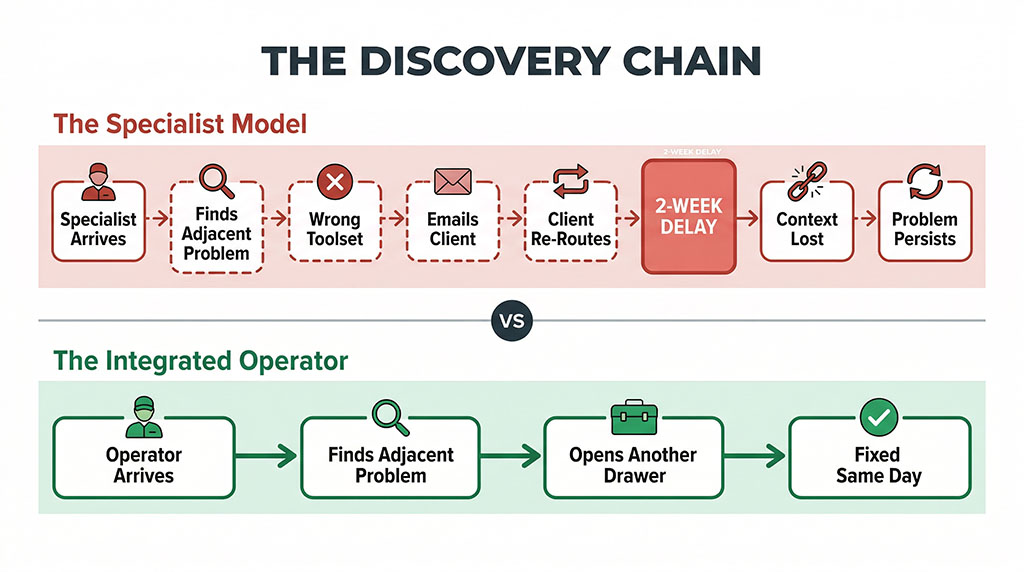
Your Google Ads specialist shows up with a screwdriver. They’re good at it — certified, experienced, sharp. They run the campaign, check the metrics, and write a report. But while they’re in there, they notice the landing page is converting at 1.3%. They see the email follow-up sequence has a 72-hour gap where leads go cold. They realise the Facebook retargeting is hitting the same audience with a conflicting message.
They see all of this. And they do nothing. Because those aren’t their screws.
They don’t have the tools. They don’t have the authority. They don’t have the context. So they send you an email — “you might want to talk to your web person about the landing page” — and move on to the next account. The problem doesn’t get fixed. It doesn’t even get properly diagnosed. It just sits there, bleeding conversions, while everyone stays in their lane.
That’s not a personnel problem. It’s a toolbox problem.
Common tools on top
King uses the toolbox as a metaphor for a writer’s craft — vocabulary on top, grammar underneath, style in the deeper drawers. But there’s a structural insight buried in the metaphor that goes beyond writing.
He describes the toolbox as having three levels, with the most-used tools on top and specialised instruments tucked into “little drawers as cunning as Chinese boxes” further down. The common tools — hammer, saw, screwdriver — sit where you can grab them without thinking. The uncommon ones — the right drill bit for a specific material, the particular wrench for an unusual bolt — live deeper, available when needed but not cluttering the surface.
This is exactly how integrated marketing capability should work.
The common tools — ad buying, content creation, email campaigns, analytics — need to be immediately accessible, in one brain, used daily. The specialised capabilities — conversion rate optimisation for a specific funnel architecture, advanced attribution modelling, platform-specific API integrations — live in the deeper drawers, pulled out when the situation demands them.
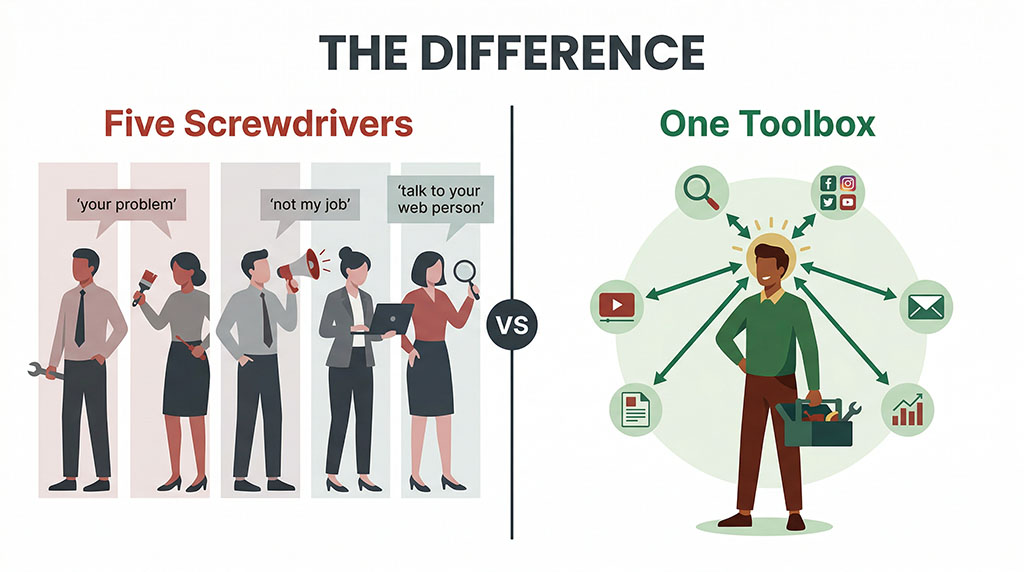
What most businesses have instead is five separate people, each with one drawer. The Google Ads person carries the top-left drawer. The SEO person carries the bottom-right. The email specialist has a single wrench. The social media manager has a hammer. And the business owner — who was supposed to be running the business — becomes the person running back and forth between them, trying to figure out which tool is needed and who has it.
King’s grandfather built that toolbox so one person could carry everything. The modern marketing equivalent? One brain seeing every channel, every data point, every customer touchpoint — not because one person is smarter than five, but because one person doesn’t lose half the day routing information between drawers that should never have been separated.
"I didn't know what else I might find to do"
This is the line that separates Uncle Oren’s philosophy from the way most businesses buy marketing.
The standard model assumes you know what you need before you start. You hire a Google Ads agency because you need Google Ads. You hire an SEO consultant because you need SEO. You hire an email specialist because you need email. Each engagement is scoped around a pre-defined problem with a pre-defined tool.
But marketing doesn’t work that way. The problems reveal themselves during the work.
You launch a paid campaign and discover that your highest-converting audience segment doesn’t match your SEO keyword strategy at all — the people actually buying aren’t the people you’ve been writing content for. You dig into email performance and realise your welcome sequence is cannibalising your retargeting ads because they fire at the same time with different offers. You analyse your CRM data and notice that leads from one channel take three times longer to close than leads from another, but you’ve been spending equally on both.
These aren’t problems you could have anticipated. They’re the loose hinge, the cracked board, the water damage behind the wall. They only become visible when someone is in there doing the work — and they can only be fixed by someone who has access to more than one tool.
When your Google Ads person discovers a landing page problem, they don’t carry a landing page tool. When your email specialist spots a paid media conflict, they don’t carry a media buying tool. When your SEO consultant identifies a content gap that paid could fill tomorrow, they don’t have the ad account login.
Each one finds something unexpected. Each one gets discouraged. Each one moves on.
The weight is the point
There’s a reason Uncle Oren’s toolbox weighed a hundred pounds. It wasn’t designed to be convenient. It was designed to be complete.
King describes watching his uncle hoist it by the grabhandles, “horsing it along at thigh level,” sweating through his white tee-shirt. When King and his brother David tried to lift it as kids, they could barely budge it. The toolbox was a burden. Carrying it was work. But Oren carried it anyway, every time, because the alternative — showing up light and getting stuck — was worse.
I think about this when business owners tell me they’d rather have five specialists than one brain carrying the whole toolbox. The logic sounds clean: why carry the whole toolbox when you only need a screwdriver?
Because you never only need a screwdriver.
Running marketing across every channel — paid, organic, email, landing pages, analytics, CRM — is heavy. It’s a lot to carry. There are days it feels like horsing a hundred-pound box across the yard when a lighter load would be easier.
But the weight is the point. The weight means you don’t have to stop and call someone else when you discover the loose hinge. The weight means you don’t lose two weeks waiting for a different specialist to get briefed on a problem you identified on Tuesday. The weight means you never look at a bleeding conversion rate and think “not my department.”
Uncle Oren didn’t carry that toolbox because he was showing off. He carried it because he’d been doing this long enough to know: the job you came to do is never the only job that needs doing.
"But what about the specialists?"
Let’s stop here. Because if you’ve been paying separate agencies for years, you’re thinking something specific right now. You’re thinking: my Google Ads person has certifications and ten years of experience in that platform. A generalist can’t match that depth.
Fair. And there are scenarios where specialists earn their keep. If you’re running an internal marketing team across multiple business units — separate brands, separate audiences, separate P&Ls — and that team already holds the strategic picture, then plugging in a dedicated platform specialist to go deep on one channel makes sense. They’re not carrying the toolbox. They’re the right drill bit pulled from a deeper drawer by someone who already has the full kit.
The problem is that most businesses hiring specialists don’t have that internal brain sitting above them. They have a founder toggling between five dashboards at 11pm. The specialist isn’t supplementing an integrated operation. They are the operation — for their one channel. And the other four channels? Someone else’s problem.
And the budget argument doesn’t change this. I’ve seen businesses spend $50K a month on a single channel. That doesn’t mean they need more specialists — it means what’s already working should get more fuel. Adding another agency to manage a bigger number on the same platform is just carrying two of the same screwdriver.
Here’s what King understood about craft that applies just as cleanly to marketing: the common tools matter more than the exotic ones.
He writes that vocabulary — the most basic tool, the “bread of writing” — belongs on top of every writer’s toolbox. Not the fancy stuff. Not the literary flourishes. The fundamentals. And he’s blunt about it: you can carry exactly the vocabulary you already have and do just fine, because “it ain’t how much you’ve got, honey, it’s how you use it.”
The marketing equivalent? The fundamentals — clear messaging, proper targeting, coherent customer journeys, consistent follow-up — produce 90% of the results. The exotic specialist knowledge — advanced bid strategies, proprietary platform tricks — produces the last 10%. And that last 10% means nothing if the first 90% is fractured across five people who never talk to each other.
Your specialist’s deep platform knowledge is worthless when it’s optimising for the wrong audience because nobody shared the CRM data. Their advanced bid strategy doesn’t matter when the landing page they’re sending traffic to contradicts the email sequence that fires afterward. They’re tuning one instrument to perfection while the rest of the orchestra plays in a different key.
King puts it more directly: “You can approach the act of writing with nervousness, excitement, hopefulness, or even despair… You can come to it any way but lightly.” The same is true of marketing. You can run it with specialists, generalists, agencies, or in-house teams — but you cannot run it lightly. And fragmentation is the lightest possible version. It’s everyone carrying one tool and nobody carrying the weight.
The silk lining and the brass latches
There’s a detail in King’s description of the toolbox that I keep coming back to. Inside the lid — this battered, grease-stained, hundred-pound box that had been dragged across job sites for decades — was a silk lining with pink cabbage roses.
It was a working tool. Beaten up, heavy, practical. And inside, something unexpectedly beautiful. The craftsmanship wasn’t just functional. It was cared for.
When King’s uncle opened the toolbox, he found more than tools. He found a brass etching of a Homer painting — The Undertow — lying in the bottom. It was later authenticated and sold for real money. The toolbox held surprises that nobody expected because it had been built with enough depth and care to contain them.
I see the same thing when marketing channels are unified under one brain. You don’t just eliminate waste. You find things.
You discover that your highest-value customers all came through a sequence nobody designed on purpose — a blog post that ranked accidentally, followed by a retargeting ad that happened to run during a sale, followed by an email that a team member wrote off-the-cuff on a Friday afternoon. With fragmented agencies, that sequence is invisible. Nobody sees the full path. With one brain holding the complete picture, you spot it, reverse-engineer it, and build it into a repeatable system.
That’s the brass etching in the bottom of the toolbox. It was always there. You just needed someone willing to carry the whole box to find it.
Build your own toolbox
King ends his toolbox chapter with a direct instruction: build your own. Fill the common drawers first. Put the fundamentals on top where you can reach them without thinking. Add the specialised tools as you need them. And then — this is the part most people skip — build up enough muscle to carry it.
“I want to suggest that to write to your best abilities, it behooves you to construct your own toolbox and then build up enough muscle so you can carry it with you. Then, instead of looking at a hard job and getting discouraged, you will perhaps seize the correct tool and get immediately to work.”
If you’re weighing whether to build this yourself, start with one question: when your channels disagree — when Google says the leads are golden and email says they’re garbage — who in your operation makes the call? Not which tool interprets the data. Not which dashboard displays it. Who decides what to do next, and do they have visibility across everything needed to make that decision well?
If the answer is “nobody” or “me, at 11pm, toggling between tabs,” that’s your first drawer to fill. Because that question — who holds the judgment that sits across all channels — is what separates a toolbox from a pile of tools. Most businesses can name their ad platform, their email tool, their analytics suite. What they can’t name is the single point of decision that connects them. And until that exists, every new tool you add is just another specialist with no peripheral vision.
The muscle matters. Carrying an integrated marketing operation is genuinely hard. It requires someone who understands paid media and organic and email and analytics and conversion optimisation — not at specialist depth in each, but with enough fluency to see how they connect and enough authority to act on what they find. That person needs to build strength over time. They need reps. They need to have carried the toolbox across enough yards to know what they’ll find when they get there.
The alternative is what most businesses are living with right now. Five specialists. Five screwdrivers. Five invoices. And a business owner standing in the yard, looking at a cracked board, wondering which one to call — while the water damage spreads behind the wall.
Uncle Oren is almost twenty years dead now, King tells us. But the toolbox survived him. It was handmade, built to hold everything, heavy enough that two kids could barely lift it. The silk was stained. The brass was tarnished. Every one of those little drawers had been opened a thousand times.
It’s the kind of object that only makes sense if you’ve done the work. A lightweight bag with three tools looks sensible from a distance. Clean, efficient, modern. But anyone who’s actually stood in front of a house — or a business — with something unexpected staring back at them knows the truth.
You carry the whole toolbox. Or you find something you didn’t expect, and you get discouraged.
Your marketing, looked at properly
Thirty minutes on your current setup — what’s working, what’s quietly leaking budget, and what I’d fix first. You’ll leave with a clearer picture whether we work together or not.
Got something specific bugging you? Flag it when you book and I’ll have it looked at before we talk.

AboutBruce Marjoribanks
Bruce Marjoribanks has spent 27 years in marketing, including building, running and selling his own agency before going independent. He now runs every channel - paid, organic, social, email, creative and automation - as one integrated system, with AI ehancing production and the judgment staying human.