
Two judges. Same defendant. Barely a tenth of the same case file.
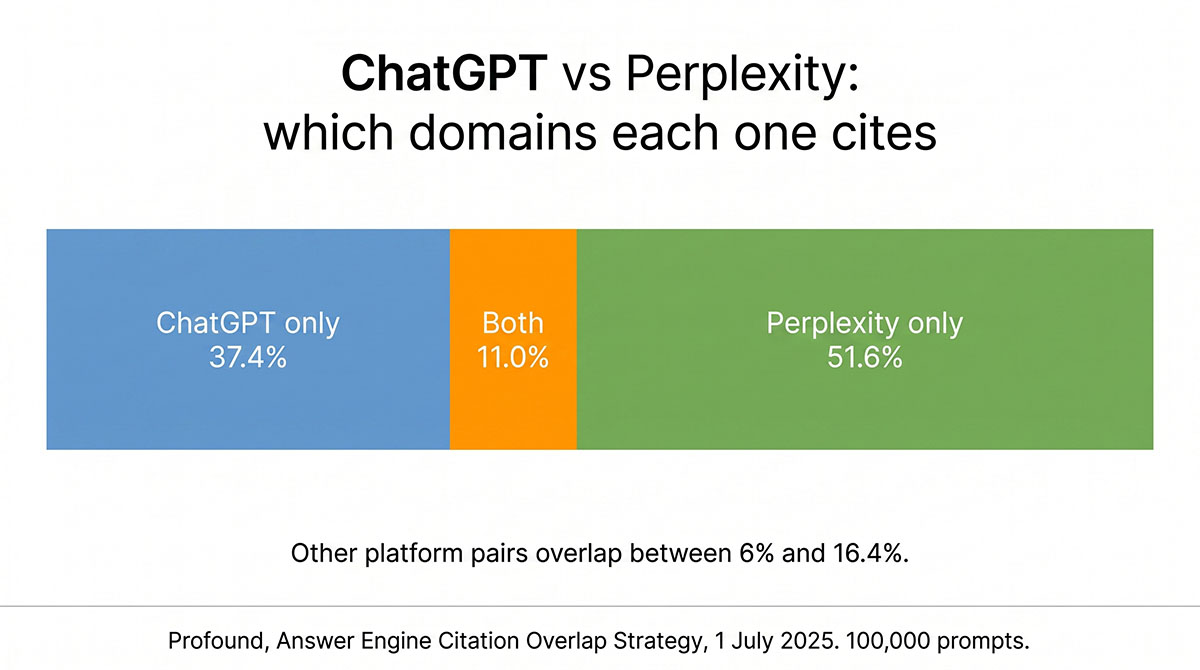
Profound ran 100,000 prompts through the major AI search platforms and recorded which websites each one actually cited. Set ChatGPT against Perplexity and only 11% of domains appeared in both. ChatGPT cited another 37.4% that Perplexity never touched. Perplexity cited 51.6% that ChatGPT never mentioned.
That is one pair. Run the comparison across the other pairs and the overlap sits somewhere between 6% and 16.4%. Whichever two platforms you put side by side, they agree on roughly one source in ten.
For a decade the rule was simple. Rank on Google and you are visible. That rule now describes one courtroom out of four.
The monoculture is over
Here’s what the old world looked like. You hired an SEO person or an agency. They got your pages ranking on Google. When someone searched for your type of service, your site appeared. Maybe position three, maybe position eight, but you were in the game. One platform, one set of rules, one optimisation playbook.
That is the world most businesses still think they are operating in.
The ground has moved, though not always in the direction the headlines suggest. Perplexity went from 250 million monthly queries in July 2024 to 780 million by June 2025, roughly tripling in about ten months. ChatGPT’s share of general search is genuinely contested. Two credible readings of the same dataset put it at about 4% and about 12% of Google’s volume, and nobody has settled which is closer to the truth.
What is not contested is what happens after the question. Google says searches in AI Mode run about three times longer than traditional queries. Longer questions get answered on the page. Semrush looked at 69 million sessions and found that between 92% and 94% of AI Mode sessions end without a single click to an outside site.
Keep the scale in view. AI Mode is still only about 0.34% of Google searches, and AI referrals account for roughly 1% of publisher visits. This is not a channel that has replaced anything yet. It is a channel where the rules are being written now, while almost nobody is watching.
You have probably noticed it yourself. You ask ChatGPT a question, get an answer with a few source links, and move on. Your customers are doing the same thing. The sources being cited might not include you.
Every platform has its own idea of a credible source
The divergence is not subtle. Each platform has developed its own bias about who deserves to be quoted. Profound measured this across 680 million citations, looking at the top ten sources each platform leaned on.
Perplexity trusts the crowd. Reddit is the biggest single name in its top-ten source pool, at 46.7% of it. Read that carefully, because the base matters. It does not mean 46.7% of everything Perplexity cites. It means the top of its source list leans very heavily on one community site. Perplexity prizes community-validated answers, real people describing real experiences.
If your business has no presence in community discussions, no Reddit threads, no forum mentions, no authentic conversation happening around your brand, Perplexity has less reason to know you exist.
ChatGPT trusts the institution. Wikipedia held 47.9% of ChatGPT’s top-ten source pool in mid-2025. Measured differently, Semrush tracked Wikipedia’s share of all ChatGPT citations across thirteen weeks to November 2025 and watched it fall from around 55% to under 20%. Different bases, same direction of travel. The direction matters more than either snapshot. ChatGPT still gravitates toward encyclopaedic, well-structured, well-referenced content, but it is spreading its citations wider than it did a year ago.
If your website reads like a brochure, all sales copy and no substance, ChatGPT has nothing to cite.
Google leans on its own ecosystem, but not the way most people assume. In AI Overviews, Reddit leads the top-ten source pool at 21.0%, with YouTube behind it at 18.8%. Ahrefs measured AI Mode separately in July 2026 and found the same order: Reddit at 19.9%, YouTube at 17.0%. Video matters. Community discussion matters more.
One caution before you build a strategy on any of this. These figures come from separate studies with different datasets, different methods and different dates. They describe the same phenomenon from different angles. They are not one tidy finding, and any comparison chart that lines them up as though they were is overstating the case.
| Measure | Perplexity | ChatGPT | Google AI |
|---|---|---|---|
| Leading source in its top-10 pool | Reddit, 46.7% | Wikipedia, 47.9%Mid-2025. On a different base, Wikipedia's share of all ChatGPT citations fell to under 20% by Nov 2025. The two figures are not on the same scale. | Reddit, 21.0%YouTube, 18.8%AI Overviews. Measured separately, AI Mode runs Reddit 19.9%, YouTube 17.0%. |
| Read the base: these are shares of each platform's top ten sources, not of everything it cites. | |||
| Citation Style | Numbered, panel-based | Narrative, footnoted | Visual, snippet-based |
| Session Behaviour | Multi-source research across cited panels | Multi-turn conversation, follow-up after follow-up | Rapid summary. 92–94% of AI Mode sessions end without a click |
| Rewards Brands That… | Show up in community discussion | Publish authoritative, well-sourced content | Produce video and hold an established domain |
Source pools: Profound, AI Platform Citation Patterns, 5 June 2025 (680M citations).
Wikipedia trend: Semrush, 13-week study, Nov 2025.
Zero-click: Semrush, 30 July 2025 (69M sessions).
AI Mode sources: Ahrefs, July 2026.
These are separate studies with different datasets, methods and dates.
"But I'm not a publisher — why should I care about citations?"
This is the part where it is tempting to tune out. Citations, AI summaries, source preferences. This sounds like a problem for media companies and content marketers. You run a business. You buy ads. Your leads come from Google Ads and Meta, not from ChatGPT mentioning you in a paragraph.
Fair enough. Let me show you what this looks like in practice.
We work with a car dealership in Auckland called Sunday Drive. They sell vehicles on consignment. You bring them your car, they handle the photography, video, marketing, and sale. Twelve months ago I searched “give me the best car dealership selling on consignment in Auckland” across every major AI chatbot. Sunday Drive appeared in none of them.
Today they come up first in both Google Gemini and ChatGPT. Gemini describes them as widely considered the gold standard for consignment in Auckland and singles out their marketing. ChatGPT recommends them first and highlights their professional marketing and consignment services. They also appear in Claude, at number three.
One caveat worth stating plainly. AI assistants are non-deterministic and their answers are shaped by the person asking. What I saw is a snapshot from a specific session on a specific day, not a fixed ranking anyone can guarantee. Run the same prompt tomorrow and the order may shift.
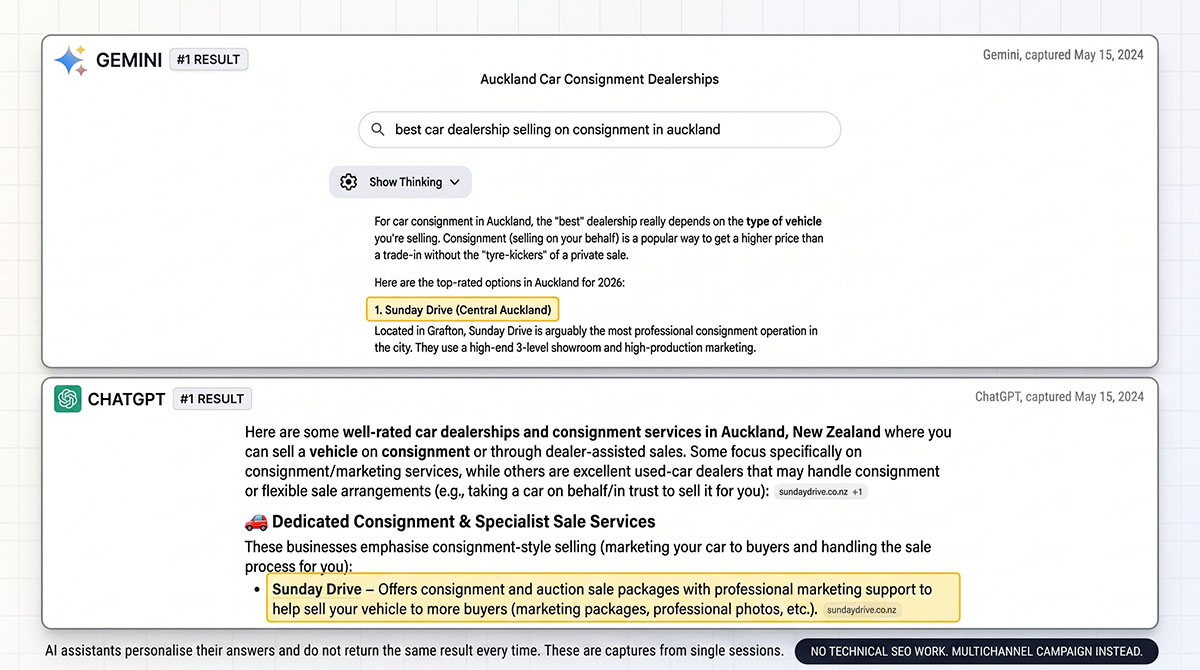
Here’s what makes this interesting. Sunday Drive did no technical SEO work during that twelve-month period. No schema markup changes. No keyword optimisation. No GEO strategy.
What they did instead was everything else. We built an integrated multichannel campaign across YouTube, TikTok, Instagram, and Facebook, paid and organic, alongside consistent social posting that showcased their inventory and expertise. AI visibility was never the goal. It was the byproduct of doing multichannel properly.
Think about that for a second. Gemini cited their YouTube presence. ChatGPT picked up on their brand positioning. The signals each platform was looking for came out of a single coordinated campaign. Not three separate optimisation efforts. One strategy, producing signals that happened to satisfy several judges at once.
Now think about what would have happened if Sunday Drive had hired a separate AI search consultant on top of their existing agencies. More money. More coordination overhead. More finger-pointing. Probably worse results, because AI platforms do not reward technical tricks. They reward brands that look authoritative across the whole web.
The fragmentation tax you're already paying
If this pattern sounds familiar, it should. It is the same problem you are already living with, one layer deeper.
Right now your Google Ads specialist does not coordinate with your Meta person. Your email team does not know what your landing pages say. Your SEO consultant has never spoken to your paid media buyer. Each one is optimising their own channel, claiming their own wins, and nobody sees the full picture.
Now add the AI search layer on top of that blindness. Your SEO person is optimising for Google rankings, and Google rankings only take you part of the way. Ahrefs ran 15,000 long-tail queries and found that just 12% of the URLs cited by chat assistants also showed up in Google’s top rankings for the same query. A separate Ahrefs study of 863,000 search results in March 2026 found that 37.9% of AI Overview citations came from pages ranking in Google’s top ten. So ranking still helps, and it helps more in AI Overviews than in chat assistants. It explains well under half of what gets cited.
Meanwhile nobody is checking whether your content is structured to be quoted. Nobody is monitoring whether your brand appears in the discussions Perplexity leans on. Nobody is producing the video that Google’s ecosystem keeps reaching for.
The Sunday Drive result did not come from adding another specialist to the pile. It came from removing the pile.
What the numbers actually support
Here is where I want to be careful, because this corner of the industry is full of numbers that fall apart when you check them.
You will see claims that AI traffic converts five times better than organic search. The best available evidence says the opposite. A study of 973 ecommerce sites with $20 billion in combined revenue compared more than 50,000 ChatGPT-referred transactions against 164 million from traditional channels. ChatGPT converted worse. Organic search came in about 13% higher and affiliate about 86% higher. A separate WebFX dataset of 2.3 billion sessions puts AI referrals at roughly 1.2 times organic, not five times.
You will also see the claim that AI referral traffic is growing 165 times faster than organic. WebFX has retired that figure themselves. Their current study reports 796% growth over two years, off a base where AI still accounts for 0.18% of total sessions.
So what does hold up?
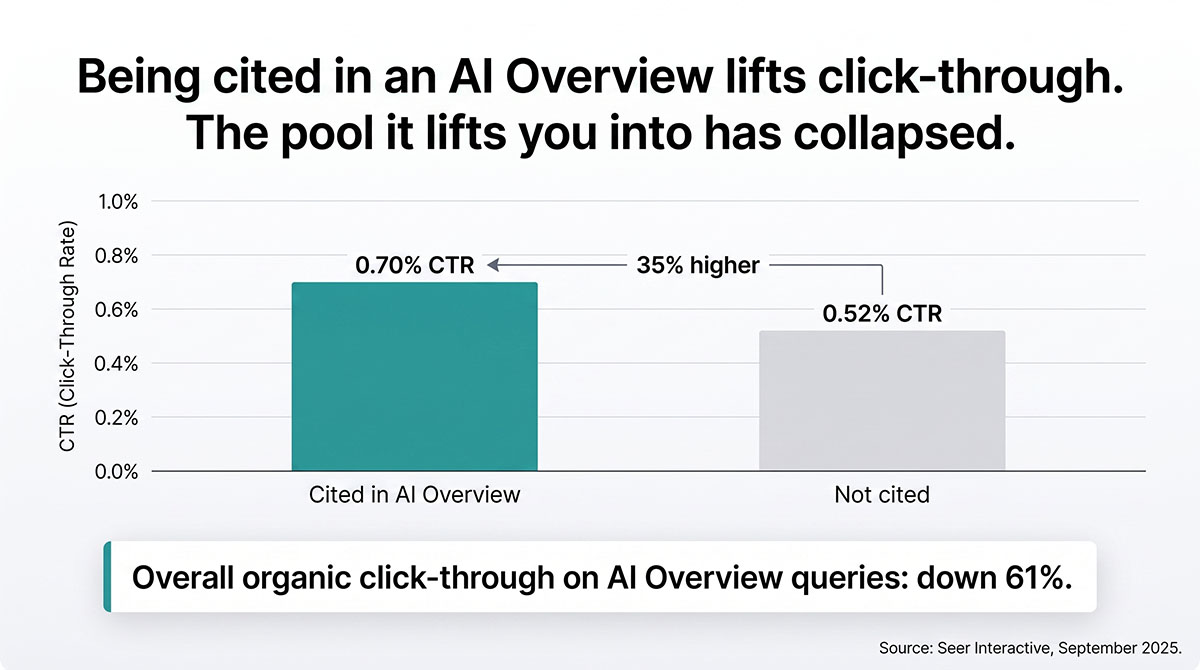
Being cited helps. Seer measured click-through rates on Google queries that triggered an AI Overview and found brands cited in the Overview earned 0.70%, against 0.52% for brands left out. That is a 35% higher click-through rate. Read the second half of that finding too. Overall organic click-through on those queries fell 61%. Being cited makes you the best of a badly degraded pool. It does not put you back where you were.
That is the honest case, and it is still a strong one. Not because AI referrals are a flood of high-converting traffic. They are not, yet. The case is simpler. When a person asks an AI which business to use and it names three, you are either one of the three or you are not in the conversation at all. There is no page two. There is no scrolling down. Sunday Drive did not win more clicks. They won the recommendation.
What you can do this week
You don’t need to overhaul everything at once. But you can start seeing the gaps.
Search for your core service queries the way a customer would describe their problem, not the way you would keyword-stuff a page. Run them in ChatGPT, Google Gemini, and Perplexity. Note where you appear, where you don’t, and who shows up instead. Run each query more than once, because the answers move. Most businesses have never done this. The results are usually sobering.
Check whether your brand has any presence in community discussions. Reddit, forums, review sites, industry threads. Perplexity weights these heavily and Google’s AI surfaces lean on them too. They are often the source your competitors are getting cited from while you are not.
Look at your content through the lens of each platform’s bias. Is your website structured to be quoted, with clear, direct answers to common questions in the first forty to sixty words of each key page? Is your YouTube channel active? Is the brand story consistent across social, web, and video, or does each channel tell a slightly different story because a different agency built it?
If the answers feel uncomfortable, that discomfort is data.
Three judges, one advocate
Those courtrooms are not going to converge. If anything they will keep diverging as each platform doubles down on what makes it distinct.
But the defendant does not need a separate legal team for each one. Sunday Drive did not need an AI search specialist, a YouTube agency, a social media manager, and an SEO consultant all billing separately and never talking. They needed one advocate who understood that the signals each judge was looking for could all be produced by a single coherent strategy.
The platforms don’t agree on who’s trustworthy. That is the new reality. The opportunity belongs to whoever stops treating each one as a separate problem and starts building the kind of brand authority that satisfies all of them at once.
Your marketing, looked at properly
Thirty minutes on your current setup — what’s working, what’s quietly leaking budget, and what I’d fix first. You’ll leave with a clearer picture whether we work together or not.
Got something specific bugging you? Flag it when you book and I’ll have it looked at before we talk.

AboutBruce Marjoribanks
Bruce Marjoribanks has spent 27 years in marketing, including building, running and selling his own agency before going independent. He now runs every channel - paid, organic, social, email, creative and automation - as one integrated system, with AI ehancing production and the judgment staying human.