
Domino’s Pizza almost got it wrong.
In the early days of home delivery, they did what any reasonable company would do — they surveyed their customers. What’s your biggest frustration with delivered pizza? The obvious answers came back. Taste. Temperature. Speed.
But the survey data didn’t match the behaviour data. Customers who rated speed as “acceptable” were still calling back to complain. Customers who said they were satisfied weren’t reordering. Something wasn’t lining up.
So Domino’s dug deeper. Past the rational answers. Past the survey-friendly responses people give when a clipboard appears. And they found the real pain hiding underneath all the sensible ones: customers hated not knowing when the pizza would arrive.
Not slow delivery. The anxiety of uncertainty. The not-knowing. Sitting on the couch watching the clock, wondering if they should start cooking something else. That feeling in your chest when you’ve promised hungry kids that dinner is coming and you can’t tell them when.
“Thirty minutes or less, or it’s free.”
Six words. None of them about taste. None about temperature. None about the things customers said mattered most. That guarantee built a global empire — not because it solved the stated problem, but because it solved the felt one. The pain customers couldn’t articulate in a survey because they didn’t have words for it.
Your customers are doing the same thing to you right now.
The pain they tell you about isn't the pain that drives the purchase
There’s a framework from neuromarketing research that splits buyer pain into three categories. It’s simple enough to sketch on a napkin — and it might be the most useful diagnostic tool most businesses have never seen.
Financial pain. This is the one everyone sells to. It costs too much. We’re wasting money. The ROI doesn’t work. It’s the first pain customers name because it’s the easiest to justify. Nobody gets questioned for wanting to save money.
Strategic pain. The process is broken. We can’t scale. We’re losing ground to competitors. This is the pain that sounds smart in a boardroom — it has the vocabulary of competence. Business owners and managers reach for strategic pain because it signals they’re thinking at the right level.
Personal pain. I’m embarrassed. I’m overwhelmed. I’m afraid this will make me look incompetent. I dread dealing with this part of my week. This is the pain that nobody volunteers.
You've already guessed which one triggers the buying decision.
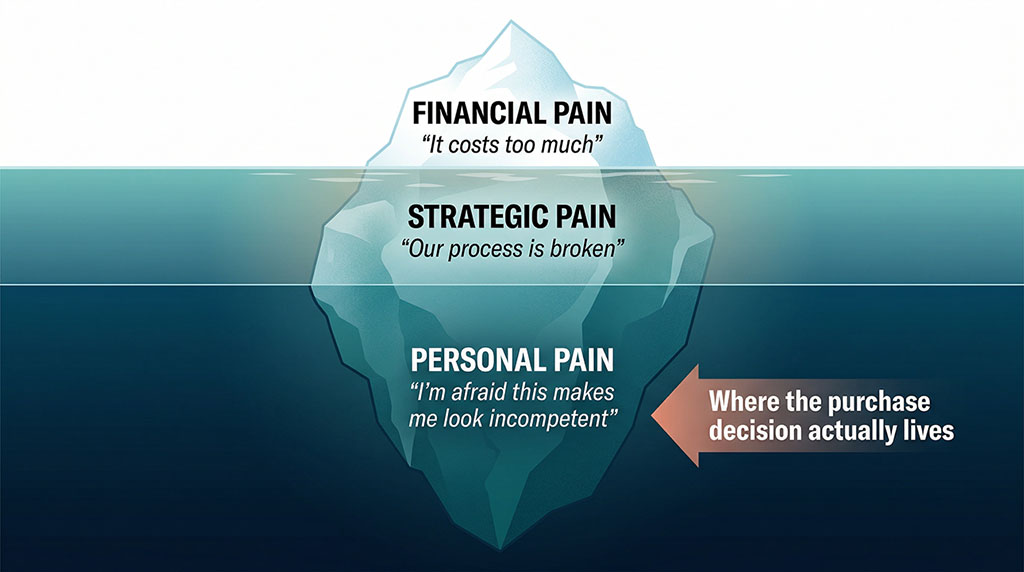
Here’s what makes this tricky: all three exist simultaneously in almost every purchase. Your customer has a real financial problem. They also have a strategic one. And underneath both sits a personal pain they’d rather not name. When you ask them what they need, they hand you the financial or strategic answer — the professional, rational, defensible one. The personal pain stays buried. Not because they’re hiding it. Most people genuinely can’t identify it in themselves.
Think about the last time you made a significant business purchase. The justification you gave your partner, your accountant, your team — was it the same as the feeling in your gut that made you finally pull the trigger?
A flag contract, a foreign company, and the pain nobody was pitching
Patrick Renvoisé’s Neuromarketing tells the story of Christophe Morin, who was running the US subsidiary of a European flag manufacturer in the mid-1990s. The target: the Atlanta Committee for the Olympic Games. A multi-million-dollar contract covering flags, flagpoles, ceremonies, and logistics for the 1996 Olympics.
The odds against him were absurd. Foreign-owned company. Minimal US presence. The most expensive bid on the table. Every rational criterion — financial, strategic — said he should lose.
Morin spent two and a half years visiting ACOG. Not pitching. Visiting. Asking questions. Mapping the organisational chart as it shifted. Sitting in meetings. Listening to what people worried about when they weren’t performing for a vendor.
What he found stunned him. The buying committee’s dominant pain wasn’t financial. It wasn’t about getting the best price on flagpoles. It wasn’t even strategic — they weren’t losing sleep over logistics timelines.
Their pain was personal. Deeply, viscerally personal.
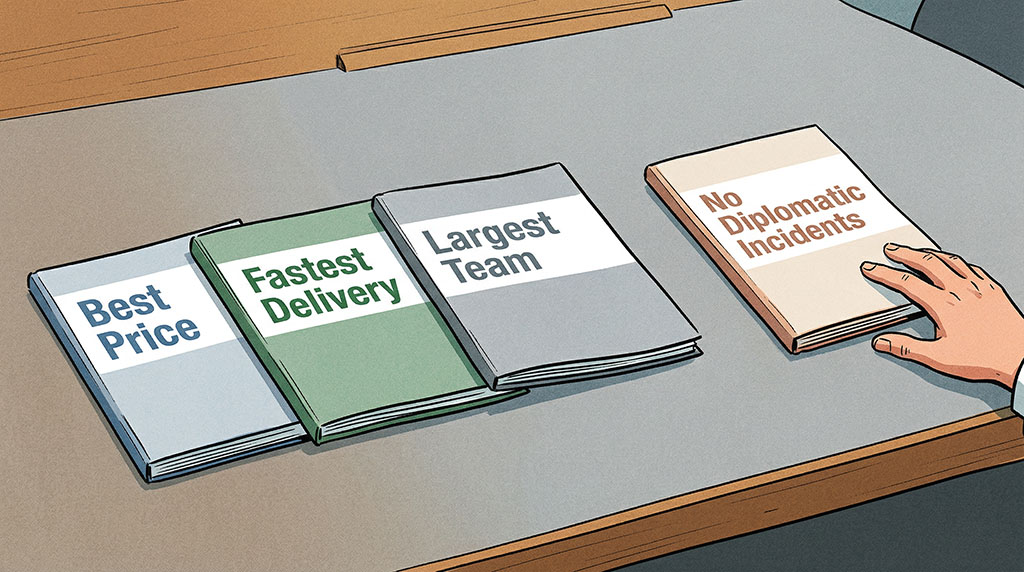
They were terrified of a diplomatic incident.
Think about it. A flag raised incorrectly. A design that hadn’t been officially updated. A protocol mistake during a ceremony broadcast to two billion people. The kind of error that doesn’t get you fired — it gets you into international headlines. Career-ending, reputation-destroying, can’t-show-your-face-at-the-next-IOC-meeting humiliation.
Every other vendor pitched price and capability. Morin pitched the fact that his company had developed the world’s only officially approved digital database of flag designs and had the deepest expertise in vexillology — the science of flags — of any company on the planet.
He didn’t sell cheaper flagpoles. He sold the guarantee that no one on that committee would end up on CNN for hanging a country’s flag upside down.
He won. Most expensive bid. Foreign company. Barely any US track record. None of that mattered — because he was the only one who diagnosed the pain running the decision.
"I already know my customers' pain. I talk to them every week."
Fair point. You probably do talk to them regularly. You might be closer to your customers than most business owners. But here’s the question worth sitting with: when was the last time a customer told you they bought because they were afraid of looking foolish in front of their team?
That they chose you because the alternative made them feel anxious and out of their depth?
That the real reason they switched from your competitor wasn’t your superior features — it was that your competitor’s system was confusing enough to make them feel stupid, and no one wants to feel stupid in their own business?
That’s personal pain. It doesn’t show up in your NPS surveys. It doesn’t come up on a discovery call. It never appears in a testimonial because no customer writes “I chose this product because the other one made me feel inadequate.”
And it’s almost certainly the layer where your deal was actually won or lost.
The neuroscience is fairly blunt about this: humans spend more energy avoiding and destroying pain than pursuing comfort. We’re not optimising for gain. We’re running from threat. And personal pain — the kind that touches identity, status, competence — registers as a more urgent threat than financial pain almost every time.
Which means your competitors who are selling on price? They’re speaking to the weakest pain channel. The ones selling on features and strategy? Slightly better, but still one layer away from the trigger.
The vendor who names the unspoken pain — the one your customer can feel but can’t articulate — wins disproportionately. Even with higher prices. Even with less brand recognition. Even as the underdog.
What this looks like in practice
You don’t need to become a therapist. You need to ask different questions and — more importantly — watch different signals.
Stop asking “what’s your biggest challenge?” in discovery calls. That question gets you the rehearsed financial or strategic answer every time. Instead, ask about the last time this problem caused them frustration. Not the business impact — the personal frustration. How did it affect their week? What did they have to cancel, delay, or apologise for?
You’re listening for emotion, not metrics.
Watch for the language of avoidance. When a prospect says “I just want this handled” or “I need to stop worrying about this,” they’re telling you the pain is personal. They’re not describing an efficiency gap. They’re describing dread. That word — “worry” — is a direct signal that you’re in personal pain territory.
Look at what they do, not what they say. If your customers keep buying a premium option when a cheaper one would solve the stated problem, the gap between those two prices is the cost of personal pain relief. They’re paying extra for peace of mind, reduced complexity, or the feeling that they’ve made the “safe” choice. That premium is your diagnostic — it tells you how much the unspoken pain is worth to them.
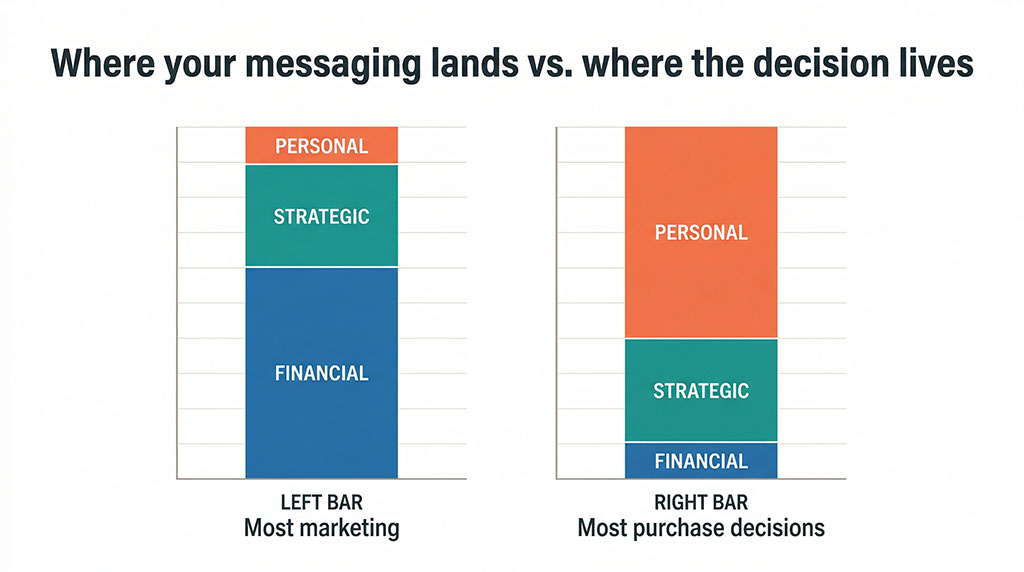
Audit your own marketing for which pain layer you’re addressing. Pull up your homepage, your ads, your sales deck. Count how many claims target financial pain (save money, better ROI), how many target strategic pain (scale faster, improve efficiency), and how many target personal pain (stop worrying, feel confident, never deal with X again).
If personal pain is below 30% of your messaging, you’re leaving the strongest motivator on the table.
The pizza, the flag, and the pain nobody names
Domino’s didn’t make a better pizza. They didn’t make a faster pizza. They named a pain their customers couldn’t articulate — the low-grade anxiety of waiting without information — and built their entire promise around eliminating it.
Christophe Morin didn’t offer cheaper flags. He didn’t pitch faster logistics. He named the private fear that an entire committee was carrying — the personal terror of a public diplomatic catastrophe — and became the only vendor offering a cure.
Your customers are sitting across the table from you right now, giving you their financial pain because that’s the professional thing to say. Underneath it is a strategic pain they’ll share if you push a little. And underneath that is the personal pain — the anxiety, the dread, the identity threat — that will actually make them buy.
The question isn’t whether that deeper pain exists. It does. The question is whether you’re the one who finds it, or whether your competitor gets there first.
Your marketing, looked at properly
Thirty minutes on your current setup — what’s working, what’s quietly leaking budget, and what I’d fix first. You’ll leave with a clearer picture whether we work together or not.
Got something specific bugging you? Flag it when you book and I’ll have it looked at before we talk.

AboutBruce Marjoribanks
Bruce Marjoribanks has spent 27 years in marketing, including building, running and selling his own agency before going independent. He now runs every channel - paid, organic, social, email, creative and automation - as one integrated system, with AI ehancing production and the judgment staying human.