
Why the hook is only step one — and what the brain needs every eight seconds after it.
Watch someone scroll Instagram for sixty seconds. Really watch them.
Their thumb moves at a steady, automatic pace — content blurring past in a continuous stream. Then something stops it. A face, a word, a sound. The thumb freezes. Three seconds pass.
Then it moves again.
The video had a hook. That’s all it had. The moment the hook delivered its promise, the brain got what it came for, quietly filed the experience away, and went looking for the next thing.
This is the most common, most expensive mistake in small business marketing. Everyone has learned — correctly — that you need to stop the scroll, open the email, grab the attention. What almost nobody teaches is what happens in the brain after that. Stopping someone is not the same as keeping them. The gap between those two things is where most marketing budgets quietly disappear.
The Principle Nobody Finished Reading
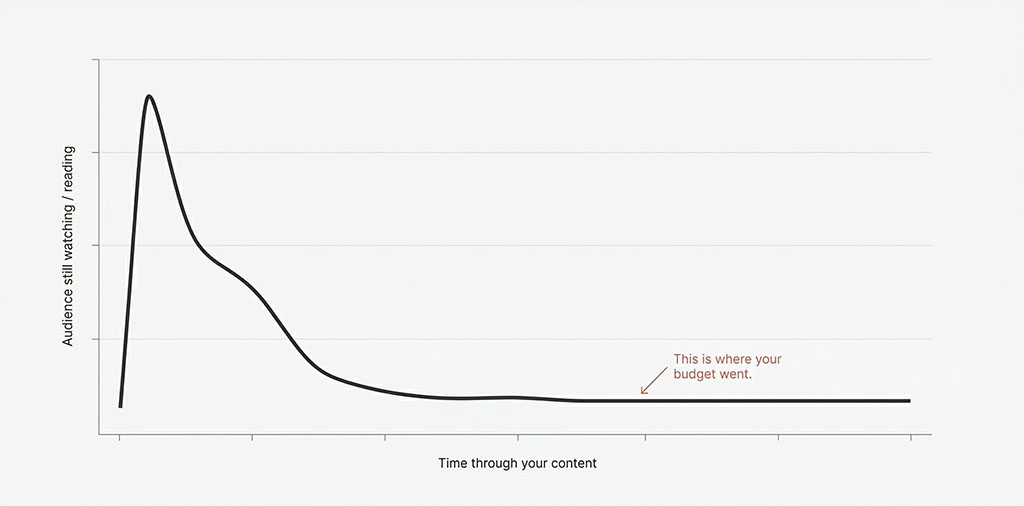
In the early 1990s, direct mail expert Denison Hatch published what he considered the foundational rule of all advertising. The chapter title was unambiguous: “The Key to Successful Advertising: Interrupt and Keep on Interrupting.”
Not “interrupt.” Not “write a great hook.” Keep on interrupting.
The distinction is everything. Hatch’s observation — drawn from decades of studying direct mail packages that generated millions in revenue — was that attention doesn’t hold. It decays. The moment you stop providing a reason to keep reading, the reader’s brain starts looking for an exit. Your job as a marketer is not to capture attention once and then deliver your message. Your job is to recapture it, repeatedly, throughout the entire piece.
The hook gets them in the door. Then you need another hook. Then another. All the way to the call to action.
In 1993, this was a principle that required a copywriter to apply by feel — crafting subheads, turning points, and re-engagement moments throughout a long-form letter. There was no analytics dashboard showing you where readers dropped off.
Now there is. And a generation of creators built an entire format around what that data revealed.
The Algorithm Independently Discovered the Same Thing
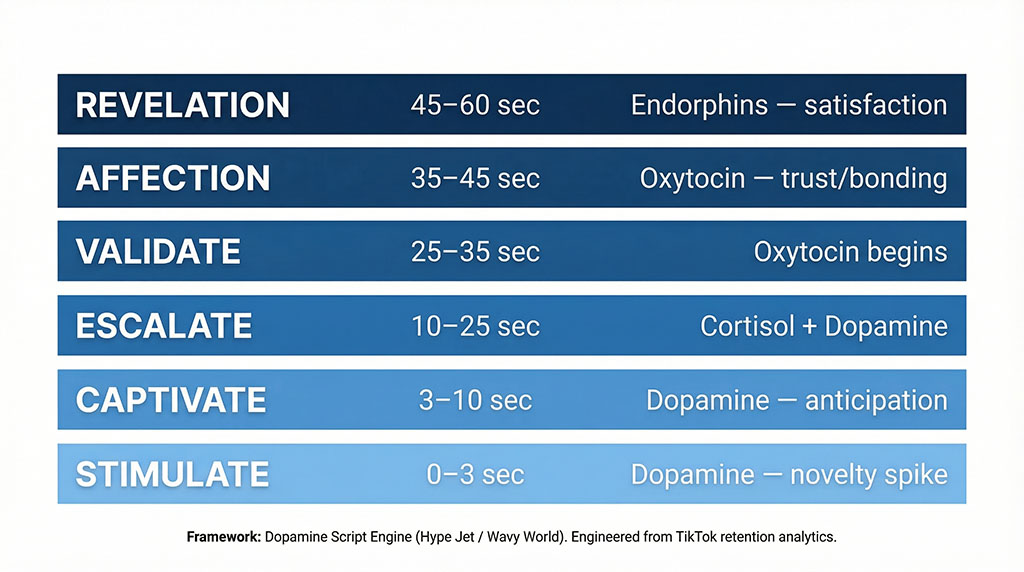
Somewhere between 2022 and 2025, a format emerged on TikTok and Instagram that creators began calling “wavvy” content. Not a visual style — a structural approach to short-form video built not around a single hook, but around continuous re-engagement every eight to fifteen seconds throughout the entire piece.
The skeleton looks like this: a high-intensity visual stops the scroll in the first two seconds. Then, instead of settling into linear delivery, the video immediately re-escalates — new reveal, new micro-question, new visual spike. Another at ten seconds. Another at twenty. The result at thirty. The CTA at forty.
Nobody in that creator community read Hatch’s chapter. The format was engineered by retention analytics — watching graphs drop and finding the moments where a new spike could rescue them. They were solving for the same problem Hatch identified thirty years earlier, using real-time data instead of intuition.
We took this seriously enough to build our own tool around it. A custom AI system — built inside Claude — that scripts wavvy-format video content using this exact architecture: six neurochemical stages mapped to specific time windows, with re-interruption built into the structure from the first frame. The reason we built it wasn’t novelty. It was because once you understand what this format is actually doing to the brain, you can’t unsee it — and you start applying the same architecture to everything else you produce.
Which brings us to the question the wavvy format doesn’t explicitly answer: why does attention decay that fast? Why does the brain need re-spiking every eight seconds just to stay with a forty-five-second video — let alone a five-hundred-word email?
What's Actually Happening in the Brain
The answer isn’t about discipline or distraction. It’s structural.
When your hook fires, something specific happens. The brain perceives a gap between what it currently knows and what it wants to know — what psychologist George Loewenstein called an “information gap” in his 1994 review of curiosity research. His framing was more forceful than most marketing writers acknowledge: curiosity, Loewenstein argued, is a form of cognitively induced deprivation. Not mild interest. Deprivation — closer to intellectual hunger than gentle intrigue. That hunger motivates the person to seek the missing information, and it can manifest as either a pleasurable pull of interest or an uncomfortable, urgent need-to-know (Litman, 2005).
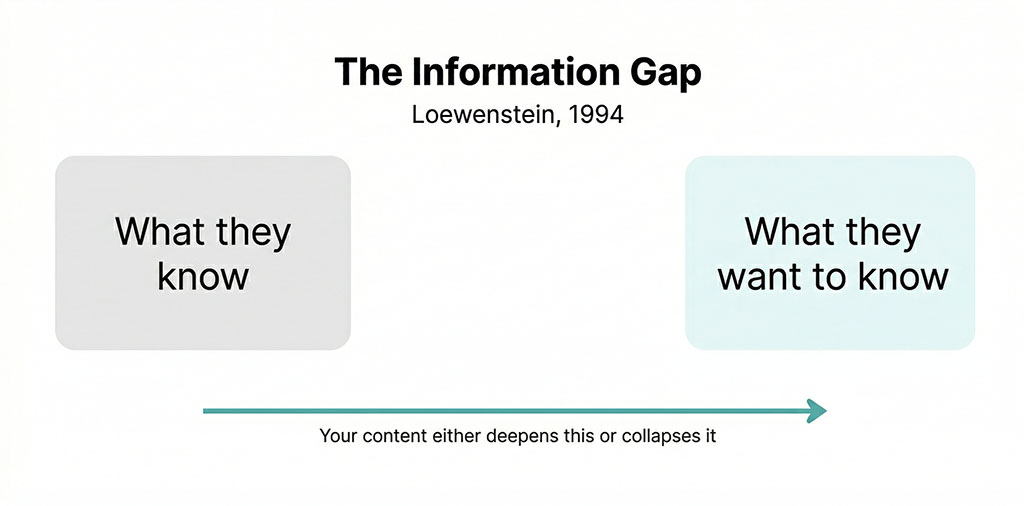
You’ve felt both versions. The headline that makes you click before you’ve consciously decided to. The email subject line that sits in your mind during a meeting because you haven’t opened it yet. That pull — that sense of incompleteness — is the information gap doing its job.
This happens constantly. Every few seconds.
The first moments after the hook are the most dangerous in any piece of marketing. This is the click-confirmation window. The brain just predicted your content would deliver something worth its time — now it checks whether you’ll follow through. Here’s where most marketing writers get the neuroscience backwards: the brain doesn’t reward a confirmed prediction with a dopamine hit. Confirmed predictions produce no phasic response — the prediction was already “cashed in” neurochemically when the cue first appeared. What actually triggers a dopamine burst is surprise — a reward that’s better than expected (Schultz, Dayan & Montague, 1997). The implication for marketing is direct. Don’t just meet the expectation your hook created. Slightly exceed it. The brain registers the surplus. That’s the hit.
Which means cognitive stillness is the enemy. Not literal stillness — but the moment your email settles into a predictable rhythm, or your ad copy sounds like every other ad in the category, the brain classifies it as background and stops processing it actively. Our brains evolved to notice novelty — movement, contrast, the unexpected — as a survival mechanism. In the wavvy format, every spike is a deliberate pattern interruption: a signal that something new is happening and attention is required.
And then there’s how it all ends.
Kahneman and colleagues (1993) documented a consistent bias in how people remember experiences: retrospective evaluations are disproportionately shaped by how intense the peak moment was and how the experience ended — not by a balanced average of every moment. Research has since extended this to advertising contexts (Baumgartner, Sujan & Padgett, 1997), though it works best for discrete, bounded experiences — which is exactly what a short-form video or a focused email is. The implication: a flat, summary-style close wastes everything that came before it. The brain is forming its final impression right now, at the close, and that impression shapes whether it acts.
One more mechanism worth understanding: the storytelling layer. When content moves from information to narrative — a real customer, a specific moment, a before-and-after with a person at the centre — something shifts in how audiences process it. Research on narrative transportation (Green & Brock, 2000) consistently shows that people absorbed in a story develop stronger story-consistent beliefs and are more persuaded than by equivalent facts presented directly. This has been confirmed across multiple meta-analyses. Stories lower the brain’s counter-arguing response. You stop fact-checking and start experiencing.
You Don't Make Viral Videos. So?
Here’s where most small business owners mentally check out. You’re not a content creator engineering retention curves for a TikTok audience. You send a monthly email. You run Google search ads. You have a services page that your web developer describes as “clean and professional.”
The format doesn’t change the mechanism.
Look at your last email newsletter. The subject line created an information gap — that’s why someone opened it. What did sentence one do? If it was “Hi, it’s [Name] from [Business] with this month’s update,” you closed the gap with nothing. No confirmation. No deepening tension. No new question. The brain got its answer — “this is a newsletter” — and left.
Look at your Google search ad. Two lines of description copy. That’s your entire re-interruption budget. Most small business description copy sounds like a brochure read aloud: “Providing quality services to clients across the region.” No pattern interruption. No contrast. No spike. The brain classified it as expected and moved to the next result.
Look at your services page. A visitor lands — the headline stopped them. Then: a paragraph of background about your business, a block of text about your process, a list of services, a contact form at the bottom. One interruption at the top, then a long cognitive flatline. By paragraph two, the brain has reclassified this page as “like every other services page” and started planning the exit.
We see this consistently when we audit client marketing. The open rate is fine. The click rate is a fraction of it. That gap — between the people who opened and the people who did anything — is almost never a CTA problem or an offer problem. It’s a re-interruption problem. The hook worked. Everything after it was a flat line.
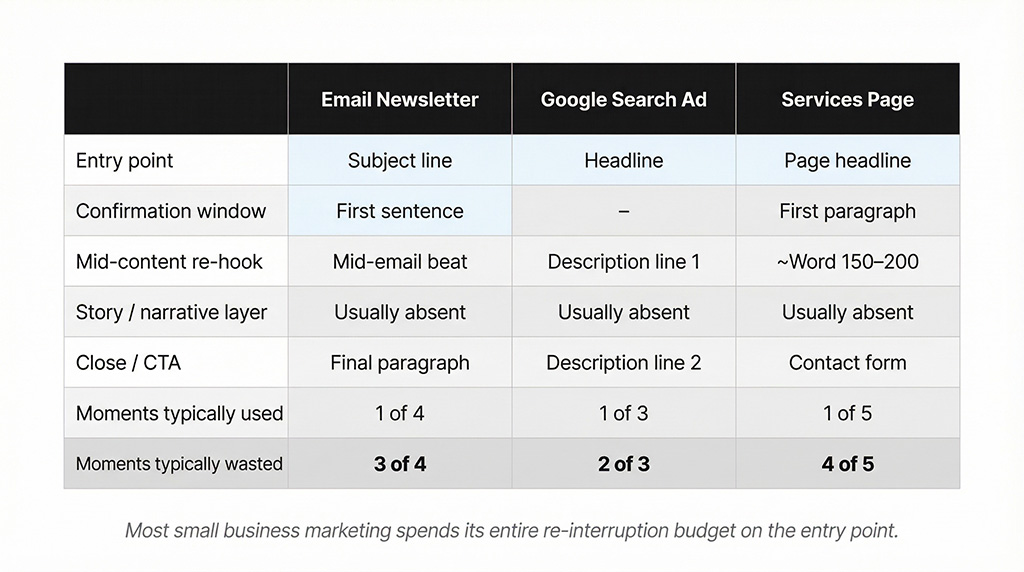
Every format has a re-interruption budget. Most small businesses spend everything on the entry and have nothing left for the middle or the close.
The Architecture, Applied
The mechanism doesn’t require video production or a marketing degree. It requires understanding where your evaluation windows fall and what to put in them.
In an email: the subject line opens an information gap. Sentence one confirms it’s real and deepening — or it collapses it entirely. Somewhere before the midpoint — before the eye goes flat — a short line, a surprising number, or a direct question creates a new spike. The CTA doesn’t summarise. It re-escalates.
In ad copy: the headline creates contrast or tension. The body copy doesn’t restate it — it introduces a new dimension: a consequence, a number, a scenario the reader recognises from their own experience. The brain gets a second hit before it makes the click decision.
On a services page: the headline stops them. The first paragraph confirms the gap and deepens it. Somewhere around word 150 to 200 — where attention is already starting to drift — you name the thing they’re actually worried about. Not your process. Their concern. That’s a pattern interruption. From there, your evidence and your close land in a brain that’s still engaged, not one that’s been running on autopilot.
This is what Hatch was describing. This is what the wavvy format was engineered around. This is what the neuroscience explains. Three different eras, three different mediums, one identical architecture: open a gap, deepen it, interrupt again, interrupt again, close at the peak.
Same phone. Same thumb. Same opening two seconds.
But this time, every time the brain reaches for the exit, something new is already arriving. A question. A number. A shift. A moment of recognition. The thumb stays still. They reach the end. They tap the link.
The hook was the same. Everything after it was different.
That difference has a name now. And it’s been sitting in a 1993 direct mail textbook — and confirmed by neuroscience — the whole time.
Your marketing, looked at properly
Thirty minutes on your current setup — what’s working, what’s quietly leaking budget, and what I’d fix first. You’ll leave with a clearer picture whether we work together or not.
Got something specific bugging you? Flag it when you book and I’ll have it looked at before we talk.

AboutBruce Marjoribanks
Bruce Marjoribanks has spent 27 years in marketing, including building, running and selling his own agency before going independent. He now runs every channel - paid, organic, social, email, creative and automation - as one integrated system, with AI ehancing production and the judgment staying human.