
The executives of the Pennsylvania Railroad gathered in 1958 to address a shrinking business. Traffic was down. Revenue was eroding. Their market share—once untouchable—was quietly bleeding to highways and airlines.
They spent three days on strategy. How to get more passengers back on trains. Which routes to protect. How to compete.
They were asking the wrong question.
By 1970, the Pennsylvania Railroad—once the largest corporation in America—was bankrupt.
Peter Drucker Watched This Happen Everywhere
Drucker spent most of his career diagnosing business failures. Not strategy failures. Not execution failures. Something earlier, and more fundamental.
In Management: Tasks, Responsibilities, and Practices, he called it a failure to answer the most important question in business: “What is our business?”
The railroad executives believed they were in the railroad business. They were in the transportation business. One word of difference. But it changed the meaning of every decision they made—which competitors to watch, which customers mattered, what to build next, where to spend. They got every one of those wrong. Not dramatically. Just consistently, for twenty years, until consistently wrong became catastrophically wrong.
Drucker argued this wasn’t bad luck. It was a predictable consequence of defining your business by what you make instead of what you do for the people you serve.
Most small business owners make the same mistake.
The Answer That Feels Right
Ask any small business owner what business they’re in. You’ll get some version of the same answer:
“I’m a plumber.”
“We run a cleaning company.”
“I do social media management.”
These feel like correct answers. They describe the work. They’re what’s printed on the website and the invoice. They’re concrete, defensible, and probably unchanged since the day the business started.
Drucker wouldn’t call them wrong. He’d call them incomplete in a way that quietly limits everything downstream.
When you define your business by the task you perform, it puts the product at the centre of every decision instead of the customer. And that single shift—product-first versus customer-first—changes what you market, how you price, who you hire, and what you build next.
This isn’t a philosophical distinction. It has immediate, practical consequences.
What the Wrong Answer Actually Costs You
Here’s what it produces in practice.
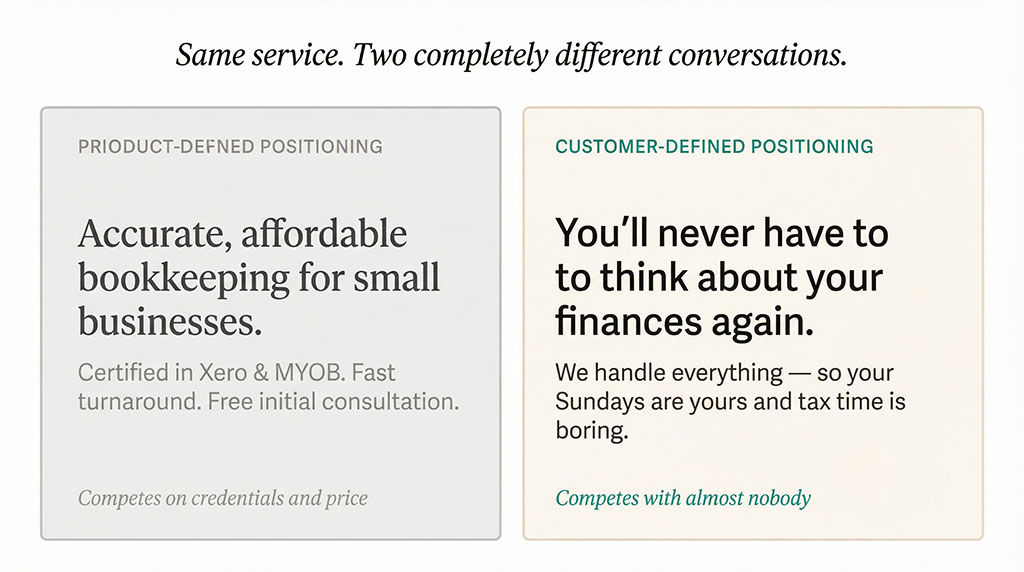
A bookkeeping firm that defines itself as “bookkeeping” markets its services by describing bookkeeping. Accuracy, software certifications, turnaround time. The features of the product.
But the small business owner hiring them isn’t thinking about bookkeeping. They’re thinking about the Sunday afternoons lost to spreadsheets. The anxiety of not knowing whether they can afford to hire someone. The April panic. They want someone to make the financial side of running a business invisible—to make it disappear from their life entirely.
The firm marketing “bookkeeping” competes on credentials and price in a category the customer barely knows how to evaluate. The firm marketing “you’ll never have to think about this again” sells something the customer has been trying to buy for years.
Same service. Completely different conversation.
This plays out everywhere. The personal trainer in the “fitness” business struggles to retain clients past February. The trainer in the “confidence for people who’ve already tried everything else” business has a waiting list. The web designer competing on “we build websites” fights Wix and offshore developers on price. The one competing on “we make your first impression win” competes with almost nobody.
In each case, the business didn’t change. The answer to Drucker’s question did.
You're Probably Thinking This Is All Very Abstract
Here’s the objection—and it’s a fair one. You didn’t start a business to philosophise about it. You have rent due, a team to keep busy, and a pipeline that needs filling. What does redefining yourself change about any of that, this week?
It changes where you look for customers.
A business defined by what it does searches for people who need that thing done. A business defined by what it does for someone searches for people who have that problem. The second pool is always larger. And the people in it are easier to reach, easier to convert, and—almost without exception—less sensitive to price.
The railroad comparison isn’t a history lesson for its own sake. If the Pennsylvania Railroad had defined itself as a transportation business, it would have watched the rise of automobiles and commercial aviation with urgency, not confusion. It might have invested in bus feeder routes in the 1940s. It might have built freight logistics divisions in the 1950s. It wouldn’t have been blindsided by competitors it wasn’t watching—because it hadn’t defined them as competitors.
The same thing happens to small businesses every year. The bookkeeper who didn’t realise she was competing with accounting software until her client base halved. The printer who couldn’t understand the drop in orders until he noticed his customers had quietly moved to digital. The travel agent who was in the “booking trips” business instead of the “making people’s dream holidays happen” business—and Airbnb, not a better travel agent, ate her lunch.
How to Answer the Question
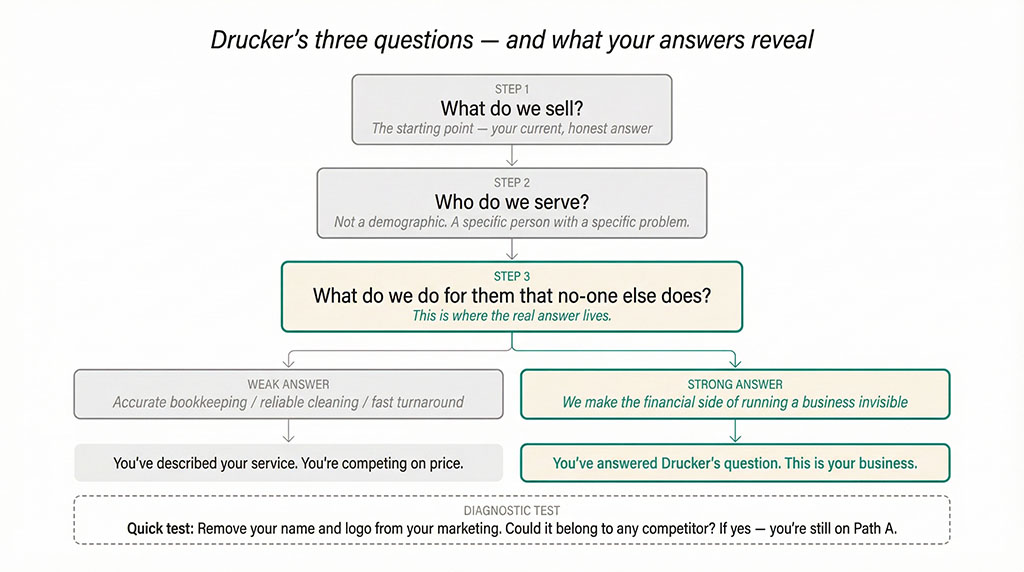
Drucker’s method is deceptively simple. Three questions, used together.
What do we sell? The current, honest answer. Your product or service, as it actually exists.
Who do we serve? Not a demographic. A specific person, with a specific problem, in a specific moment.
What do we do for them that they can’t easily get elsewhere? This is where the real answer lives.
Not “accurate bookkeeping”—every bookkeeper says that. Not “reliable cleaning”—every cleaning service promises that. What do you specifically do for the specific person you actually serve best?
A quick test: if you removed your name and logo from your marketing, could it belong to any competitor? If yes, you’ve described what you do. You haven’t answered what business you’re in.
The 10-Minute Version
Take three pieces of paper.
On the first, write every problem your best clients had before they hired you. Not the service they needed—the situation they were in. On the second, write what changed for them after working with you. Not the deliverable—the feeling, the outcome, the thing they could now do or stop worrying about.
On the third, write one sentence connecting the two:
“We help [specific person] go from [problem state] to [outcome state].”
That sentence is your answer to Drucker’s question. It’s also—and this is not a coincidence—the most effective single thing you can put on a homepage.
Most businesses have this backwards. They write the homepage first and try to extract the positioning from it later. Drucker’s question runs the other direction: answer it properly first, and the homepage, the pitch, the sales conversation, the referral script—all of it flows from that answer.
When the Question Matters Less
This reframe matters most in businesses where the customer is choosing you specifically—service businesses, expertise businesses, businesses built on trust and relationships. If your business is purely transactional—commodity products, standardised specs, purchasing decisions made purely on price—the customer-first definition matters less. When someone needs a specific part in a specific size, the philosophy of the seller is not the point.
But if you’re a business where the client’s decision involves any degree of judgement about who to trust, Drucker’s question is not optional. It’s the foundation everything else rests on.
Standing at the Switch
The Pennsylvania Railroad had a switch in front of it for twenty years. Transportation was changing. The market was changing. The customers were there, moving in a new direction. What was missing was a clear answer to what business they were actually in—which would have told them, immediately, where the tracks needed to go.
You have the same switch in front of you.
The question is whether you’re in the business you think you’re in—or the one your best clients are already paying you to be in.
One of those is a much better business.
Your marketing, looked at properly
Thirty minutes on your current setup — what’s working, what’s quietly leaking budget, and what I’d fix first. You’ll leave with a clearer picture whether we work together or not.
Got something specific bugging you? Flag it when you book and I’ll have it looked at before we talk.

AboutBruce Marjoribanks
Bruce Marjoribanks has spent 27 years in marketing, including building, running and selling his own agency before going independent. He now runs every channel - paid, organic, social, email, creative and automation - as one integrated system, with AI ehancing production and the judgment staying human.