
The analytics that cost Fortune 500s six figures? AI just put them in your price range.
Two dashboards. Two completely different stories.
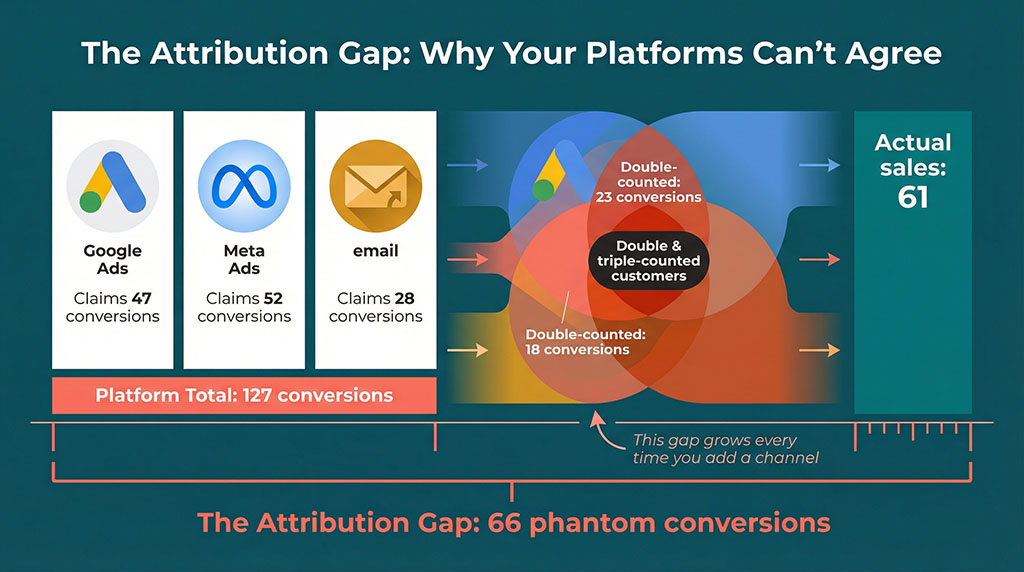
Google says last month’s campaign drove 47 conversions. Meta says it drove 52. Combined, that’s 99—except your actual sales were 61. You’re staring at the screen doing math that will never reconcile, because both platforms are claiming credit for the same customers, and neither one is telling you which dollars actually moved the needle.
You’ve been here before. Every small business owner running paid ads has. You make the budget call based on gut, hope the numbers sort themselves out, and quietly wonder how much you’re lighting on fire each month.
Turns out, you’re not paranoid. The biggest players in advertising just confirmed what you suspected.
The $32 billion confession
The IAB just published its State of Data 2026 report—a survey of over 400 senior brand and agency leaders at the largest companies in the U.S. The findings are blunt. Up to 75% of these decision-makers say their measurement tools underperform on the basics: accuracy, speed, trust, and cost-effectiveness. These are organizations with dedicated analytics departments, seven-figure tool budgets, and entire teams devoted to understanding which ads work.
And they still can’t figure it out.
The measurement approaches they rely on—attribution models, incrementality tests, marketing mix models—each answer a different question but rarely talk to each other. Only 39% use all three together. The rest are making multi-million-dollar allocation decisions with partial information.
You know what that feels like at $5,000 a month. Imagine it at $5 million.
But here’s where the report gets interesting for business owners operating at your scale. The IAB estimates that if AI makes measurement more accurate and trusted, planners would shift 5.6% more spend into undervalued channels. Across the U.S. ad market, that’s $26 billion in redirected media investment plus $6 billion in recovered team productivity. That $32 billion isn’t new money—it’s money already being spent, just spent wrong because the measurement couldn’t keep up.
The same force that’s about to correct course for Nike and Procter & Gamble is about to reach your ad account.
The channels you depend on are the ones nobody can measure
Here’s the data point the report buries that should matter most to you.
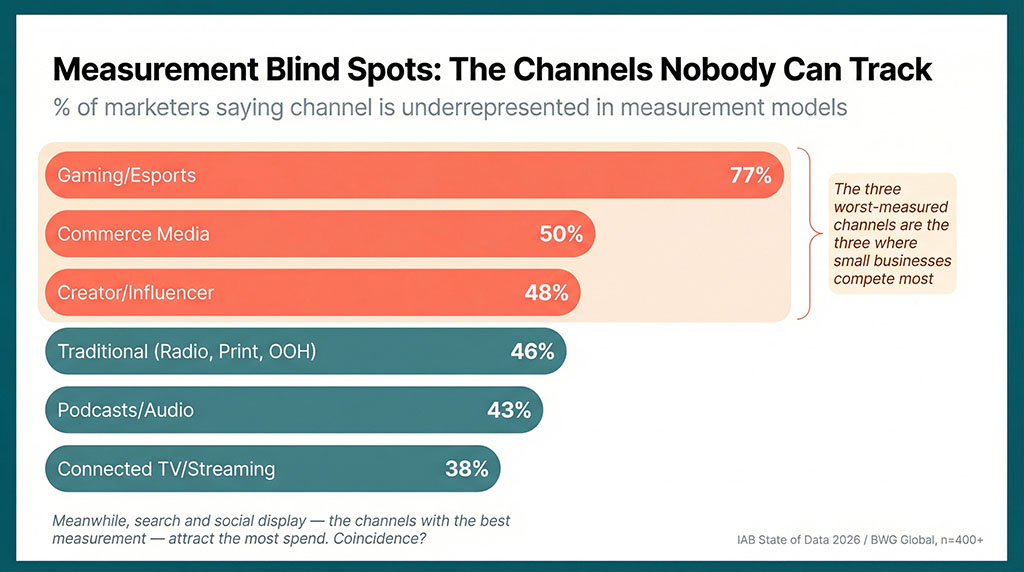
The IAB asked marketers which media channels are underrepresented in their measurement models. The top three: gaming (77% say it’s underrepresented), commerce media like Amazon and retail networks (50%), and creator/influencer marketing (48%). Traditional media—radio, print, out-of-home—came in at 46%.
Read that list again. Those aren’t the channels Fortune 500 brands care most about. Those are the channels you care about. Small businesses disproportionately rely on creator partnerships, Amazon storefronts, TikTok Shop, and niche platforms where the measurement infrastructure was never built for scale.
The big brands have been pouring money into search, display, and social—the channels where measurement works best—partly because measurement works best there, not because those channels necessarily deliver the highest return. The models have a built-in bias toward what’s easy to count.
Think about what that means for your business. You’re running influencer campaigns and seeing results in your sales but can’t prove the connection in a dashboard. You’re selling through Amazon but your mix model (if you even have one) treats that channel as a rounding error. You’re making decisions about where to spend next quarter based on the channels that are easiest to measure, not the channels that are working hardest.
That’s the same $32 billion problem—just at your scale.
What AI actually changes (and what it doesn't)
The report tracks a meaningful shift in how AI is being applied to ad measurement. Today, AI mostly does the grunt work—cleaning data, normalizing formats across platforms, pulling reports together. The kind of tasks that eat 42% of a media planner’s time before they ever get to think about strategy.
Within the next one to two years, the buy-side expects AI to move into harder territory: designing test structures, matching ad exposures to actual outcomes, tuning the models themselves. That’s the work that used to require a team of data scientists and six months of runway.
Some practitioners aren’t waiting for that timeline. The tools to do this already exist. AI coding assistants can connect directly to your ad platforms, your CRM, your analytics suite, and your sales data through API connectors—pulling live data from Google Ads, Meta, Salesforce, HubSpot, and a dozen other sources into a single analysis environment. From there, predefined analytical frameworks crunch the data automatically: matching search intent to lead quality, tying ad exposures to actual closed revenue, identifying which campaigns drove real pipeline and which ones just generated clicks that went nowhere.
The mechanics are surprisingly accessible. It’s a tool sitting on a desktop. The hard part—and the part that still requires human expertise—is the intellectual architecture underneath: knowing which data sources to stitch together, which questions to ask, how to structure the analytical sequence so the output is actually trustworthy. The AI is the engine. The strategy for how to wire it is the IP.
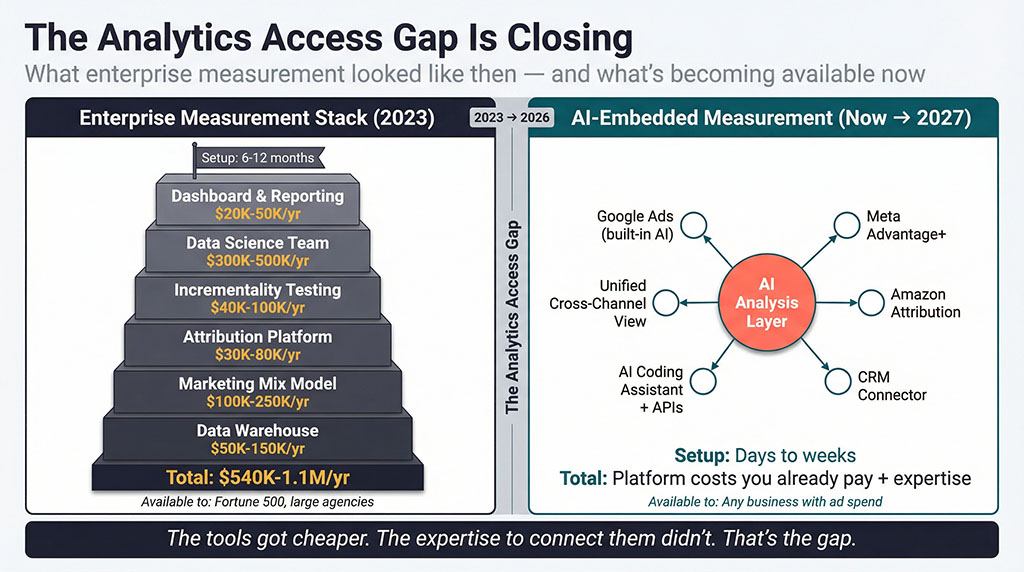
That distinction is what creates what you might call the Analytics Access Gap—the space between “the tools exist” and “someone knows how to use them.” The engine just dropped to near zero. The expertise to wire it together didn’t. And that gap is where most small businesses are about to get stuck.
For large organizations, this means their marketing mix models—historically updated once or twice a year because of the labor involved—could shift to quarterly refreshes. That matters. An annual model is telling you what worked last year. A quarterly model is telling you what’s working now, while you still have time to adjust.
For small businesses, the change is more fundamental. You were never going to hire a data science team. You were never going to build a marketing mix model from scratch. The cost and complexity put enterprise-grade measurement entirely out of reach.
That barrier is collapsing. The 83% of planning teams already using general-purpose AI tools in their measurement work are proving out the approach. The sophistication is migrating downstream—into the platforms you already pay for and into standalone tools that cost a fraction of what a single analyst’s salary would run you.
The gap between “what Nike knows about their ad performance” and “what you know about yours” is narrowing for the first time. Not because the tools got incrementally better. Because the architecture changed.
"Great, but I run a 12-person company"
Let’s pause. Because you’re reading about enterprise brands and major agencies. The $32 billion figure is a number from a conference room you’ll never enter. Marketing mix models? Incrementality tests? You’re trying to figure out whether to put another $500 into Instagram Reels or Google Search this month.
That skepticism is earned. Most measurement research treats small businesses as an afterthought.
But the reason this shift matters for you is that the tools aren’t staying behind enterprise paywalls.
The same AI capabilities that help an analytics team at Unilever tune their marketing mix model quarterly are showing up inside Google’s Performance Max, inside Meta’s Advantage+ campaigns, inside Amazon’s attribution tools. The sophistication is being embedded into platforms you already use, at price points you already pay.
That 69% of analytics teams scaling AI right now? They’re building the infrastructure that your self-serve tools will run on within 18 months. The 44% of analytics teams using AI agent platforms today? Those agents are being productized for the rest of the market.
You don’t need to build the system. You need to be ready to use it.
Three things to do before the tools arrive
The report outlines detailed recommendations for enterprises—governance frameworks, cross-functional working groups, data taxonomy standardization. You don’t need most of that. But three things will determine whether you capture this wave or miss it.
Get your data house in order now. AI measurement tools are only as good as the data they ingest. If your conversion tracking is broken, your UTM parameters are inconsistent, or your CRM doesn’t connect to your ad platforms, no amount of AI will save you. Spend the time now to ensure your Google Analytics, your Meta pixel, your email platform, and your point-of-sale system are all tracking consistently. This is unsexy work that pays compound interest.
Start tracking channels you’ve been ignoring. The IAB data makes it clear: the channels with the worst measurement today are the ones most likely to be undervalued. If you’re running influencer campaigns, start building even rough tracking—unique discount codes, dedicated landing pages, post-campaign sales lifts. When AI-powered measurement tools mature enough to model these channels, you’ll need historical data to feed them. The business owners who start capturing this data now will have a 12-to-18-month head start.
Question your platform’s self-reported numbers. Every ad platform grades its own homework. Google will always tell you Google works. Meta will always tell you Meta works. The IAB report finds that 72% of attribution users say cross-channel performance capture doesn’t perform well. As AI tools begin to offer independent cross-platform views, the businesses that have been skeptical of self-reported metrics will adapt faster than the ones who took them at face value.
Back to those two dashboards
Google still says 47. Meta still says 52. Your actual sales are still 61.
But the gap between what you can see and what’s actually happening is about to shrink—not because you’re hiring a data science team, but because the same AI that’s restructuring measurement for the largest advertisers in the world is being pushed downstream into the tools sitting open on your laptop right now.
The IAB’s $32 billion figure represents misallocated spend across the entire industry. Your version of that number is smaller. A few hundred here, a few thousand there—spent on the wrong channels because you couldn’t see what was working.
The tools to see it are arriving. The Analytics Access Gap—knowing how to wire them together—is the only thing standing between you and the view that Fortune 500 brands have had for years.
For the first time, that gap is closeable.
See What Your Ad Spend Is Actually Doing
We’ll pull your platform data into one view and show you where the attribution overlaps, the blind spots, and the budget going to channels that can’t prove they’re working.
Most clients find 20-40% of their spend is allocated based on whichever platform grades its own homework the loudest. Takes 30 minutes.
You don’t need more dashboards. You need one person who can read all of them at once.
Data and findings referenced in this article are from the IAB State of Data 2026: The AI-Powered Measurement Transformation report, published February 2026 in partnership with BWG Global. The study surveyed 400+ senior planning and analytics decision-makers at U.S. brands and agencies.