
It’s Monday morning. An ecommerce agency account manager opens Google Ads, coffee in hand, ready to adjust bids on a client’s Shopping campaigns. Check the search term report. Tweak the product feed. Shuffle some budget from Display into Performance Max. Maybe build a few new ad variations if there’s time.
Except Google built all of that into the platform last month. The bids adjust themselves. The feed syncs automatically from Shopify. The AI wrote 70 million ad variations in a single quarter — for other clients just like theirs. The account manager sips their coffee and stares at a dashboard that, increasingly, doesn’t need them.
This isn’t speculation about what might happen. It already happened.
What changed in January
In January 2026, Google launched something called the Universal Commerce Protocol. UCP, for short. The name is boring. The implications are not.
Google co-built it with Shopify, Walmart, Target, Visa, Mastercard, and Stripe. That’s not a partnership announcement. That’s the entire transaction infrastructure of Western ecommerce agreeing on a single standard — a common language that lets AI agents discover products, check inventory, compare prices, and complete purchases without a human ever leaving the search interface.
Read that again. A customer asks Google’s AI a question about a product. The AI searches, compares, recommends, and sells — all inside Search. No click-through to the brand’s website. No landing page. No separate checkout. The storefront, the ad platform, and the cash register collapsed into one screen.
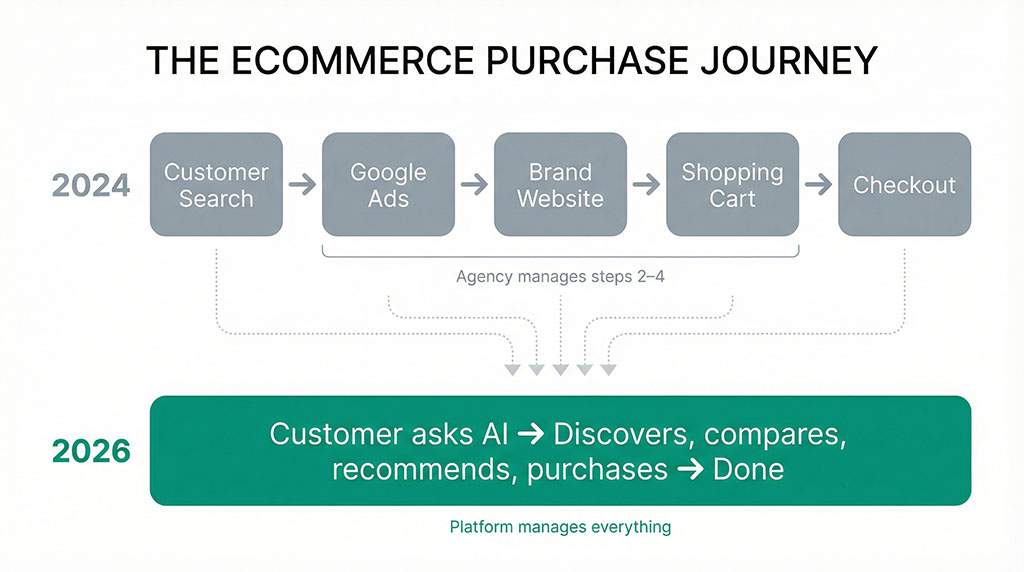
Google calls it “Instant Checkout.” The experience works inside AI Mode and the Gemini app. Shopify stores connect natively. Etsy and Wayfair were first live, with Shopify, Target, and Walmart rolling out now. The AI handles the creative. The protocol handles the transaction. The platform handles the distribution.
So where, exactly, does the ecommerce agency fit?
The layer that disappeared
Think about what an ecommerce agency actually sells. Not what’s on the proposal deck — what they actually do day-to-day.
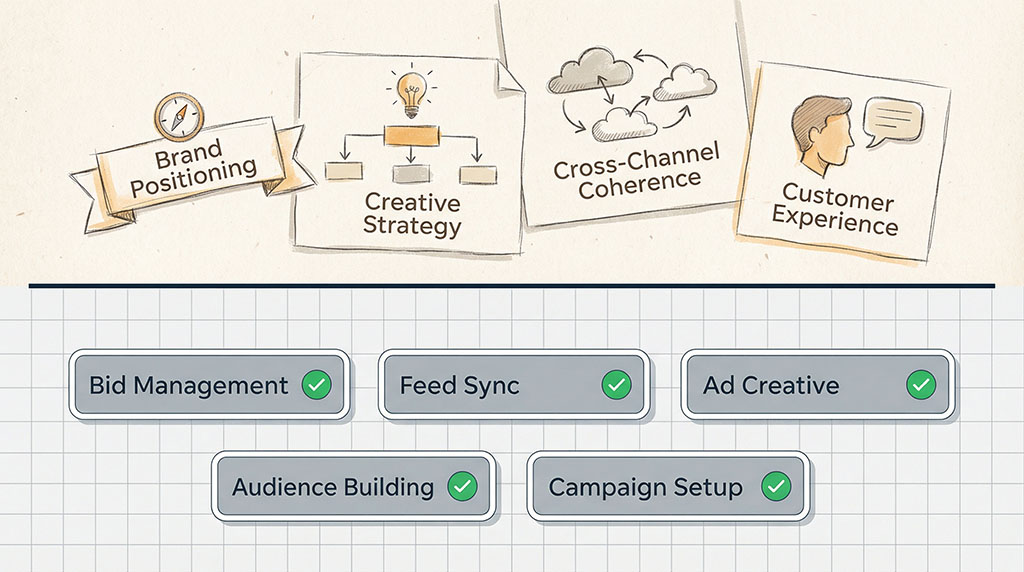
They manage product feeds. They set up Shopping campaigns. They write ad copy. They adjust bids. They build audiences. They test creative. They monitor performance and move budget around.
Each of those tasks has been absorbed by the platform in the last twelve months. (New) Google’s AI Max — tested across 892 advertiser accounts during beta — delivered 23% better cost-per-acquisition than Performance Max and 31% more conversions than standard Search campaigns. It finds high-intent queries that human managers miss by processing millions of search signals simultaneously. (Knew) That’s the equivalent of a junior media buyer who works 24 hours a day, never takes a sick day, and gets measurably better results.
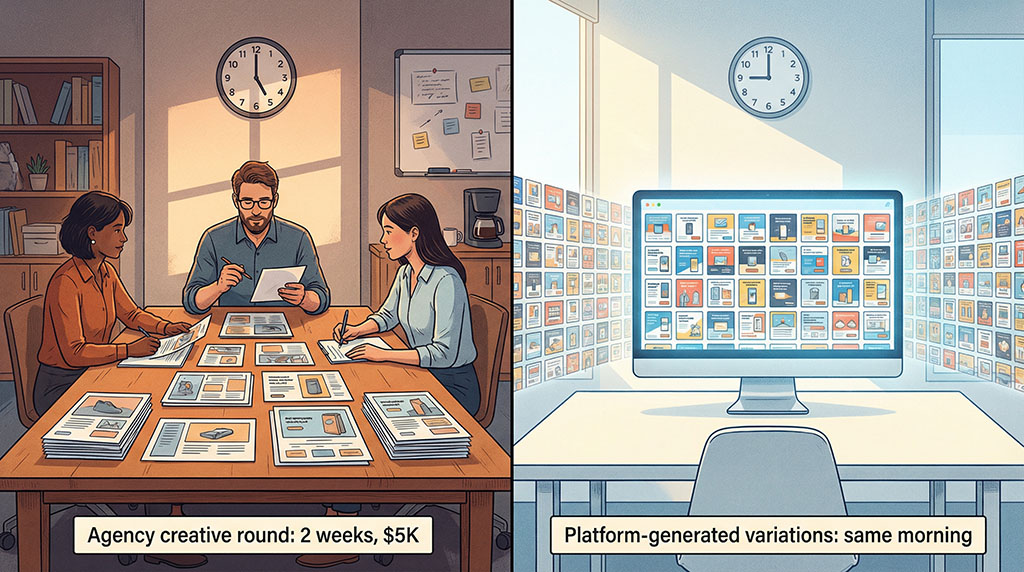
The creative production layer went the same way. In Q4 2025 alone, Gemini generated nearly 70 million creative assets inside AI Max and Performance Max campaigns. (New) Not templates. Not suggestions. Finished ad variations — images and video — assembled from product feeds and brand guidelines, tested against each other, and scaled automatically based on performance. (Knew) The design agency that charges $5K for a batch of ad creatives is now competing with a machine that produces thousands of variations before lunch.
And the feed management layer — the technical plumbing that justified an entire category of Shopify apps and specialist agencies — is being standardised out of existence by UCP itself. When your storefront talks directly to the ad platform in a shared protocol, the middleware broker becomes redundant. You don’t need someone to manage the connection between two systems that were designed to connect natively.
"But someone still has to manage all of this"
Here’s the objection. And it’s reasonable.
Automation still needs oversight. Someone has to set the strategy. Define the target customer. Choose the right product mix. Decide on promotional timing. Interpret the data and make judgment calls. Performance Max is powerful, but left unsupervised it’ll happily spend your budget on Display placements that look great in the dashboard and do nothing for revenue.
All of that is true. And none of it is what most ecommerce agencies actually do.
Be honest. How many ecommerce agencies are genuinely setting strategy? How many are providing real judgment on offer positioning, competitive differentiation, or customer lifetime value? And how many are running a playbook — upload feed, set bids, build audiences, optimise toward ROAS targets, run the same Google Ads scripts every other agency runs — that the platform now does natively, and better?
The uncomfortable answer: the vast majority of ecommerce agency work is execution. Campaign setup. Bid management. Feed troubleshooting. Reporting. That’s the layer Google just ate.
The strategic work — the work that actually requires a brain — was never the agency’s strong suit in the first place. Especially when you’re paying three or four separate specialists who each see one channel and none of them talk to each other.
What Google can't automate
This isn’t a “robots are taking over” story. There’s a clear line where the automation stops.
Brand positioning. Google’s AI can generate a thousand ad variations, but it can’t decide what your brand stands for. It can’t tell you whether to compete on price or quality. It can’t build the emotional connection that turns a one-time buyer into a repeat customer.
Creative strategy. The AI assembles assets from what you give it. The quality of the input determines the quality of the output. Someone still needs to understand which message lands with which audience at which stage of consideration — and that requires market understanding that no algorithm has.
Customer experience beyond the click. UCP handles the transaction. But what happens after? Returns, support, loyalty, retention — the pieces that determine whether a customer is worth $50 or $5,000 over their lifetime. No protocol solves that.
Cross-channel coherence. The more Google automates within its own walls, the more important it becomes that your email, your organic content, your brand presence, and your post-purchase experience all tell the same story. The platform optimises its own channels. It doesn’t coordinate across everything else.
These are the things that require human judgment. Strategic thinking. A coherent point of view about who you’re selling to and why they should care.
And — here’s the part most people miss — these are exactly the things that fragmented agency setups are worst at. When your Google person doesn’t talk to your email person who doesn’t talk to your creative team, nobody owns the strategy. Everyone owns a channel. The channels are being automated. What’s left is the thing nobody was responsible for.
What this means if you're paying attention
Google didn’t just update its ad platform. It absorbed an entire industry’s worth of execution work into its own infrastructure. The Shopify-to-Google pipeline is now native. The AI writes the ads, manages the bids, and — with Instant Checkout — closes the sale without the customer ever leaving Search.
For ecommerce brands, the question isn’t whether to use these tools. You don’t have a choice. The question is what you do with the humans and the budget you used to spend on the work the platform now does for free.
And if you run a business that isn’t ecommerce — if you sell services, or generate leads, or operate in a space where the path from “interested” to “paying customer” is longer and messier than a product feed and a checkout button — you should be watching this closely. The platforms always start with the simple use case. Then they move upstream.
It’s Monday morning. The account manager finishes their coffee. The dashboard is green. The AI is running. The feed is synced. The campaigns are live.
There’s nothing left to do. That’s the point.
See What the Platforms Already Do That You’re Still Paying For
Your agency runs scripts the platform runs natively. They adjust bids the AI adjusts faster. They manage feeds that now sync automatically. Book a free audit and we’ll map exactly which tasks on your agency’s invoice Google automated last quarter.
Book Your Agency Waste Audit →
Most clients find 30–40% of their agency bill covers work the platforms now do better. Takes 30 minutes.
The dashboard doesn’t need a babysitter. It needs a strategist.