
It’s 2:14 AM and your prospect can’t sleep.
He’s lying in bed with his phone propped against his chest, Notes app open, running the same calculation he’s run a dozen times this month: “$50K at 7.9% over five years = $1,006/month. Can’t afford it. Save $1,000/month for 30 months instead? Kids will be 14 and 11 by then. Use the emergency fund? No, that’s for emergencies.”
He closes the app. Stares at the ceiling. Opens the app again.
You don’t know this yet. You’re about to spend $15,000 on ads targeting “Males, 40+, interested in Finance.” And you’re going to wonder why nothing converts.
The gap between demographics and decisions
Most advertisers research their prospect the way you’d fill out a police report. Age. Gender. Location. Income bracket. Interests. They build a profile that’s technically accurate and emotionally dead.
I used to do this too. I’d pull an Audience Insights report, look at the affinity categories, sketch a rough persona, and start writing ads. The ads were fine. “Fine” meaning forgettable. Meaning a 1.2% click-through rate that decayed to nothing within two weeks.
Those figures are from my own client accounts. Unaudited, and one business’s results — not a benchmark, and not a promise.
The shift happened when I stopped asking “who is my prospect?” and started asking “what is my prospect doing at 2 AM when nobody’s watching?”
That’s when the real research begins. Not demographics. Behaviour loops. Belief systems. The private rituals of someone stuck in a problem they can’t solve.
What a real prospect profile looks like
For a recent campaign, I spent weeks building what I’d call a living document—not a one-page persona, but a layered psychological profile that eventually ran over 200 pages. Demographics were one page. The other 199 were about what the prospect believes, what they feel, and the specific patterns they repeat when nobody’s looking.
Here’s a fraction of what that looks like.
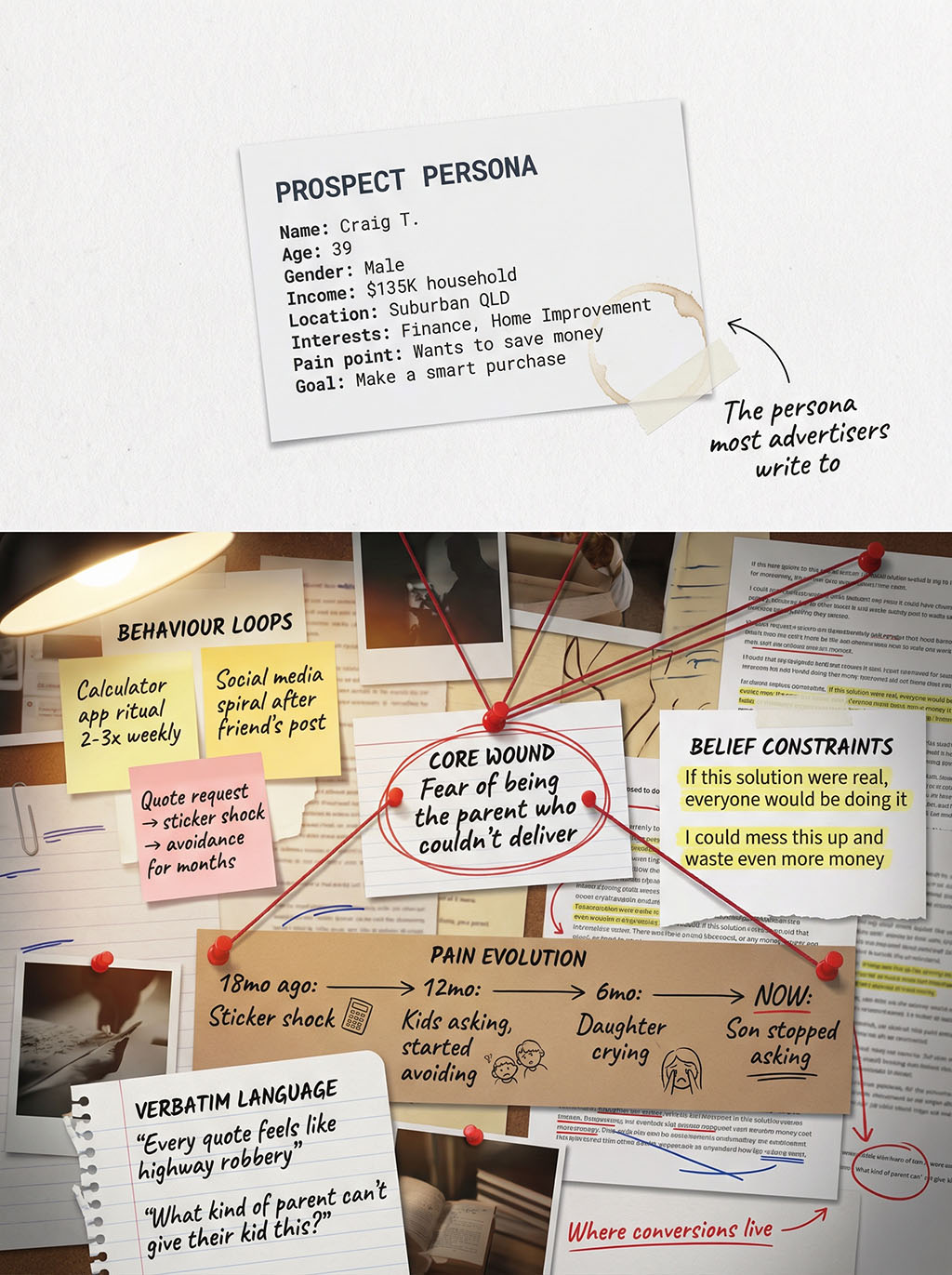
Take the midnight financial gymnastics I described in the opening. That’s not a detail I invented. It’s a pattern that emerged from customer interviews, forum deep-dives, and testimonial analysis. When I mapped the full behaviour loop, it looked like this:
Can’t sleep → open calculator app → work backward from product cost to payment options → factor in interest → factor in emergency fund depletion → close app convinced it’s impossible → repeat 2-3 times weekly.
That’s not a demographic. That’s a screenplay. And when you can see the screenplay, you can write the ad that interrupts it.
Or take the social media torture pattern I uncovered for the same campaign:
See friend’s post about buying the product → click through all photos → check their profile for hints about how they afforded it → Google the company → get discouraged by prices → close app feeling worse than before.
When you know that loop exists, you don’t write an ad that says “Affordable prices!” You write an ad that says “Your mate paid $24K, not $58K. Here’s the method he used.” Because you’re entering the exact conversation already happening in their head—which is precisely what Robert Collier meant when he gave us that famous instruction decades ago.
Going deeper than wants: Mapping the belief system
Victor Schwab, in How to Write a Good Advertisement, defined four categories of what prospects want: what they want to gain (health, money, prestige), what they want to be (good parents, creative, influential), what they want to save (time, money, worry), and what they want to do (win affection, satisfy curiosity).
That framework is the starting point. But it’s only the first layer.
The layer underneath—the one that actually determines whether someone clicks or scrolls past—is their belief system. Specifically, three questions:
What do they need to believe about themselves before they’ll buy? In the campaign I mentioned, the prospect needed to believe they were capable of making a big purchase decision without getting ripped off. Their self-concept was: “I’m smart enough to know I’m being exploited, but not smart enough to find the alternative.” Every ad that assumed confidence misfired. The ones that acknowledged doubt converted.
What do they need to believe about you before they’ll buy? They needed to believe we weren’t just another version of the same industry they distrusted. Not “we’re different.” They needed proof mechanisms—specific, named examples of people like them who succeeded.
What do they need to believe about the product before they’ll buy? They believed the product category required specialised expertise they didn’t possess. The core belief blocking the sale wasn’t about price. It was: “I could mess this up and waste even more money.” Until we addressed that belief directly, no discount or promotion moved the needle.
This is what I mean by visualisation. Not imagining a stick-figure persona named “Strategic Steve.” But mapping the belief architecture so precisely that you could predict which specific objection would surface at which stage of the funnel.
"This sounds like a lot of work for one campaign"
I know what you’re thinking. You’ve got a client on the phone wanting ads live by Friday. You’ve got three other accounts to manage this week. You’re not about to spend two weeks documenting your prospect’s midnight calculator habits.
But you’re already spending that time. You’re just spending it on the wrong side of the equation.
Every failed ad set is a research expense you didn’t categorise correctly. That $10,000 you burned through “testing audiences”? That was the cost of guessing. The $3,000 in creative variations that all flopped? That was the cost of writing to a demographic instead of a belief system.
The research doesn’t slow you down. It eliminates the cycle of launching, watching, failing, pivoting, launching again. When you know your prospect’s core wound—the deep fear driving their behaviour—you write fewer ads. And more of them work.
For the campaign I’ve been referencing, I identified what I call the “core wound” beneath the purchase decision. It wasn’t about money. It was about identity: the fear of being revealed as the parent who couldn’t deliver on promises. The prospect’s real terror was that their kids’ core childhood memory would be “Mum and Dad always said we’d do it but never did.”
Once I had that, I didn’t need 47 ad variations. I needed three. One that named the wound. One that showed someone with the same wound who found the solution. One that made the first step so small it didn’t trigger the fear of failure. Campaign cost dropped. Conversion rate nearly doubled.
The research process that gets you there
The gap between “Males 40+, interested in Finance” and “lying awake at 2:14 AM running impossible calculations” is bridged by a specific research process. Not a checklist—a method of progressive depth.
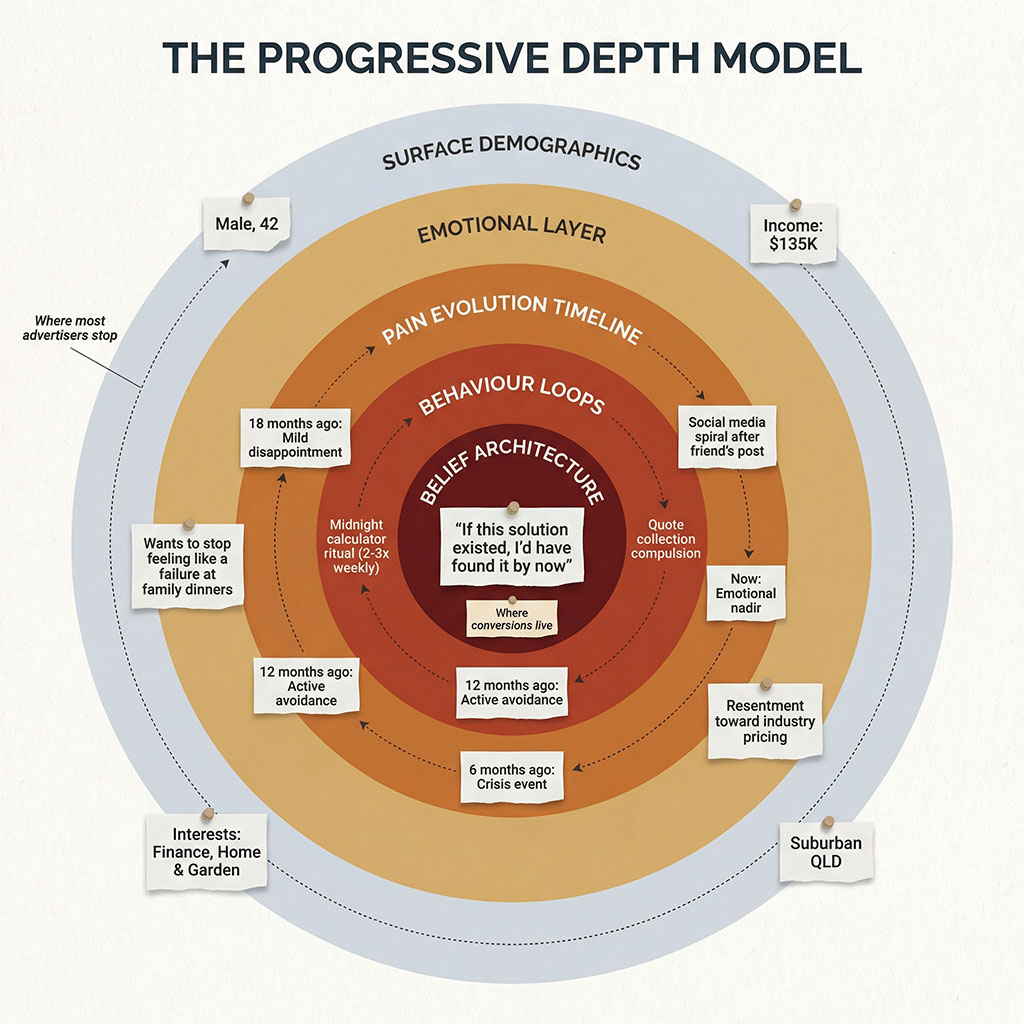
Start with the surface: Demographics, yes. But also: what magazines do they read? What Facebook groups are they in? What YouTube channels do they watch at night? This tells you what language they’re swimming in, which phrases feel native and which feel like marketing.
Move to the emotional layer: What does your prospect deeply want—not need, want? Needs are rational. Wants are compulsive. A prospect needs to save money. They want to stop feeling like a failure at the next family dinner. The want is where the energy lives.
Map the pain evolution: Pain isn’t static. It has a timeline. For the campaign I described, the prospect’s pain started as mild disappointment (18 months ago), escalated to avoidance behaviour (12 months ago), reached crisis point when a specific social event forced confrontation (6 months ago), and arrived at emotional nadir—the point where their child stopped asking because they’d learned not to trust the promise.
When you can trace that arc, you know exactly where your prospect is sitting emotionally when they see your ad. And you can match your message to that specific moment.
Identify the behaviour loops: These are the repetitive patterns I described earlier—the midnight calculations, the social media spirals, the quote-collection compulsions. Every stuck prospect has 3-5 loops they cycle through. Find them and you find your ad hooks.
Uncover the closely held beliefs: What does the prospect believe about your industry, about your category, about themselves? In my research, I found beliefs like “If this solution were real, everyone would already be doing it” and “I’ve tried everything—if a solution existed, I would have found it by now.” Those beliefs were the real competitors. Not other companies. Beliefs.
Mine for real language: Pull exact phrases from testimonials, forums, support tickets, review sites. Not paraphrased. Verbatim. “Every quote feels like highway robbery” hits differently than “consumers express frustration with pricing.” One is a headline. The other is a research summary.
What your whole funnel is really doing
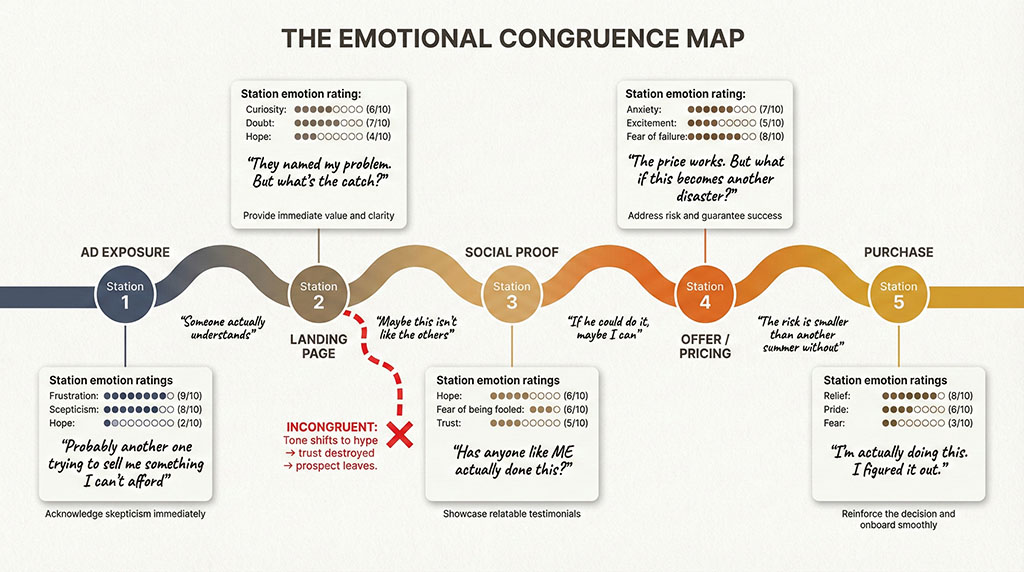
Here’s the concept that ties all of this together: emotional congruence.
Your prospect is experiencing a specific emotion right now—frustration, guilt, inadequacy, hope, scepticism. Your ad needs to meet them in that emotion. Not the emotion you wish they had. Not “excited about your product.” The real one.
Then every step of your funnel moves them along an emotional arc. The ad acknowledges where they are. The landing page shifts them toward possibility. The testimonials provide permission to believe. The offer removes the specific fear blocking action.
If any step is emotionally incongruent—if your ad speaks to frustration but your landing page assumes excitement—the prospect feels it. They don’t articulate it. They just leave.
When the research is deep enough, you can map this emotional journey step by step. What does the prospect see, hear, and feel at each stage? What’s the primary emotion being triggered by the headline? By the first scroll? By the pricing section? Each transition either maintains congruence or breaks it.
Back to 2:14 AM
The man staring at his ceiling with the calculator app isn’t a segment. He’s not a lookalike audience or an interest category. He’s a specific person with a specific wound, caught in a specific loop, holding a specific set of beliefs about why his problem can’t be solved.
When you can see him—not a version of him, not a demographic proxy, but the actual human running impossible calculations in the dark—you stop writing ads that talk at prospects and start writing ads that finish their sentences.
That’s the visualisation the research earns you.
And it’s the only unfair advantage left in advertising that an algorithm can’t replicate.
Your marketing, looked at properly
Thirty minutes on your current setup — what’s working, what’s quietly leaking budget, and what I’d fix first. You’ll leave with a clearer picture whether we work together or not.
Got something specific bugging you? Flag it when you book and I’ll have it looked at before we talk.

AboutBruce Marjoribanks
Bruce Marjoribanks has spent 27 years in marketing, including building, running and selling his own agency before going independent. He now runs every channel - paid, organic, social, email, creative and automation - as one integrated system, with AI ehancing production and the judgment staying human.