
Why most small business marketing stops improving — and the daily habit that fixes it
Jordan Tice, 24 years old. Twin bed. Beat-up Martin guitar. A borrowed chair because the room wasn’t big enough for two.
He’s working on a new tune. Fast one. Bluegrass rhythm, Debussy melody — a combination that has no business working and somehow does. He plays a phrase. His face shows strain. He breathes in sharp, sporadic gasps. Then he hits a wrong note.
He doesn’t finish the song. He doesn’t file the mistake away for review. He stops mid-phrase. Backs up. Starts again. Right there. Right then.
I’ve never seen a marketing team do that once.
The difference wasn't hours. It was what they did with them.
Cal Newport, author of So Good They Can’t Ignore You, started playing guitar at twelve. So did Jordan Tice. Same instrument, same starting age. By eighteen, Newport could play hundreds of songs — a solid six years of serious playing. Jordan, at that same age, was touring professionally with established bluegrass musicians and had signed his first record deal.
Newport’s explanation for the gap is the most useful thing I’ve read about getting better at anything:
The difference had less to do with the hours they practiced, and more to do with what they did with those hours.
Newport played songs he already knew. Tice practiced by playing just past what he could do — a little faster than comfortable, always with immediate correction when something slipped. Newport eventually named it himself: I played. But he practiced.
For small business owners doing their own marketing, this distinction is everything.
Deliberate practice has three components.
Stretch: operating just past your current ability.
Struggle: the mental strain of not quite making it.
Immediate feedback: knowing the instant you hit a wrong note.
Remove any one of those three, and you’re back to playing songs you already know. Most marketing operates with none of them.
The producing always pulls harder than the analysing
Think about the last campaign you ran. You built the creative. Wrote the copy. Set the targeting. Hit publish. Let it run, pulled a report, changed the headline, cut the underperforming ad set. Moved on.
That’s not practice. That’s playing.
It feels like work — because it is work. The outputs are real. The effort is genuine. But something critical is missing from the loop.
Here’s something I’ll say directly, because it describes every project: there is a constant battle between producing work and actually stopping to understand what it did. The producing always pulls harder. There’s a deadline, an ad budget burning, a post that needs to go out. Analysis feels like a luxury — something you get to when there’s breathing room, which is never.
So the loop never closes. You accumulate experience — campaigns run, budgets managed, channels tested — without developing the deeper craft those experiences should be building. You play. You don’t practice. And slowly, without noticing, you plateau.
This is the real reason most small business marketing stalls. Not bad instincts. Not limited budget. Feedback latency — the gap between producing work and understanding what it actually did — is wide enough that the practice loop collapses before it can complete.
Why your weekly report is doing archaeology, not practice
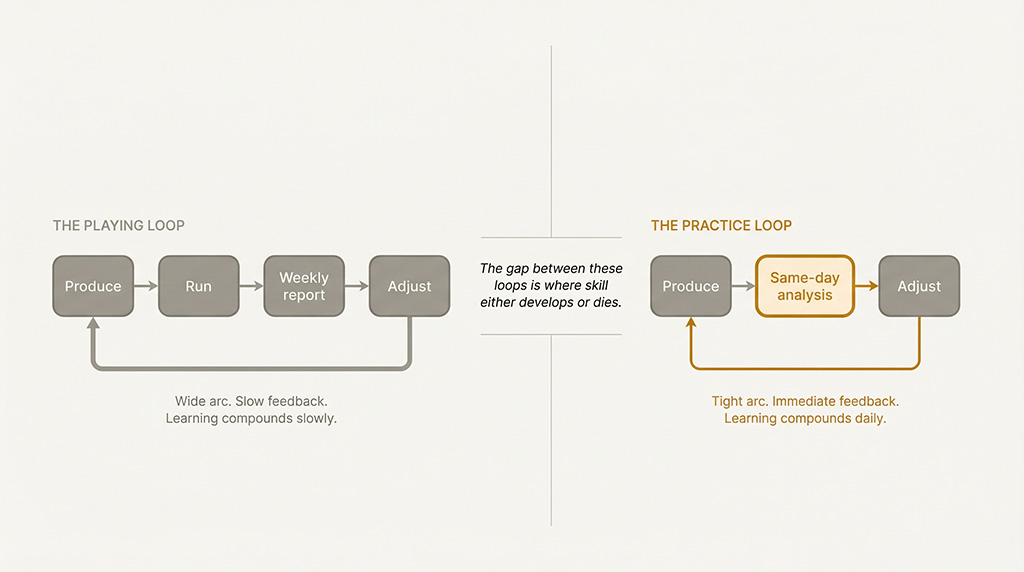
You’re probably thinking: I do analyse. I run tests. I check performance. I have reports.
Those things matter. This isn’t an argument against them.
But consider what Tice’s practice actually looked like. He didn’t run a phrase once a week and assess which version felt better. He played it hundreds of times, adjusting in real time, stopping the instant something slipped. The feedback was immediate. The correction was immediate. The loop was tight enough that the learning could compound.
A weekly report is feedback with a seven-day lag. By the time you sit down to review performance, the creative has run its course, the audience has moved, and the specific moment where something worked or broke is buried under days of subsequent noise. You’re not learning from the experience. You’re doing archaeology.
The question isn’t whether you analyse. It’s how tight you can make the loop between production and understanding — because the tighter the loop, the faster the craft develops.
The tool only works if the habit exists
Tools like Claude Code can connect directly to your ad platforms, your CRM, your analytics, and your sales data. Not to generate reports you could get elsewhere — but to pull all of it into a single view and let you have a conversation about what it means.
Eight in the morning. Coffee still hot. One question: why did Thursday underperform? You’re not pulling five tabs and cross-referencing spreadsheets. You’re asking, and something that holds the full picture answers. What happened yesterday. Why click-through rate dropped on day three. Whether the leads from that campaign actually converted downstream. What to try next, and why.
A dashboard shows you data. Conversational analysis lets you argue with it.
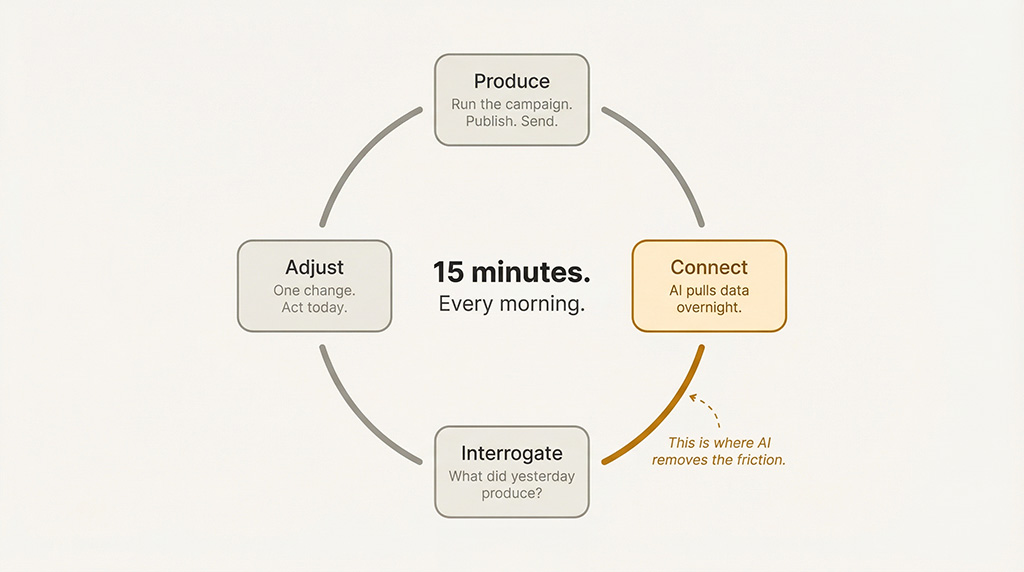
That last part matters more than people realise. The compression — from here’s what happened to here’s what it means and what to change — drops from hours to minutes. For a small business owner who is also the strategist, the copywriter, the analyst, and the account manager, that compression is the difference between the feedback loop closing and collapsing.
The friction was never really about willpower. It was about the sheer effort required to pull disparate data together, make sense of it, and act before the next fire arrived. Remove that friction, and the habit becomes possible. Leave it in place, and the habit dies every time.
But the tool only works if the habit exists.
Tice didn’t become a professional guitarist because he had a better guitar. He became one because he practiced every day, with the same intensity, always pushing just past comfortable. The Martin in that tiny room was a means. The daily discipline was the thing.
The specific form of the habit matters less than its consistency. What works: ten to fifteen minutes at the start of each working day. Not a full audit of everything — a single focused question. What did yesterday’s activity actually produce? Where in the funnel did things move or stall? What’s one thing worth adjusting today?
Done daily, this stops feeling like analysis. It starts feeling like tuning. The same way Tice backed up to the start of the phrase — not the start of the song.
The phrase isn't finished yet
Back to Jordan’s room. Twin bed. Borrowed chair. That beat-up Martin.
When Newport asked him how long it would take to master the technique he was working on, Tice thought for a moment.
“Probably like a month,” he guessed.
Then he played through the phrase one more time.
He wasn’t frustrated. He wasn’t tracking hours. He didn’t have a dashboard of weekly improvement metrics. He had a phrase that wasn’t right yet, and he had today, and he had the discipline to stop the instant he hit a wrong note.
Most of us have a version of that phrase — a campaign that isn’t converting, a message that isn’t landing, an audience we haven’t cracked. We just rarely stop mid-phrase to fix it. We finish the song. We file the report. We move to the next project.
Jordan would call that playing.
Find out whether your marketing is telling the story that sets you apart — or just filling space
Most audits we run surface the same problem: businesses doing solid work, with a genuine story inside them, but advertising that could belong to any competitor on the street. The Schlitz rooms are already there. Nobody’s walked through them yet.
Takes 30 minutes.