
The soundman had tears in his eyes. “Nice thing you did for Sam,” he said.
Billy Crystal had no idea what he was talking about. He’d barely met Sammy Davis Jr. before this gig—a month-long residency at Harrah’s in Lake Tahoe, Crystal opening, Sammy headlining, twenty-eight shows. But every night, Sammy walked onstage after Crystal’s set and told the audience a completely fabricated story about their deep friendship. A different story each time. How Crystal had visited him in the hospital and nursed him back to health. How they’d shared some unforgettable night together. How Billy was one of the great ones.
None of it happened.
Crystal thanked the soundman, then quietly asked him to start taping Sammy’s introductions. By the end of the run, he’d collected twenty-five stories. Twenty-five elaborate, affectionate, totally invented tales—each one building Crystal’s credibility with a new audience, night after night, compounding like interest.
Here’s the part that matters: Crystal’s NBC variety show had just been canceled. After two episodes. He was walking into restaurants imagining the whispers—he’s finished. The industry had written him off. And every night in Lake Tahoe, Sammy Davis Jr. was rewriting that story for two thousand strangers who had no idea who Billy Crystal was.
This wasn’t a favor. To Sammy, it was just show business. “That’s it, and that’s all,” Crystal wrote in his memoir Still Foolin’ ‘Em.
But what Sammy did—instinctively, without being asked—is the single most powerful mechanism in marketing. And most people get it completely wrong.
The principle Carlton nailed (and most people fumble)
Copywriting legend John Carlton calls it the Third-Party Endorsement. The concept is deceptively simple: before your prospect reads your pitch, someone they already trust tells them you’re worth listening to.
Carlton’s framing is precise. A cold prospect doesn’t know you. They’re suspicious. You’re the stranger who showed up uninvited. But when a trusted figure introduces you—writes a cover letter, lends their name, vouches for your credibility—everything changes. You stop being the anonymous outsider. You become, in Carlton’s words, “an invited guest, the friend of a friend.”
This is the most reliable trust-transfer mechanism that exists. Not testimonials buried on page four of your website. Not “as featured in” logos. An actual human being with authority telling the audience, before you open your mouth, that you belong here.
You’ve felt this work on you. Think about the last time a friend said “you have to meet this person” before a dinner party. You showed up already warm. Already curious. Already disposed to like them. Now think about the last time someone cold-pitched you on LinkedIn. The difference isn’t the message. It’s the frame.
Sammy understood this at a molecular level. He didn’t just endorse Crystal. He narrated Crystal into a story the audience already wanted to believe—that their hero had a protégé worth knowing. Each fabricated tale was a new chapter in that story. By the time Crystal took the stage, he wasn’t an unknown opener. He was Sammy’s guy.
What Sammy did that most endorsement strategies miss
Carlton’s framework is correct. But the Crystal-Davis story reveals three dimensions that most people never consider when they’re chasing endorsements, testimonials, and introductions.
The endorser chose Crystal. Crystal didn’t ask.
This is the part nobody talks about. Crystal didn’t pitch Sammy on a “cross-promotion opportunity.” He didn’t draft talking points. He didn’t send a briefing document.
He showed up to the dressing room two hours early every night—not to network, but because he genuinely wanted to hang out with a man he idolized. He studied Sammy’s cadence. Listened to his stories. Watched his show every single night from the wings.
Sammy’s endorsement was a byproduct of proximity, respect, and genuine interest. Not a transaction.
The second dimension: Sammy didn’t describe Crystal’s skills. He told stories about Crystal’s character.
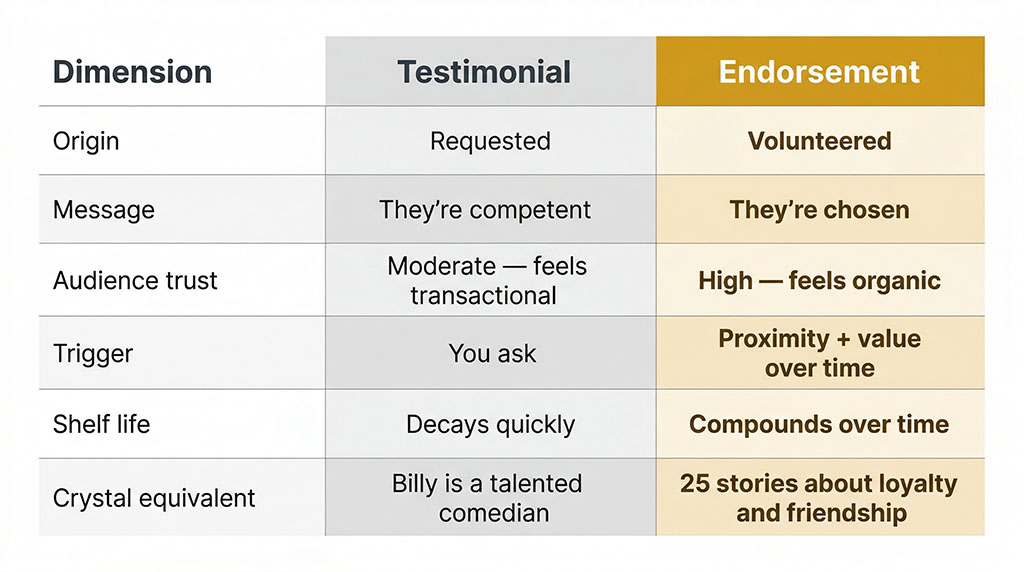
Not once did Sammy walk out and say, “Billy Crystal is a talented comedian. He does excellent impressions. You should pay attention.” That’s a testimonial. That’s what most companies put on their landing pages—functional descriptions of competence.
Instead, Sammy told stories about loyalty. About friendship. About shared experience. He made Crystal a person the audience felt they already knew. By the time Crystal walked out, the crowd wasn’t evaluating his jokes. They were welcoming someone they’d been primed to like.
The third dimension is the one that changes everything: the endorsement landed hardest because Crystal was at his lowest point.
His show had been canceled. Two episodes. The industry consensus was that he was done. In that context, Sammy’s nightly stories didn’t just warm up a crowd. They performed a resurrection. They replaced the existing narrative—”canceled, finished”—with a new one—”beloved by Sammy Davis Jr.”
Most people pursue endorsements when they’re already winning. They collect testimonials after the success. But the physics of third-party endorsement actually work in reverse. The wider the gap between where you are and where the endorser places you, the more dramatic the trust transfer.
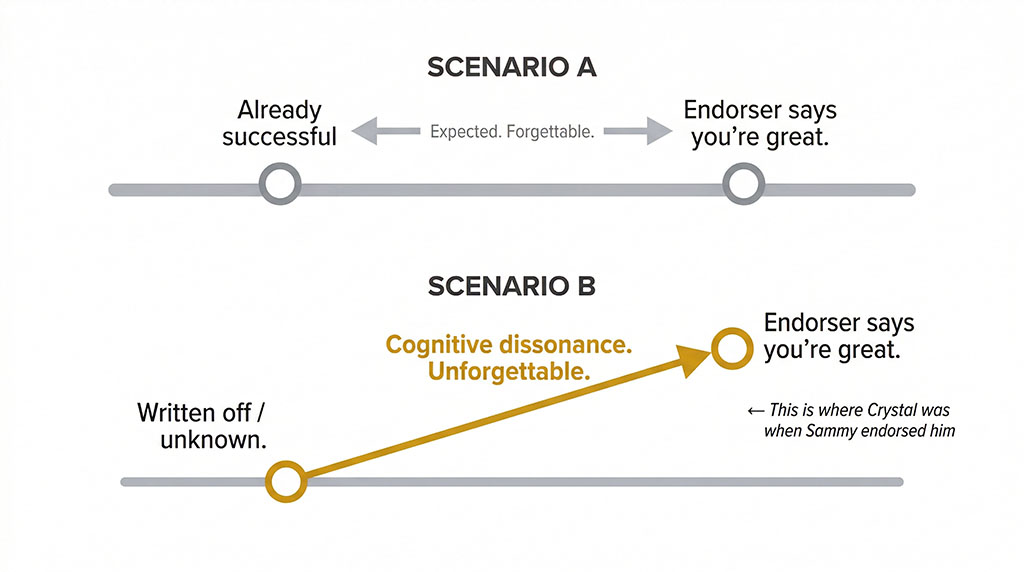
A glowing recommendation for someone who’s already famous? Nice. Expected. Forgettable.
A glowing recommendation for someone the world has written off? That stops people cold. It creates cognitive dissonance—wait, what does this person know that I don’t?—and that dissonance is the engine of attention.
"But I don't have a Sammy Davis Jr."
Fair. Most of us don’t have a living legend willing to fabricate stories about our friendship every night for a month.
But that objection misunderstands what actually happened.
Sammy didn’t endorse Crystal because Crystal was special. Crystal was an unknown opener on a bad run. Sammy endorsed him because Crystal did something specific: he showed up early, consistently, with genuine curiosity and zero agenda. He made himself present in Sammy’s world without asking for anything.
That’s not a celebrity dynamic. That’s a human one. And it’s replicable.
The mechanism breaks down into three things you can actually do, starting this week:
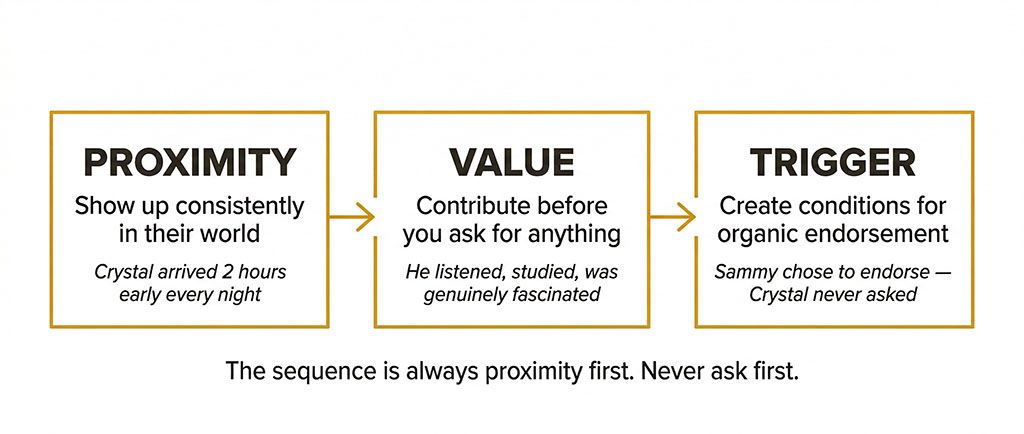
Put yourself in proximity to the people whose audiences you want to reach—and bring value before you ask for anything.
Crystal didn’t pitch. He listened. He showed up. He was genuinely fascinated by Sammy’s craft. That fascination was the value he brought. When you spend time in someone’s world—commenting thoughtfully on their work, showing up to their events, contributing to their projects—you become familiar. Familiar isn’t famous. But familiar is the prerequisite for endorsement.
Make yourself easy to endorse by being specific about what you do and who it helps.
Sammy could tell stories about Crystal because Crystal had a clear identity: young comedian, great impressionist, good guy. If Crystal had been a vague “creative professional” doing a little comedy, a little acting, a little writing, Sammy would have had nothing to narrate. The more specific your work, the easier it is for someone to tell your story to their audience.
Stop asking for testimonials. Start creating situations where endorsement happens naturally.
Crystal never asked Sammy to introduce him. He created the conditions—proximity, genuine interest, consistent presence—and the endorsement emerged. The best third-party endorsements aren’t solicited. They’re triggered.
The founder who builds in public and attracts investors who approach them. The consultant whose client casually mentions their name in a board meeting. The writer whose reader forwards their piece to a colleague with “you need to read this.”
These are all the same mechanism Sammy performed in Lake Tahoe. The endorser chose. The endorsed showed up and did the work.
The part Carlton's framework gets exactly right
Let’s be clear about something: none of this replaces the structural technique Carlton teaches. If you’re writing a sales page, a cold email, a pitch deck—the mechanics of third-party endorsement still apply. You still need someone credible to set the frame before your audience encounters your message.
A cover letter from a respected figure. A foreword from a known name. A warm introduction before the meeting. These are the tactical applications, and they work because they exploit the same trust-transfer that Sammy performed live.
But the Crystal story adds a layer Carlton’s framework implies without stating outright: the best endorsements come from people who endorse you because they want to, not because you asked them to. When the audience senses that an endorsement is transactional—a blurb swap, a paid testimonial, a quid pro quo—the trust transfer weakens. When the endorsement feels spontaneous, organic, almost compulsive on the part of the endorser, it’s nearly impossible to resist.
Sammy told those stories because it was show business to him. Because building up the opener was part of the craft. Because generosity was woven into how he performed. That’s what made it so powerful. The audience never once thought, “Is Sammy being paid to say this?” They thought, “Sammy loves this kid.”
That’s the difference between a testimonial and an endorsement. A testimonial says you’re competent. An endorsement says you’re chosen.
Twenty-five stories, none of them true, all of them real
Crystal kept those tapes. Twenty-five fabricated stories that became the most valuable marketing asset he never paid for—collected by a man who was supposed to be finished, performing in a casino in the mountains, opening for a legend who decided, without being asked, that this kid was worth talking about.
The soundman cried over a story that never happened.
And that tells you everything about how trust actually works. People don’t fact-check endorsements. They don’t verify the hospital visit or cross-reference the timeline. They feel the conviction of the person speaking—and they transfer that conviction to the person being spoken about.
You don’t build that with a testimonial request form. You don’t manufacture it with an influencer deal.
You build it the way Crystal did—showing up two hours early, watching from the wings, being so present in someone’s world that they can’t help but tell people about you. Even if they have to make up the details.
That soundman at Harrah’s cried over a hospital visit that never happened. And twenty-five fabricated stories later, a canceled comedian walked out of Lake Tahoe with the only marketing asset that actually matters: someone else’s conviction that he belonged.
See Who’s Setting Your Frame
Map how your audience actually encounters you — cold, warm, or introduced — and find out where trust is leaking before you ever get to make your case.
Most clients find they’re spending on ads and outbound when their highest-converting channel is a single person saying their name in the right room. Takes 30 minutes.
You don’t need a louder pitch. You need a Sammy.
The Sammy Davis Jr.–Billy Crystal story is drawn from Crystal’s 2013 memoir Still Foolin’ ‘Em. The Third-Party Endorsement framework is from John Carlton’s advertising curriculum via The Marketing Rebel.