
Claude Hopkins was standing inside the Schlitz brewery in 1906, trying to understand what he was selling.
He’d been brought in to rescue a struggling account. Schlitz was a solid beer — third in America, behind Anheuser-Busch and Pabst — but its advertising said almost nothing about why anyone should choose it. Generic quality claims. Copy that could have run for any beer, from any brewery, in any city.
So Hopkins went to Milwaukee. Toured the plant. Spent the next few hours increasingly confused.
The brewing rooms had plate-glass walls. The air was filtered before it touched the beer. Every bottle was steam-sterilised. The hops were sourced globally. Copper vats were washed twice daily. The beer sat aging for months before a single bottle was filled.
Hopkins turned to his guide. “Why isn’t any of this in your advertising?”
The answer came back without hesitation: “Because every brewery does the same thing.”
Hopkins paused. Then said something that changed the way advertising works.
“It doesn’t matter that everyone does it. You’re the first one to say it.”
The business that tells the story first owns the story
Schlitz ran a campaign built around their process. Plate-glass rooms. Steam-sterilised bottles. Filtered air. They didn’t claim to be the only brewery that operated this way. They just described it — plainly, specifically — to people who’d never thought about how beer was made.
Within months, Schlitz moved from third to first in America.
Not by changing the beer. Not by cutting prices. Not by building new facilities. By saying out loud what they’d always done in private.
This was 1906. The principle hasn’t moved an inch.
You're probably doing this right now
Think about the last time a client asked how you actually work.
Not what you do — how you do it. What happens after they call. What you check before you start. How you handle the thing that always goes wrong on a job like theirs.
Chances are, you gave them some version of the Schlitz answer: We just do it properly. Doesn’t everyone? And moved on, because that didn’t seem worth advertising.
But here’s what Hopkins understood: your customers can’t see inside the brewery. They don’t know what you check or how you work or what you quietly refuse to cut corners on. They’re making decisions based entirely on whatever information reaches them. If you haven’t described the plate-glass rooms, those rooms don’t exist — as far as they’re concerned.
What this looks like in practice
A painting contractor — eleven years in business, solid reputation — has one non-negotiable: they always prime. Proper surface preparation, three coats, every time. Even on jobs where they could get away with less. They’ve never once mentioned this in their marketing, because “that’s just how you’re supposed to paint.”
Their competitors quote cheaper. Some of them aren’t priming. The contractor doesn’t know this. They just quietly lose jobs on price.
The fix is almost embarrassingly simple. Describe the process. Explain what proper preparation actually does for how long the paint holds. You’re not attacking competitors. You’re just saying what you do — and letting the contrast do its own work.
The pattern repeats across professional services. An accountant sends every client a plain-English summary alongside each filing — not just the forms, an actual explanation of what was filed, why, and what to watch next quarter. Eight years. Every client, as standard. They’ve never mentioned it in their marketing, because in their own words: “Doesn’t everyone do this?”
They don’t. Most clients from other firms have never received one. But the accountant who leads with “you’ll understand every filing before we submit it, in plain English, every time” is immediately different from every practice on their street — most of whom say something vague about “proactive advice” and leave it there.
The Schlitz Gap
What you do vs. what your marketing says
| What you do (privately) | What your marketing says |
|---|---|
| Always prime, three coats, full surface prep | Quality painting services, competitive rates |
| Plain-English summary with every filing, every time | Proactive advice for your business |
| Full dealership ecosystem — off-market access, buying advice, inspections, sourcing | Car finance. Competitive rates. Apply today. |
| The right column is what most small businesses advertise. The left column is what wins customers — once someone says it first. | |
Here's where most business owners push back
“But I genuinely don’t do anything different. My process is the same as everyone else’s. No plate-glass rooms. No special system. I just do the work.”
This is the hardest version of the problem, and it deserves a straight answer.
You’re almost certainly wrong about the process. Most business owners have been inside their own operation so long that the things that make them careful, methodical, or genuinely good at what they do have become invisible. You need someone to walk through it with you the way Hopkins walked through that brewery — without knowing what’s normal, noticing everything.
But even if you’re right — even if every step of your process genuinely matches your competitors’ — there’s still the question of how you describe the experience of working with you. The moment of certainty a client feels before they commit. How you handle the complication that always shows up. What you do at the end of a job that most people in your industry never think to do.
That’s the story nobody’s telling. And it’s yours to tell first.
The Sunday Finance example
When we reviewed Sunday Finance’s advertising strategy this year, we found the Schlitz problem operating at scale.
Sunday Finance is the finance arm of Sunday Drive, an Auckland specialist dealership. It does what every broker does: car loans, competitive rates, application support. And that was almost exactly what their advertising said. They looked and sounded like every bank, credit union, and finance broker in the NZ market — which, to be blunt, is what they’d been positioning themselves as.
Here’s what the advertising wasn’t saying.
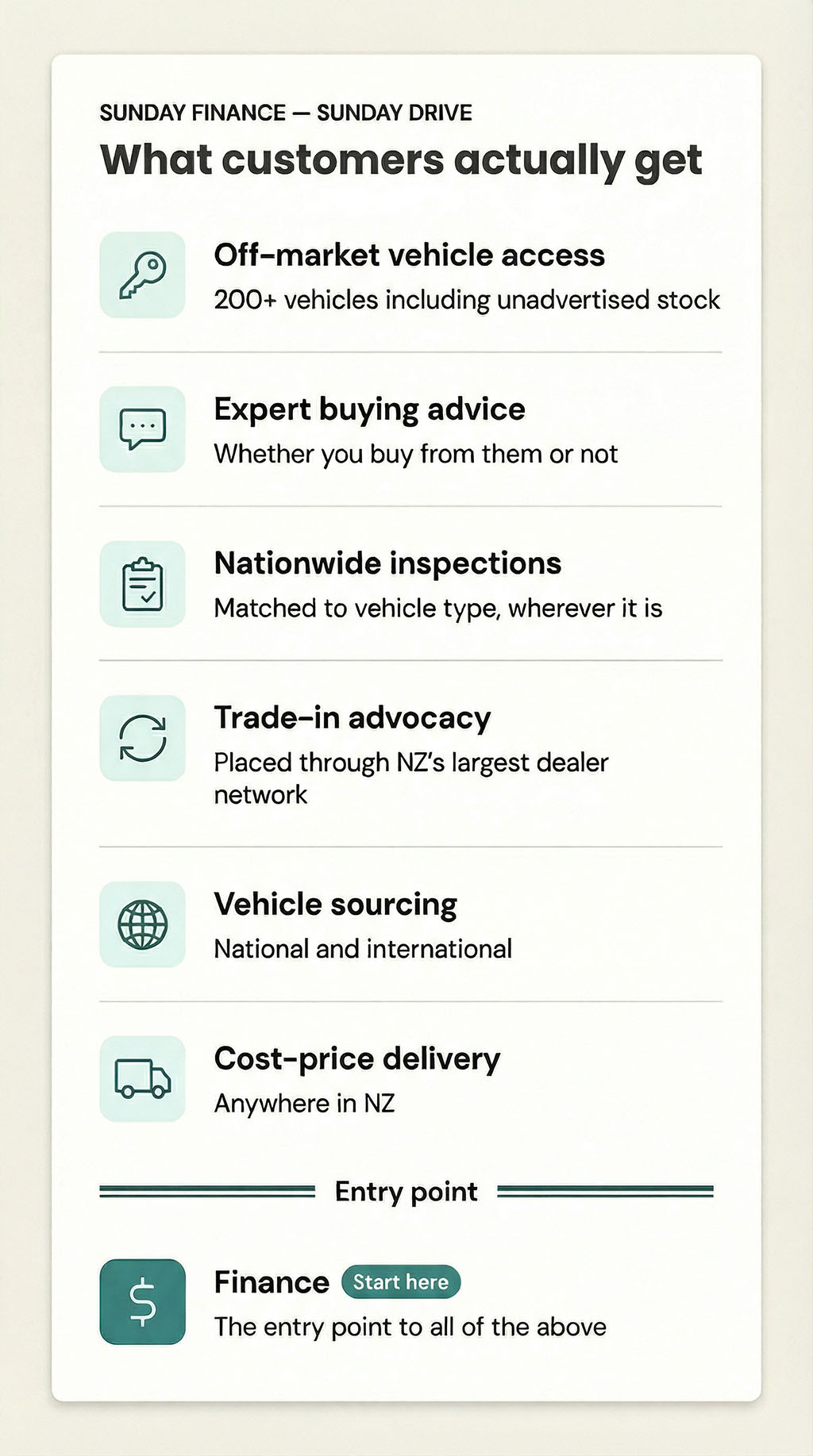
Because Sunday Finance sits inside a specialist dealership, every finance customer gets access to something no bank or broker can offer: the dealership itself. Off-market vehicle access — 200+ vehicles, plus an unadvertised database of stock that never touches Trade Me. One-on-one buying advice from a team that has bought and sold hundreds of cars a year, whether or not you’re buying from them. Nationwide inspections matched to vehicle type — European specialists for European cars. Trade-in advocacy through one of NZ’s largest dealer networks, placing your car with the best buyer rather than the nearest one. Vehicle sourcing, nationally and internationally. Cost-price delivery anywhere in NZ.
None of this was in the advertising.
Not because it didn’t matter — it’s extraordinary, particularly in a market where most people buying a car have no expert in their corner at any point in the process. It wasn’t there because the Sunday Finance team had been doing it for so long that it had become invisible to them. The word “finance” was the brewery wall. Everything behind it was the plate-glass rooms.
The strategic shift was simple in principle and significant in practice: stop advertising like a broker. Start advertising the ecosystem. The finance is the entry point. The dealership access is the reason to choose it over every alternative in the market.
We’re in the early stages of rolling this out — the lead data will tell the real story over time. But the opportunity was clear the moment we looked at it the way Hopkins looked at Milwaukee: the differentiator had been there all along. It just hadn’t been said. sundayfinance.co.nz
Walk through your own brewery
Hopkins left Milwaukee with a campaign. He didn’t invent a single thing about how Schlitz made beer. He walked through the plant, asked obvious questions, and wrote down what he saw in language that customers could understand.
That’s the exercise.
Walk through your own business this week like you’ve never seen it before. Notice what you check that clients don’t know you check. Notice what you do as standard that others skip. Notice the thing you’d be embarrassed not to do — because that’s almost always the thing worth advertising.
The story isn’t hiding. It’s been inside the brewery the whole time.
Find out whether your marketing is telling the story that sets you apart — or just filling space
Most audits we run surface the same problem: businesses doing solid work, with a genuine story inside them, but advertising that could belong to any competitor on the street. The Schlitz rooms are already there. Nobody’s walked through them yet.
Takes 30 minutes.