
A man walks onto a building site with a hammer in one hand and a saw in the other. He looks at the pile of timber. He looks at the blueprint for a three-bedroom house. He starts swinging.
Two weeks later, he’s standing in front of something that vaguely resembles a wall. No plumbing. No wiring. No foundation. Just timber nailed together with enthusiasm and hope.
You’d call that man delusional. You’d be right.
Now explain to me how learning Facebook Ads and a funnel builder is any different.
The "I know funnels" problem
Somewhere in the last decade, the marketing education industry pulled off one of its greatest tricks: convincing business owners that learning one or two tactics equals knowing how to market.
Buy this course on Google Ads. Master this email sequence. Build this funnel template. Plug in, switch on, count your money.
You’ve seen the promises. Maybe you’ve bought them.
Here’s what those courses don’t mention — a marketing funnel isn’t a tactic. It’s an ecosystem. And ecosystems don’t care how good you are at one thing. They care whether everything connects.
Think about your car for a second. A Ferrari engine is useless without a transmission. A perfect transmission is useless without wheels. Wheels are useless without brakes. You wouldn’t buy a Ferrari engine, bolt it to a shopping trolley, and wonder why you’re not winning races. But that’s what most businesses are doing with their marketing.
One brilliant skill. No system around it.
The 22 pieces nobody lines up for you
I’m going to list every element that has to work together for a funnel to actually produce money. Not theoretically — operationally. This is what separates the businesses pulling $30K months from the ones burning through ad spend wondering what went wrong.
The front-end mechanics: Front-end marketing. Lead generation. Media buying creative. Audience targeting. Scaling traffic. Effective pattern interrupts.
The conversion layer: Copywriting. Buyer psychology. Big Marketing Idea generation. Dimensionalised benefits. Unique Mechanism engineering. Offer creation. Prospect problem identification.
The back-end engine: Back-end marketing. Customer onboarding. Unconverted lead follow-up. Offer sequencing. Campaign stacking. AOV boosting.
The measurement system: Marketing metrics. Performance tracking. Assessing Acquisition Aggression.
That’s 22 distinct skills. Not 22 variations of the same thing — 22 different disciplines that each affect the others.
Miss one and the whole thing leaks. Miss three and you’re pouring water into a colander wondering why the bucket never fills.
![[VISUAL BRIEF: Ecosystem Diagram — Circular diagram showing all 22 skills as interconnected nodes, grouped into four clusters (Front-End, Conversion, Back-End, Measurement). Lines connecting them show dependencies. Three nodes highlighted in red showing "typical gaps" — Purpose: Show that these aren't a checklist but an interconnected system where gaps create cascading failures]](https://www.untappedprofits.co/wp-content/uploads/2026/02/22-skills.jpg)
How the gaps actually kill you
Here’s what makes this dangerous: the failures aren’t obvious. They’re silent.
A business owner runs Facebook Ads. The ads are good — solid creative, decent targeting, reasonable cost per click. Traffic hits the landing page. Some people opt in. A few buy.
The numbers look… fine. Not great. “Fine.”
So they tinker with the ads. Change the headline. Adjust the audience. Test new images. Spend another month. Numbers stay “fine.”
The ads were never the problem.
The problem was that nobody engineered a Unique Mechanism into the offer — so the landing page sounded like every competitor. The problem was that unconverted leads disappeared into a void because there was no follow-up sequence. The problem was that first-time buyers never got a back-end offer, so customer value stayed flat while acquisition costs climbed.
Three invisible gaps. All downstream from the one skill the business owner didn’t know they needed.
You’ve felt this. You’ve had that nagging sense that something isn’t clicking — that the numbers should be better given how much effort you’re putting in. That nagging feeling is the sound of gaps you can’t see because nobody told you to look for them.
The swimlanes illusion
And if you’ve tried to solve this by hiring specialists — an ads person here, a copywriter there, an email agency over there — you’ve likely created a different problem entirely.
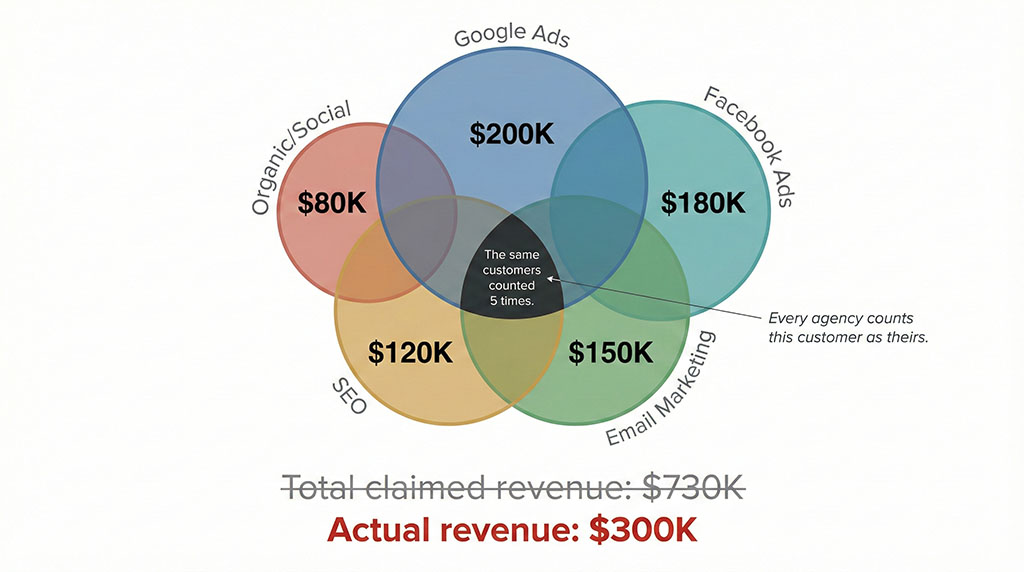
I call it the swimlanes illusion. Five agencies, each in their own lane, each reporting their own metrics, each claiming wins. The Google Ads agency says they drove $200K in revenue. The Facebook agency claims $180K. The email team reports $150K. The SEO consultant takes credit for $120K.
Add it up: $650K in reported revenue.
Actual revenue? $300K.
The numbers weren’t wrong exactly — they were overlapping. Every agency counted the same customer through their own lens. Nobody was looking at the full picture because nobody could. Each specialist sees their channel. Nobody sees the system.
It’s the marketing equivalent of five blind men describing an elephant. Each one is accurate about their part. None of them are right about the animal.
"But one person can't master 22 skills"
I can hear the objection from here.
This is unrealistic, Bruce. You’re saying I need to be an expert copywriter AND a media buyer AND an analytics wizard AND an offer architect? Nobody has time for that. This is exactly why people hire specialists.
And you’re half right. Nobody is going to master all 22 at an elite level. That’s not the point.
Think about a film director. Martin Scorsese doesn’t operate the camera, mix the sound, build the sets, compose the score, and act in every scene. But he understands what each of those disciplines needs to deliver. He knows when the lighting is wrong. He knows when the edit is too slow. He knows when the score is overpowering the dialogue.
He doesn’t do every job. He understands every job well enough to make them work together.
That’s the difference between a marketer and someone who knows a marketing tactic. A marketer understands how offer creation affects ad performance. How audience targeting shapes the copy. How onboarding sequences influence lifetime value. How back-end offers subsidise front-end acquisition costs.
You don’t need to be the world’s best copywriter. You need to know when the copy isn’t doing its job — and what job it was supposed to do in the context of the full system.
The conductor doesn’t play every instrument. But they know instantly when the oboe is out of tune.
The rarest person in the room
Here’s what makes this problem so stubborn: the person who can see all 22 pieces at once barely exists.
Specialists are everywhere. You can find a brilliant media buyer in 20 minutes on LinkedIn. A sharp copywriter by lunch. An email strategist by end of day. The market is flooded with people who are excellent at one thing.
The person who understands how offer architecture affects ad performance? How onboarding sequences change lifetime value, which changes how much you can afford to spend on acquisition, which changes your entire media buying strategy? That person took 20 years to develop — because you can’t learn systems thinking from a course. You learn it from running campaigns, watching what breaks, tracing failures back three or four steps to the actual cause, and doing that hundreds of times.
I proved this to myself when I trained a marketer named David. He was green — close to zero experience. Over 15 weeks I walked him through every nuance, every hidden mechanic, every connection between the 22 skills. He went on to generate roughly $300K in months.
But here’s the part people miss when they hear that story. David didn’t design the system. I did. He executed a framework that took two decades of failure, testing, and pattern recognition to build. The 15 weeks gave him the playbook. The playbook took 20 years to write.
That’s the real bottleneck. Not the tactics — those are available to anyone with a credit card and a Udemy account. The bottleneck is the person who knows which tactics matter for your specific situation, in what order, and what’s quietly failing in the background while you focus on the obvious stuff.
That person is rare. And hiring five specialists doesn’t replace them — it just gives you five people who can’t see each other’s work.
What this means for your business
You have two paths.
Path one: Audit your own system. Go through the 22 skills listed above. For each one, ask yourself honestly: “Do I understand this well enough to know when it’s broken?” Not “can I execute it perfectly” — just “can I tell when it’s off?” Mark the gaps. Those gaps are where your money is disappearing.
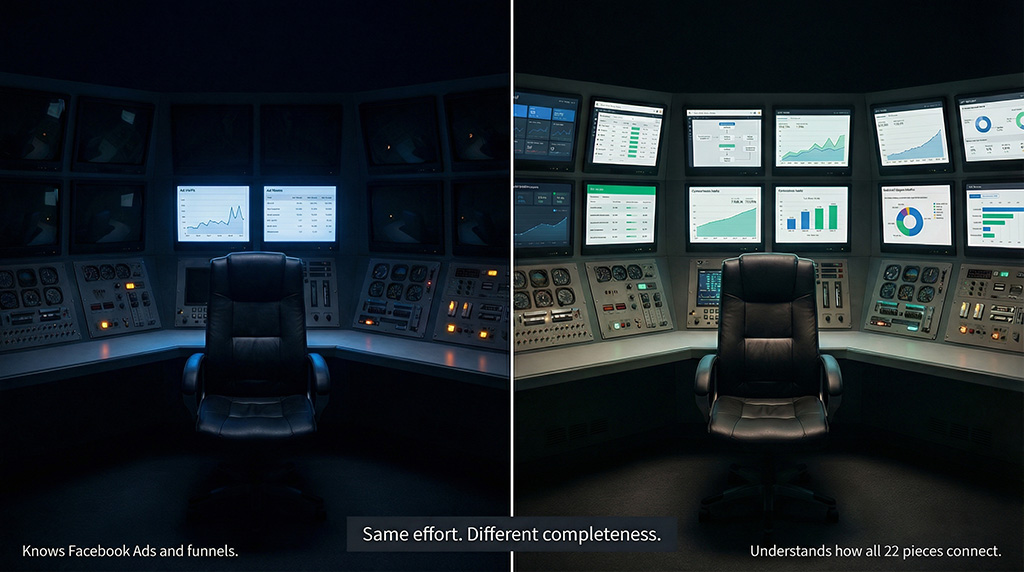
Path two: Get someone who sees the full picture to look at your system and tell you where the leaks are. Not an agency that only sees their channel. Not a freelancer who’s brilliant at one thing. Someone who understands how all 22 pieces are supposed to fit together — and can spot which ones are missing or misfiring.
Either path works. What doesn’t work is standing on the building site with a hammer and saw, convinced that effort alone will turn timber into a house.
Because effort without completeness is just expensive frustration. And that house you’re trying to build? It needs a plumber, an electrician, a foundation, a roof — and someone who knows how they all connect.
The hammer and saw were never the problem.
The blueprint was.
Find your missing pieces in 30 minutes
Most business owners have three to five of the 22 skills running well — and no idea which of the remaining ones are silently draining their results. Our Agency Waste Audit maps your full system and pinpoints exactly where the gaps are costing you money.
One conversation. A complete picture. No more guessing which piece is broken.