
Two business owners walk into a marketing meeting. Both run similar-sized service businesses. Both spend $5,000 a month on ads. Both have agencies running “A/B tests” every month.
Twelve months later, one of them has cut their cost per lead in half. The other is still getting the same results they got on day one — and their agency keeps telling them “we’re optimising.”
What’s the difference?
It’s not budget. It’s not the platform. It’s not even the agency’s talent. It’s what they’re actually testing.
The Expensive Illusion of A/B Testing
Here’s what most agencies won’t tell you: the vast majority of ad “tests” aren’t tests at all.
Nielsen’s landmark study of nearly 500 advertising campaigns found that creative accounts for 47% of a brand’s sales impact — more than targeting, reach, and every other factor combined. When the creative is strong, it becomes the overwhelming driver of results: up to 89% of sales lift for digital campaigns.
That means your creative is the single biggest lever you have. And most agencies are wasting it.
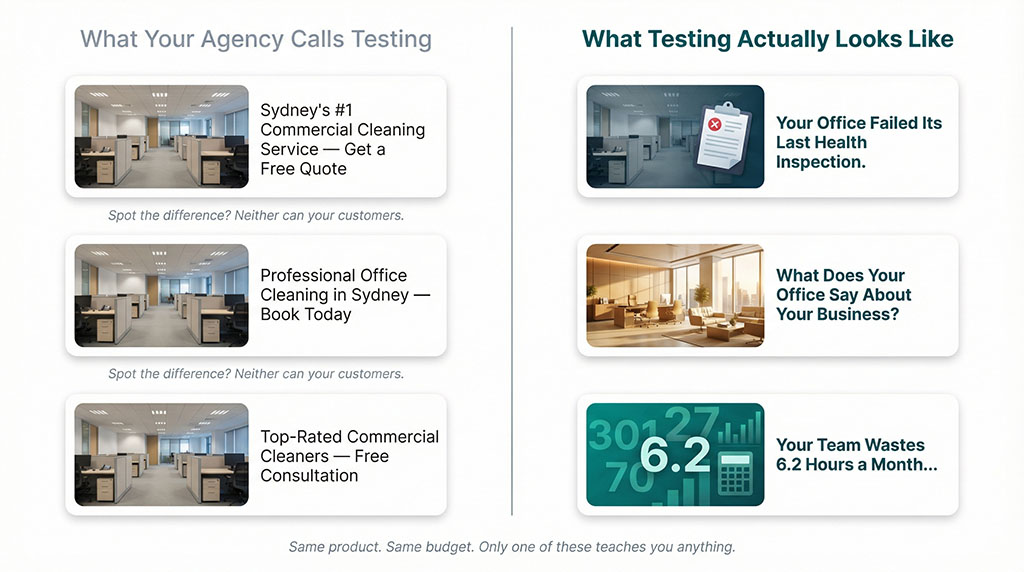
They’re running what we call A/A tests — changing “Best Plumber in Sydney” to “Top-Rated Sydney Plumber” and calling it a split test. Different words, same message, same result. It’s like taste-testing the same soup from two different bowls.
Your agency sends you a report showing Ad B beat Ad A by 0.3%. Everyone nods. Nothing meaningful changes.
Meanwhile, the real question — what actually makes your customers pick up the phone? — never gets asked.
A Tale of Two Business Owners
Let’s make this concrete. Meet Sarah and Mark. Both own commercial cleaning companies in Sydney. Both spend $5K/month on Google and Meta ads. Both hired agencies promising “data-driven results.”
Mark’s agency runs tests like this every month:
- Ad 1: “Sydney’s #1 Commercial Cleaning Service — Get a Free Quote”
- Ad 2: “Professional Office Cleaning in Sydney — Book Today”
- Ad 3: “Top-Rated Commercial Cleaners — Free Consultation”
They swap synonyms. They shuffle the call-to-action. They test “Book Today” against “Get Started.” Every month, Mark gets a report full of graphs showing tiny percentage differences between ads that are, fundamentally, identical.
After 12 months, Mark has tested 36 ad variations. He’s learned that “Free Quote” slightly outperforms “Free Consultation.” That’s it. His cost per lead is roughly where it started. His agency calls this “optimisation.”
Sarah’s agency does something different. They test genuinely different motivations:
- Ad 1 (Fear): “Your Office Failed Its Last Health Inspection. It Won’t Fail the Next One.”
- Ad 2 (Status): “What Does Your Office Say About Your Business? Walk a Client Through It Tomorrow With Confidence.”
- Ad 3 (Financial): “Your Team Wastes 6.2 Hours a Month Cleaning Up After Your Current Cleaners. Here’s What That Actually Costs You.”
These aren’t three ways of saying “we clean offices.” Each ad targets a completely different reason someone might hire a commercial cleaner: fear of compliance failure, desire to impress clients, frustration with wasted money.
Month 1: Sarah discovers the fear-based compliance angle gets 3x the click-through rate of the others. That’s a genuine insight — her market is more motivated by avoiding a problem than by status or savings.
Month 3: She tests three variations within the fear angle — different compliance fears, different urgency triggers. Her cost per lead drops 22%.
Month 6: She’s now explored two more motivation categories. She’s found that financial waste messaging works brilliantly for larger offices (10+ employees), while compliance fear dominates for medical and food-service businesses. Her campaigns are now segmented by motivation, not just demographics.
Month 12: Sarah’s cost per lead is 51% lower than where she started. More importantly, she understands her market. She knows exactly which emotional triggers move which segments. Every new campaign builds on real insight, not guesswork.
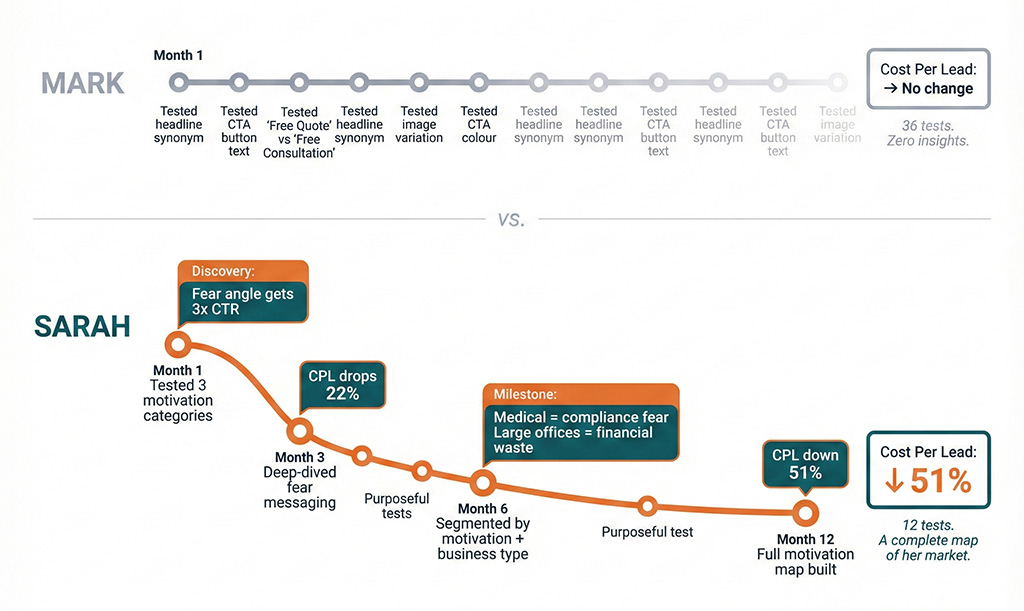
Mark? He knows that “Free Quote” beats “Free Consultation.” His cost per lead hasn’t moved.
Same budget. Same platforms. Same twelve months. Completely different outcomes — because one of them was actually testing, and the other was just rearranging words.
The 360° Vision Method
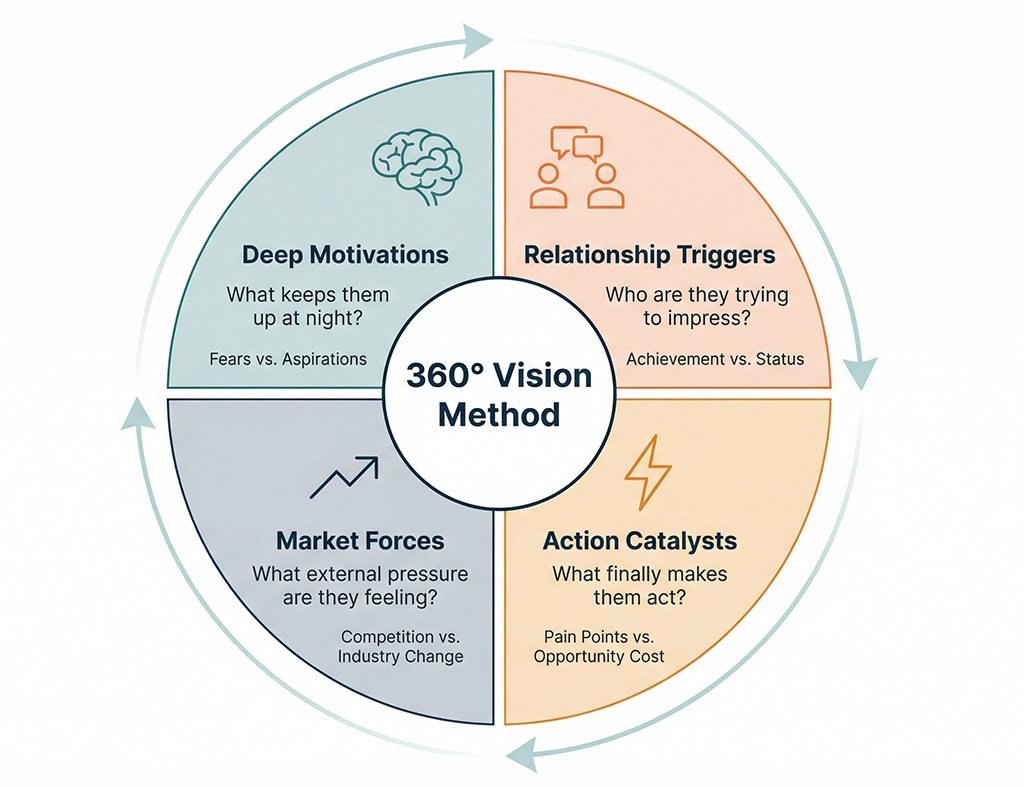
The gap between Sarah and Mark isn’t luck. It’s a framework. We call it the 360° Vision Method — a systematic way to uncover the genuinely different angles hiding in your market, so every test teaches you something real.
Instead of testing word variations, you test across four distinct motivation categories:
1. Deep Motivations
What keeps your customer awake at 3 AM? This is usually the most revealing place to start because it directly taps into what your customers are worrying about right now.
Test ads that target their fears against ads that target their aspirations. Compare urgent problem-solving messages against future benefit messages. These often perform wildly differently — and the winner tells you whether your market is running from something or running toward something.
2. Relationship Triggers
Who is your customer trying to impress — or trying not to disappoint?
Test ads about personal achievement against ads about social status. Compare messages about standing out versus fitting in. For B2B, this often reveals whether your buyer is trying to look good to their boss, their clients, or their peers — and each of those requires a completely different message.
3. Market Forces
What external pressures are shaping their decisions right now?
Test ads about beating competitors against ads about staying ahead of industry changes. Compare immediate threat messages against future opportunity messages. This category often produces winners during periods of regulatory change, economic shifts, or industry disruption.
4. Action Catalysts
What finally tips someone from “thinking about it” to “doing it”?
Test ads focused on what they’re losing right now against ads focused on what they’ll miss out on. Compare deadline-driven urgency against loss-aversion messages. This category helps you understand not just why they want to buy, but what finally makes them act — which is a different question entirely.
How This Works in Practice
Pick one category to start with. “Deep Motivations” is often the best first move.
Create three ads, each targeting a completely different motivation within that category. Using the productivity software example:
Angle 1 — Fear of Falling Behind: “While You’re Buried in Spreadsheets, Your Competitors Are Already Done”
This targets anxiety about becoming obsolete. It focuses on the growing gap between your prospect and their successful competitors. It emphasises time being wasted right now.
Angle 2 — Personal Achievement: “Be the Person Who Goes Home at 5 While Everyone Else Works Late”
This targets desire for work-life mastery. It focuses on personal identity and status — not what the software does, but who they become when they use it.
Angle 3 — Financial Impact: “Your Business is Leaking $4,000/Month in Manual Tasks”
This targets concrete financial waste. It focuses on measurable business impact with a specific, tangible number that makes the problem feel real and immediate.
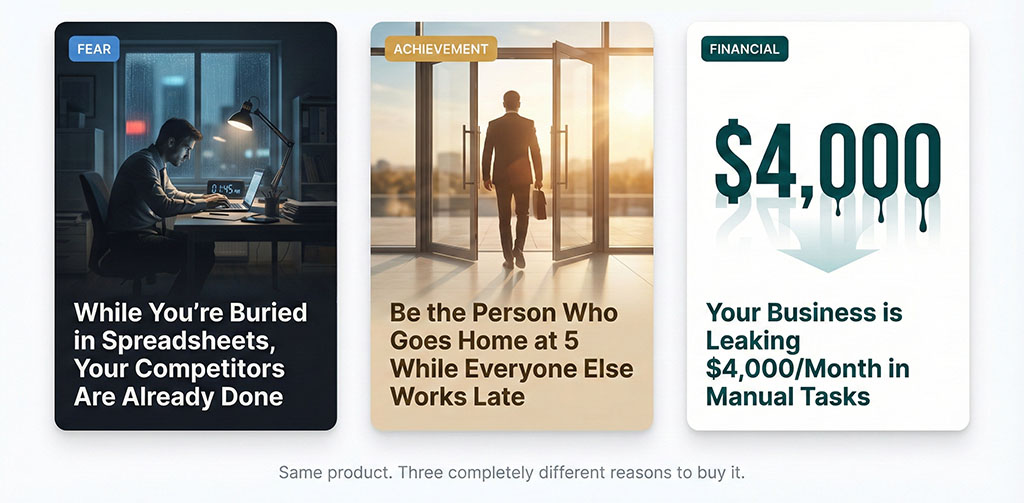
Notice what’s happening. Each angle triggers a different emotional response. Each speaks to a distinct motivation. Each could appeal to entirely different segments of your market. And critically, the winner tells you something meaningful about your customers — not just which synonym they prefer.
That’s the difference between testing and pretending to test.
The Compounding Effect
Here’s why this matters so much over time.
Every month that Mark’s agency runs synonym tests, they learn nothing new. Month 12 looks like Month 1 with slightly different fonts on the report.
Every month that Sarah’s agency tests a different motivation category, the insights compound. By month 6, she doesn’t just have better ads — she has a map of her market’s psychology. She knows which triggers work for which segments, which fears are stronger than which desires, and which action catalysts actually move people.
That map makes everything better. Not just ads — landing pages, email sequences, sales conversations, even service packaging. When you understand why people buy, you stop guessing everywhere.
This is why genuine testing pulls ahead over time. It’s not a one-off improvement. It’s a compounding advantage that grows with every real test you run.
What to Watch Out For
When businesses try to implement this alone, the same mistakes tend to come up.
Testing too many angles at once. You don’t need to test all four categories simultaneously. Start with one. Get a clear winner. Then test variations within that winning category before moving to the next. Depth beats breadth.
Not letting tests run long enough. A genuine motivation test needs enough data to be meaningful. Pulling the plug after three days because one ad “looks like it’s winning” defeats the purpose. Let each variation gather enough conversions to trust the result.
Losing the thread between ad and landing page. If your ad targets fear of compliance failure but your landing page talks about how affordable you are, you’ve broken the chain. The motivation that got the click needs to be the motivation that gets the conversion.
Falling back into synonym testing. It’s comfortable. It’s easy. It feels like progress. Resist it. If your three ad variations don’t make you feel slightly uncomfortable about how different they are from each other, they’re probably not different enough.
The Real Question to Ask Your Agency
Next time your agency presents their monthly “testing results,” ask them one question:
“What did we learn about our customers this month that we didn’t know last month?”
If the answer is “Ad B’s headline got 0.2% more clicks than Ad A’s” — that’s not learning. That’s rearranging deck chairs.
If the answer is “We discovered that your market responds 3x more strongly to fear of falling behind than to financial savings messaging, and we’re now building our Q2 campaigns around that insight” — that’s the 360° Vision Method at work.
Your ads should be getting smarter every month. Not just slightly cheaper — fundamentally smarter. Each test should teach you something new about the people you’re trying to reach.
If that’s not happening, your testing isn’t testing. And every month it continues, Sarah is pulling further ahead.
Your marketing, looked at properly
Thirty minutes on your current setup — what’s working, what’s quietly leaking budget, and what I’d fix first. You’ll leave with a clearer picture whether we work together or not.
Got something specific bugging you? Flag it when you book and I’ll have it looked at before we talk.

AboutBruce Marjoribanks
Bruce Marjoribanks has spent 27 years in marketing, including building, running and selling his own agency before going independent. He now runs every channel - paid, organic, social, email, creative and automation - as one integrated system, with AI ehancing production and the judgment staying human.