
At some point the numbers stopped making sense.
The campaigns were running. CPA was where it needed to be. The system that had worked for two years was still running exactly the same way — and producing less. Not dramatically less. Just enough less that you kept assuming it was seasonal, or a platform change, or creative fatigue, or something fixable. So you fixed it. Tweaked the audiences. Refreshed the creative. Adjusted the bids. The CPA crept back toward acceptable. Then crept up again.
This is the ceiling most performance-focused businesses hit, and almost none of them diagnose it correctly. They treat it as a performance problem — something wrong with the execution — when it’s actually something wrong with the question they’ve been asking from the start.
The question was: how do I generate leads at an acceptable cost?
The question they never asked: why does it cost more to acquire the same customer than it did eighteen months ago?
The Logic That Traps You
The small business owner’s approach to marketing has an internal logic that is completely reasonable and almost always wrong.
Phase one: get leads. Performance marketing — paid search, paid social, whatever channel reaches buyers at the moment of intent. Measure CPA. Optimise. Scale what works.
Phase two: once performance is dialled in and cash flow is stable, think about brand. Awareness. Positioning. The longer-term stuff.
The problem is that phase two never arrives. Not because the business fails, but because phase one never fully stabilises. CPA fluctuates. Platforms change. Competition increases. There’s always a reason to keep optimising before you shift attention to something harder to measure.
So the business stays in phase one indefinitely. And the ceiling gets lower every year.
What's Actually Happening at the Ceiling
In 1977, a philosopher named E.F. Schumacher drew a distinction that explains this pattern precisely.
He called them convergent and divergent problems. Convergent problems have correct answers — the more you study them, the more solutions agree. Divergent problems are different: the more logically rigorous your position, the more the answers pull apart.
His example was education. Push the argument for discipline and authority to its logical extreme and you get a prison. Push the argument for freedom and self-expression to its extreme and you get a jungle. Both positions are right. Both, taken alone, are catastrophic. The tension between them isn’t a problem to solve. It’s the condition that education has to operate inside.
Brand versus performance is the same structure.
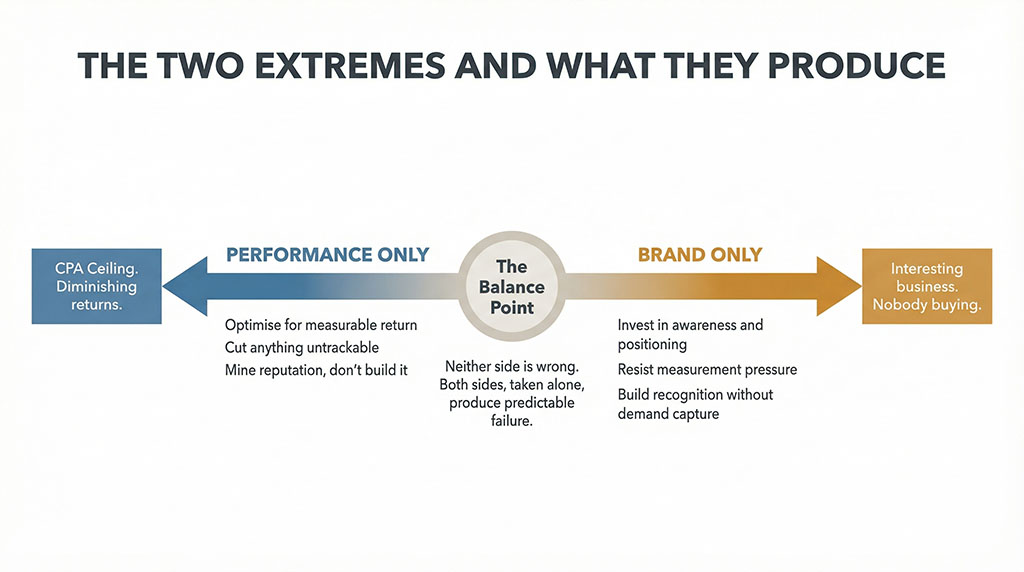
Push performance to its logical extreme — optimise everything for measurable short-term return, cut anything that doesn’t generate a trackable lead — and you get a business that is efficiently mining a reputation it didn’t build and isn’t replenishing. The CPA looks fine until it doesn’t. Then it looks like a ceiling.
Push brand to its logical extreme — invest in awareness and positioning, resist the pressure to measure everything — and you get a business that has interesting things to say and nobody buying them.
Both are right. Both, taken alone, produce predictable failure.
The Ceiling Is a Brand Problem. It Always Was.
Here is what happens in the market while a business runs phase one indefinitely.
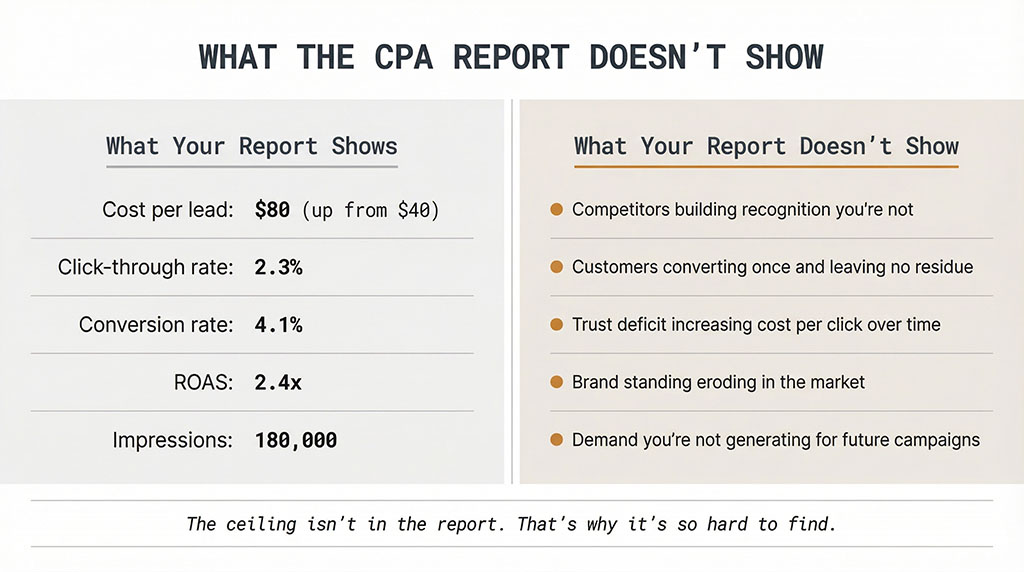
Every ad a customer sees without already knowing the brand costs more to convert — because trust hasn’t been built ahead of the click. Every competitor building recognition in the same space makes your acquisition costs higher — because you’re fighting for attention in a market where they already belong. Every customer who arrived through a performance channel and had an unremarkable experience leaves no residue — no referral, no organic search behaviour, no word of mouth — because there was nothing to remember beyond the transaction.
Brand isn’t the halo you add when performance plateaus. It’s the atmospheric pressure that determines how hard performance has to work. Let it drop long enough and you don’t just hit a ceiling. You start losing ground you can’t see being lost because it doesn’t appear in a CPA report.
The business that cracked lead generation at $40 and now can’t hold it below $80 hasn’t failed at performance. They’ve succeeded at performance inside a brand vacuum they created themselves.
The Part Where the Budget Objection Arrives
Right here is where most business owners push back.
Fine in theory. But I have a finite budget. I have to decide where the money goes this quarter. I can’t split it equally between brand and performance and call that a strategy.
This is the right objection. It just contains a hidden assumption that isn’t true.
The assumption is that brand and performance are competing uses of the same budget — that money spent on one is money not spent on the other, and that the allocation decision is the strategic question.
It isn’t. Brand and performance are not two separate campaigns running in parallel. They are two dimensions of every single marketing decision you make. Every performance campaign is either building or eroding your brand — whether you’re tracking that or not. Every creative decision, every message, every channel you appear in is either reinforcing something worth remembering or spending down a reputation that is harder to replenish than it was to build.
The allocation question is real but it’s secondary. The primary question is whether anyone in your marketing is holding both dimensions in view at the same time — asking, before the campaign launches, what it will do to the business’s standing in the market over twelve months, not just what it will do to CPA over the next thirty days.
Most performance-focused setups have nobody asking that question. Not because the people running the campaigns are incompetent. Because the entire measurement framework is built to make that question invisible.
Why This Debate Never Gets Settled
The marketing industry has been arguing brand versus performance for decades. It produces a new round of case studies every year. LinkedIn fills with confident declarations from both camps. The debate continues because everyone treats it as a convergent problem — as if more data and more case studies will eventually produce a correct answer that settles it.
Schumacher’s framework says it won’t. Can’t. Divergent problems don’t converge toward a solution no matter how much evidence you accumulate. The tension between them is the point. It’s what keeps the problem alive and generative.
The businesses that have learned to operate well inside that tension aren’t the ones who found the right answer. They’re the ones who stopped looking for one.
They run performance campaigns consciously designed to do brand work at the same time. They measure what they can and make judgment calls about what they can’t. They resist the pressure to cut anything that doesn’t generate a trackable lead this month, because they understand that the atmospheric pressure determining their cost of acquisition next year is being set right now.
That capacity — to hold two opposing things in productive relationship without collapsing into one of them — is what Schumacher called wisdom. It’s not a personality trait. It’s a skill. And it’s the one thing no optimisation framework, no attribution model, and no AI system can supply on your behalf.
Back to the ceiling.
Same business. Same channels. Same budget.
The campaigns are still running. But before the brief goes to whoever manages them, there’s a question being asked that wasn’t being asked before: what is this campaign doing to our standing in the market, not just our cost per lead?
The CPA doesn’t transform overnight. But the ceiling starts to move. Slowly, then less slowly — because the performance work is finally operating inside a system that’s building something, rather than mining something it never built.
That’s not a brand strategy or a performance strategy. It’s just a more complete question.
It was always the right one to start with.
Find out whether your performance budget is building something or mining something
Most audits we run surface the same pattern: businesses scaling spend on channels that are working on paper, while the brand pressure that makes those channels work is quietly dropping.
Takes 30 minutes.
Book Your Audit →