
It goes like this. A brand’s Facebook agency and its Google agency end up targeting the same audience with the same offer through two different channels. Both report strong reach. Neither knows the other exists. The brand is paying twice to annoy the same people, and calling it strategy.
This isn’t a one-off. It’s the structural consequence of splitting your marketing across specialists who can’t see each other’s work. And the data from McKinsey, BCG, Gartner and Harvard now points in one direction: the multi-agency model isn’t underperforming. It’s collapsing.
The numbers behind the fracture
Marketing budgets have flatlined at 7.7% of revenue, according to Gartner’s 2025 CMO Spend Survey of 402 marketing leaders. Gartner’s 2019 survey put the same figure between 10% and 11%. That budget isn’t growing back. Inside that shrinking envelope, companies keep funding several agency relationships at once, each running separate tools, separate dashboards and separate definitions of success.
The waste compounds at every layer. Gartner found in 2023 that companies use only 33% of their marketing technology capabilities, down from 58% in 2020. The tools aren’t bad. Fragmented teams buy overlapping software that nobody fully adopts. Asana surveyed 10,624 knowledge workers for its Anatomy of Work Index and found that 58% of the working day goes to coordinating work rather than doing it. Strategy alone accounts for under a tenth. When your agencies don’t share data, that coordination tax climbs.
The price of fragmentation isn’t only time. Gartner puts the cost of poor data quality at at least $12.9 million a year per organisation, based on 2020 research. The ANA’s programmatic transparency work, built on log-level impression data from 21 major advertisers, found $26.8 billion in unrealised media value in the second quarter of 2025. More middlemen. More opacity. Less return.
Here’s the pattern nobody talks about. Media-only agency relationships average 3.7 years. Integrated full-service relationships average 7.3 years — twice as long.1 The fragmented model doesn’t just cost more. It churns faster, and every replacement starts the learning curve over from zero.
What unified intelligence actually looks like
The counterargument is obvious: specialisation produces expertise. A dedicated SEO agency knows search better than a generalist ever could.
That was true when the bottleneck was knowledge. It is no longer true when the bottleneck is integration. The most striking evidence for that didn’t even come from marketing.
BCG’s 2025 measurement study found that leading marketers, the ones who had cleared several obstacles at once, reported revenue growth up to 70% higher than their peers. Unifying marketing mix modelling, incrementality testing and multi-touch attribution into one framework is one practice inside that bundle rather than the whole explanation. It is also the practice that makes the others measurable.
McKinsey argued in 2021 that marketers can achieve a 15% to 20% ROI lift by managing the full funnel as one system instead of as separate channels. That is a stated potential rather than a measured comparison of integrated and siloed companies. The reasoning behind it is the problem we opened with. Media mix models will recommend more spend on branded search terms even when the brand already captures nearly all of the organic results. A unified view catches that. Separate agencies never will, because the agency running paid search has every financial incentive not to mention it.
BCG and Google ran a set of experiments lasting four to six weeks. Brands with full data integration improved return on ad spend by up to 33%. Costs fell 30%. Online transactions rose 50%.
This isn’t incremental. Unified intelligence is a different category of capability.
One marketer with AI versus five agencies without it
In June 2026, Anthropic released Claude Fable 5 and Claude Mythos 5, along with the safety documentation for the most capable models it has built. Fable 5 is the model in public hands. Mythos 5 sits in a more capable class above it. The system card ran 319 pages. Buried inside was a finding with nothing to do with marketing and everything to do with your agency roster.
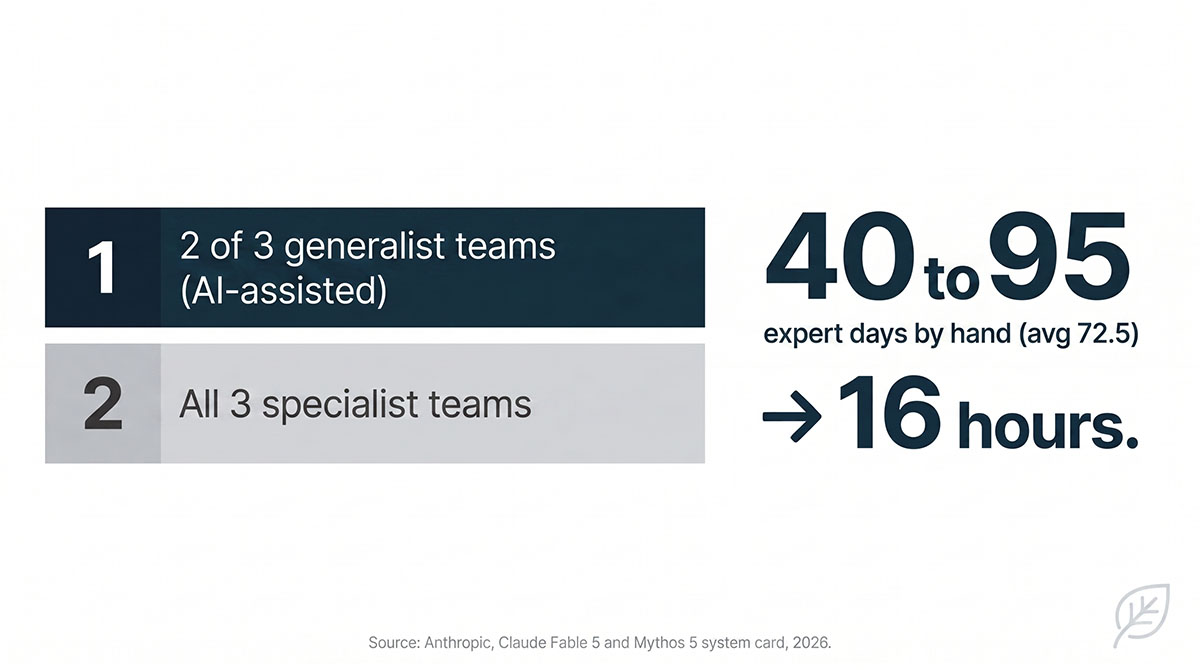
The company wanted to know whether generalists armed with AI could match genuine specialists. So it took twelve scientists, split them into six two-person teams, and handed them a hard problem: design an end-to-end defence against an engineered strain of rice blast, a crop disease. Three teams included world-leading experts in rice blast. The other three were general microbiologists who had never specialised in it, but who had the model.
Two of the three generalist teams beat all three specialist teams. On scientific quality and on feasibility. Graders estimated the work would have taken a specialist between 40 and 95 working days by hand, averaging 72.5. The generalists did it in 16 hours.
The people without the domain expertise won. The AI didn’t turn them into experts. It made the gap between expert and generalist stop mattering. The premium you pay a specialist agency is a premium on scarce knowledge. That scarcity just collapsed.
And the report is honest about the limits, so we will be too. The model didn’t work alone, and it didn’t work cleanly. The generalists were still PhD scientists. The model over-engineered, made confident mistakes, and needed capable humans to catch them. Anthropic’s own conclusion is that it still can’t replace a world-class specialist outright. Which is exactly the point. The question was never whether you need a strategist. It’s whether you need five of them.
This wasn’t the first sign, either. In September 2023, Harvard Business School, MIT Sloan, Wharton and BCG published a pre-registered randomised controlled experiment, the gold standard in research design, testing what happens when consultants use AI. They gave GPT-4 to 758 BCG consultants across 18 realistic tasks including creative, analytical and marketing work.
The results: AI-assisted consultants completed 12.2% more tasks, finished 25.1% faster, and produced work rated 40% higher in quality. Below-average performers gained the most, improving 43%. The biggest gains went to the people who needed them.
Apply that to the marketing context. McKinsey projects that generative AI could add productivity worth 5% to 15% of total marketing spend, roughly $463 billion a year across the industry.
This is where the maths breaks the old model. If AI compresses the work that took 100 agency hours into 10 hours of AI time plus 5 of human oversight, the billable-hour structure evaporates. The value shifts from execution capacity to strategic integration, meaning the ability to see all channels, all data and all customer touchpoints at once, then make decisions that account for the whole picture.
Gartner’s generative AI research found that 40% of marketing leaders name cost efficiency as the ROI they have achieved from it, and that 77% of marketing organisations already using generative AI apply it to creative development. The CMO Survey from Duke and Deloitte tracked generative AI adoption in marketing growing 116% year over year, now covering 15.1% of all marketing activities and projected to reach 44.2% within three years. AI overall sits at 17.2%.
The companies pulling ahead aren’t just using AI as a faster tool. BCG and Google’s survey of more than 2,000 marketers found that AI leaders report 60% greater revenue growth than their peers, though that figure is self-reported and correlational. McKinsey’s State of AI report shows that high-performing AI organisations are nearly three times more likely to have fundamentally redesigned their workflows rather than bolting AI onto existing processes.
"This is consultant-speak for selling a different kind of dependency"
Fair objection. Let’s sit with it.
The research I’ve cited comes overwhelmingly from consultancies that profit when companies restructure. McKinsey sells transformation projects. BCG sells measurement frameworks. Gartner sells advisory subscriptions. Every one of them has a commercial interest in you believing the old model is broken. With one exception. The rice blast finding came from an AI lab’s own safety document, written to flag the model’s dangers rather than to sell marketing services. It has no stake in whether a single agency lives or dies.
And the counterpoints are real. Over 80% of companies remain in early AI stages, according to BCG. Two-thirds are stalled by lack of knowledge or too many options. The Harvard and BCG experiment also found a “jagged frontier,” where AI dramatically improved performance on some tasks while degrading quality on others that fell outside its competence boundary. AI is not a magic wand, and one person with ChatGPT is not a replacement for genuine creative expertise developed over decades.
Agencies provide real value. External perspective prevents internal echo chambers. Deep specialisation in complex areas like programmatic buying or brand strategy draws on institutional knowledge that doesn’t transfer easily. The WFA found that satisfaction with in-house agencies sits at 86%, but only 33% report complete satisfaction, meaning the majority still see gaps. Those are brands rating their own in-house teams, which is worth holding in mind.
So this isn’t an argument that all agencies are useless. It’s an argument that the model, five separate agencies with five separate data sets and five separate incentive structures pulling in different directions, is structurally incapable of delivering what the market now demands. McKinsey found that only 27% of consumer and retail marketing leaders have operating models they would describe as mature and fit for purpose. The model isn’t just expensive. For most companies, it was never properly built in the first place.
The question isn’t whether you need external expertise. It’s whether that expertise should come from five disconnected specialists who can’t see each other’s data, or from a consolidated structure, whether that’s one exceptional person with AI, a lean integrated team, or a single strategic partner, that operates from a single source of truth.
The shift is already happening
This argument would be theoretical if companies weren’t already moving. They are, and at scale.
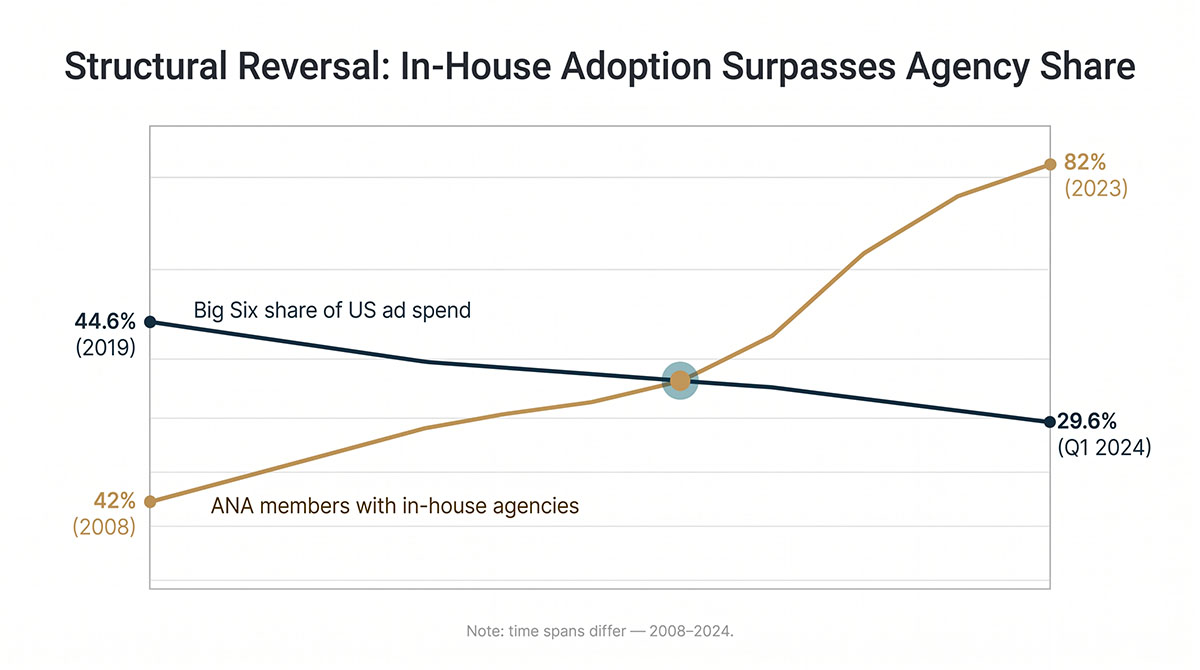
ANA data from 2023 shows that 82% of member companies operate in-house agencies, up from 42% in 2008. That’s not a trend. That’s a structural reversal over 15 years. Sixty-five percent had moved work previously handled by external agencies in-house within the prior three years.
The World Federation of Advertisers found that 66% of major multinational brands now have in-house capabilities, and 56% plan to bring more digital production in-house within three years. A separate report from the WFA and MediaSense found that only 11% believe their current agency model aligns with future requirements, and that 37% are actively seeking fewer, more integrated partners. MediaSense sells agency review consulting, so weigh that second pair accordingly.
The financial data tells the same story from the other side. The Big Six agency holding companies controlled 29.6% of total US ad spending in Q1 2024, down from 44.6% in 2019.2
The agencies themselves know. WPP cut 5.4% of its workforce in a single year, from 114,173 people at the end of 2023 to 108,044 at the end of 2024. IPG shed roughly 4,100 over the same period, from 57,400 to 53,300.3 The rest are restructuring around AI. The ones that survive will look nothing like the ones you’re paying today.
What the transition actually requires
McKinsey’s personalisation research puts the prize at 5% to 15% additional revenue growth and a 10% to 30% increase in marketing ROI. Read that carefully, because it is a return figure rather than a cost cut, and it comes from doing personalisation properly rather than from swapping vendors. Doing this well is genuinely hard. BCG’s EMEA study of 100 brands found that average marketing maturity fell 8% between 2021 and 2024, and BCG’s own reading is that the bar rose rather than that performance dropped.
The practical path looks something like this.
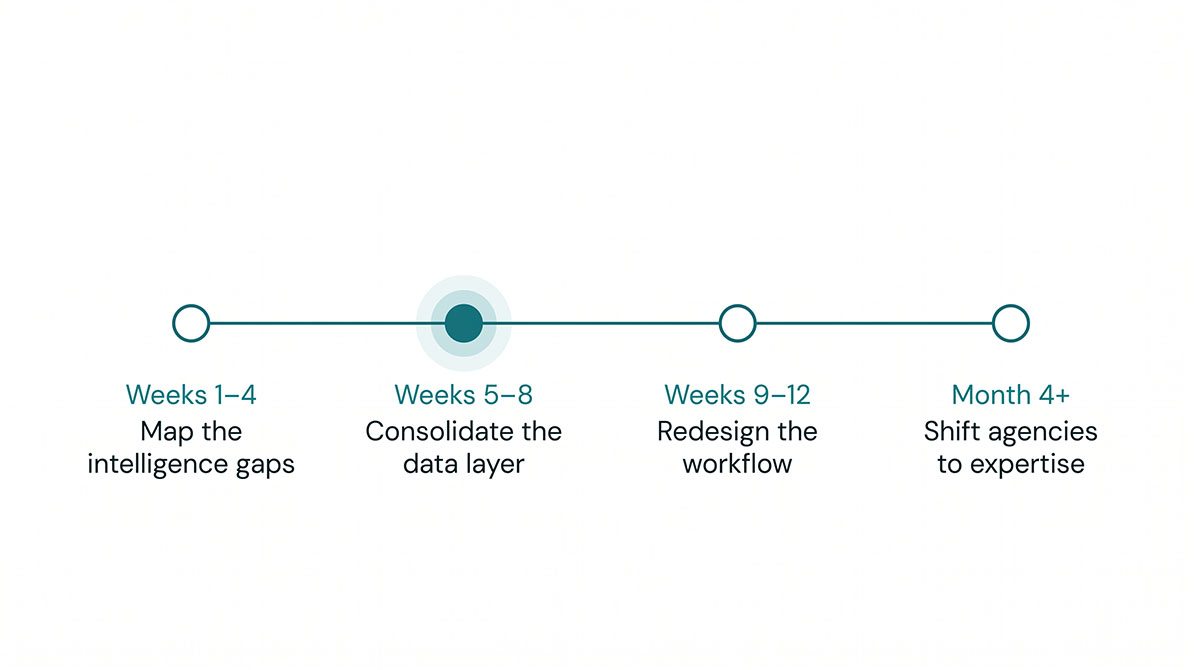
Weeks 1 to 4: Map the intelligence gaps. Audit every tool, every dashboard and every data source across all your current agencies. Document where data doesn’t flow between systems. Identify the decisions you currently make on incomplete information. This is usually a longer list than anyone expects.
Weeks 5 to 8: Consolidate the data layer first. Before changing any agency relationships, unify your analytics. This is the foundational step. As McKinsey notes, AI can only optimise what it can see. If your data stays fragmented, AI will optimise for local maximums like clicks, opens and impressions rather than global ones like profit and lifetime value.
Weeks 9 to 12: Redesign the workflow, not just the org chart. McKinsey’s State of AI research shows that high performers are nearly three times more likely to have fundamentally redesigned workflows rather than simply layering AI onto existing processes. This means rethinking how decisions get made, not just who makes them.
Month 4 onward: Shift external relationships from execution to expertise. Agencies aren’t the enemy. Fragmentation is. The future model uses external specialists for genuine strategic input and capability spikes, the work that requires deep institutional knowledge you can’t build overnight, while keeping intelligence, data and decision-making unified internally.
What happens when one person sees both screens
Remember the two agencies targeting the same audience? In a consolidated model, the marketer sees the overlap on day one. They merge the audiences, kill the duplicate spend, and redirect that budget into untouched segments neither agency knew existed. No new creative. No new platform. No new budget. Someone could finally see both channels on the same screen.
That’s the difference between marketing as a collection of disconnected tactics and marketing as an integrated intelligence system. Every data point in this piece, from BCG’s revenue growth gap to McKinsey’s ROI lift, traces back to one structural advantage: the ability to see the whole picture at once.
Gartner’s 2025 CMO Spend Survey found 39% of CMOs planning to cut agency budgets.4 Eighty-two percent have built in-house capabilities. The model isn’t ending because AI made it obsolete. It’s ending because AI made the cost of fragmentation visible for the first time.
The question isn’t whether this shift happens. It’s whether you spot your own audience overlap before your competitor does. If you want the full case for the alternative, I’ve laid it out in 12 reasons to hire an AI-powered generalist instead of an agency of specialists.
Sources
- ANA and 4As, Client-Agency AOR Relationship Tenure, 30 April 2025. Sample size and fieldwork dates are not publicly disclosed. The study measures the tenure of ongoing AOR relationships, not completed lifespans, so it understates how long relationships eventually run. Note that the report’s headline finding runs the other way to the argument here: average tenure across all disciplines has more than doubled since 2016, from 3.2 years to roughly seven. The 4As is the agencies’ own trade body.
- Advertiser Perceptions, Changing Agency Dynamics, 7 August 2024; the precise 44.6% figure is EMARKETER’s rendering of the same dataset. A proprietary vendor estimate with no published methodology or sample; Advertiser Perceptions’ own post says “more than 44%” for 2019. The endpoints are not strictly like-for-like — 2019 is a full year, 29.6% is a single quarter. Advertiser Perceptions sells research to both agencies and marketers.
- WPP plc, Annual Report on Form 20-F for the year ended 31 December 2024, and The Interpublic Group of Companies, Form 10-K for the year ended 31 December 2024, with the prior year from its FY2023 Form 10-K. Audited filings. WPP’s decline is 6,129 people, or 5.37%. IPG states both years as “approximately”, so 4,100 is a difference of two rounded figures. Headcount changes reflect disposals and acquisitions as well as redundancies.
- Gartner, 2025 CMO Spend Survey, 12 May 2025. 402 CMOs and marketing leaders in North America, the UK and Europe, fielded February to March 2025, mostly at companies above $1bn revenue — enterprise sentiment, not mid-market. The figure measures stated intent, not cuts actually made. Gartner sells advisory services to the CMOs it surveys.
Your marketing, looked at properly
Thirty minutes on your current setup — what’s working, what’s quietly leaking budget, and what I’d fix first. You’ll leave with a clearer picture whether we work together or not.
Got something specific bugging you? Flag it when you book and I’ll have it looked at before we talk.

AboutBruce Marjoribanks
Bruce Marjoribanks has spent 27 years in marketing, including building, running and selling his own agency before going independent. He now runs every channel - paid, organic, social, email, creative and automation - as one integrated system, with AI ehancing production and the judgment staying human.