
His name was Evan Meyer. He didn’t exist.
Ryan Holiday invented him at 2am, under the yellow wash of a Kinko’s parking lot, stuffing freshly printed stickers into a jacket pocket. He drove to a billboard he’d designed and paid for himself, taped an obscene message across it, photographed the damage from a moving car window, drove home, and sent two emails to two major blogs — signed Evan Meyer, concerned citizen, outraged witness.
One blog replied within the hour: You’re not messing with me, are you?
No, Holiday wrote back. Trust me, I’m not lying.
That one planted story — one fake tip, one fake name, one defaced billboard — became the opening move in a campaign that put Tucker Max’s movie on the front page of FoxNews.com, Page Six of the New York Post, and editorial columns in the Washington Post and Chicago Tribune. Eventually: a #1 New York Times bestseller. Total PR budget for all of it: essentially zero.
I’m not telling you to commit fraud. I’m telling you the fraud was concealing something real — a tactic that works just as well without any of the lies.
It’s called trading up the chain. And if you run a small business with no publicist, no press contacts, and no idea how to start, it’s the only PR strategy worth properly understanding.
What Holiday Was Actually Doing
Strip out the fake names and manufactured outrage. What’s underneath is disarmingly simple.
Holiday understood that every journalist — whether they write for a local community newsletter or a national masthead — operates on a single mental shortcut above all others: has someone else already decided this is worth covering?
Publications don’t hunt for undiscovered stories in isolation. They watch each other. Small blogs watch smaller blogs. Mid-tier outlets watch the small blogs. Regional press watches the mid-tier. National press watches all of them. Each link in the chain scans the links below it for story leads, because a story that’s already been covered somewhere is a story that’s already been risk-assessed by someone else.
Which means if you can get the smallest credible link in your chain to cover you, you now have something more powerful than any press release: proof that your story has already been deemed newsworthy.
And existing coverage is a journalist’s favourite thing in the world, because it means someone else already did the hard part.
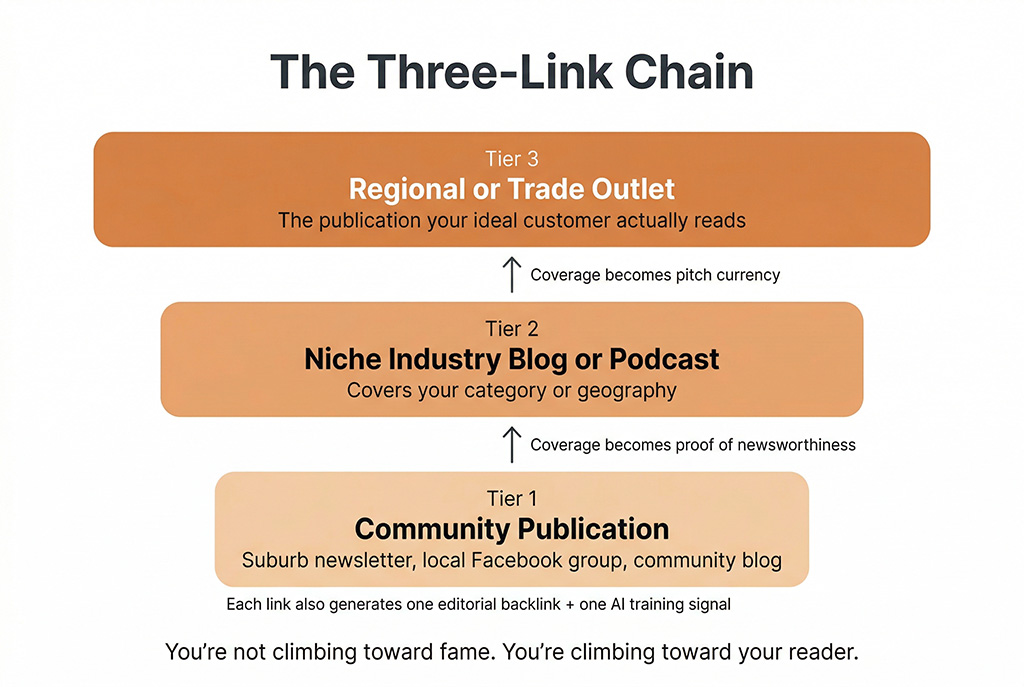
Holiday called this trading up the chain. Start with a tiny outlet. Use that coverage to pitch a bigger one. Use the bigger one to reach the one that actually matters for your business. The story legitimises itself as it climbs — not because it becomes more interesting at each level, but because the number of outlets that have covered it keeps growing, and each new journalist uses that number as permission to cover it themselves.
This is the honest version of what Holiday did. No Evan Meyer required.
The Part Nobody Tells You About "Free" PR
Before going further, a correction.
This tactic isn’t free.
It costs time — sustained, specific time across weeks or months. Getting your first small coverage requires research into the right publication, a pitch written well enough to solve the editor’s problem, follow-up when they don’t respond, and often near-complete story drafts for understaffed bloggers who have no bandwidth to develop your angle themselves. Depending on your hourly rate, “free PR” might cost you more than a month’s retainer with a junior publicist.
Go in with clear eyes about that.
What it doesn’t require is existing contacts, industry connections, or a $10,000 retainer with an agency that sends the same generic press release to 200 journalists and reports back that it was “distributed widely.”
That’s the real value of the trade. Not zero dollars. Zero prerequisites.
The Wall You're Already Building
You’re thinking: This is a great tactic for someone promoting a controversial movie. I run a physiotherapy practice. The Sydney Morning Herald isn’t covering my dry needling technique.
Fair. And correct — if that’s the chain you’re measuring.
But Holiday’s chain ran from fringe blogs all the way to national newspapers because his goal was national attention. Your chain doesn’t need to reach a national masthead to work. It needs to reach the publication your ideal customer actually reads — which, for most small businesses, sits somewhere in the middle of the chain, not at the top.
The physiotherapy practice doesn’t need the SMH. It needs:
- The local suburb newsletter or community Facebook group (link 1)
- A niche health and wellness blog or podcast covering your city (link 2)
- A regional business outlet or industry trade publication (link 3)
Three links. Your chain. And the psychology operates identically at every level. A journalist at link 3 looking at your pitch alongside twenty others has one quick question: has anyone else already decided this business is worth covering? When the answer is yes — and you can show them the links — their decision just got significantly easier.
The chain doesn’t need to be long. It needs to be intentional.
How to Run It
Map your three links before you contact anyone.
Identify the smallest credible publication in your community or industry that your target customers actually read. This is your starting point. Don’t skip it because it feels beneath you — small coverage is the mechanism, not the consolation prize. Then name the next link up, and the one above that. Write down all three before making a single approach.
Do the journalist’s job for them.
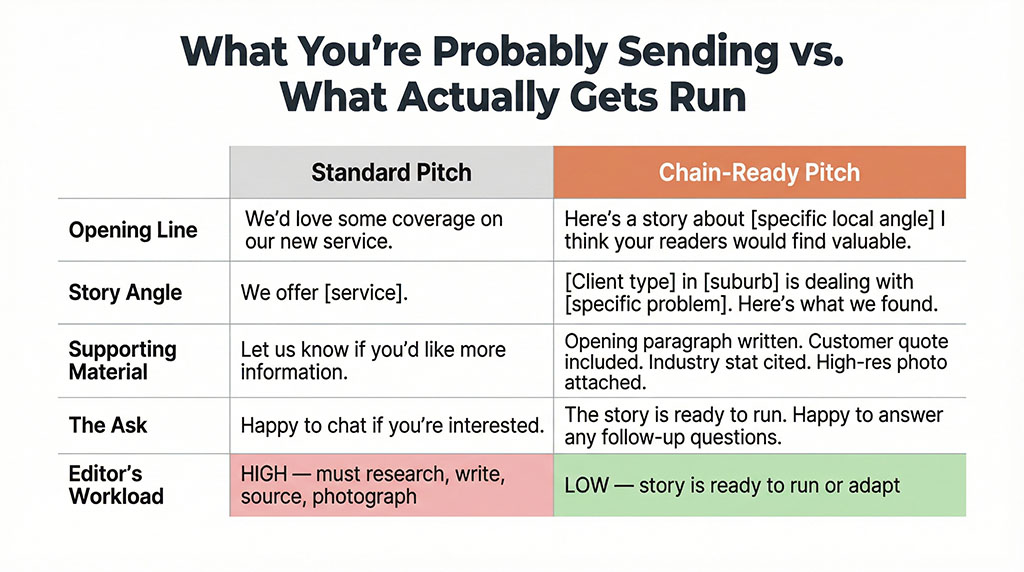
Holiday got coverage partly through deception and mostly through making stories so easy to run that a time-poor blogger couldn’t say no. He wrote the angles. He provided the photographs. He answered every question before it was asked.
Do the same thing honestly. When you pitch the suburb newsletter, don’t send “we’d love some coverage on our new clinic.” Send the story. Write the opening paragraph yourself. Include a customer quote, one surprising statistic about your industry, and a high-resolution photograph. The editor’s job just became copying and pasting — and that’s exactly what you want.
This works because local and niche publications are almost always understaffed. They need content more than they need standards. Give them a complete story and you’ve solved a real problem for them.
Turn coverage into currency immediately.
The moment your first piece publishes, save the URL and screenshot it. You’ll use both. When you pitch link 2, open with: “We were recently featured in [Publication] — I wanted to share a story I think your readers would find equally relevant.”
You’re not namedropping. You’re reducing risk for the next journalist. You’re showing them the decision has already been made once. That’s a different conversation entirely from a cold pitch — you’ve seen that difference yourself every time a restaurant with a line outside draws a longer line than an empty one next door.
Give the story somewhere to go.
Holiday’s campaigns always had a hook that made escalation feel natural — a controversy that grew, a counter-response, a new development. Each link felt like they were adding a chapter, not reprinting the original.
Your hook doesn’t need controversy. A milestone works (“we hit 500 clients in our first year”). So does a community angle, a counter-intuitive finding from your work, or a tie to something already running in the news cycle. What it cannot be is static. The story needs a reason to keep moving upward.
What to Expect, Honestly
The first pitch will probably land in silence.
Send it anyway, then pitch a different angle to a different publication at the same level. The first coverage is the hardest — not because the chain logic doesn’t work, but because you’re asking a journalist to be first, and being first carries risk.
The second pitch converts faster. You have something to show. The third faster still. By the time you reach your target publication — the one whose coverage would genuinely move the needle — you’re not a cold approach. You’re a business that has already been validated twice by people in their industry.
Budget four to six hours per link: research, drafting, follow-up. Call it twelve to twenty hours total from community newsletter to regional trade press. That’s real. Spread across two or three months, it’s also a compounding asset — not a one-off spend, but coverage that stays indexed, stays findable, and keeps doing the validation work in every pitch you send for the next two years. And there’s a second compounding effect most people don’t think about when they start.
The Byproduct Nobody Mentions
Every time a publication runs your story, something else happens quietly in the background.
They link to your website.
Not a directory listing. Not a paid placement. An editorial link from a credible, independently operated news source — the kind that search engines have been trained to treat as a genuine signal of authority, because historically, that’s exactly what it was. A regional outlet linking to your business is saying, in the language search infrastructure understands: this place is real, relevant, and worth pointing to.
This matters for two reasons most small business owners haven’t connected yet.
The first is conventional search. Google’s ranking signals have always weighted editorial links from established publications above almost every other factor. The reason is simple: those links are hard to manufacture. You can’t buy them, you can’t automate them, and you can’t fake your way to them at scale — unless you’re Ryan Holiday, and even he eventually ran out of fake names. A single link from a legitimate regional news site is worth more to your search visibility than dozens of links from directories, comment sections, or the kinds of “guaranteed backlink” packages that land in your inbox every fortnight.
The second reason is newer, and most businesses haven’t caught up to it yet.
AI search tools — the features now built into Google, the standalone tools like Perplexity and SearchGPT, the AI assistants that answer questions directly rather than returning a list of links — are trained on the same internet these publications live on. When a user asks one of these tools “who are the best physiotherapists in Parramatta,” the answer isn’t pulled from a database of businesses that paid to be listed. It’s synthesised from sources the AI was trained to treat as credible: publications, editorial coverage, cited experts.
A business that has been written about in a community newsletter, a health and wellness blog, and a regional business outlet has a training signal that a business with only a Google Business Profile does not. The chain tactic doesn’t just build press coverage. It builds the kind of documented existence that AI systems use to decide whether a business is worth mentioning at all.
None of this should be the reason you start trading up the chain. The reason to start is that it builds genuine credibility with real customers through real publications. But understanding that each link in your chain is also a permanent, indexed, AI-readable record of your business being deemed worth covering — that changes how you think about the time investment.
You’re not doing PR that happens to help SEO.
You’re doing PR, and the internet’s entire infrastructure is quietly rewarding you for it.
Somewhere right now, a journalist is skimming subject lines. Most of what they’re reading is cold, generic, and asking them to care about something they’ve been given no reason to care about.
One email reads differently: “Following coverage in [Publication], I wanted to share something I think your readers would find relevant.”
Holiday understood that sentence wasn’t lying. It was just making the journalist’s decision easier.
You don’t need a fake name to send it.
Find out if your business has a press moment worth engineering
Most businesses we talk to have three or four genuine story angles sitting unused — milestones unframed, positions undeclared, data nobody’s packaged. The pitch isn’t the problem. Knowing what to pitch is.
Takes 30 minutes.