
It’s 1937. A dining room in Manhattan’s Statler Hotel. The waiters have just been handed new scripts.
From now on, they won’t ask: “Can I take your drinks order?” They won’t say: “Would you like any wine with dinner tonight?”
They’ve been trained to ask exactly this: “Would you prefer red or white wine this evening?”
Wine sales shot up.
The man responsible was Elmer Wheeler — a sales researcher who spent two decades testing 105,000 sentences on 36 million consumers to find out which specific words drive purchase decisions. His core finding: asking customers which instead of if is one of the most reliable conversion improvements available to any business, at any price point, in any industry.
Most small businesses are running their entire sales operation on “if.” They have been since Wheeler published his research in 1937 and the business world largely moved on without reading it.
Wheeler's discovery started at a gas station
Wheeler grew up helping his father run a service station near Rochester. One day, a Standard Oil salesman stopped in and asked Elmer how he approached customers. Wheeler told him: sometimes he’d ask how much they wanted, sometimes whether they wanted five gallons or ten.
The salesman gave him one sentence to try instead: “Shall I fill it up?”
The next motorist pulled in. Wheeler said it. The tank got filled — fifteen gallons, not five. One sentence. No discount. No pitch. Wheeler later wrote that the sentence “has been working successfully now for twenty years.”
He spent the rest of his career figuring out why.
What Wheeler had stumbled on is deceptively simple. Asking “if” creates a binary: yes or no. Asking “which” creates a selection: this option or that one. Selection decisions are cognitively easier than binary decisions — your brain doesn’t have to evaluate whether it wants something, just which version. That’s less mental work. And people, being people, default to the path of least resistance.
This isn’t manipulation. It’s friction removal. The customer who says yes to red wine wasn’t talked into drinking — they were spared the effort of deciding whether to drink at all.
Wheeler published his findings in Tested Sentences That Sell in 1937. It outsold every other book on selling written in the following twenty years. Then he was forgotten. Which is a shame, because the principle applies to your proposal follow-up email just as much as it did to that Manhattan dining room.
Here's the objection forming in your head
Your customers aren’t hotel diners in 1930s Manhattan. They research. They read reviews. They compare three vendors, loop in a decision-maker, and still take another two weeks. A grammatical nudge won’t move a buyer who’s got a spreadsheet open.
That’s a reasonable objection. Here’s a data point that isn’t from the Depression era.
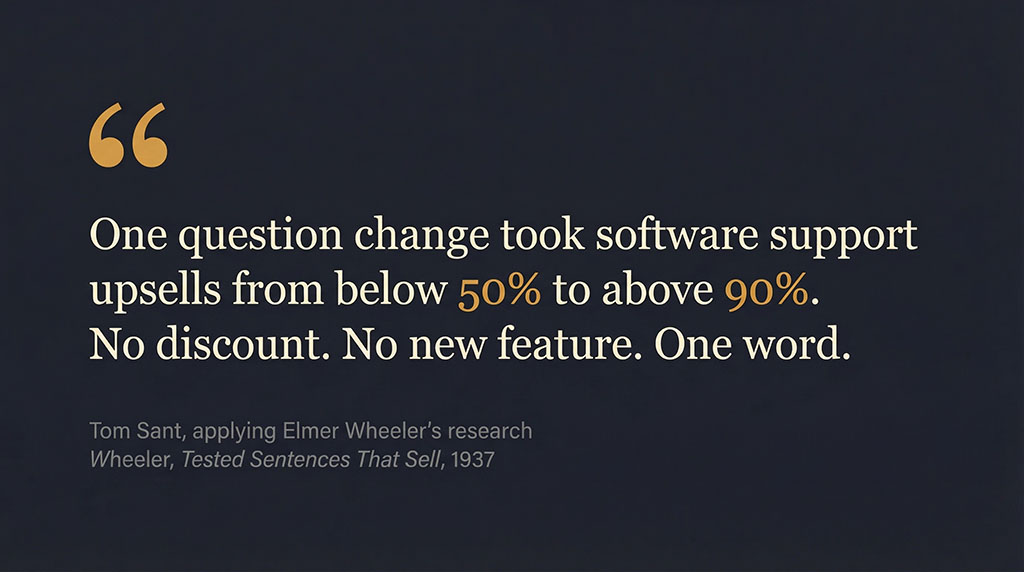
Business writer Tom Sant — who spent years excavating Wheeler’s work and applying it to modern sales — tested this principle when selling software support packages. The old question: “Would you like to add a maintenance plan?” Customer response: pushback. They’d argue the price, ask for it free, or stall. Attach rates sat below 50%.
The new question: “Which support package works better for you — 24/7 coverage, or business-hours only?”
Attach rates went above 90%.
B2B software buyers. Not hotel guests being handed a wine list. People who’d done due diligence, compared options, negotiated on price — and still responded to the “which” framing because it removed one cognitive step: should I buy this became which version do I want. The research didn’t change. The friction at the final moment did.
The five places "if" is costing you right now
| Touchpoint | "If" phrasing | "Which" phrasing |
|---|---|---|
| Website CTA | "Get in touch if you'd like to talk" | "Book a 20-min call or send us a brief" |
| Proposal close | "Let me know if you'd like to proceed" | "Should we start on the 1st or the 15th?" |
| Upsell conversation | "Would you be interested in the add-on?" | "Which channels do you want — social only, or social plus email?" |
| Referral ask | "If you know anyone who might benefit…" | "Who's one person this would help — someone new, or an established business?" |
| Follow-up email | "Just checking in to see where things stand" | "Are you closer to ready, or still gathering information?" |
Every "if" phrasing creates a yes/no exit. Every "which" phrasing creates a path forward.
Wheeler’s principle is most useful not as a mindset shift but as an audit. Run it across these five touchpoints:
Your website CTA. “Get in touch” and “Book a call” are both “if” questions in disguise — they ask whether the visitor wants to take a step. “Book a 20-minute call or send us a brief” is a “which.” Two options, both moving in the same direction.
Your proposal close. “Let me know if you’d like to proceed” hands the cognitive burden entirely to the client. “Should we kick things off on the 1st or the 15th?” assumes the sale. Wheeler’s research consistently showed assumed-sale closes outperform permission-seeking ones — not because they pressure the client, but because they make agreement easier.
Your upsell conversation. “Would you be interested in the social media add-on?” gives the client a clean exit. “Which channels do you want included — social only, or social plus email?” doesn’t. Same service, different cognitive load on the other end.
Your referral ask. “If you know anyone who might benefit…” is a polite exit. Nobody acts on it. “Who’s one person in your network this would be useful for — someone building a new business, or someone running an established one?” forces a mental scan. Mental scans produce names.
Your follow-up email. “Just checking in” is barely a question. “Are you closer to ready to move, or still gathering information?” gives the prospect a response that isn’t yes or no. Either answer tells you something useful. Either answer keeps the conversation moving.
How to run a Wheeler audit in a week
Pick one touchpoint — just one. Find where you’re currently asking “if” in disguise. Rewrite it as a “which.” Test it over the next ten conversations, emails, or client interactions.
One condition: the options in your “which” question have to be genuinely available. Wheeler’s research showed that false choices — “would you prefer the gold plan or the platinum plan” when there are actually five plans — collapse the effect. The selection has to be real, and both paths have to lead somewhere useful.
Wheeler spent two decades and 36 million test subjects to establish this. You can get preliminary evidence in a week.
Find out how many of your touchpoints are asking “if” when they should be asking “which”
Most audits we run find the same thing: CTAs that create exits, proposal closes that hand the decision back, and follow-up sequences full of “just checking in.” The language is polite. The conversions are not.
Takes 30 minutes.
The waiter in that Statler Hotel dining room didn’t talk anyone into drinking wine. He just made the path to yes shorter. His guests still chose. They just chose more easily.
Your business has a dining room too — probably several. The question is which word you’re using when you walk up to the table.