
A bakery truck is driving back and forth across the Golden Gate Bridge.
Inside, hidden among the bread trays, a camera crew is shooting stolen footage for a film the city of San Francisco has already refused to cooperate with. The city fathers said no — they worried that depicting the bridge being destroyed would imply it wasn’t structurally sound. Ray Harryhausen said fine, and shot it anyway.
It Came from Beneath the Sea became a hit.
But here’s the part nobody talks about. The octopus attacking that bridge — the creature at the center of the entire film — only had six tentacles. Not eight. Before a single frame was shot, Harryhausen had quietly amputated two of them. Animating fewer appendages would save time and money. “Time is money,” he said, matter-of-factly. “We had a sextopus. We kept them disguised underneath the water because nobody would count them.”
Nobody counted them.
The film ran. Audiences loved it. The city fathers didn’t ban it. And Ray Bradbury — who wrote the original short story that inspired the film — got his rights bought without anyone mentioning the missing tentacles.
Small businesses spend years apologizing for constraints their clients never see. That’s the Sextopus Strategy in reverse — and it’s costing you.
The anxiety nobody admits out loud
There’s a conversation that happens in almost every small business. Sometimes it’s spoken. More often, it’s the voice in your head at 11pm when you’re looking at a competitor’s website.
They have a bigger team. A nicer office. A client list with names on it. We can’t compete with that.
This is the tentacle-counting problem. And it’s costing you business — not because the gaps are real, but because you’re the only one in the room doing the counting.
Harryhausen made films across four decades working almost entirely alone. No team of CGI artists. No studio infrastructure. Just one man, a garage, some metal armatures, his father engineering the skeletons and his mother sewing the costumes, and an irrational commitment to making the thing in front of him feel alive.
When a 12-year-old Dennis Muren — who would later win eight Academy Awards for visual effects — saw the Cyclops from The Seventh Voyage of Sinbad standing on a beach, he went back to see the film eight more times that week. Not because the budget was impressive. Because the Cyclops felt real.
What your clients are actually paying attention to
Here’s where the Harryhausen lesson gets uncomfortable. Because it isn’t just about cutting costs cleverly or hiding your constraints below the waterline.
It’s about what your customers are actually buying.
Multiple people who worked with Harryhausen said the same thing independently, in different words: his creatures weren’t convincing because they looked real. They were convincing because they thought. The Ymir — an alien creature from 20 Million Miles to Earth — gets angry because he’s been tormented. A troglodyte in Sinbad does “this really sad motion with its eyes” and the audience feels it. The skeletons in Jason and the Argonauts weigh each other up before fighting — you can see them considering their next move.
“I knew those were rubber skeletons,” said one filmmaker who watched those scenes as a boy. “But they were thinking.”
That’s the actual product. Not the technical achievement. The illusion of interiority.
Your clients aren’t buying your team size. They’re buying whether you understand their problem. They’re not buying your office. They’re buying whether the person they’re talking to gives a damn. They’re not counting your tentacles. They’re watching your eyes.
What you think they're counting vs. what they're watching
What you think they're counting
What they're actually watching
Team size
Does this person understand my specific problem?
Office or brand polish
Did they follow up without being asked?
Client logo list
Does one specific person own my account?
Proposal length and production
Did they ask the question no one else asked?
Years in business
Do they talk about my problem or their credentials?
Price relative to larger competitors
Do I trust that they care if this works?
The left column is what's visible on a website. The right column is what gets remembered after the meeting.
This is where you're going to push back.
You’re thinking: that’s a fine story about a legendary filmmaker who already had credibility. People already wanted to believe in him.
You’re a small business. You don’t have Harryhausen’s filmography. When your competitor shows up with a more impressive deck and a client list full of recognizable names, clients notice. Sometimes the tentacles do get counted.
That’s real. Sit with it for a second.
Now ask a different question: when a client chooses the bigger competitor and it doesn’t work out — and in our experience working with small business owners, it often doesn’t — what reason do they give? It’s almost never “they didn’t have enough staff.” It’s almost always some version of we felt like just another account, or nobody seemed to actually care about our problem, or they were too big to move quickly.
The tentacles weren’t the issue. The character was.
Harryhausen’s creatures lost fights, got killed, moved with a slightly jerky stop-motion gait that technically shouldn’t convince anyone of anything. Audiences mourned them anyway, because he had put himself into each one. His daughter said it plainly: “He was all those creatures a little bit.”
You cannot manufacture that with headcount.
What this looks like in practice
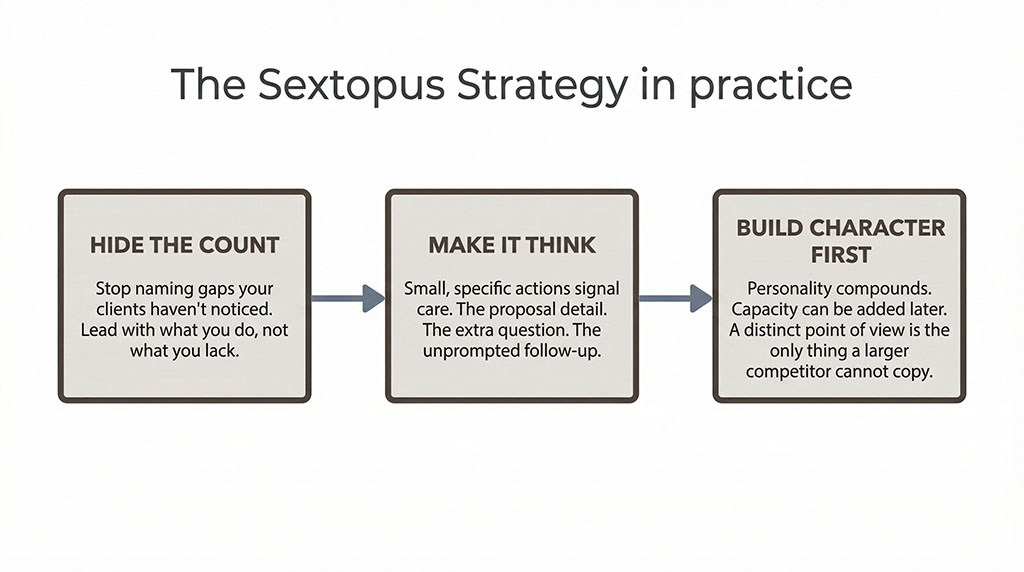
Stop inventorying your gaps in client conversations. The moment you say “we’re a small team, but…” you’ve pointed at the missing tentacles. The client wasn’t looking. Now they are. Lead with what you do — specifically, concretely, with examples — and let the constraint stay underwater.
Make your work feel like it’s thinking. Harryhausen spent 4.5 months on a single skeleton battle sequence, averaging 13 frames of film per day. Half a second of footage. Not because he had to — because that was the standard he held. The equivalent for your business isn’t longer hours. It’s the specificity in a proposal. The extra question in a discovery call. The unprompted follow-up. Small movements that signal: something is alive inside this business.
Build character before you build capacity. Most small businesses try to look bigger than they are. Harryhausen did the opposite — he made six-tentacled monsters people fell in love with, from a garage, with his father doing the engineering and his mother sewing the costumes. He didn’t become influential because he scaled. He became influential because his work had a personality no budget could replicate. You can draw a direct line from a man in a Los Angeles garage to Lord of the Rings, Jurassic Park, the entire modern visual effects industry — not because he had resources, but because he had a point of view so distinct it was impossible to mistake for anyone else’s.
The city of San Francisco never found out about the bakery truck. The film played, the bridge survived in real life, and nobody counted the tentacles on the creature pulling it apart on screen.
What they remembered was the creature.
That was always the only thing for sale.
Find out whether your marketing is building character or just filling a calendar
Most audits we run surface the same problem: content built around what’s easy to produce, messaging measured on volume, and nobody asking whether any of it is actually making clients feel something.
Takes 30 minutes.