
You know the feeling. Your morning scroll delivers a trending sound, a meme format, a cultural moment gathering momentum, and somewhere between your second coffee and your first meeting an ad appears in your feed from a brand that clearly saw the same trend. Except something is off. The connection between the trend and the product is so thin you can see through it. The copy reads like someone fed a brief into a generator with the instruction “make it relevant.” Your face does that involuntary thing, half wince, half pity.
That reaction needs a name. I call it the cringe gap.
You have felt it as a consumer a thousand times. You might have produced it yourself once or twice. That moment when a business grabs a trending format and bolts their product onto it with all the subtlety of a bumper sticker on a Bentley.
Here is what the cringe gap actually represents. It is a missing step in the process between spotting a trend and producing an ad. A translation step that almost nobody talks about, because the dominant advice in marketing right now is some version of “move fast.”
Move fast is half the answer. The other half determines whether your trend-jacked creative makes people lean in or scroll past with secondhand embarrassment.
The speed consensus isn't wrong, it's incomplete
The case for urgency has real evidence behind it. MAGNA and Sightly ran a study called Societal Sync across more than 5,300 participants. Ads placed against a live cultural moment tripled purchase intent and doubled search intent. Among people who had never bought from the brand before, purchase intent rose 23 percent when the ad ran within a week of the moment.
Now read what that research is and who paid for it. MAGNA is IPG Mediabrands’ media investment arm and Sightly sells video ad technology. Both of them make money when brands buy more culturally timed media, which is what the study recommends. It measures stated intent from survey participants, not purchases and not media cost. Nobody tracked whether those 5,300 people went on to buy anything.
So take the direction and discount the size. Something real is happening when creative lands inside a live moment. The multiple is a survey answer, not a receipt.
You will also hear people claim that culturally timed creative buys cheaper impressions. I went looking for the source behind that number and there isn’t one. Treat it as folklore until somebody shows you the study.
The window is genuinely narrow, though. In April 2026, Publicis Groupe and TikTok published a joint whitepaper built on six months of data. The median TikTok trend in Australia and New Zealand lasts three days. Just over half, 55.9 percent, are gone inside a working week. If you are deliberating on Monday, the moment is buried by Wednesday.
Here is the part the “move fast” crowd skips. Only 27 percent of trends hold relevance beyond two weeks. Roughly three quarters of the trends businesses scramble to capitalise on have stopped mattering inside a fortnight.
That is the finding. Here is my own arithmetic on top of it. Think about how long your build, your approval and your platform’s learning phase actually take, then put that number next to a fortnight. For a lot of businesses the trend is finished before the campaign has settled. The whitepaper does not say that. Your own calendar will.
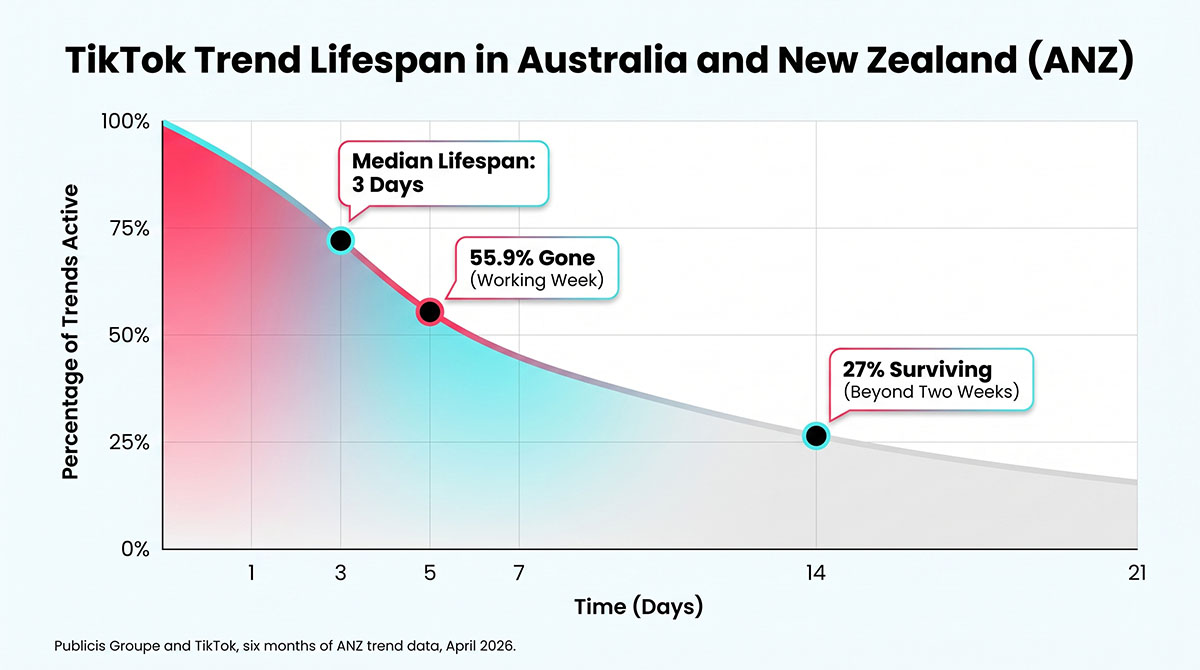
The speed-first approach has businesses chasing an evaporating target. The ones that consistently produce culturally resonant creative are not faster. They are more selective. They solved a different problem. Not how quickly can we react, but which trends deserve a reaction at all, and how much creative weight can they carry.
The translation step nobody teaches
In September 2014, DiGiorno Pizza tweeted “#WhyIStayed You had pizza.” They matched a trending hashtag without spending thirty seconds understanding what it was about. Domestic violence survivors were sharing their stories in the wake of the Ray Rice video. DiGiorno deleted the tweet and spent days replying to people individually to apologise. The apology tour was sincere. The damage was already done.
You probably remember Burger King UK’s International Women’s Day headline in March 2021. “Women Belong in the Kitchen.” It was designed as a thread. The next tweet explained that only 20 percent of chefs are women and that the brand was funding culinary scholarships worth 25,000 dollars. Social media does not work in threads. Most people saw the first line and nothing else. The post was deleted with an apology.
The detail that proves the point is this. The identical headline ran as a print ad in the New York Times, where the explanation sat immediately below it on the same page, and it worked. Same words. Same brand. Same intent. One format kept the context attached and one tore it off. The failure was never the concept.
These are not failures of speed. They are failures of translation. The trend existed. The brand connection existed. Pizza and staying. Kitchens and cooking. What was missing was the diagnostic step: does this trend carry cultural weight that our brand is not equipped to handle, in the format we are about to use?
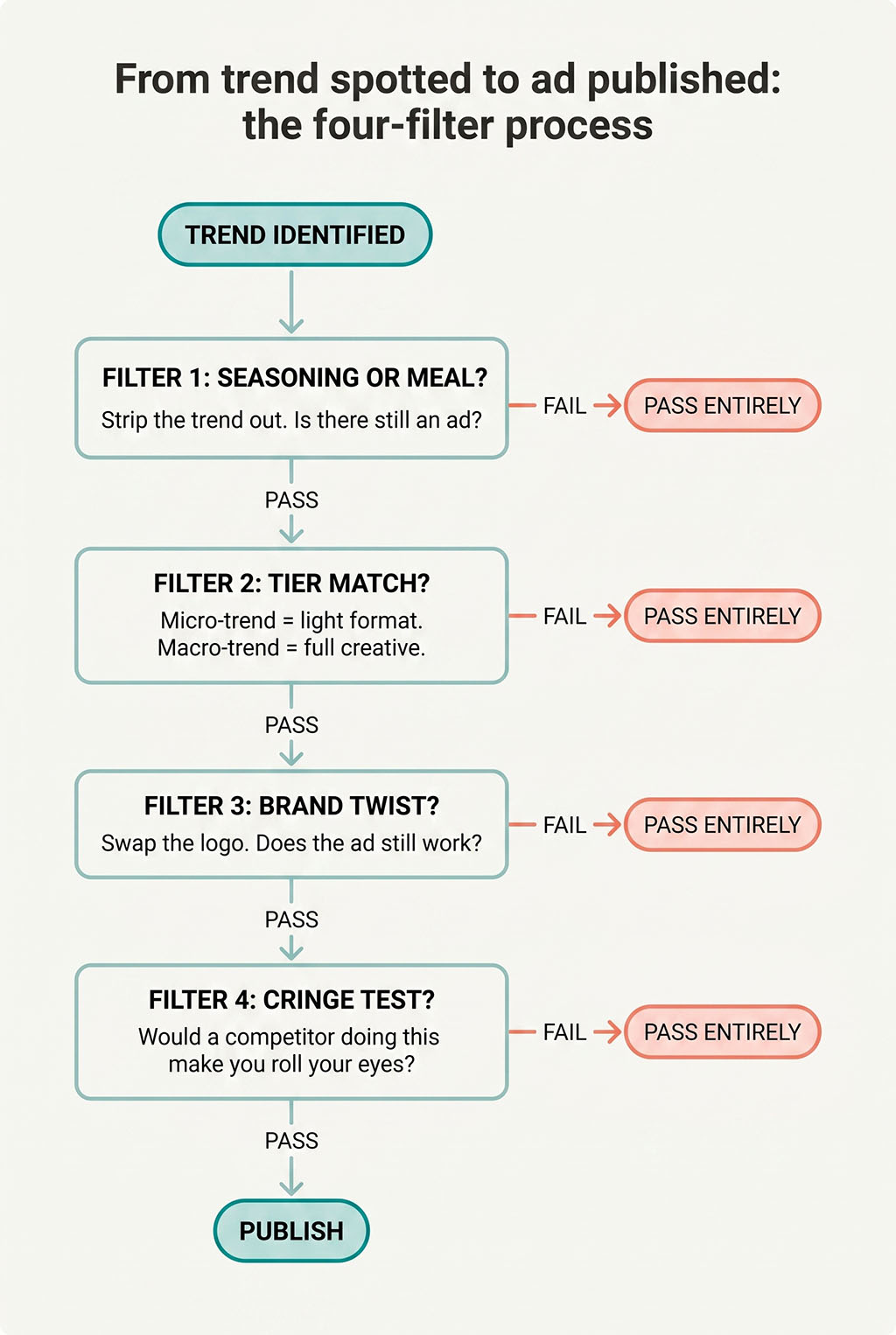
The gap between spotting a trend and producing an ad contains four filters. Skip any of them and you are gambling with your reputation.
Filter one: is the trend the seasoning or the meal? Your product’s value proposition is the dish. The trend adds relevance, timing and emotional resonance. It makes people pay attention right now instead of scrolling past. It does not replace the reason to buy. Strip the trend out of the concept. If there is no ad left underneath, you built the meal around the garnish and it will collapse.
Filter two: does the trend tier match the production weight? Use the lifespan data to set the tiers, because it draws the line for you. A micro-trend is a sound, a meme format or a visual aesthetic that lives somewhere between a few days and a fortnight. That is the 73 percent. It pairs with light creative. A quick UGC video. A static image with a sharp caption. Do not build a ten-slide carousel around a sound that will be dead in four days.
Macro-trends are the 27 percent that clear two weeks and keep going for months. Wellness culture. Authenticity over polish. The de-influencing mood. Those earn deeper investment. Full narrative arcs. Proper storytelling. Campaign-level creative that takes weeks rather than hours. If a trend has not proved it can survive a fortnight, it has not earned that budget yet.
Think of it like matching wine to food. You do not open the reserve bottle for Tuesday night leftovers.
Filter three: the brand twist. Swap your logo for a competitor’s. Does the ad still work? If yes, you have not finished. The execution has to include something only your brand can credibly say, show or reference. When the American burger chain Wendy’s opened its first Australian store on Cavill Avenue in Surfers Paradise, it launched on World Redhead Day, 23 May 2025, with a campaign called Redhead Redemption. It turned “ranga,” a word most brands would run from, into a badge of honour. It won at the 2025 B&T Awards, and the campaign side reports 434.6 million earned impressions with sales 45 percent above forecast. Those two numbers come from the agency and the award entry, so treat them as the campaign’s own account of itself rather than an audited result. The award is the independently verified part.
The reason it belongs here has nothing to do with the numbers anyway. No other fast food chain could have run that ad. The trend, Australian slang and cultural identity, was the seasoning. Wendy’s red-haired brand identity was the meal.
Filter four: the cringe test. Before anything goes live, ask one question. Would this feel forced if a competitor did it? If you can picture a rival brand running the same concept and you would roll your eyes, the connection between trend and brand is not strong enough. Find a sharper angle or pass entirely.
"So this is a framework for doing nothing."
That is the objection and it is reasonable. Four filters. A three day median. By the time you have run the diagnostic the trend is buried in yesterday’s scroll.
Except the filtering does not happen after a trend appears. It happens before.
The businesses that produce culturally fluent ads at speed have pre-built their guardrails. They already defined their brand voice boundaries. They already know which trend tiers they can execute against and at what production weight. They already decided what cultural territory is and is not theirs to play in.
Duolingo’s social team does not deliberate for three days when a trend surfaces. Zaria Parvez, who runs the account, describes a standing two day cycle from concept to execution, and the team approves its own content rather than waiting on senior leadership. There is a Standards and Practices channel where they can pull in a consultant when something needs a second opinion, but the default is that the people who understand the character make the call. The guardrails are structural, built into how the team operates, so the per-trend decision happens in minutes, not meetings. Yes or no. Light touch or full send.
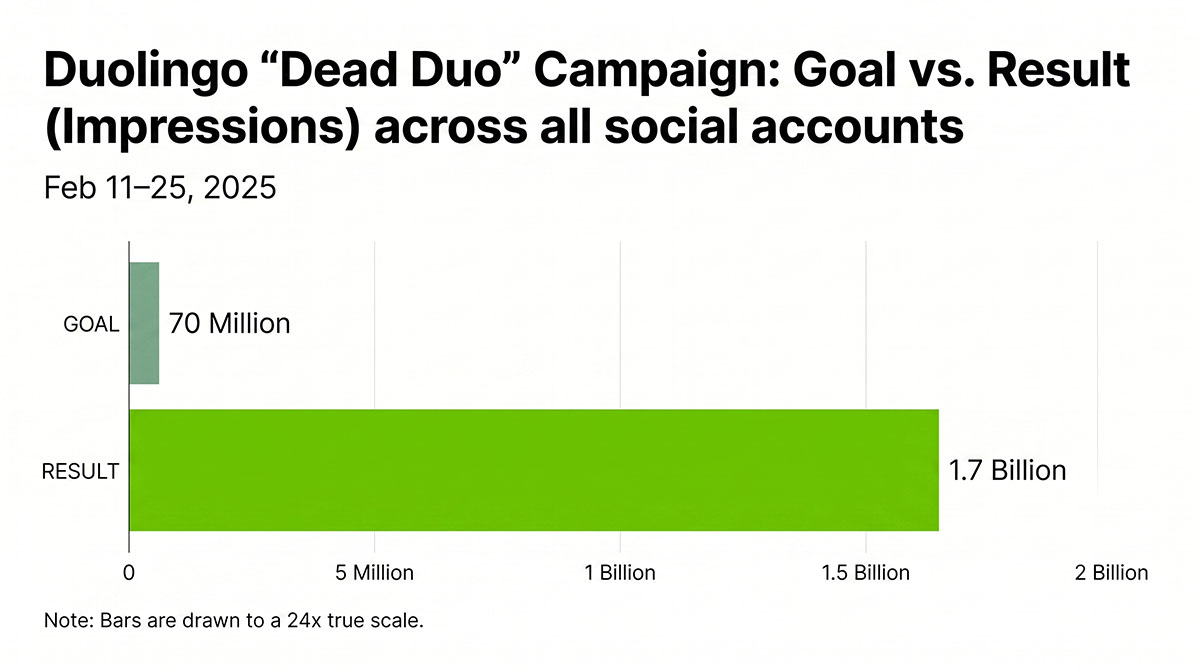
Look at what that structure produces. In February 2025 Duolingo killed off its mascot in a two week campaign that ran from the 11th to the 25th. The internal goal was 70 million impressions. It generated 1.7 billion across the brand’s social accounts, and roughly twice the social conversation of the top ten Super Bowl ads that year. That was not spontaneity. It was a planned campaign executed by a team that had already settled what the owl would and would not do, which is exactly why they could commit to something that risky without a month of meetings first. Every trend that hits their filter either fits the character or gets passed on. No committee. No agonising.
It is the same principle behind every fast kitchen. A chef who preps their mise en place, with ingredients measured, sauces reduced and stations organised, can plate a dish in ninety seconds when orders come in. The speed comes from the preparation, not from skipping steps. A chef who grabs ingredients mid-service and improvises everything produces chaos, not cuisine.
The framework does not slow you down. It eliminates the trends you were going to waste cycles on anyway, the three quarters that evaporate, and lets you move decisively on the 27 percent that last.
Where speed-first still wins
The filtering framework is not universal. Some moments demand pure reactive speed and the filters compress to a single gut check.
In November 2023 a customer’s Stanley cup survived her car burning out, and her TikTok showing the ice still intact went viral. Within days, Stanley’s global president Terence Reilly filmed a personal response and offered to replace the car she had lost. Her video landed mid-November, his reply was public by the 20th, and the replacement car was delivered on 20 December. No ten-slide carousel. No four-filter diagnostic. The connection between trend and product was so direct that the only filter needed was can we respond authentically? The answer was yes. The result was the most compelling product demonstration the brand could have engineered, except they did not engineer it. They showed up.
The distinction is between trends that happen to your brand, meaning customer UGC, product moments and category conversations, and trends that happen around your brand, meaning cultural moments, meme formats and audio trends. The first category demands speed with minimal filtering. The second demands the full translation process. Confusing the two is how businesses end up forcing a connection the audience can smell from three scrolls away.
Building the filter into the system
The practical question is not whether the framework makes sense. It is whether it survives a Tuesday morning when a trend is peaking and the pressure to post feels physical.
The answer is to stop treating trend response as an ad-hoc creative exercise and start treating it as an operational system. Pre-define your brand’s cultural territory. Document which trend tiers match which production levels. Build the cringe test into your approval workflow, not as a vague “does this feel right” but as the specific question: would this work identically for a competitor?
The best restaurants do not decide their menu when customers walk in. They already chose which ingredients they work with, which techniques suit their kitchen, and which dishes they will never serve regardless of what is popular. When a seasonal ingredient appears at the market, the decision to use it is fast, because the criteria already exist.
That is the reframe worth holding onto. Your product is the dish. Your value proposition is the recipe. Cultural trends are the seasonal ingredients that make the menu feel alive and current and worth coming back for. The meal was always the point.
The businesses that get this right are not the ones who react fastest. They are the ones who built a kitchen that knows exactly which ingredients belong on which plates, and which ones to leave at the market no matter how popular they are.
Your marketing, looked at properly
Thirty minutes on your current setup — what’s working, what’s quietly leaking budget, and what I’d fix first. You’ll leave with a clearer picture whether we work together or not.
Got something specific bugging you? Flag it when you book and I’ll have it looked at before we talk.

AboutBruce Marjoribanks
Bruce Marjoribanks has spent 27 years in marketing, including building, running and selling his own agency before going independent. He now runs every channel - paid, organic, social, email, creative and automation - as one integrated system, with AI ehancing production and the judgment staying human.