
Why defending yourself in the reply box costs you customers — and what to write instead
Her fingers were on the keyboard. The review had been up six hours.
“Terrible experience. Staff were rude and unprofessional. Would never return.”
The reviewer had been the problem — difficult from the moment she walked in, impossible to please, left without paying the full amount and then had the nerve to—
She started typing.
We pride ourselves on exceptional service. In this instance, the customer was…
Every reputation management guide will tell you to respond to negative reviews. That part is correct. Businesses that respond to reviews are consistently perceived as more trustworthy than those that don’t. Review response matters.
What those guides won’t tell you is what not to say.
The instinct — the human, defensible, completely natural instinct — is to correct the record. Especially when the review is wrong. Especially when you know exactly what happened and the reviewer is leaving out the part where they were rude to your staff, where they agreed to the terms, where you went above and beyond and still they left unhappy.
The instinct is to respond like a reasonable person presenting their side of the story.
That instinct will cost you customers. Reliably.
Why Nobody in the History of Commerce Has Ever Read a Correction and Thought "They're Right"
Here’s where we need to talk about Al Capone.
In 1931, Capone genuinely believed he was a public benefactor. America’s most notorious gang leader — the man who ran Chicago, who ordered hits, who built an empire on violence — described himself to a reporter as “unappreciated and misunderstood.” He wasn’t posturing. He meant it.
“Two Gun” Crowley, a killer who’d shot a policeman at point-blank range, left a letter after his capture: “Under my coat is a weary heart, but a kind one — one that would do nobody any harm.”
Dale Carnegie, who documented both cases in How to Win Friends and Influence People, wasn’t collecting gangster trivia. He was making a point that should stop you mid-keystroke: nobody, ever, blames themselves.
Not murderers. Not difficult customers. Not the reviewer who left your business two stars after breaking three policies and demanding a refund.
Lewis Lawes, longtime warden of Sing Sing prison, confirmed it after years of studying the criminal mind: most inmates “stoutly maintain they should never have been imprisoned at all.” They rationalise. They explain. They build an air-tight case for their own innocence, right up until sentencing.
If hardened criminals in maximum security prisons can’t locate their own fault — what makes you think the person who left you a one-star review is going to read your carefully worded correction and think: Actually, they’re right. I was the problem.
They’re not. They’re going to do something worse.
Before We Go Further — You're Probably Thinking Something
But my situation is different. The review contains a factual error. It accuses us of something that didn’t happen. We have documentation. We have witnesses. This isn’t a matter of opinion — this is false.
That’s the hardest version of this problem, and it deserves a straight answer.
Here’s what actually happens when you correct the record publicly.
The reviewer — who is already Capone in their own mind, already the wronged party — reads your correction. Their brain, which cannot locate the part of itself that accepts blame, goes to work building a counter-case. Then they reply. The exchange continues, in public, on your business profile, visible to every prospective customer who searches your name for the next three years.
Carnegie put it plainly: criticisms are like homing pigeons. They always return home.
You can’t win this argument. Not because you’re wrong — you might be completely right. But because the argument itself is the loss. Every exchange in that comment thread is a red flag for a stranger who wasn’t there and has no way to know who’s telling the truth.
They’re not going to parse the dispute. They’re going to feel the temperature. And an argument under a one-star review reads the same regardless of who started it.
The worst-case review response isn’t no response. It’s a back-and-forth under a one-star review that makes your business look brittle.
The Test Pilot Who Got It Right
There’s a pilot named Bob Hoover — famous test pilot, regular at air shows — who landed a plane after both engines stopped at 300 feet. When he inspected the aircraft, he found it had been fuelled with jet fuel instead of gasoline. A young mechanic’s mistake. Expensive plane, three lives nearly lost.
Hoover walked up to the mechanic, put his arm around the man’s shoulder, and said: “To show you I’m sure that you’ll never do this again, I want you to service my F-51 tomorrow.”
No lecture. No justified anger. No correction of the facts.
Carnegie documented this story for the same reason it applies here: the response that costs you nothing in the moment is often the one that preserves everything long-term. Hoover kept his mechanic, his reputation for grace under pressure, and the trust of everyone who watched it happen.
You have the same choice in the reply box.
The Three-Move Protocol
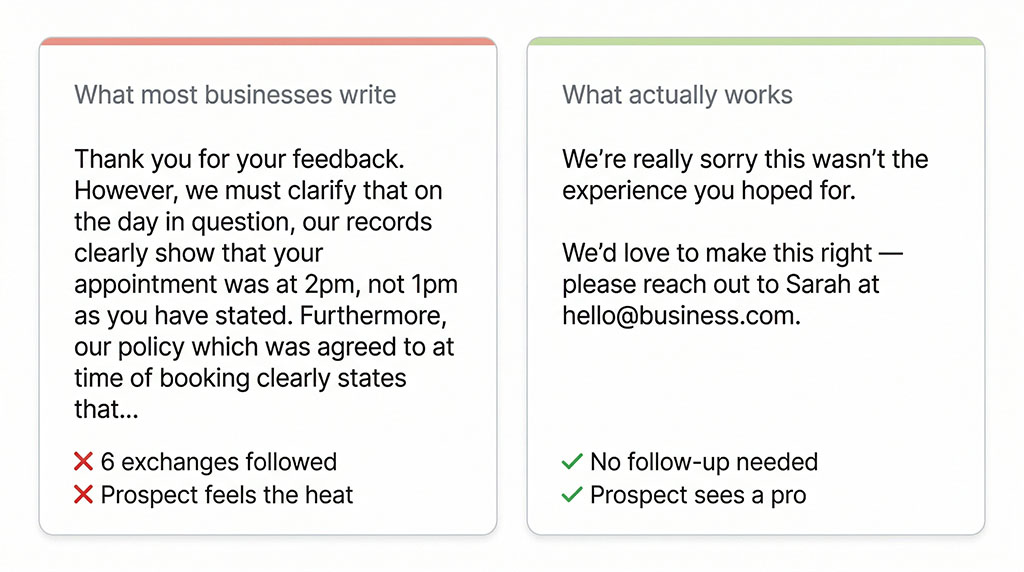
Move 1: Acknowledge without conceding.
“We’re really sorry to hear this wasn’t the experience you hoped for.”
This is not an admission of wrongdoing. It’s acknowledging they’re unhappy — which is already true, already public, and uncontested. You’re not agreeing with their version of events. You’re meeting them where they are. Every future reader sees a business that takes feedback seriously rather than one that circles the wagons.
Move 2: Move the conversation offline.
“We’d love to make this right — please reach out to [Name] directly at [contact].”
This does two things at once. It signals to every reader that you take complaints seriously, and it removes any substantive exchange from public view. Nothing good happens in the reply thread. The conversation you need to have — the one where facts might actually be corrected, where resolution is possible — happens privately.
Move 3: Say nothing more in public.
No follow-up. No clarification. No “just to add.” One response, then done. If they reply publicly again, you’ve already said everything that needed saying. The record shows a business that reached out and offered to resolve the issue. That’s the version future customers see.
When the Standard Protocol Doesn't Apply
Three situations require a different calculation.
If a review contains a health or safety claim that could cause genuine harm if left uncorrected, address it — once, clearly, without emotion. Not to win the argument. To protect people who might be affected by false information.
If a review violates the platform’s own policies (fabricated, posted by a competitor, or contains personal information), use the platform’s dispute mechanism before responding publicly. You may not need to respond at all.
If your industry has professional or regulatory standards that require a public record, one measured correction is sometimes necessary. One. Then stop.
Outside those cases: three moves, then close the tab.
Nine Words
She deleted the draft.
Twelve lines about the customer’s unreasonable behaviour, the policy she’d agreed to, the staff members who’d done nothing wrong — all of it true, all of it irrelevant.
She typed nine words instead:
“We’re sorry this wasn’t the experience you deserved — please call us.”
Twenty-seven other people would read that one-star review over the next month. None of them would know what really happened. But they’d see a business that responded like a professional — not an owner who’d been wounded, not a team that got defensive, not a company that needed to win.
That’s the Capone principle, applied to the reply box: the person who wronged you genuinely doesn’t think they did. You can’t argue them out of that belief. But you can choose what every future customer thinks of you instead.
Struggling with a review situation right now? [Contact us / Book a free 20-minute call] — we help small businesses build reputation systems that work before a bad review lands, not after.