
The bicycle hasn’t changed in 140 years.
Not really. The materials are lighter, the gears more precise, but the basic design — two wheels, pedals, chain, handlebars — locked in during the 1880s and stayed there. Every engineer who tackled the problem of human-powered two-wheeled transport arrived at the same answer. The design converged, stabilised, and that was that.
In 1977, the economist E.F. Schumacher used the bicycle to explain something most business owners have felt but never had language for: why some problems get solved and stay solved, and why others eat frameworks for breakfast.
He called them convergent and divergent problems. The distinction will change how you think about almost everything in your business.
The dead kind and the living kind
A convergent problem is a bicycle. Study it long enough, and all smart people arrive at the same answer. The design gets refined, optimised, finalised. Once solved, the problem is dead. You follow the instructions. You don’t need creativity or judgment — you need execution. Setting up a CRM is a convergent problem. Configuring your tracking pixels. Building a landing page template. These have correct answers, and the correct answers are stable.
Schumacher’s observation was that modern business — and modern thinking in general — treats every problem as if it’s convergent. As if the right framework, the right process, the right consultant will find the answer, and then the answer will hold.
But some problems aren’t bicycles.
Schumacher’s example was education. How do you teach children well? One group of experts says discipline and authority — structure produces learning. Push that logic to its conclusion and the school becomes a prison. Another group says freedom and autonomy — intrinsic motivation produces learning. Push that logic to its conclusion and the school becomes a jungle.
Both arguments are internally consistent. Both are backed by evidence. And the more rigorously you pursue either one, the further apart they get.
That’s a divergent problem. The answers don’t converge toward a solution. They diverge toward opposite extremes. And the harder you push for a clean resolution, the worse things get.
You've lived this. Probably last quarter.
Think about the last management framework your business adopted. EOS. OKRs. Agile. Traction. A new accountability structure, maybe. A new meeting rhythm.
It worked. For a while. People were energised by the clarity. Roles got cleaner. Decisions got faster.
Then — around month four, five, six — the cracks appeared. The system that created accountability started creating rigidity. The structure that drove focus started killing adaptability. The process that simplified decisions started ignoring the messy ones that didn’t fit the framework.
You didn’t implement it wrong. The framework isn’t broken. You ran into the wall that Schumacher described fifty years ago: you applied a convergent solution to a divergent problem.
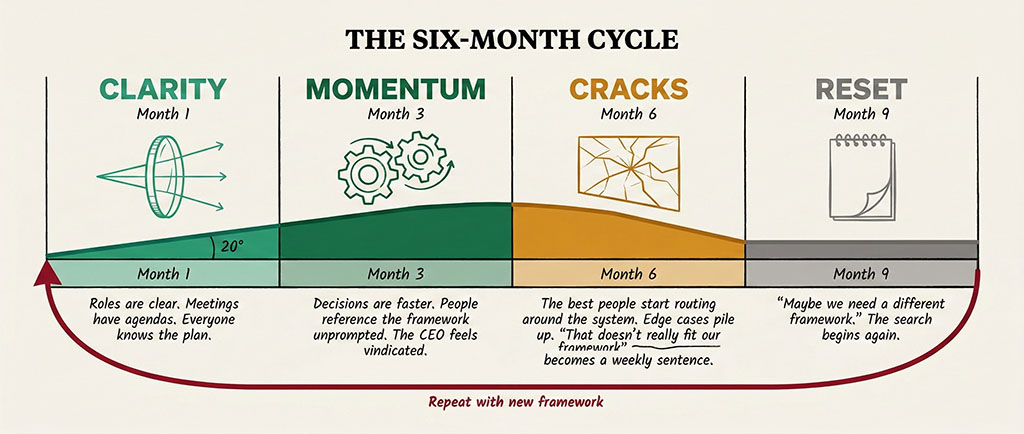
Growth versus sustainability. Freedom versus accountability. Innovation versus consistency. Speed versus quality. These are the problems that actually keep you up at night. And they’re all divergent. The more logically you pursue one side, the more damage you do to the other.
A framework that prioritises accountability will, if followed consistently, squeeze out the autonomy your best people need to do creative work. A framework that prioritises autonomy will, if followed consistently, dissolve the structure that keeps everyone pointed in the same direction.
No amount of tweaking the framework fixes this. The problem isn’t the specific framework. It’s the assumption that the problem is convergent — that a correct answer exists, and you just need to find it.
"So you're saying don't bother with frameworks?"
No. And this is where most people misread Schumacher.
Convergent problems are real, and frameworks solve them brilliantly. You absolutely need a system for your finances, your project management, your reporting cadence, your onboarding process. These are bicycles. Solve them, document the solution, and move on.
The danger is in the category error — applying convergent thinking to divergent territory. And most business owners can’t tell which is which, because the consulting industry has a financial incentive to sell every problem as convergent. That’s the only type they can package into a methodology, train a team on, and charge recurring fees for.
Here’s a rough diagnostic. If you can imagine a panel of experts studying the problem and eventually agreeing on a single best answer — it’s convergent. Solve it with a system.
If you can imagine equally smart experts studying the problem and arriving at opposite conclusions, both well-reasoned — it’s divergent. No system will hold. Something else is needed.
The part Schumacher got most right
So what does work for divergent problems?
Schumacher pointed to the French Revolution’s motto: Liberté, Égalité, Fraternité. Liberty and equality are a classic divergent pair. Leave people free, and the strong dominate the weak — no equality. Enforce equality, and you must curtail freedom. Logic can’t reconcile them. Push either to its extreme and something breaks.
The revolutionaries added a third word. Fraternité — brotherhood. And Schumacher’s insight was that this third force comes from a higher level than the two opposites. Liberty and equality can be legislated. Brotherhood can’t. It has to come from the people themselves. It’s a quality of character, not a rule of law.
In education, the higher force that holds discipline and freedom together is love. You can’t put it in the lesson plan. You can’t build a curriculum around it. The great educators aren’t the ones who found the right balance between structure and freedom — they’re the ones who transcended the trade-off entirely because they genuinely cared about the students. The tension didn’t disappear. It stopped being destructive.
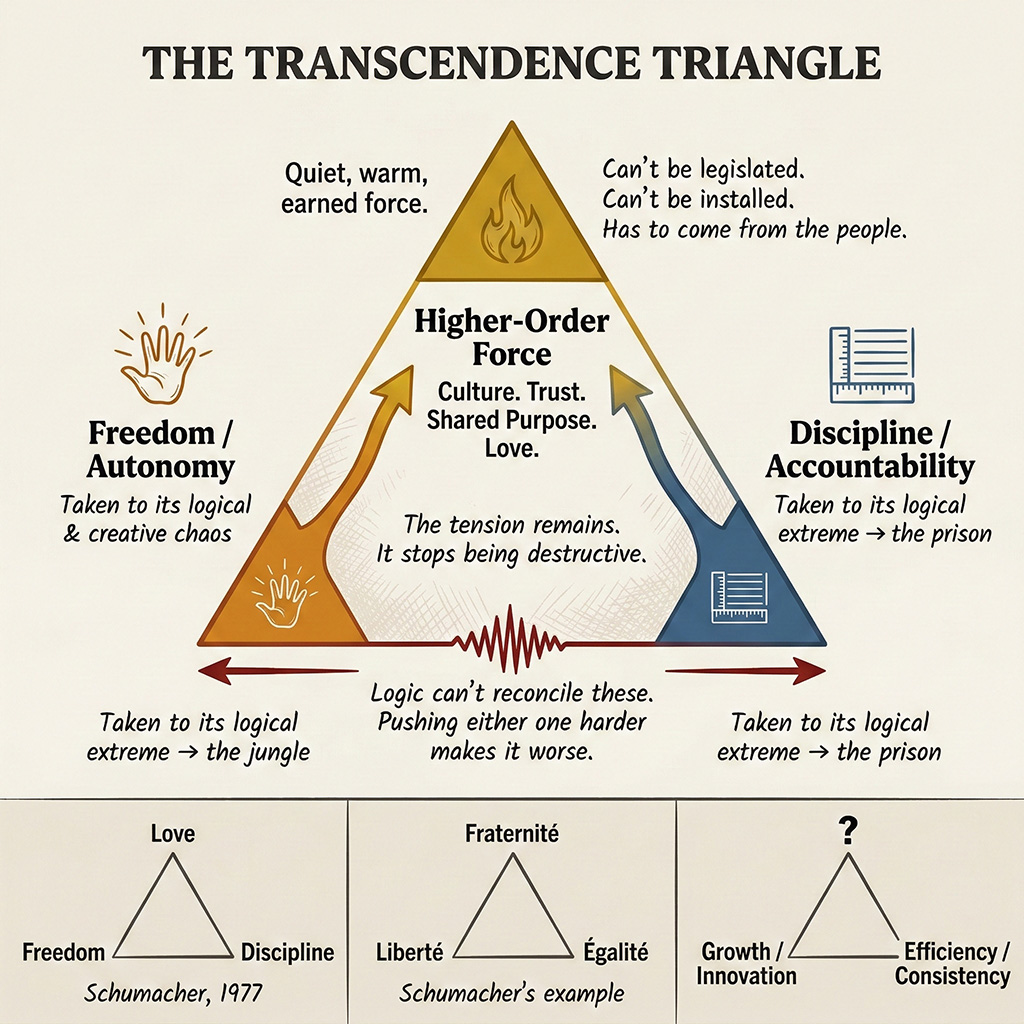
In a business, the divergent tension between growth and sustainability, between freedom and accountability, between innovation and consistency — that tension doesn’t get resolved by a better org chart. It gets held together by something harder to install and impossible to fake: trust between people who share a genuine purpose.
That’s not a framework. That’s a quality of leadership. And it’s why companies with mediocre systems but strong culture outperform companies with brilliant systems and hollow culture — every single time.
What this means on Monday morning
Schumacher wasn’t a business consultant. He was an economist and philosopher, and he died the year Guide for the Perplexed was published. He wasn’t trying to help you run your Q3 planning session.
But the diagnostic is immediately useful. Next time you’re frustrated that a system stopped working, ask one question: Was this a bicycle, or was this something alive?
If it was a bicycle — if the problem was a process that needed documenting, a workflow that needed standardising, a tool that needed configuring — then the system should have worked, and you should troubleshoot the implementation.
If it was something alive — if the problem involved people pulling in different directions, competing priorities that both matter, tensions that resist clean resolution — then the system was never going to hold. You were building a bicycle to solve a problem that isn’t mechanical. The answer isn’t a better framework. It’s a better question: What’s the higher-order force that holds these opposites together in our specific business?
Sometimes that force is a leader who earns trust from both sides of the tension. Sometimes it’s a shared mission that makes trade-offs feel less like losses. Sometimes it’s radical transparency — one person who sees the whole picture and can hold competing priorities without flinching.
It’s never a slide deck.
The bicycle hasn't changed in 140 years
And it shouldn’t. It’s a convergent solution to a dead problem, and dead problems stay solved.
Your marketing strategy, your team dynamics, your growth trajectory — these are not bicycles. They’re living systems full of living tensions. Every time you try to “solve” them the way you’d solve a design problem, you’ll get six good months and then the cracks.
Schumacher would tell you to stop looking for the right framework. Start looking for the right force — the one that doesn’t eliminate the tension, but makes it productive. The one you can’t buy, can’t copy, and can’t install from a playbook.
The one that has to come from you.
Most marketing fragmentation is a divergent problem disguised as a convergent one. No framework will fix it. But you already knew that.
See What One Brain Would Change
Map your current agency setup against the integrated model — and find out where the gaps, overlaps, and wasted spend are hiding.
Most clients find 2–3 channels working against each other that nobody spotted because nobody could see both. Takes 30 minutes.
You don’t need a better framework. You need to stop being the one holding it all together.