
You’re at a barbecue. You barely know the host. Some guy in a polo shirt corners you near the drinks table and opens with: “Bro, have you heard about $LUNAR? I got in early—I can still get you a spot.”
You smile politely. You look for the exit.
He might be right. $LUNAR might 10x. But you don’t care, because he skipped every step that would make you care. He read the room like a man wearing a blindfold—started the conversation at the wrong point, for the wrong person, at the wrong time.
Your ads are doing this every single day.
Not because the copy is bad. Not because the offer is weak. Because you’re starting the conversation in the wrong place. And that one mistake—where you open—is the difference between an ad that prints money and one that burns it.
Forget the textbook. Here's what actually matters.
There are five levels of customer awareness. You’ve probably seen them floating around marketing Twitter, usually in some overly academic diagram that makes the whole thing feel like a college lecture.
Here’s what most people teaching this stuff won’t tell you: don’t be a nerd about it.
These levels are a loose mental model—not a taxonomy to memorise. They exist for one reason: to tell you where to start your ad. That’s it. The only difference between an “unaware” ad and a “most aware” ad is the opening line. Where you pick up the conversation.
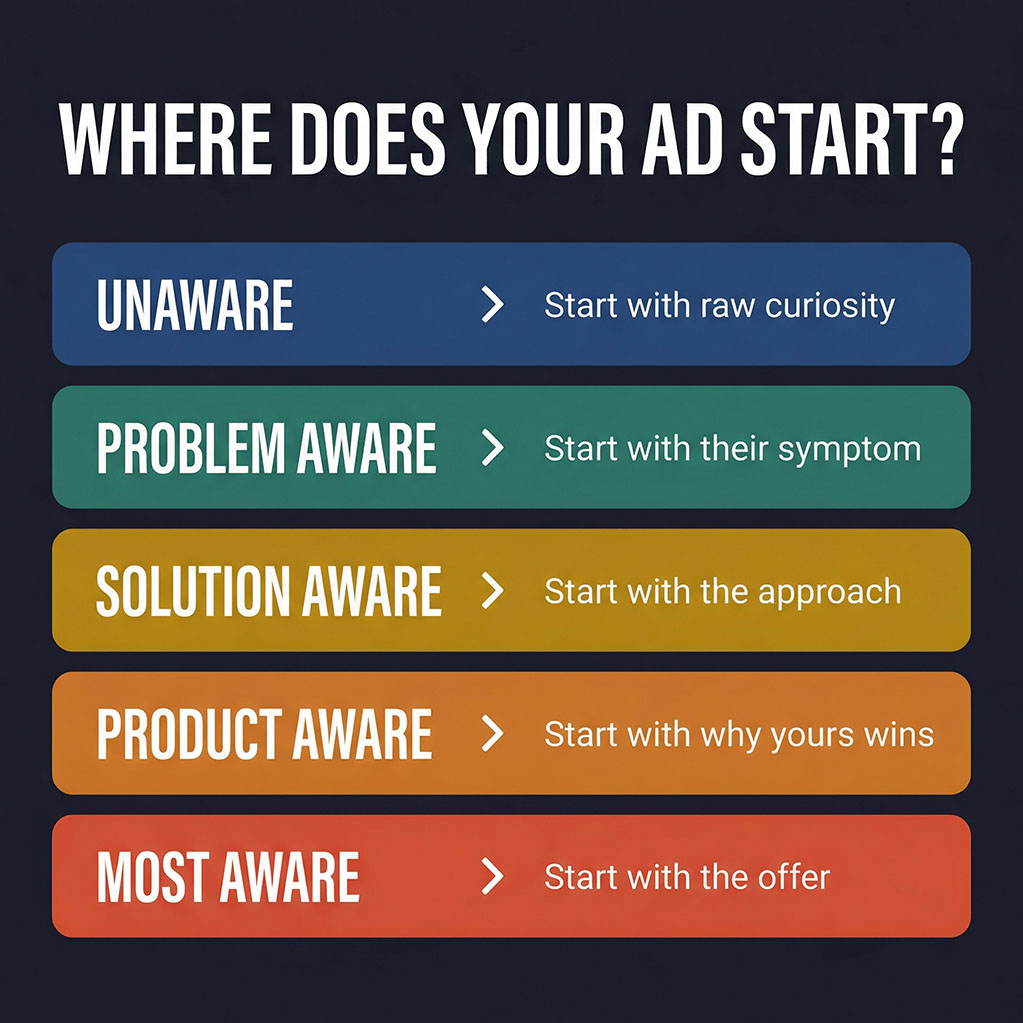
Here’s the cheat sheet:
Unaware — They don’t even know they have a problem. You’re starting with raw curiosity. Something interesting, weird, or unexpected that pulls them in sideways.
Problem Aware — They know something’s wrong. They feel the symptom. You’re starting with their pain—naming the problem they’ve been ignoring or can’t quite articulate.
Solution Aware — They know solutions exist. They’re shopping. You’re starting with the promise of a solution—any solution—and why the approach matters.
Product Aware — They’ve narrowed it down to your category. They want a chiropractor, not a massage therapist. You’re starting with why your specific type of solution beats the alternatives.
Most Aware — They know you. They’ve been to your site, maybe even bought before. You’re starting with a reason to act now—an offer, a deadline, a nudge.
Five levels. Five different starting lines. One decision: which door does your prospect walk through?
The part nobody talks about: the journey is always the same
Here’s where it gets interesting—and where most awareness-level content completely drops the ball.
Every prospect, regardless of where they start, needs to travel the same path before they buy. The destination doesn’t change. Only the boarding point does.
Think of it like a bus route with six stops:
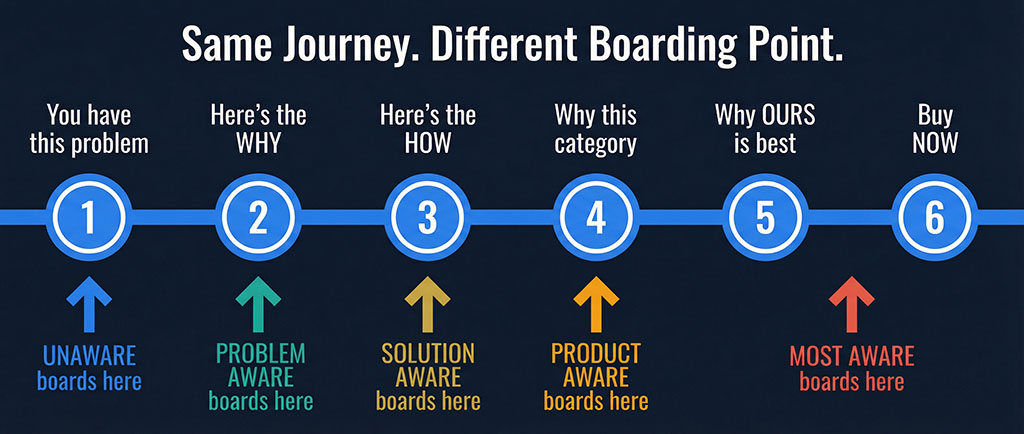
Stop 1: You have this problem (or you’re missing this opportunity). Stop 2: Here’s the mechanism—the why behind the fix. Stop 3: Here’s the specific approach—the how. Stop 4: Here’s why this category of solution is the right one. Stop 5: Here’s why ours is the best in the category. Stop 6: Here’s why you should buy right now.
An unaware prospect needs to board at Stop 1. You’ve got to take them through every stop on the line. That might happen in a single long-form ad, or it might happen across your ad, your landing page, and your product page working together.
A most-aware prospect? They’ve already ridden stops 1 through 5. They just need the final nudge at Stop 6—a limited-time offer, a reminder, a reason to pull the trigger today.
A problem-aware prospect boards at Stop 2. A solution-aware prospect boards at Stop 3. And so on.
The mistake most advertisers make is writing every ad like the prospect is boarding at the same stop. Usually Stop 4 or 5—somewhere mid-journey—because that’s where the advertiser is most comfortable talking. You already know your product is great. You love explaining features. So you default to product-aware messaging and wonder why your ads don’t convert.
Meanwhile, there’s an enormous pool of people at Stop 1 and Stop 2 who would buy from you—if you’d just start the conversation where they are, not where you are.
Here’s a concrete example. Say you’re a chiropractor in Auckland. If you run a headline like “How to Choose the Best Chiropractor in Auckland”—that’s a Stop 4 ad. It only works for people who’ve already decided they want chiropractic care and are comparing providers.
But the golfer who plays three times a week and wakes up with a stiff lower back? He’s at Stop 1. He doesn’t know he needs a chiropractor. He doesn’t even think of his stiffness as a “problem” yet—it’s just Tuesday morning. Your Stop 4 ad is invisible to him. Not because the copy is bad, but because you opened the conversation ten steps ahead of where he is.
An unaware ad for that same chiropractor might open with: “The weekend hobby that’s quietly wrecking your spine.” Pure curiosity. No mention of chiropractic. Just a door into the conversation—the right door, for that person, at that stage.
"That's great in theory. But I can't see awareness levels in my ad dashboard."
This is the real objection, and it’s valid.
There’s no dropdown in Meta Ads Manager that says “show me only the problem-aware segment.” You can’t create an audience of “people at Stop 2.” Your ad account is a blunt instrument—you’re broadcasting to a mixed crowd where all five awareness levels are jumbled together, scrolling the same feed.
So how do you actually use this?
You don’t target awareness levels. You diversify your ad inventory across them.
Say you’re making 20 ads this month. If all 20 are solution-aware (“Here’s why our approach works better than the alternatives”), you’ve written one type of conversation opener and broadcast it to a room full of people at different stages. The ones at Stop 3 might bite. Everyone else scrolls past.
Instead, spread those 20 ads across the levels. Maybe five unaware ads that hook with raw curiosity. Five problem-aware ads that name specific symptoms. Five solution-aware ads. And five that hit your warmest audience with direct offers.
Now you’ve got conversations starting at every door. The algorithm handles the matching—it’s actually quite good at figuring out which message resonates with which person. But it can only match what you give it. If you only hand it one type of ad, it can only have one type of conversation.
The real reason to understand awareness levels isn’t academic. It’s inventory management. It’s making sure you don’t have gaps in your account where an entire segment of buyers is being ignored because nobody wrote an ad that starts where they are.
The 30-second audit you can do right now
Pull up your last 20 ads. Categorise each one by where it starts the conversation:
Does it open with curiosity or a surprising hook unrelated to your product? That’s unaware.
Does it name a symptom or problem right out of the gate? Problem aware.
Does it compare approaches or talk about the category of solution? Solution aware.
Does it assume the prospect already wants what you sell and focuses on why yours is best? Product aware.
Does it go straight to an offer, a deadline, or a reason to buy now? Most aware.
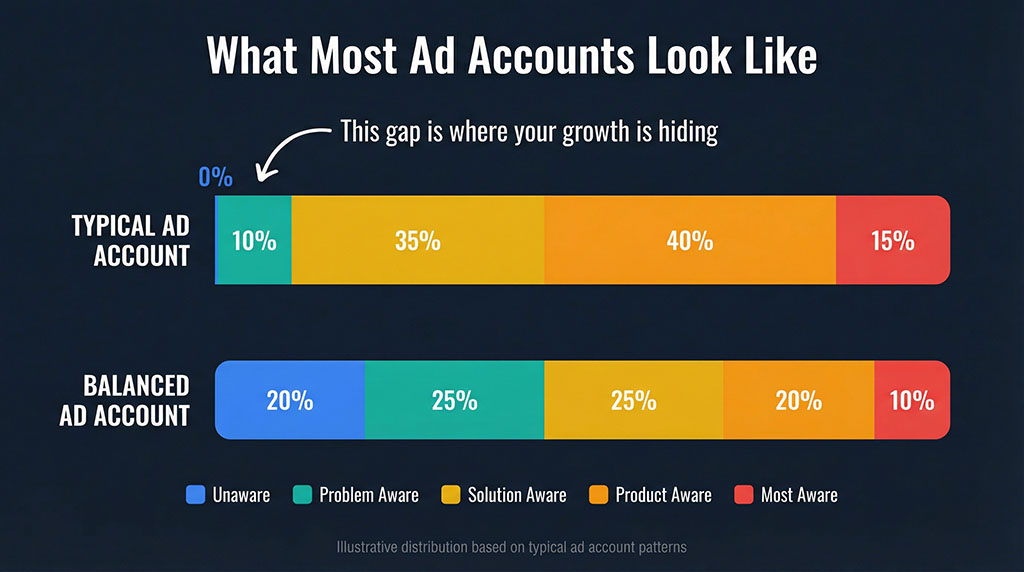
Now look at the distribution. If 15 out of 20 are product-aware or solution-aware—and that’s what we see in most ad accounts—you’ve found your gap. You’ve found the reason your ads aren’t scaling. There’s a massive pool of problem-aware and unaware prospects your account is completely ignoring.
Fill the gap. Write the ads that start where those people are. The journey will take care of itself.
Match the opening to the starting point
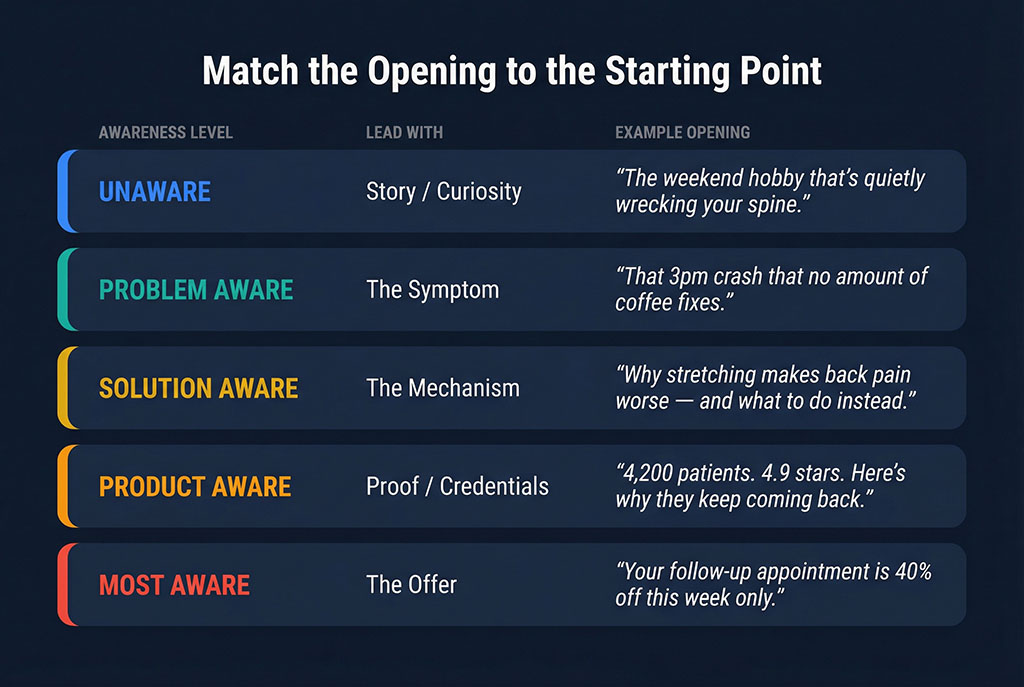
Once you know which awareness level you’re writing for, the opening style follows naturally:
For unaware prospects, lead with story or curiosity. A surprising fact. A pattern they haven’t noticed. Something that earns attention without asking for it. You’re the interesting stranger at the party who says something unexpected—not the guy pitching his startup.
For problem-aware prospects, lead with the problem. Name it. Describe the symptom so precisely they feel seen. “That 3pm crash that no amount of coffee fixes” is problem-aware. You’re the person at the party who says, “You look exhausted—rough week?” and immediately you have their attention because you noticed what they’re going through.
For solution-aware prospects, lead with the mechanism—the how and why your approach works differently. They’re already shopping. Don’t re-explain the problem they already know about. Show them the angle they haven’t considered yet.
For product-aware prospects, lead with proof. Testimonials, results, case studies, credentials. They already believe in the solution category—now they need to believe in you.
For most-aware prospects, lead with the offer. Direct. No preamble. These are your warmest people. Treat them like old friends at the party—skip the small talk, go straight to the good stuff. A deadline, a bonus, a reason to stop procrastinating and buy.
Each opening earns the right to move the prospect to the next stop on the route. Curiosity earns the right to introduce the problem. Naming the problem earns the right to present the solution. Proof earns the right to make the offer. You can’t skip stops—but you can board at whatever station your prospect is standing at.
Back to the barbecue
Remember the $LUNAR guy by the drinks table? Here’s what he should have done.
Read the room. Is this person already into crypto and just looking for the next play? Open with the offer—the tokenomics, the entry point, the deadline.
Is this person someone who understands investing but hasn’t touched crypto yet? Open with what makes this category different—why digital assets, why now.
Is this person someone who has no idea what a token is, doesn’t think about investing, and came to this barbecue to eat a sausage and talk about the football? Then don’t pitch. Tell a story. Say something interesting. Earn the next sentence before you try to earn their money.
That’s all awareness levels are. Reading the room so you know which conversation to start. Your ads are just conversations at scale—thousands of them happening simultaneously, each one starting with a single opening line.
The question isn’t what to say. It’s where to begin saying it.
Get that right, and the rest of the journey takes care of itself.
Find the Gaps Your Ads Are Missing
We’ll map your current ad account against all five awareness levels—and show you exactly where the conversations aren’t happening.
Most accounts have 80% of their ads fighting over 20% of the market. We’ll spot the empty lanes in about 15 minutes.
You don’t need more ads. You need ads that start in the right place.