
In the summer of 2009, four research papers landed at the same computer science conference. Four teams. Four universities. No coordination between them.
Every paper tackled the same narrow problem — information dissemination in networks — using the same narrow technique: randomised linear network coding. A technique so obscure it had barely existed two years earlier.
Cal Newport, attending the conference as a researcher, found this baffling. Not the work itself — the simultaneity. How does a technique that almost nobody knew about in 2007 produce four independent papers at the same conference in 2009? No one had assigned the problem. No one had coordinated the approach. Four separate teams had simply looked at the same frontier and seen the same gap.
Steven Johnson, in his 2010 book Where Good Ideas Come From, had an explanation for this. He called it the adjacent possible.
The Territory That Only Exists at the Edge
Johnson borrowed the term from evolutionary biologist Stuart Kauffman, who used it to describe how complex chemical structures emerge from simpler ones. Given any set of existing chemical components, only certain new combinations are possible — the ones that can be made from what’s already in the system. Everything else remains out of reach until those combinations exist.
Johnson applied the same logic to ideas. Breakthrough discoveries don’t come from nowhere. They emerge just beyond the current frontier — in the space of combinations that only becomes visible once you’ve mastered what’s already known.
That’s why Newport’s four research teams saw the same gap simultaneously. Randomised linear network coding had just crossed into mainstream awareness in their field. The moment it did, it redefined the frontier. And everyone standing at that frontier — only those people — suddenly saw the same adjacent possible open up. The same unmapped territory appeared to all of them at once.
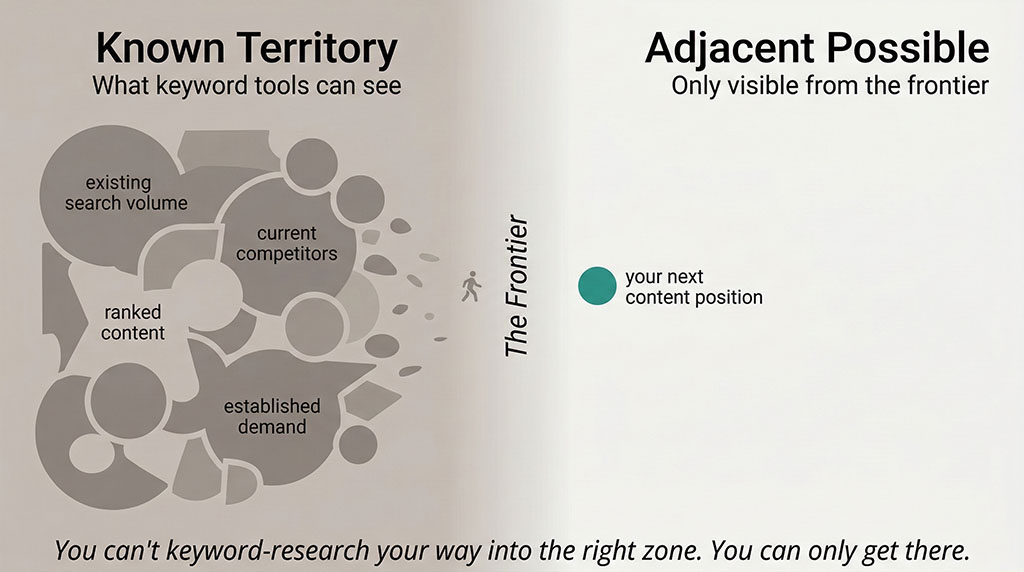
Here’s the part that should stop every content marketer cold: you can only see the adjacent possible from the frontier. From further back, it doesn’t exist yet. The view simply isn’t there.
What Keyword Research Actually Measures
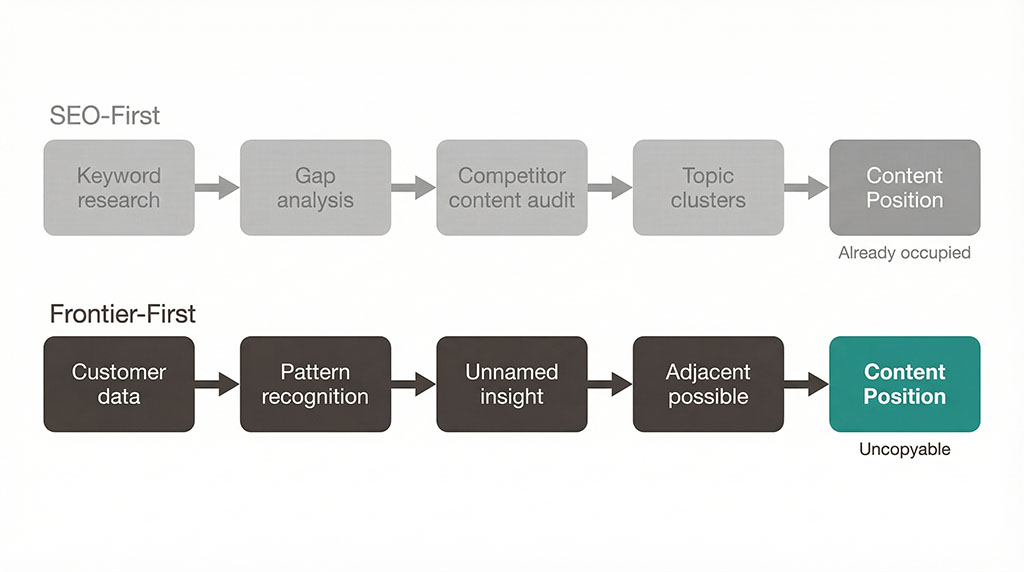
Keyword research measures existing search behaviour. What people typed into Google last month, last quarter, last year. Every tool in the category — SEMrush, Ahrefs, Moz — draws from the same pool of historical data. When you build your content strategy from it, you’re building it on a map of territory that’s already been settled.
The gap analysis shows you where demand exists without supply. What it cannot show you is demand that hasn’t formed yet — because the ideas that would create it haven’t reached the frontier of your market.
This is not a flaw in SEO tools. It’s what they are. They’re maps of known territory. Detailed, useful, and entirely backward-looking.
Newport extends Johnson’s framework into careers: a mission that will actually work — one with real differentiation and real momentum — can only be found once you’ve built expertise that gets you to the cutting edge. “If you want to identify a mission for your working life,” Newport writes, “you must first get to the cutting edge — the only place where these missions become visible.”
The same constraint applies to content strategy. The topics that will define your market in 18 months aren’t in keyword tools right now. They’re in the adjacent possible — just beyond the current frontier — and they’re only visible from one place.
What the Cutting Edge Looks Like in Marketing
In science, the cutting edge is where existing knowledge ends and new combinations become possible. In marketing, it’s simpler to define: it’s proximity to what your customers are actually doing before they tell you about it.
Not the demand they’ve already formed into search queries. The behaviour that precedes the query — the pattern that hasn’t crystallised into a searchable question yet but will. The objection that appears in sales calls six months before it appears in keyword tools. The segment that converts differently from every other segment but hasn’t been named yet. The question your best customers ask that none of your content has ever answered.
This is the adjacent possible of your market. It lives in your customer data. And it’s invisible to everyone looking at the same keyword tools — because keyword tools, by definition, only show what’s already happened.
Gong didn’t find their content position by researching “sales call analysis software.” They found it by being closer to sales conversation data than anyone else in their market — and noticing what that data showed about how top performers actually behaved. The insight that the best salespeople talk less and listen more wasn’t in any keyword database in 2016. It was in 100,000 recorded sales calls. The research budget didn’t create the insight. The proximity to the frontier did.
Klaviyo did the same thing with email. Their platform runs for 183,000 brands. Sitting in that operational data was a finding nobody had commissioned: automated flows account for 5.3% of email sends and drive 41% of revenue. That number is now cited everywhere. It wasn’t discovered by a research team. It was discovered by someone reading what the platform already knew.
"We Don't Have Gong's Research Budget"
This is the right objection. Gong has a team dedicated to mining that data. Most businesses don’t.
But this gets the causality backwards. The research budget followed the insight — it didn’t produce it. The original discovery came from someone being close enough to the customer data to notice a pattern that nobody had named yet. That doesn’t require a research team. It requires proximity and the integrated view to see across the full picture at once.
Newport is direct about this in the career context: trying to identify your mission before you’ve reached the cutting edge always fails. “Sarah was trying to find a mission before she got to the cutting edge,” he writes of one case study. “From her vantage point, she was much too far from the cutting edge to have any hope of surveying the adjacent possible.”
The same failure mode plays out in content strategy constantly. A brand attempts to build a thought leadership position from a content calendar built on keyword gaps — which is exactly equivalent to trying to find your mission from a position far behind the frontier. The position you find from there is always a position someone else already occupies.
The brands that find uncopyable content positions aren’t spending more on research. They’re standing closer to their own frontier.
The Fuel Index puts a number on what that proximity is worth: content built from original data is 4.5 times more likely to be cited in AI search results than purely qualitative content. Not 10% more likely. Not twice as likely. Four and a half times. The gap between consensus content and frontier content isn’t closing — it’s the entire game now.
How to Get to the Frontier
Newport’s framework gives a precise answer: you get to the cutting edge by building rare and valuable expertise until you’re operating at the frontier of your field. There’s no shortcut. The adjacent possible only becomes visible once you’re there.
In marketing terms, this means two things.
The first is genuine depth in your category. Not broad awareness of your industry’s talking points — the kind of depth that comes from being closer to how customers in your market actually behave than any of your competitors. What they do before they buy. What changes their mind. What they ask that no competitor has yet answered. This isn’t research. It’s proximity, accumulated over time.
The second is integrated visibility. The adjacent possible in your market lives at the intersection of channels — in the patterns that span paid, organic, email, and direct simultaneously. It doesn’t appear in any single channel’s data. A segment that converts differently doesn’t show up in your paid media report or your email analytics alone. It shows up when someone looks at all of it at once, over enough time, with enough context to know what they’re seeing.
This is why fragmented marketing — multiple agencies, siloed data, no single view — is not just operationally inefficient. It makes it structurally impossible to reach the frontier of your own market. Nobody has the complete picture. Nobody can see what’s just past the edge of the map.
Newport’s conclusion about missions applies exactly: “If you want to identify a mission for your working life, you must first get to the cutting edge.” For content strategy, read: if you want a content position nobody can copy, you must first get close enough to your own customer data to see what’s not yet named.
In 2009, those four research teams didn’t coordinate. They didn’t need to. They were all standing at the same frontier, and the adjacent possible had opened up in front of all of them at once.
The brand that gets to the frontier of its market first doesn’t have that problem. The insight is there, unmapped, uncopyable — and the rest of the market is still pointing keyword tools at territory that’s already been taken.
Getting to the frontier of your market requires a complete picture of your customer data — across every channel, at once. Most businesses can’t see that picture because their data lives in separate agency dashboards with nobody reading all of it simultaneously. An Agency Waste Audit is where that changes. [Book yours here →]