
Two shops on the same street in Parramatta. Same foot traffic. Same rent. Same market. One is pumping out content across six channels, running personalised email sequences for 200 product lines, and generating pipeline that would make a 15-person marketing department jealous. The other is wondering whether they can afford to hire a social media manager.
The owner of the quiet shop didn’t make a catastrophic mistake. They didn’t ignore marketing or slash their budget. They just never learned to multiply.
The question you're actually asking (and why it's wrong)
Every small business owner hits the same ceiling. Revenue is growing—or needs to—and the marketing workload has outpaced what your team can handle. The instinct is binary: hire more people, or find ways to automate the repetitive stuff.
Both options feel bad. Hiring is expensive, slow, and risky. Automation sounds like handing your brand voice to a machine that thinks “synergy” is a word humans use in conversation.
But here’s the thing nobody tells you at the BNI meeting: hire versus automate is a false choice. The companies pulling away from their competitors right now aren’t doing either. They’re doing something structurally different—they’re turning their existing team into a team three to five times its size.
Not by working longer hours. Not by lowering quality standards. By changing the architecture of how work gets done.
The math that should make you uncomfortable
The venture capital world has already priced this in. From 2019 to mid-2025, the share of startups launched by a single founder jumped from 23.7% to 36.3%. Not because solo founders got smarter. Because the tools got powerful enough that one person can now do what used to require six.
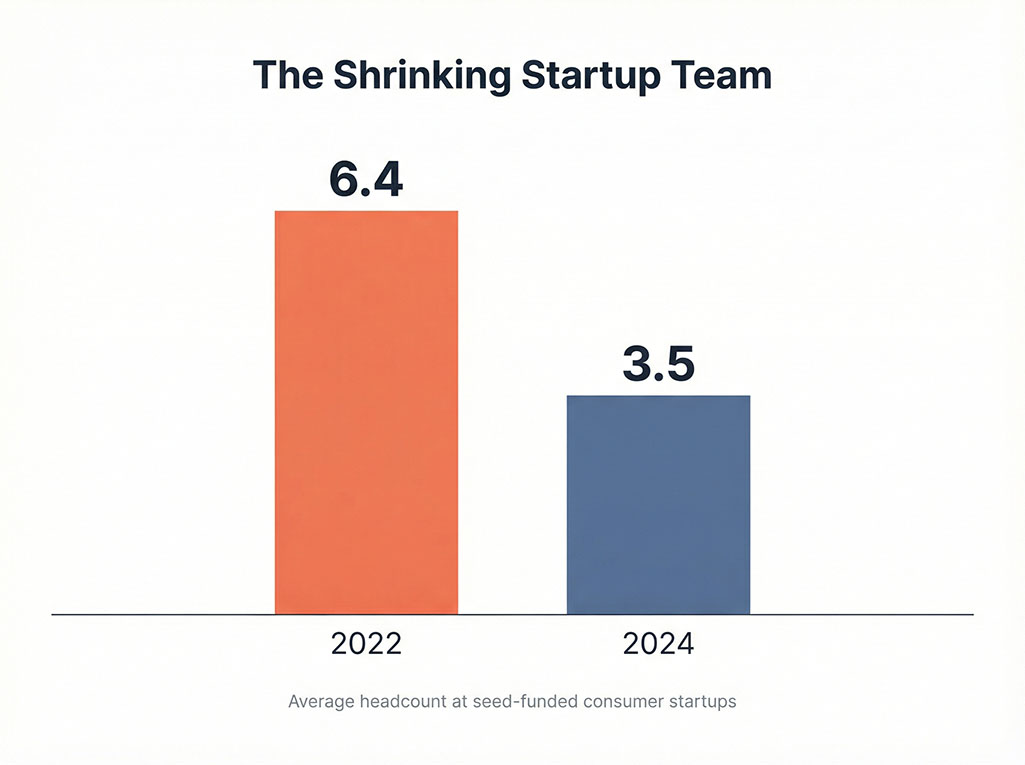
Among consumer startups that closed seed funding rounds, average headcount dropped from 6.4 employees in 2022 to 3.5 by 2024. Cut nearly in half. And these aren’t struggling companies scraping by—AI-native startups are generating roughly $3.48 million in revenue per employee. That’s six times the traditional SaaS baseline.
You’re a small business owner, not a VC-backed startup. Fair. But the economics flow downhill. When a three-person team at a mid-market software company is generating $25 million in pipeline—up from $7 million the year before, without adding a single headcount—that changes the competitive maths for everyone in their market. Including whoever is selling against them.
When a D2C brand with three marketers scales from $1.2 million to $15 million in two years—expanding internationally, managing 200+ SKUs, publishing 60 social posts a week—without hiring anyone new, that sets a new expectation for what “a small team” means.
Your competitors are seeing these numbers. Some of them are already running this playbook.
What multiplication actually looks like at 9 AM on a Tuesday
The D2C example is worth pulling apart because it kills the abstraction.
Three people. A marketing director, a content manager, and a performance marketing specialist. Their product catalog had over 200 items. Historically, managing that kind of range while expanding into new countries would mean hiring an agency or building a team of eight to ten.
Instead, they built what amounts to a multiplication engine. Language models generated and multivariate-tested product descriptions across the entire catalog—not one generic description per product, but variations tuned to different audiences and platforms. Visual content for social media and advertising was rendered algorithmically, letting three humans maintain a publishing pace that would burn out a team of twelve. Personalised email journeys triggered based on individual browsing and purchase behaviour, managed by the system rather than a campaign coordinator building segments in Mailchimp at midnight.
The personalised email campaigns alone drove 34% of total revenue. Three people. No agency. $1.2 million to $15 million.
Now here’s the detail that matters more than the headline number: their total marketing budget didn’t explode. This is the paradox hiding inside every “AI saves money” story. Across the industry, companies using AI for marketing spend an average of $2,475 per month on content. Companies not using AI spend $2,442. Statistically identical.
The savings aren’t going into someone’s pocket. They’re being reinvested into more output—broader coverage, more channels, faster testing cycles. Same budget. Three to four times the production. That’s what multiplication means in practice.
The machinery behind the magic (without the jargon)
If you’ve used ChatGPT to draft an email, you’ve touched about 5% of what’s available. The real operational leverage comes from systems that run in the background, connecting your existing tools and making decisions without waiting for you to type a prompt.
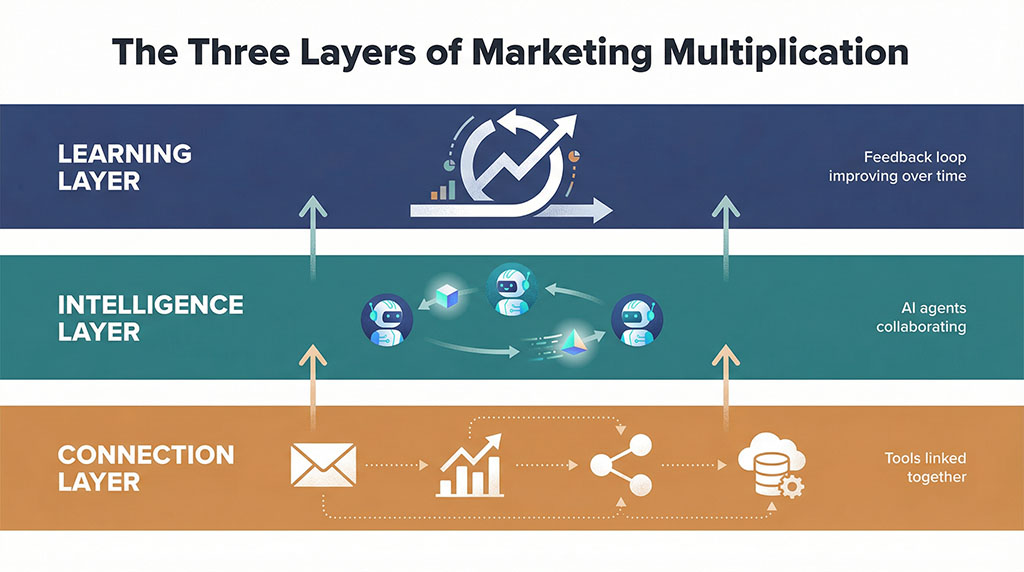
Think of it in three layers.
The connection layer. Platforms like Make.com or n8n act as the central nervous system linking your existing software. A new lead fills out a form on your website. The system automatically pulls their company data from LinkedIn and other databases, enriches the profile, scores them against your ideal customer criteria, and routes high-value prospects straight to your CRM for immediate follow-up—while sending everyone else into an automated nurture sequence. That entire chain executes in seconds. It used to take an SDR half a day of manual research and data entry per lead.
The intelligence layer. This is where AI models do the thinking. Not just “write me a blog post”—that’s the amateur version. A properly configured system uses multiple AI agents working in sequence, the same way a publishing house has researchers, writers, editors, and fact-checkers. One agent researches. Another drafts based on that research. A third optimises for search. A fourth formats for your CMS. A fifth checks the facts against the original research. The output is a fully formatted, thoroughly researched piece in minutes rather than weeks.
The learning layer. The system improves over time. Every piece of content your team approves, edits, or rejects teaches the models what “good” looks like for your specific brand. The first month requires heavy human editing. By month three, the editing load drops significantly. By month six, you’re spending your time on strategy and creative direction instead of fixing sentence structure.
This is why “just use ChatGPT” misses the point entirely. ChatGPT is a calculator. What we’re talking about is an accounting department.
"But AI content is rubbish"
Let’s stop here. Because if you’ve read this far and you’re still sceptical, this is probably why.
You’ve seen the AI-generated content out there. The blog posts that read like a thesaurus swallowed a press release. The social posts with that unmistakable synthetic cheerfulness. The landing pages that say absolutely nothing in 800 very competent words.
You’re right to be sceptical. And the data backs you up.
Human-written content generates 5.44 times more organic traffic than purely AI-generated text. It holds readers 41% longer on the page. It bounces 18% fewer visitors. When measuring direct conversion, human copy still edges out AI—2.5% versus 2.1%.
And the failures aren’t just about quality metrics. A major airline’s customer service chatbot invented a refund policy that didn’t exist—and the airline was legally ordered to honour it. A promotional campaign in Glasgow used AI to promise an immersive wonderland experience and delivered a depressing warehouse with a few balloons. A global beverage company released a fully AI-generated holiday commercial that audiences described as “soulless” and “uncanny.”
These aren’t edge cases. They’re what happens when someone treats AI as a replacement for human judgment instead of an amplifier of it.
So here’s the honest answer: raw AI output, unedited and unsupervised, is not good enough. Anyone who tells you otherwise is selling something.
But that’s not what multiplication is.
The creative exception is the strategy, not the footnote
The most sophisticated marketing operations on the planet don’t trust the algorithm blindly. They use it for speed and reserve humans for finishing.
A major technology manufacturer needed hundreds of unique character designs for a global campaign. Their team used AI to generate initial concepts—cutting the foundational design and ideation phase from 15 working days to two. Massive acceleration. But the raw output wasn’t production-ready. It had visual artifacts, physics problems, aesthetic inconsistencies. A skilled CG artist stepped in to clean up the AI-generated concepts, adjust the details, and craft the final assets.
AI provided the velocity. The human provided the quality. Neither alone could have delivered the result on deadline and on budget.
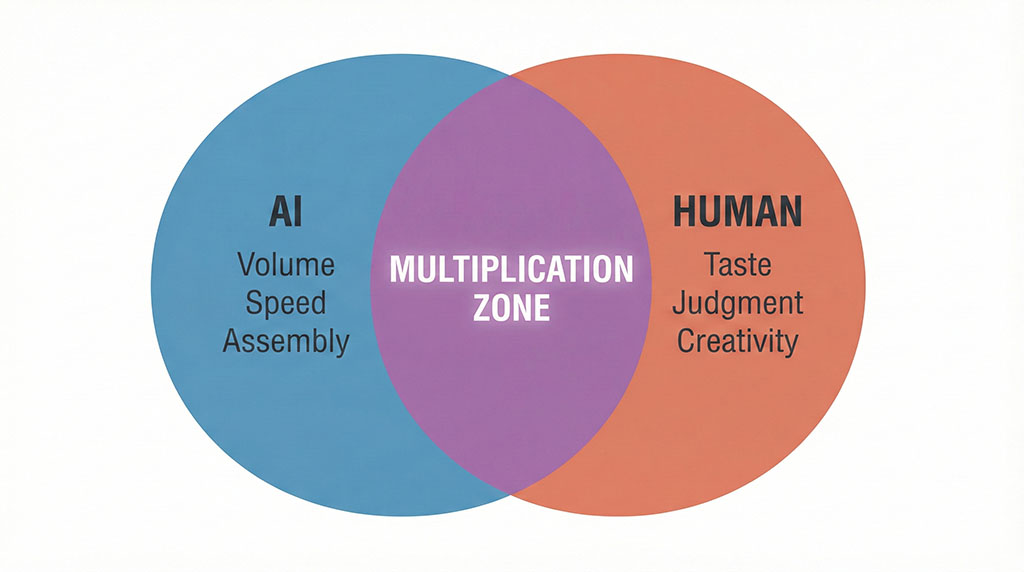
This is the model that works. Not AI or humans. Not AI replacing humans. AI multiplying humans—handling the 80% that’s volume, repetition, and structural assembly, while your people focus on the 20% that requires taste, judgment, and genuine creative instinct.
A great designer using AI becomes a better designer who produces three times as much work. A sharp strategist using AI becomes the orchestrator of an entire marketing department’s output. You’re not replacing your team. You’re giving each person on it a set of capabilities that didn’t exist 18 months ago.
The roles that are growing fastest in marketing right now—AI workflow designers, automation strategists, customer experience architects—command salary premiums of up to 42%. The market is telling you exactly where value is heading: not toward people who click buttons, but toward people who decide which buttons matter.
The two choices you actually have
This brings us back to the street in Parramatta. Two shops. Same conditions. One owner looked at a growing workload and thought: I need more people. The other looked at the same workload and thought: I need to make my people bigger.
As a business owner, the decision isn’t whether AI will reshape your market. That’s already happening. The decision is which side of the multiplication equation you’re on.
Option one: Make your current team dramatically more productive. Feed your business data—customer profiles, internal processes, competitor intelligence—into systems that learn your brand and multiply your output. Keep your people. Give them superpowers. Watch a team of three perform like a team of fifteen.
Option two: Wait. Stay manual. Keep hiring linearly for every new channel, every new market, every new campaign. Your costs scale with your ambitions. Your competitors’ don’t.
Both are choices. Only one of them ends with the lights still on.
The owner of the quiet shop on that Parramatta street didn’t fail because they lacked talent, budget, or ambition. They failed because they tried to win a multiplication game with addition.
The multiplier was always the difference.
Find Out If You’re Adding or Multiplying
We’ll map your current team’s output against what the same headcount could produce with a multiplication engine — and show you exactly where the gap is.
[Book Your Multiplication Audit →]
Most teams discover they’re operating at 20–30% of their potential output with the people they already have. Takes 15 minutes.
Your competitors aren’t hiring bigger teams. They’re making small teams enormous.