
Three ads. One pool company. All running to the same calculator page.
Ad 1: “Design Your Dream Pool — Get an Instant Price Estimate” Ad 2: “Find Out How Much Your Pool Will Cost — Try Our Free Calculator” Ad 3: “Get Your Pool Price in Under 60 Seconds — Free Pool Calculator”
The previous agency had been rotating versions of these for months. New images swapped in every four weeks — a different angle of a pool, a family shot instead of an empty backyard, a sunset where there was previously a sunrise. They called it “testing.” It was in their package.
But strip away the surface differences and something becomes obvious: all three ads say the same thing. Same angle. Same emotional trigger. Same stage of awareness. The only people who’d ever click any of them are prospects who already know they want a pool and are ready to check pricing.
That’s not testing. That’s decorating.
The illusion of variety
This pattern is everywhere, not just swimming pools. Pull up your last 10 ad creatives right now. Ignore the fonts, the colours, the specific words. Ask yourself: what is the underlying concept of each one?
If more than three share the same core message, you haven’t been testing. You’ve been making the same ad look different enough to feel productive.
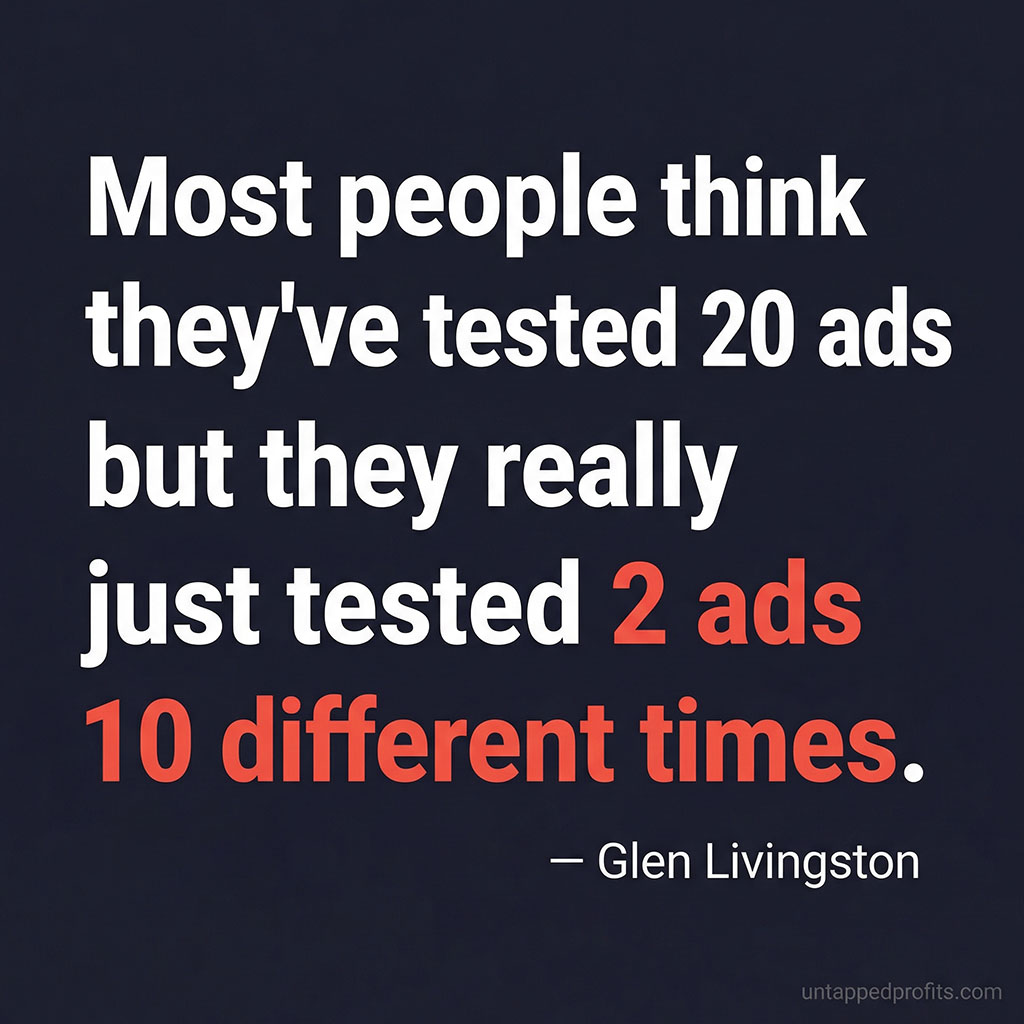
Glen Livingston put it bluntly: “Most people think they’ve tested 20 ads but they really just tested 2 ads 10 different times.”
Here’s why this matters more than most advertisers realise. Ad platforms are built on dynamic creative optimisation. Meta, Google — they’re algorithmically serving your best-performing combinations to your best prospects. When you feed the algorithm three variations of the same concept, it isn’t learning what type of message resonates. It’s learning which wording of an identical message gets slightly more clicks. That’s an optimisation ceiling you’ll hit fast and never break through.
The real leverage isn’t in testing headlines. It’s in testing concepts.
What a "concept" actually means
Three urgency headlines aren’t three concepts. They’re one concept — urgency — tested three ways.
Take that pool company. Their agency was running:
- “Last Chance! Offer Expires Tonight!”
- “Act Fast! Limited Time Discount Ending!”
- “Quick! Sale Closing Shortly — Don’t Miss Out!”
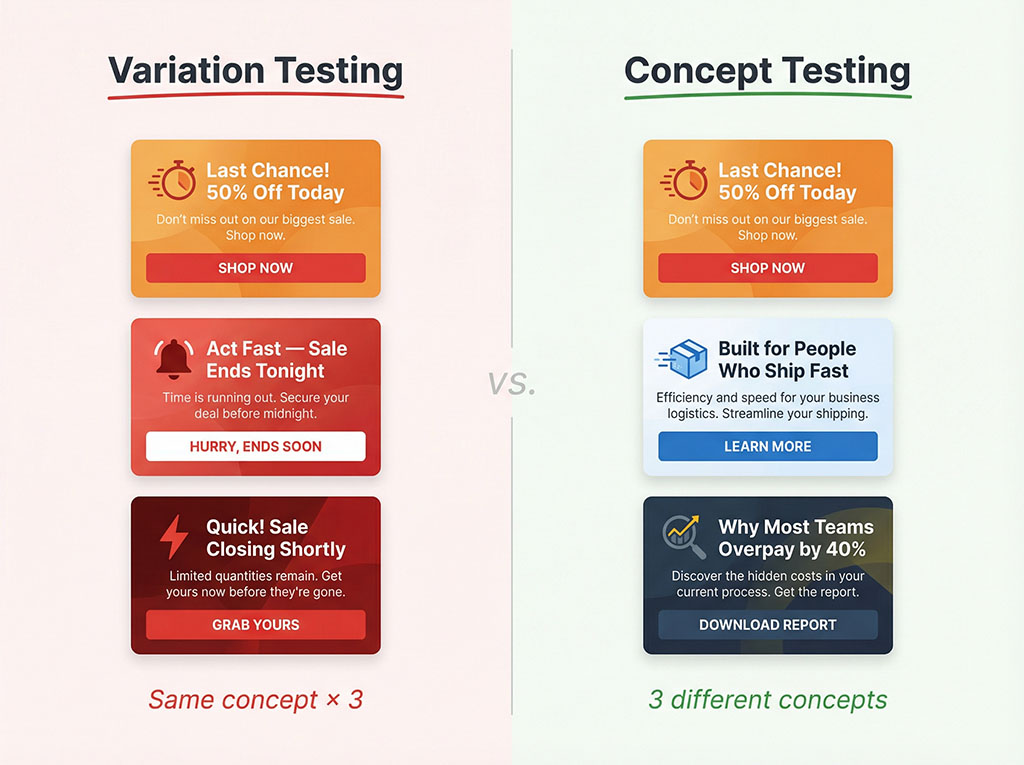
Different words. Identical psychology. If you tested these against each other for six months, you’d learn which urgency phrase performs 3% better than the others. You wouldn’t learn whether urgency is even the right approach for that audience.
Three genuinely different concepts would look more like this:
- Urgency: “Lock in 2024 pricing before January increases — deposit holds your price for 3 months”
- Identity: “The families on your street with pools didn’t earn more than you. They just found a different way to buy.”
- Conspiracy/Exposé: “Pool companies charge $58K. Their actual work? Three phone calls to the same tradies you drive past daily.”
Now you’re testing something. The urgency ad targets prospects ready to act. The identity ad targets parents wrestling with guilt and inadequacy. The exposé ad reframes the entire purchase decision by attacking the industry’s pricing model.
Each one speaks to a different emotional trigger. A different stage of awareness. A different belief about what’s actually blocking the purchase.
That’s a test.
The framework that forces different concepts
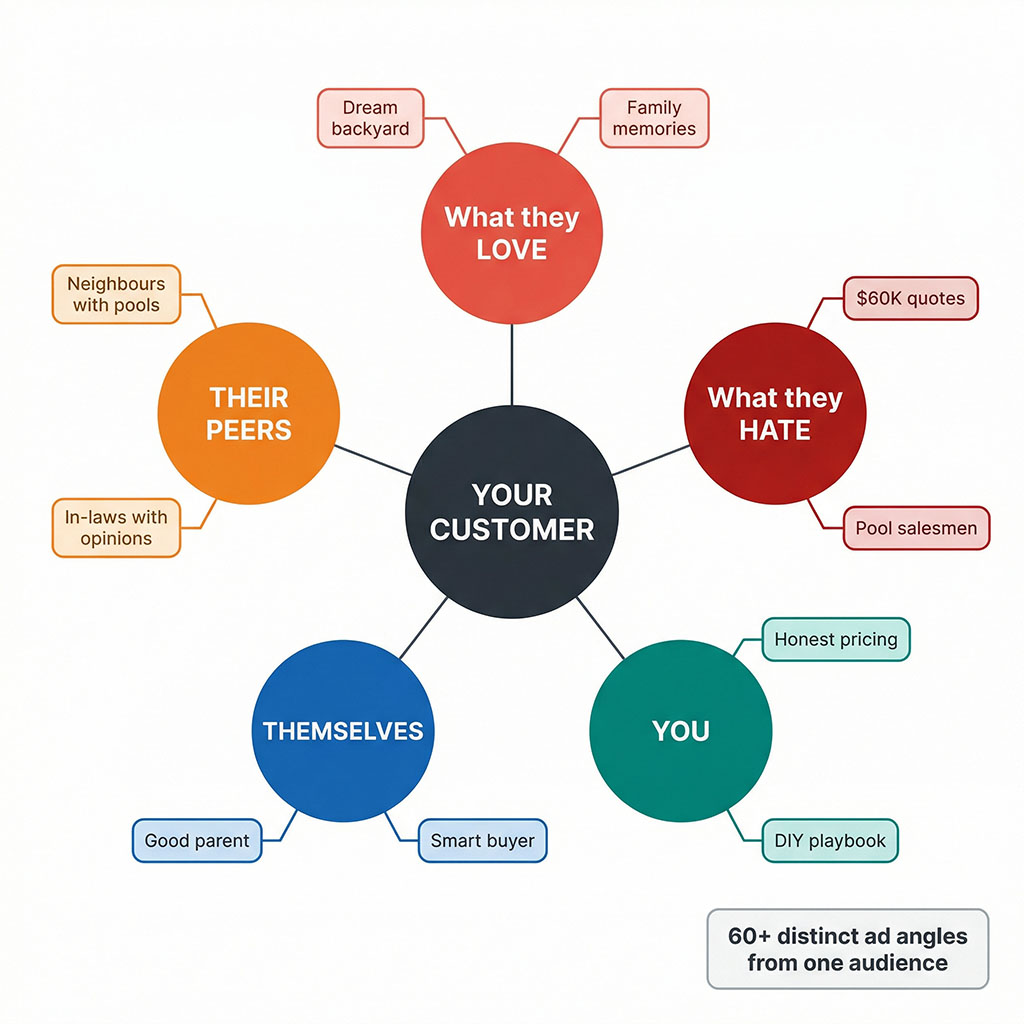
Perry Marshall calls it the Swiss Army Knife technique, and the core idea is simple: instead of brainstorming “different ads,” you brainstorm different relationships between your customer and the world around them.
Think about it. Your customer has a relationship with:
- The thing they love (the pool, the backyard, summer memories)
- The thing they hate (pool company salesmen, $60K quotes, being ripped off)
- You (the alternative, the honest option, the insider)
- Themselves (their identity as a provider, a smart buyer, a good parent)
- Their rivals/peers (the neighbours with pools, the in-laws with opinions)
Most ads only explore one or two of these relationships. The calculator ads from our pool company? They only addressed the relationship between the customer and the product (“find out how much your pool costs”). That’s one angle out of dozens.
When we rebuilt the strategy for Swimming Pool Kits Direct, we mapped every relationship — customer to product, customer to enemy, customer to self, product to enemy, self to peers — and found over 60 distinct angles for a single market segment. From one audience. For one product.
That’s not a creative exercise. That’s a systematic process that produces more genuinely different ad concepts than most businesses test in a year.
"I don't have time to build 60 ad concepts"
Fair. And you don’t need to.
You’re thinking this only works for companies with massive creative teams and six-figure ad budgets. But the framework doesn’t require you to run 60 ads simultaneously. It requires you to think in 60 directions — then pick the three or four that map to your funnel stages.
Here’s what that looks like in practice.
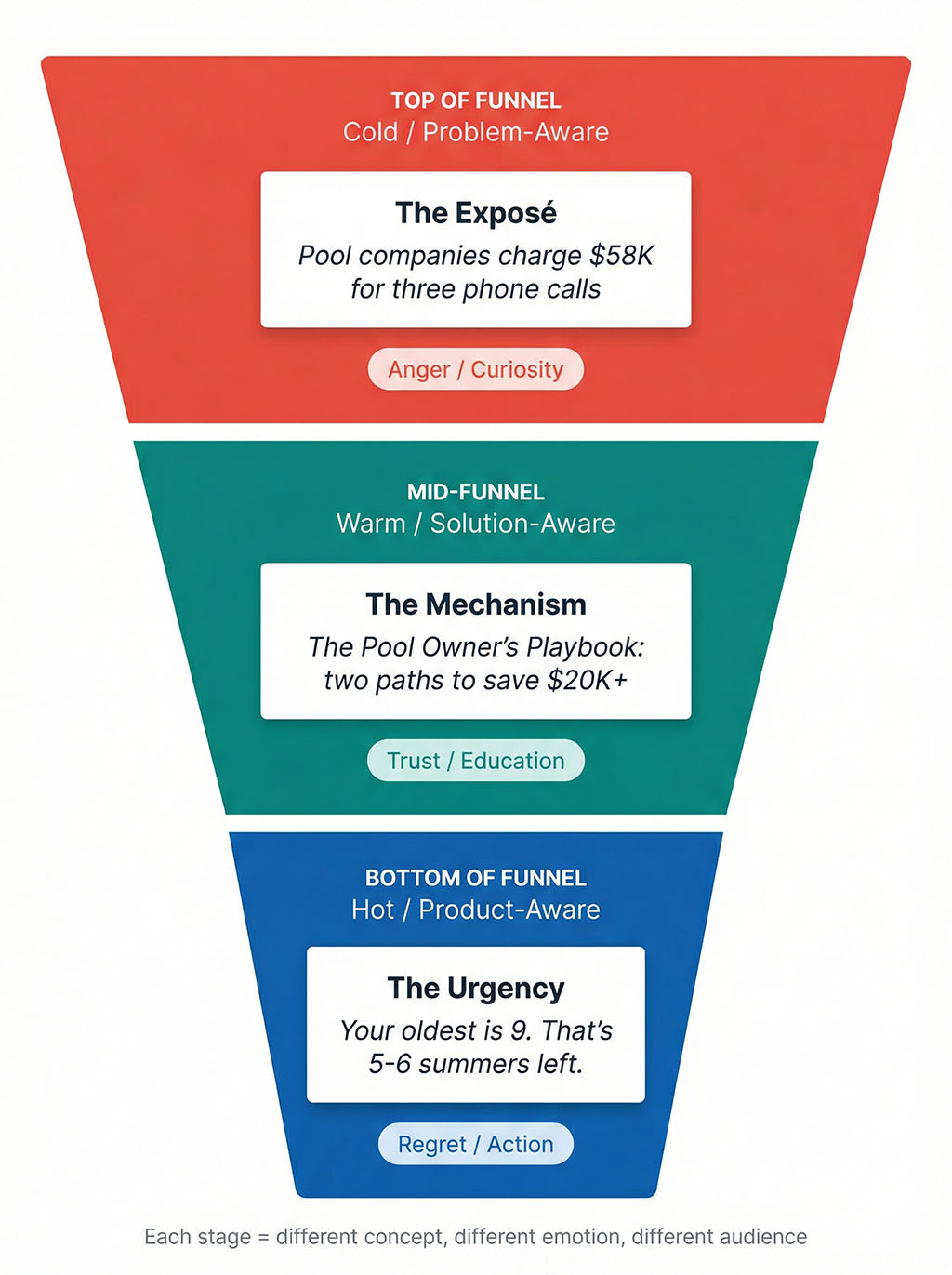
For the pool company, we didn’t build 60 ads. We built a strategy that covers the full buyer journey with genuinely distinct concepts at each stage:
Top of funnel (cold traffic, problem-aware prospects): The exposé angle. “Pool company wanted $15K for the dig. My excavator charged $3K. Same hole. Same guy.” This isn’t selling a product — it’s installing a belief. The belief that the pool industry has manufactured artificial complexity to justify markup. It attracts attention from people who aren’t shopping yet but feel the frustration.
Mid-funnel (warm traffic, solution-aware prospects): The mechanism angle. How the “Pool Owner’s Playbook” works — the specific steps, the two paths (full DIY coordination vs. recommended installer), the savings breakdown. This is education, not persuasion. It builds trust with people who already know they want a pool but need confidence that this approach is real.
Bottom of funnel (hot traffic, product-aware prospects): The urgency angle — but real urgency, not manufactured scarcity. “Your oldest is 9. That’s five or six summers before they’re ‘too cool’ for family pool time.” This targets parents who’ve already done the research and are paralysed by decision fatigue. The urgency isn’t a countdown timer. It’s their kid growing up.
Three stages. Three fundamentally different concepts. Each one pulls a different emotional lever, speaks to a different awareness level, and attracts a different slice of the audience.
Compare that to three versions of “Get Your Pool Price in Under 60 Seconds.”
How to actually do this
Start with the classic pairings. Before you touch the relationship mapping framework, test across these foundational opposites:
Pain vs. Pleasure. One ad highlights the problem they’re escaping. Another highlights the outcome they’re chasing. These attract different psychological profiles — “away from” vs. “toward” motivated buyers — and you need to know which dominates your market.
Authority vs. Empathy. One ad leads with credentials, data, proof. Another leads with “I’ve been where you are.” Test which earns trust faster with your specific audience.
Us vs. Them. One ad positions your product. Another attacks the alternative. These produce wildly different engagement patterns and attract buyers at different decision stages.
Pick two of these pairings. Build one ad per side. Run them in dynamic creative format — multiple headlines and images within the same ad — so the platform optimises combinations rather than competing separate ads against each other.
That’s four genuinely different concepts from 20 minutes of thinking. More conceptual range than most advertisers test in a quarter.
Once you’ve exhausted the classic pairings, graduate to the relationship mapping. Take your customer and map their relationship to five entities: the thing they love, the thing they hate, you, themselves, and their peers. Each relationship produces four to six distinct angles. That’s where the 60+ concepts come from — and where the real breakthroughs hide.
The compound effect
Here’s what changes when you test concepts instead of variations.
Each genuinely different concept that wins tells you something structural about your market. Not “this headline gets 2% more clicks,” but “our audience responds more to identity-based messaging than price-based messaging.” That’s an insight that reshapes your entire marketing — emails, landing pages, sales calls, positioning.
Variation testing gives you incremental improvements. Concept testing gives you directional intelligence.
The pool company’s previous agency spent months learning which calculator headline performed marginally better. That ceiling was always low because everyone who’d click any calculator ad was already in the same narrow band of awareness. The new strategy reaches people at every stage — from the parent who doesn’t know DIY pools exist, to the tradie who wants wholesale access, to the frustrated buyer who’s been burned before.
Different concepts. Different funnel stages. Different market segments. Each one feeding the next.
Three ads, same calculator page
Those three original pool calculator ads are still sitting in the old account. They look professional. The images are polished. The copy is clean.
They just all say the same thing.
The new strategy has concepts that target parents feeling guilty about broken promises to their kids. Concepts that expose how pool companies manufacture artificial complexity. Concepts that speak directly to tradies who want wholesale access. Concepts that rebuild trust with buyers who’ve been burned by other companies.
Same product. Same market. Completely different conversations.
That’s the difference between testing ads and testing ideas. And the ideas are where the money is.
Stop Decorating. Start Testing.
We’ll audit your ad account and show you the concepts you’ve never tested, the funnel stages you’re skipping, and the spend that’s going nowhere.
Most accounts are running 3 versions of 1 idea. Takes 15 minutes to find out if yours is too.
You don’t need more ads. You need fewer ads that actually say different things.