
Old maps used to have blank spaces. Not small ones — massive stretches of ocean and coastline where cartographers simply ran out of knowledge. And because leaving it blank felt too honest, they filled those gaps with illustrations of sea monsters and a Latin phrase that’s survived five centuries: “Hic sunt dracones.”
Here be dragons.
The cartographers weren’t stupid. They knew the blank spaces probably contained something — land, resources, trade routes, entire civilisations. But they couldn’t see past the edges of what they already knew. So the space between the known territories stayed empty. For decades. Sometimes centuries.
Right now, you’re running your business on one of those old maps.
Your products, your customers, your competitors, your marketing channels — those are your known territories. You can see them clearly. You’ve charted them. You operate on them every day. And like those 15th-century cartographers, you’re making all your decisions based on what’s already on the map.
The problem isn’t the territories you know. It’s the ocean between them you’ve never looked at.
The space between what you already know is where the money is
Stephen Wolfram — the physicist and computer scientist behind Wolfram Alpha and Mathematica — published a piece last year called “Generative AI and Mental Imagery of Alien Minds.” Heavy title. But buried inside the academic language is an idea that should change how every business owner thinks about AI.
Wolfram’s argument: human knowledge organises itself into “concept islands.” Each island is a cluster of related ideas — things we’ve named, categorised, and built businesses around. “Marketing” is an island. “Plumbing” is an island. “Coffee shops” is an island.
Between those islands? Wolfram calls it interconcept space. The vast territory between established ideas where connections exist that nobody’s mapped yet. Patterns nobody’s named. Opportunities nobody’s spotted — not because they’re hidden, but because they fall between the categories we already think in.
Here’s the part that matters for you: AI doesn’t think in islands the way humans do.
When you sit down to solve a business problem, your brain defaults to the island you’re standing on. A plumber thinks about plumbing. An accountant thinks about accounting. A café owner thinks about coffee. That’s not a failure of imagination — it’s how human cognition works. We think from where we stand.
AI thinks from everywhere at once. It doesn’t respect the boundaries between your concept islands because it doesn’t know they’re supposed to be separate. It sees the connections between “plumbing” and “sustainability” and “home energy audits” — connections that exist in reality but are invisible from any single island.
That’s not a technical capability. That’s a perspective you’ve never had access to before.
What interconcept space looks like in a real business
This sounds abstract, so let me make it concrete.
A physiotherapy practice I know was doing fine. Good reputation, steady clients, standard marketing — “we fix back pain” on Google Ads, referral program for existing patients, occasional Facebook posts showing exercises.
All of that was on the map. Charted territory. Competent.
When they started using AI to analyse their client data alongside broader health trends, something odd surfaced. Their highest-value patients — the ones who stayed longest and referred the most — weren’t coming in for back pain at all. They were coming in after being diagnosed with anxiety or depression. Their GPs had suggested physical therapy as a complementary treatment.
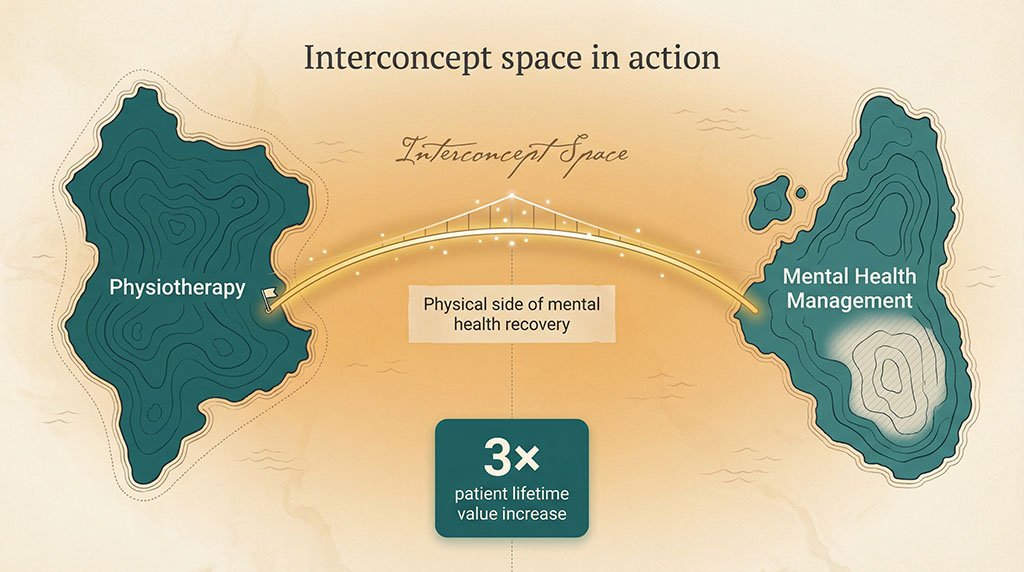
The connection between mental health treatment pathways and physiotherapy marketing isn’t on anyone’s map. No physio marketing guide covers it. No agency would have recommended targeting it. It exists in the interconcept space between “physiotherapy” and “mental health management” — two islands that, from either shore, look completely unrelated.
That practice now runs campaigns specifically targeting people recently prescribed SSRIs, positioned as “the physical side of mental health recovery.” Their average patient lifetime value tripled.
They didn’t find a new island. They found what was between two islands they’d been standing on all along.
Why your current approach can't see this
Think about how you make strategic decisions right now. You look at what competitors are doing. You check industry benchmarks. You ask your agency (or your five agencies, none of whom talk to each other) what’s working in your vertical.
Every one of those inputs comes from the same island.
Competitor analysis tells you what other people on your island are doing. Industry benchmarks tell you the average performance on your island. Your agency tells you the standard playbook for your island. It’s all island knowledge. It’s all already on the map.
None of it will show you the $400,000 sitting in the ocean between your island and the one three categories over.
Wolfram’s research makes a point that’s easy to miss: AI doesn’t just think faster than humans. It thinks differently. He calls it an “alien mind” — not because it’s scary, but because it occupies a completely different position in what he terms “rulial space.” Think of it as the universe of all possible ways to process information. Humans sit in one region. AI sits in another. And from that different vantage point, it sees patterns that are invisible from where we stand.
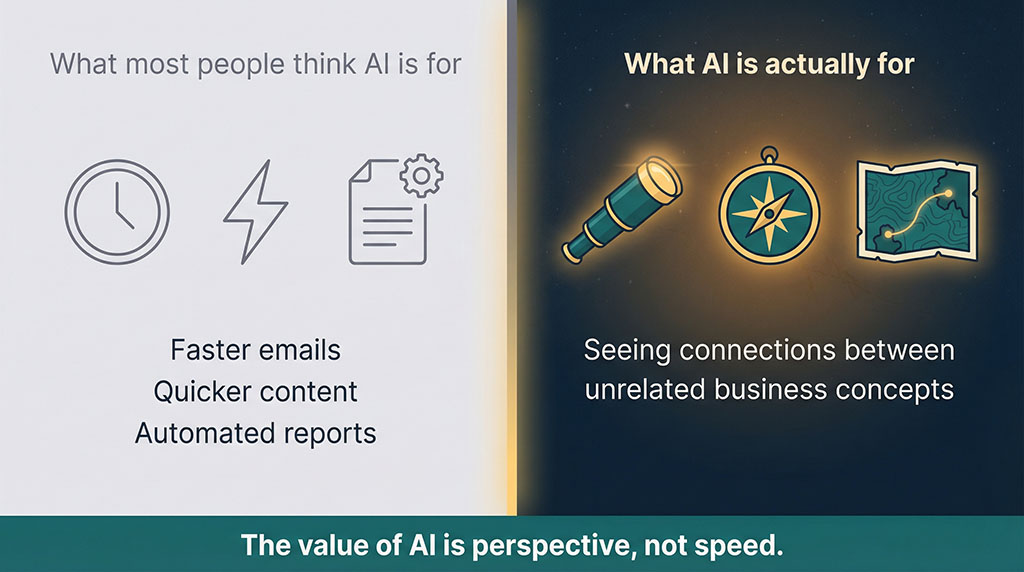
This is the part most AI marketing gets wrong. They sell you speed. “AI writes your emails faster.” “AI generates your social posts in seconds.” That’s using a telescope as a paperweight. The value isn’t speed. The value is perspective — seeing your business from a position no human brain can occupy.
"That's nice. But I need more customers by Friday."
I can hear you from here.
Interconcept space. Alien minds. Rulial space. Mate, I run a landscaping company. I need leads, not a physics lecture.
Fair enough. So let’s talk about leads.
A landscaping company in suburban Melbourne was spending $3,200 a month on Google Ads. Standard setup: “landscaping services Melbourne,” “garden design,” “lawn maintenance.” Decent return. Nothing special. Entirely on the island.
They fed their client data — job types, timing, suburbs, property values, repeat rates — into an AI analysis alongside publicly available data on property sales, renovation permits, and seasonal weather patterns. The AI didn’t produce a better ad headline. It surfaced a pattern: their most profitable clients weren’t searching for landscaping at all. They were searching for “increase property value before selling” and “pre-sale home improvements.”
The connection between real estate preparation and landscaping marketing was sitting in the interconcept space between those two industries. No landscaping marketing guide mentions it. No Google Ads agency running standard campaigns would have found it, because they’re optimising within the boundaries of the island you’re already on.
That landscaping company now runs a “pre-sale garden transformation” package. Average job value went from $2,800 to $11,500. Same crew. Same tools. Different map.
This isn’t philosophy. It’s revenue that was sitting in the blank space between two ideas you already had — waiting for something that could see both shores at the same time.
The real reason most businesses won't do this
Concrete images stick in your brain at roughly ten times the rate of abstract concepts. Research on visual cognition puts the recall difference at around 6.7% versus 0.7% after a five-minute delay. That’s not a rounding error — it’s an order of magnitude.
This matters because every AI company in the world is making the same mistake. They’re selling you abstraction. Clean white interfaces. Minimalist logos. Vague promises about “transforming your workflow.” They’re describing the telescope without ever showing you what’s through the lens.
That’s not an accident. It’s a positioning problem across the entire industry. When you look at how AI companies present themselves — OpenAI, Google, everyone — it’s the same sterile, abstract aesthetic. No characters. No narrative. No here’s what this actually looks like when you use it. They’re selling the concept of seeing differently without ever giving you the experience of it.
Which means most business owners still think of AI the way those old cartographers thought about the blank ocean: probably something there, but too vague to act on.
The businesses pulling ahead right now aren’t the ones with bigger budgets. They’re the ones who stopped treating AI as a faster version of tools they already had and started using it as a map of territory they’d never seen.
Here be revenue
Those old cartographers eventually crossed the blank spaces. They had to. The ones who stayed on their known islands watched as the explorers who ventured into the gaps built the trading empires of the next century. Not because they were braver. Because they stopped assuming the map was complete.
Your map isn’t complete either.
The connections between your customer data and industries you’ve never considered, between your service delivery patterns and market shifts happening three categories over, between problems your clients have that they’d never think to bring to you — all of that exists. Right now. In the space between your concept islands.
Wolfram gave it a name. Your P&L calls it something else: untapped profit.
The dragons were never real. But the territory behind them always was.
Stop marketing on the island. Start mapping the ocean.
Our Agency Waste Audit doesn’t just find where you’re bleeding money across disconnected agencies. It identifies the interconcept spaces in your business — the revenue sitting between what you already know, invisible to any single-channel agency but visible to one brain seeing the whole map.
Takes 30 minutes. You’ll leave with a map that looks nothing like the one you walked in with.