
She’d done everything right.
Twelve months building her brand. Real money in ads — not “let’s see what happens” money, proper budget with a strategy behind it. The creative looked good. Her product was genuinely better than the competition’s. She’d hired someone to sort the targeting.
March 2025. She’s sitting at her kitchen table at 7am, coffee going cold, scrolling through the results. Impressions: strong. Click-through: decent. Sales: almost nothing.
She refreshed the page. Same numbers.
I keep thinking I’m missing something. Like there’s a switch I haven’t found yet.
There wasn’t a switch. The ads weren’t broken. Her product wasn’t broken. What had changed — quietly, without anyone sending a memo — was the brain on the other side of the screen.
The brain your ads were written for
Here’s what most businesses running ads in Australia haven’t absorbed yet.
Australian wages currently have roughly the same purchasing power they did in 2011 — the year the iPhone 4 was considered cutting-edge technology. A decade of financial progress, erased. Nine in ten Australians say living pressures are worse than the year before. A 2024 MYOB survey found 56% of consumers were actively cutting back because of cost-of-living pressure — and the first cuts weren’t luxuries. They were things people used to consider normal.
Your customers haven’t stopped wanting things. They’ve stopped being able to think about wanting things.
That distinction matters more than almost anything else in your marketing right now.
What financial stress actually does to a buyer
In 2013, Harvard economist Sendhil Mullainathan and Princeton psychologist Eldar Shafir published research in the journal Science showing that financial stress doesn’t just feel bad — it physically reduces cognitive capacity. Under financial pressure, the brain “tunnels.” It narrows focus to the immediate crisis and crowds out almost everything else. Long-term planning, aspirational decisions, investment in future outcomes — these get neurologically deprioritised.
You’ve felt this yourself. Think about the last time you were genuinely stressed about money. Not abstract worry — real, staring-at-the-bank-account stress. Were you thinking about next year? Browsing for inspiration? Or were you completely locked onto the number in front of you and how to change it before it mattered?
That’s tunneling. Right now, that’s the operating state of a significant portion of your customer base.
Here’s what tunneling does to your advertising.
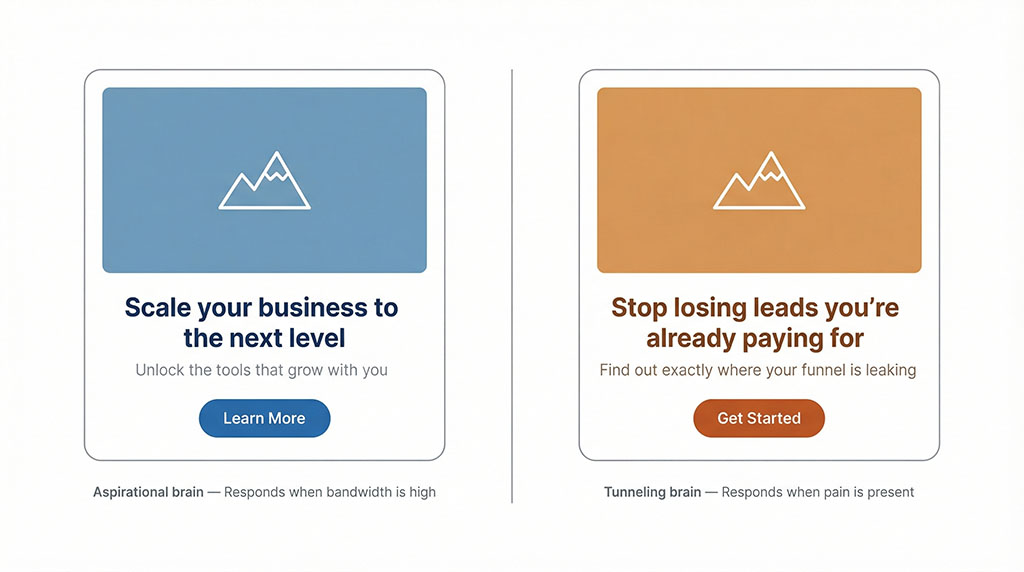
Language like “grow your business,” “scale faster,” “unlock your potential” — these are futures. They require your customer to imagine a better version of their life and feel sufficiently stable to invest in reaching it. That works when people have cognitive bandwidth. When someone is tunneling, that language washes over them. Not because they don’t want those things. Because their brain, under scarcity, cannot hold the future in mind the way it used to.
The ads haven’t changed. The brain reading them has.
The brands that read the room
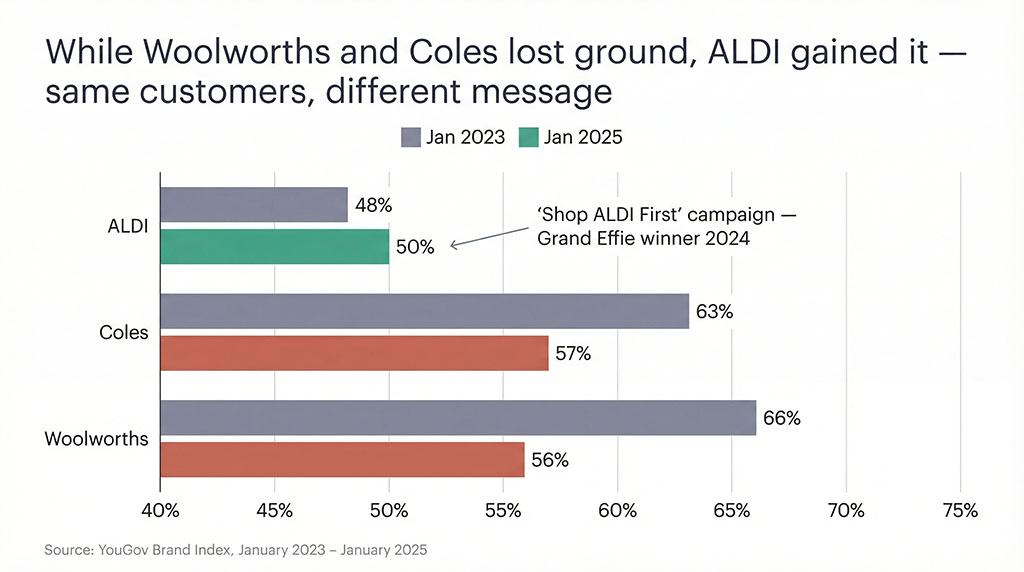
In early 2023, at the start of Australia’s cost-of-living crunch, ALDI launched a campaign called “Shop ALDI First.” The premise wasn’t “discover our great range” or “Australia’s freshest produce.” It was simpler and harder: we will save you cold, hard cash, and you should let us. The campaign acknowledged the financial reality Australians were living in rather than trying to sell around it.
ALDI gained 4% in customers that year. Over the same period, Woolworths’ consideration score dropped 10 points. Coles dropped 6. This campaign won the Grand Effie at the 2024 Australian Effie Awards. ALDI was selling the same groceries they’d always sold. The product didn’t change. The message reached a brain that could actually receive it.
The same pattern played out on a more dramatic scale during the 2008 financial crisis. While every major carmaker was lobbying for government bailouts, Hyundai changed its message entirely: buy our car, and if you lose your job within a year, return it. No penalty. No questions. The U.S. auto market fell 37% that January. Hyundai’s sales rose 14%. By mid-2009 they had their highest-ever U.S. market share. The car was the same car.
What changed was that the message addressed the fear actually in the room — not the dream of driving something beautiful, but the reality of a car payment that might become unaffordable.
Why this isn't about going cheap
Now here’s the objection forming in your head, and it’s a fair one.
If I lead with savings and cost-cutting, I’m training my customers to see me as the cheap option. I’m eroding the brand I’ve spent years building. I might win a few short-term sales and lose my positioning in the process.
This concern is legitimate. It also leads to the wrong conclusion.
The brands that won — ALDI, Hyundai, Taco Bell, whose sales rose 61% during the 1990s recession while McDonald’s fell 28% after going quiet — none of them abandoned their positioning. They didn’t rebrand as discount alternatives. They added a message track aimed at a different brain state, running alongside everything they were already doing.
The mistake is treating this as binary: either you sell the dream or you sell the cure. The smarter play is both, simultaneously, for different people in different states.
A pool company did this recently. They kept running the dream ads — golden-hour light, beautiful water, happy families. Alongside those, they added a second track: a guide showing two paths to pool installation, one of which saves $20,000 to $40,000 compared to using a builder. Same product. Same outcome at the end. Two entry points into the same conversation — one for the aspirational brain, one for the tunneling brain. Their competitors are still running only the first track.
The audit question
Look at your current ads and your landing pages. Honestly. How many of them speak to a problem your customer already has — right now, today — versus a result they might want to achieve someday?
Futures require optimism. Cures require pain. Pain is not in short supply.
This isn’t about becoming a discount brand or racing to the bottom on price. It’s about recognising that the same customer who responded to “grow your revenue” messaging twelve months ago now reads that phrase differently. They’re not stupid. They know their situation. A message that cheerfully sells them the future while ignoring the present can feel tone-deaf at best, dishonest at worst.
The cure layer doesn’t always mean cheaper. Sometimes it’s risk removal — if it doesn’t work, you don’t pay. Sometimes it’s eliminating a current inefficiency — you’re spending $X more than you need to, and here’s the proof. Sometimes it’s time — stop spending three hours a week on this. The common thread is that the problem already exists in the customer’s life. You’re not asking them to imagine a benefit. You’re offering relief from something they’re already feeling.
That’s a fundamentally different ask — and in this economy, it’s one a tunneling brain can actually say yes to.
There’s a switch, it turns out. Just not the one most people are looking for.
It’s not in the targeting settings or the creative refresh or the landing page. It’s in the question you’re asking your customer to answer. “Do you want this future?” requires optimism. “Do you have this problem?” requires only honesty — and right now, honesty is something most Australians have in abundance.
The customers are still there. They’re just in a different state than they were. Meet them where they are, and the numbers start to move.
Find out whether your current spend is reaching a brain that can actually buy
Most audits we run surface the same problem: messaging built for aspiration, campaigns measured on reach, and nobody asking whether any of it is landing with a customer who has the headspace to say yes.
Takes 30 minutes.