
The decision is already made.
Not after they read your headline. Not after they watch three seconds of your video. Not after the opening line of your email loads. Before any of that. Your prospect encountered your ad, your landing page, your subject line — and somewhere in the next 200 milliseconds, a part of their brain that predates language ran a three-item checklist and rendered a verdict.
You weren’t there for it. Neither was your copywriter.
The neuroscientist who proved emotion decides everything
In 1994, Antonio Damasio studied patients with damage to the part of the brain that generates emotion. Cognitively, they were intact. IQ normal. Language normal. Reasoning normal. They could describe the logical case for any decision in precise detail.
They just couldn’t decide.
Something as simple as choosing what to eat became paralysing. Both options had pros and cons. With no emotional signal to break the tie, the rational brain spun in circles. Damasio’s conclusion was stark: emotion isn’t a shortcut around rational decision-making. It is the decision-making. Logic builds the case. Emotion pulls the trigger.
You’ve probably heard a version of this before — “people buy on emotion, justify with logic.” Every copywriting course says it. Most marketers nod along and then write another ad full of features and benefits aimed squarely at the rational brain.
Because knowing it and engineering for it are two completely different things.
The dominant emotion already in the room
Clayton Makepeace called it the “dominant resident emotion” — the feeling already living in your prospect’s head before your ad appears. Not the emotion you’re trying to create. The one that’s already there.
Your prospect isn’t a blank slate waiting to be impressed. They arrived carrying something. Maybe it’s the low-level anxiety of a business owner who’s watched three ad campaigns fail to deliver. Maybe it’s the frustration of someone who knows their product is better but can’t seem to make buyers see it. Maybe it’s the quiet fear that their competitors are pulling ahead and they don’t know why.
That emotion is resident. It’s running in the background of every message they receive from you.
The job of your marketing isn’t to install a new emotion. It’s to meet the one that’s already there — to show the prospect that you understand what they’re carrying, that your product connects to it directly, that relief or transformation or confidence is on the other side.
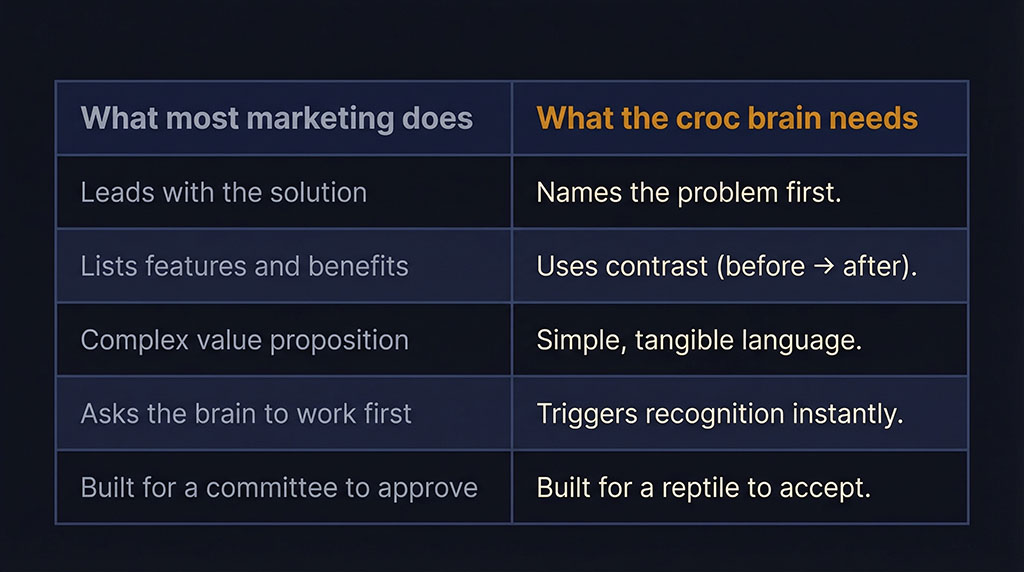
Ben Settle put it bluntly: “The best way to write any kind of copy is to create a vision of the problem, expand it, make it a horror show, then tell them about your solution. But what do most people do? They come out swinging with benefits and claims and ‘here’s why you should buy’ nonsense.”
Most marketers lead with the solution before they’ve earned the right to offer one. They skip the problem. They skip the emotion. They go straight to the pitch — and wonder why nobody’s listening.
The gate before the emotion
Here’s what most “sell emotionally” content leaves out. And this is where it gets uncomfortable.
Even if you know your prospect’s dominant resident emotion, you can still lose them before it fires.
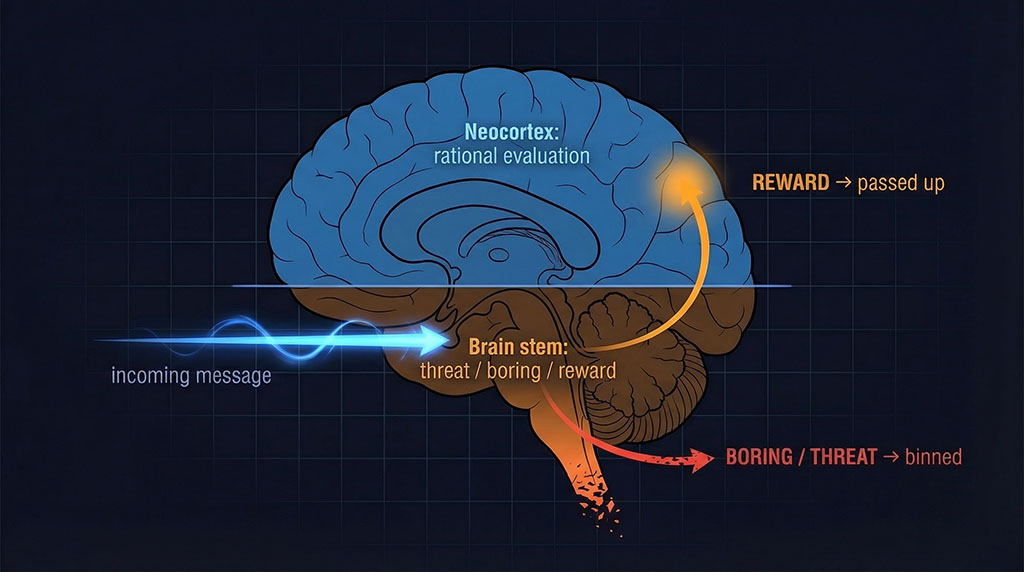
Oren Klaff spent years studying how the brain evaluates incoming information under pressure — specifically why some pitches get through and others get binned before anyone consciously processes them. His finding: the most primitive part of the brain, the brain stem, acts as a filter for everything that enters. It doesn’t evaluate your message. It classifies it. Fast. And it only has three categories.
Threat. Boring. Reward.
That’s the entire vocabulary. Three outputs. Everything you send — every ad, every email subject line, every landing page headline — gets sorted into one of those three bins in the first fraction of a second. If it lands in “reward,” it gets passed up the chain for conscious attention. If it lands in “threat” or “boring,” it gets dropped. The rational brain never sees it. The dominant resident emotion never gets a chance to fire.
Most marketing lands in “boring.” Not because it’s badly made. Because it’s complex.
The brain stem doesn’t read. It pattern-matches. Complexity — nuance, caveats, multi-part value propositions, “we help businesses like yours achieve sustainable growth through integrated marketing solutions” — registers as effort. Effort is neither threat nor reward. Effort is boring. Boring gets binned.
The part your A/B tests can't fix
You already know people make emotional decisions. You test your creative. You use storytelling. You put real faces in your ads instead of stock photography. You’ve read the books.
And your marketing still underperforms in ways the data can’t fully explain.
Here’s why: your testing operates inside the funnel. The croc brain filter operates before the funnel. You’re running carefully designed experiments on a stage a large portion of your audience never consciously stepped onto.
A/B testing headline A against headline B is a legitimate exercise. But if both headlines failed the three-item filter in the first 200 milliseconds, you’re measuring which one lost more slowly. The problem isn’t the headline. The problem is upstream of the headline.
This doesn’t mean testing is useless. It means the sequence matters. You can’t optimise your way past a filter you haven’t addressed first.
What the brain stem actually responds to
The croc brain is, as your lizard brain always suspected, a selfish bastard. It’s not interested in your product. It’s not interested in your story. It responds to one thing: signals that are immediately, unambiguously relevant to survival and self-interest.
Contrast works. The brain stem understands before and after faster than it understands any abstract benefit. Simple, tangible language works — not because your prospects aren’t intelligent, but because the part of the brain making the initial call isn’t running on intelligence. Novelty works briefly, as a pattern-interrupt, but novelty without relevance gets filed under “interesting and irrelevant” — which is just a slower route to boring.
What works best is the thing Makepeace identified and Klaff confirmed from a completely different direction: start with the problem the prospect already feels. Make it vivid. Make it specific. Make it worse before you make it better. The brain stem recognises pain faster than it recognises opportunity — because for most of human history, missing an opportunity was survivable, and missing a threat wasn’t.
Your prospect’s dominant resident emotion isn’t just a copywriting insight. It’s the signal the brain stem is already scanning for. Give it that signal first — clearly, immediately, without complexity — and you clear the gate. Everything after that, the case you build, the solution you offer, the rational justification that seals the decision, actually gets seen.
200 milliseconds, reconsidered
Go back to that prospect. Same screen. Same ad.
This time the message was built for the gate first. Not clever. Not feature-led. Not a multi-part value proposition that needed a second read. It spoke directly to the thing they were already carrying — the anxiety, the frustration, the fear — in plain language, with contrast, without asking their brain to work before it decided whether to pay attention.
The brain stem ran its checklist. Reward.
The message got through. The dominant resident emotion fired. The rational brain got its turn — and found a logical case waiting for it.
That’s not a better ad. That’s the same insight your industry has been teaching for 30 years, finally aimed at the right layer of the brain, in the right order.
The decision was already made. This time, in your favour.
See What One Brain Would Change
Map your current agency setup against the integrated model — and find out where the gaps, overlaps, and wasted spend are hiding.
Most clients find 2–3 channels working against each other that nobody spotted because nobody could see both. Takes 30 minutes.
You don’t need a better agency. You need to stop being the one holding it all together.