
Picture a plate of steamed broccoli. No seasoning. No sauce. Just broccoli, sitting under fluorescent lights, being aggressively nutritious at nobody.
That’s what most marketing looks like.
The information is accurate. The features are listed. The benefits are stated. The call-to-action is right where it should be. Your agency followed the playbook — clean product shots, benefit-driven headlines, a nice tidy feature comparison. It checks every box. And your audience scrolled past all of it in under two seconds, the same way you’d walk past that plate of broccoli at a buffet on your way to something that actually looks like it wants to be eaten.
Here’s the part that stings: the broccoli isn’t wrong. It’s nutritious. It’s good for you. It’s technically everything it should be.
Nobody ordered it.
The comfortable lie agencies tell you
The standard approach to marketing content is built on a reasonable-sounding idea: describe your product clearly, explain the benefits, target the right audience, and people will buy.
Agencies love this model. It’s efficient to produce. Easy to get sign-off on. The deliverables look professional — and “professional-looking” is often what business owners are paying for without realising it. You get a clean PDF or a polished social carousel, you see your product described accurately, and it feels like marketing is happening.
There’s one problem. It only works on people who already know they want what you sell.
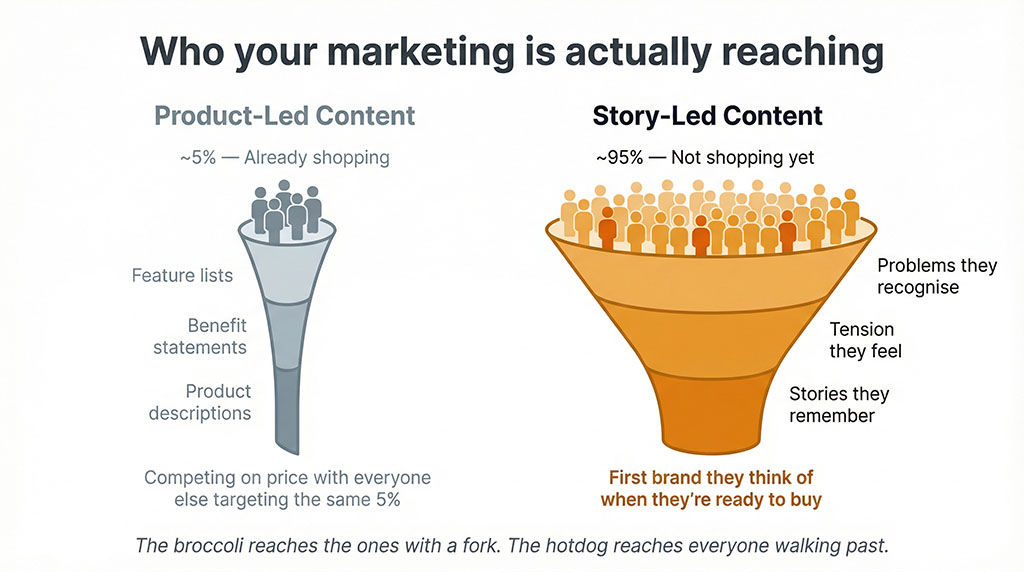
That’s a much smaller group than you think. Research from the Ehrenberg-Bass Institute suggests that at any given time, roughly 95% of your potential market isn’t actively looking to buy. They’re not comparing features. They’re not reading your specs page. They’re not even aware they have the problem your product solves — or if they are, it’s sitting on a list of things they’ll deal with “eventually.”
Your broccoli reaches the 5% who already pulled out a fork. It completely misses everyone else.
And yet, most agencies keep producing broccoli — because broccoli is easy to make, easy to justify, and easy to measure in a monthly report. “We produced 12 pieces of content, ran 4 ad variations, and optimised your landing page.” All true. All broccoli.
A hotdog that nourishes like broccoli
When Don Hewitt created 60 Minutes in 1968, TV news was pure broccoli. Dry. Factual. Dutifully important — and largely ignored by anyone who wasn’t already committed to watching the news.
Hewitt did something different. He wrapped hard journalism inside human stories, tension, and conflict. After Hewitt died in 2009, his friend Alan Alda — the actor who played Hawkeye in M*A*S*H — was asked why 60 Minutes became one of the highest-rated shows in television history. Not just news. All of television.
Alda’s answer: “They gave you a hotdog that nourished you like broccoli.”
Think about what that means. A hotdog looks fun. It looks like something you want to pick up. Nobody has to convince you a hotdog is worth your time. But Hewitt’s hotdog still delivered substance — real journalism, real information, real insight. The nutrition was all there. It was just wrapped in something people actually wanted to consume.
Every cable news network since — Fox, CNN, MSNBC — has tried to copy this model. Not because it’s gimmicky. Because an audience that wants to consume your information is fundamentally larger than an audience that needs it.
That’s the gap in your marketing. You’re producing content people might need. You’re not producing content people want.
What makes a hotdog a hotdog
So what’s the actual difference? It’s not production value. It’s not fancier graphics, better stock photos, or a more expensive agency. It’s conflict.
Disney figured this out decades ago. As one of their own specials put it: take a story with no villain, no danger, no evil plans — put them together and what have you got? Boredom. It’s the villain that determines how much the audience cares about the hero.
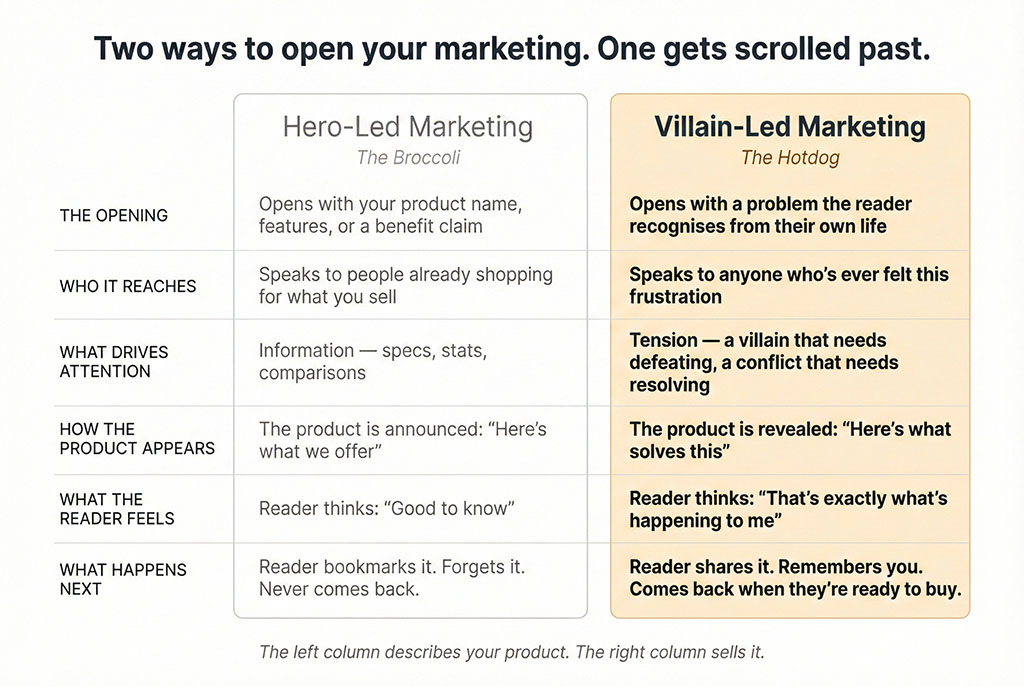
Your product is the hero of your marketing. But most agencies spend all their time talking about the hero. Features, benefits, capabilities, pricing. Hero, hero, hero.
Nobody cares about the hero until they feel the villain.
The villain is the real problem your customer experiences. Not the sanitised version from a product brief — the one that actually frustrates them. The late night worry. The thing they complain about to their business partner on a Friday afternoon. The nagging feeling that something isn’t working and they can’t quite put their finger on it.
When you dramatise that villain — when you make your audience feel its weight before you ever mention your product — your marketing stops being a feature list and starts being a rescue mission. And rescue missions hold attention. Feature lists don’t.
Trial lawyer Gerry Spence understood this. While other attorneys filed dry legal briefs stuffed with precedent and procedure, Spence told stories. He put the jury inside the problem — made them feel the danger, the injustice, the stakes — before he ever introduced his argument. He went virtually undefeated across a career spanning decades.
He wasn’t winning because he had better facts. He won because twelve people in a jury box felt something before they were asked to decide.
That’s what story does in your marketing. Not “storytelling” as a buzzword on an agency’s capabilities page. Story as a structural decision: lead with the villain, not the hero. Make the audience feel the problem before you offer the solution.
"But my customers just want the specs"
Right about now, you might be thinking: this is all well and good for TV shows and courtrooms. But you sell [commercial plumbing / accounting software / industrial equipment / something decidedly un-cinematic]. Your customers don’t want drama. They want specifications, pricing, and a delivery date.
For the narrow slice of people actively shopping for what you sell right now — you’re absolutely right. Give them the specs. Make it dead easy to buy. That’s not a marketing problem. That’s a sales page.
But if your entire marketing strategy is a sales page, you’re only ever talking to the people who already decided to look for you. You’re fighting over the 5% — the same 5% your competitors are also targeting with their own broccoli — and completely ignoring the vast majority who could become your customers next quarter, next year, or three years from now.
Story is how you reach people who aren’t shopping yet. A story about a villain they recognise — a frustration they share, a situation that mirrors their own — doesn’t require them to be “in market.” It just requires them to be human. And when they are finally ready to buy? You’re the one they already know. You’re the one who understood their problem before they even started looking for a solution.
The 95% aren’t unreachable. They’re just not listening to broccoli.
The five-second test
Here’s something you can do this afternoon. Pull up the last five pieces of content your agency — or your internal team, or you — produced. Social posts, emails, ads, blog articles. Whatever’s recent.
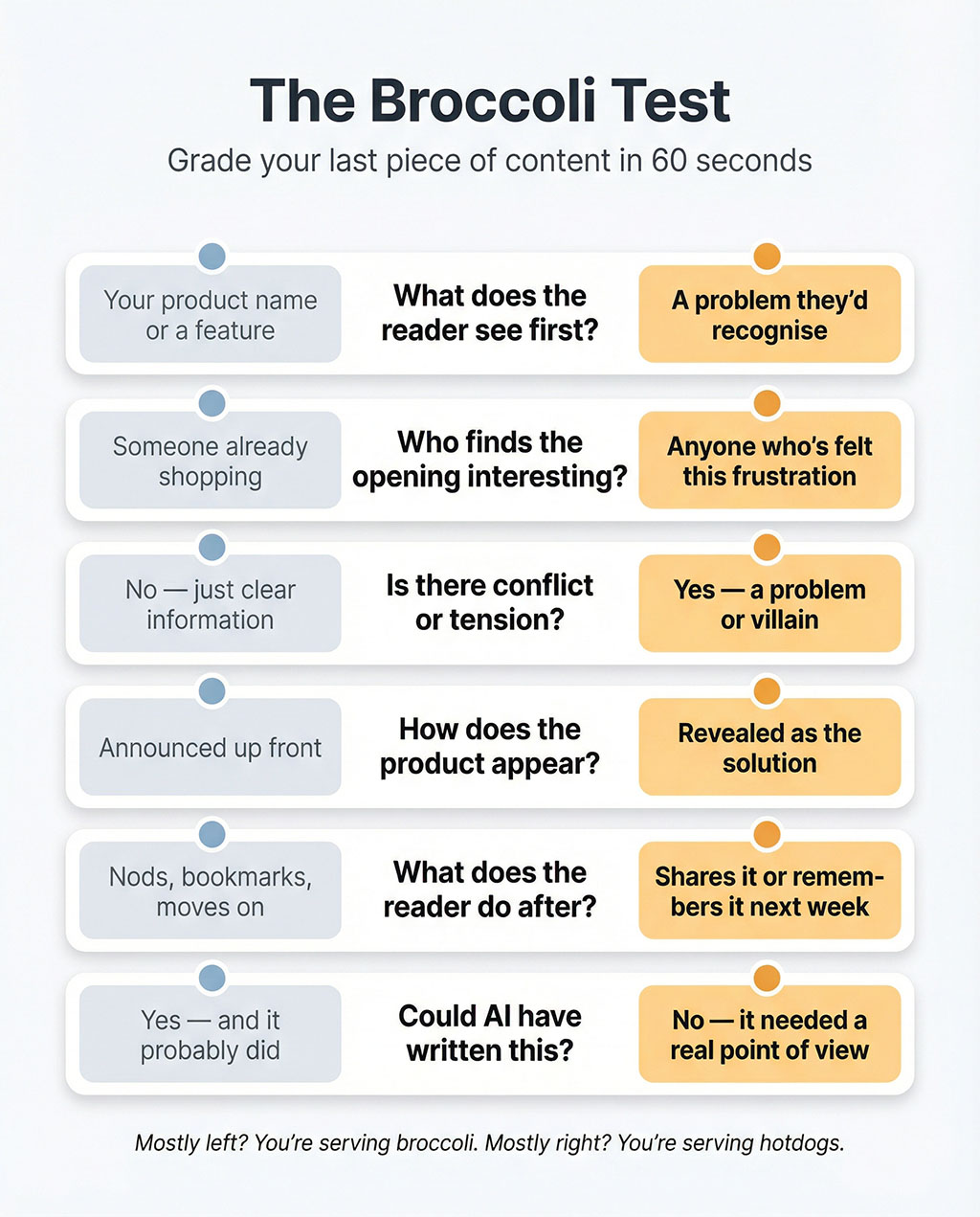
For each piece, ask one question: Would someone who has no idea what my product is find this interesting?
Not “informative.” Not “well-designed.” Interesting. Would they stop scrolling? Would they read past the first line? Would they feel something — curiosity, recognition, tension — before they ever encountered a product name?
If the honest answer is no — if the only people who’d engage with it are people who already know they need what you sell — you’re serving broccoli. Technically correct, well-presented broccoli that 95% of your potential market is walking straight past without a second glance.
The fix isn’t about being louder or funnier or more “creative” in the way that usually means a bigger production budget. It’s structural. Lead with the villain, not the hero. Dramatise the problem before you present the solution. Make your content something people want to consume before you ask them to act on it.
The plate is still there
A hotdog that nourishes like broccoli. That’s not a creative philosophy. It’s a business decision — the decision to stop marketing exclusively to people who already pulled out their wallet, and start reaching the enormous majority who haven’t.
Your broccoli isn’t wrong. The information is solid. The features are real. The benefits check out.
But it’s still sitting there under the fluorescent lights. Untouched. Getting cold. While your audience walks past with a hotdog in their hand — one they picked up from whoever understood that wanting comes before needing.
The question isn’t whether your marketing is accurate.
It’s whether anyone is hungry for it.
See If You’re Serving Broccoli
We’ll pull your last 90 days of content and run it against the same test — what’s reaching the 5% who already know you, and what’s reaching everyone else.
Most clients find their entire content calendar is product descriptions wearing different outfits. Takes 15 minutes.
You don’t need more content. You need content people are hungry for.