
In 1975, a salesman at a consumer electronics show handed Joe Sugarman a tiny walkie-talkie.
Sugarman looked it over. Small walkie-talkies were nothing new — you could buy one at any RadioShack. He handed it back.
Then the salesman mentioned something almost as an afterthought: one of the unit’s two frequencies sat right next to the CB radio band sweeping America that year. Truck drivers were using CB radios to warn each other about speed traps. Songs were being written about them. The fad was so intense that units were flying off shelves before they could be restocked.
Sugarman looked at the walkie-talkie again.
He didn’t change the product. He didn’t change the price. He renamed it “The Pocket CB” and sold 250,000 units.
Same electronics. Same plastic casing. Same range, same battery life, same frequencies. The only thing that changed was the concept — the idea he wrapped around the product. And that single idea multiplied its sales by a number so large it’s almost easier to think about in terms of what was left behind: the original walkie-talkie, sitting unsold in every RadioShack in America.
What Sugarman actually meant by "the concept"
Joseph Sugarman’s copywriting rule is quoted often, misunderstood constantly: Never sell a product. Always sell a concept.
Most people hear that and imagine something expensive — brand storytelling, a creative agency, a workshop with Post-it notes. That’s not what it means.
The concept is the idea that makes the product suddenly make sense. It’s the angle that collapses the distance between “what this is” and “why I want one.” Sugarman’s walkie-talkie wasn’t sold as “a compact two-way radio with dual-frequency capability.” It was sold as the thing that let you join the CB radio phenomenon without buying a CB radio.
Same product. Different frame. The frame is the concept.
Notice what Sugarman didn’t do. He didn’t invent a story or manufacture a meaning that wasn’t there. He looked at what the product could genuinely do — broadcast on a CB-adjacent frequency — and found the concept that was already living inside it.
That’s the discipline. Not creativity for its own sake. Discovery.
Why most small business marketing describes instead of sells
Open the website of almost any local tradesperson, accountant, gym, or consultant. Read their homepage. Then read their closest competitor’s.
They say the same things.
Experienced team. Quality service. Competitive rates. Local knowledge. Contact us today.
This isn’t because these businesses are dishonest or lazy. It’s because they’re describing what they do accurately and completely — and still producing marketing that could belong to anyone on their street. The description is correct. The concept is missing.
The reason is structural. Business owners know their product from the inside. They know the process, the inputs, the steps. When they sit down to write a Facebook ad or update their website, they describe what they see from that vantage point: the thing they make or do.
What they can’t see — what’s genuinely invisible until someone names it — is the concept the customer is actually buying.
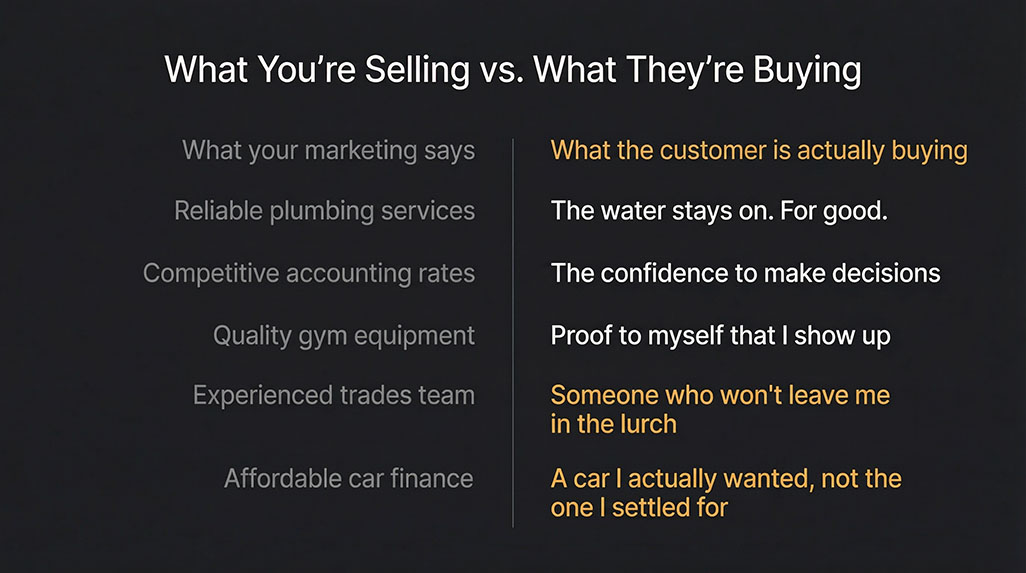
The customer of a plumber isn’t buying pipe repair. They’re buying the moment the water goes back on and stays on, and the certainty it won’t fail again. The customer of an accountant isn’t buying tax returns. They’re buying the ability to make business decisions without financial dread. The customer of a gym isn’t buying equipment access. They’re buying proof — to themselves — that they’re the kind of person who shows up.
Those are concepts. And none of them require a logo redesign or a branding retainer to put into words. They require one question, answered honestly: What is the customer actually walking away with?
Here's where most business owners push back
“This is what big brands do. I fix air conditioners. Or I do bookkeeping. Or I run a café. There’s no concept in what I sell — it’s just a service.”
This is the honest version of the objection and it deserves a direct answer.
The concept isn’t invented. It’s found. It’s almost always sitting right next to the thing you already do well, waiting to be named.
The air conditioning contractor who guarantees a call-back within two hours on the hottest day of the year isn’t selling cooling. They’re selling the end of helplessness on the one day it matters most. The bookkeeper who delivers a plain-English summary alongside every quarterly report — so the business owner understands exactly where they stand without needing to understand accounting — isn’t selling bookkeeping. They’re selling the confidence to actually run the business. The café that sources from three local farms and prints the farmers’ names on the menu isn’t selling coffee. They’re selling the feeling of choosing something that means something.
None of those concepts require a rebrand. They require a clear statement of what the customer is actually walking away with — which is almost never the literal product or service.
The numbers behind the shift
The objection above is understandable. But it doesn’t hold up.
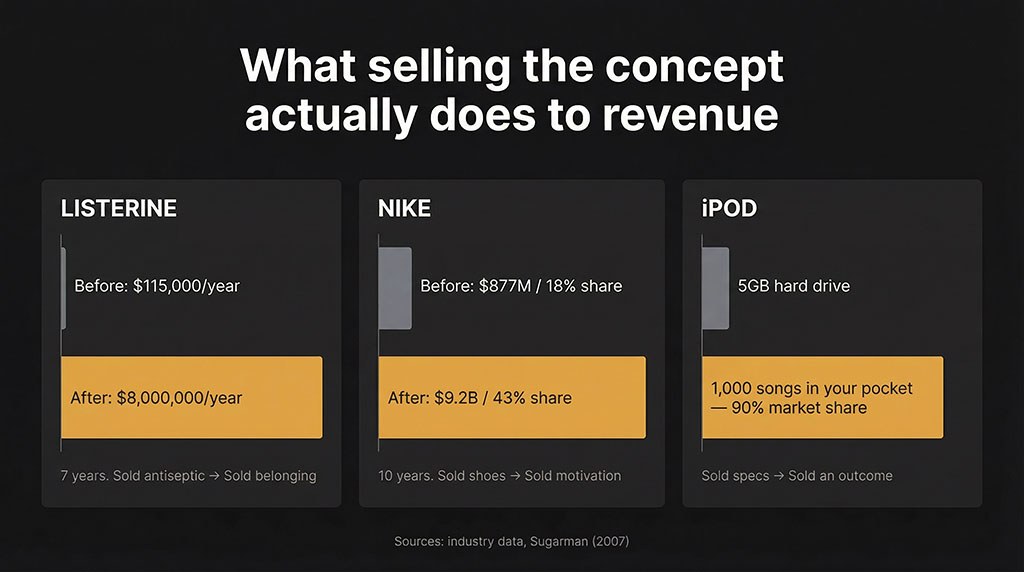
Listerine spent four decades selling antiseptic liquid. Annual revenue sat at $115,000. In the 1920s, one campaign reframed ordinary bad breath as a social catastrophe using an obscure Latin medical term – halitosis – and repositioned the product around social acceptance rather than germ-killing chemistry. Revenue went from $115,000 to over $8 million in seven years. The product didn’t change.
Nike was losing to Reebok in 1987. Its advertising focused on shoe technology and performance specs for serious athletes. Then “Just Do It” arrived — a campaign that barely discussed shoes at all, and instead sold determination, grit, the internal battle of motivation. U.S. market share went from 18% to 43% over the following decade. Sales grew from $877 million to $9.2 billion.
The iPod launched in 2001 into a crowded market where every competitor advertised megabytes and hard-drive capacity. Steve Jobs described the same product as “1,000 songs in your pocket.” Competitors offering more storage for less money captured less than 4% of the market. The iPod took 90%.
Not one of these companies changed what they were selling. They changed the concept they were selling it under.
Sugarman wasn’t working with Nike’s budget or Apple’s R&D. He was selling a walkie-talkie at a consumer electronics show. The same principle operates at every scale.
How to find yours
Sugarman spent two days inside the Sensor Watch factory before he wrote a word. He interrogated engineers. He asked the obvious questions nobody had thought to ask out loud. What came back wasn’t a spec sheet — it was a headline: Laser Beam Digital Watch. Not the technical details. The story buried inside them.
Three questions, taken seriously, do the same work for most businesses.
The first: What does the customer stop worrying about the moment they hire you? Not what you deliver — what anxiety disappears. That’s usually the concept.
The second: What would a satisfied customer tell their friend about working with you — not what you did, but what it felt like? That story, compressed into a phrase, is often closer to your real concept than anything currently on your website.
The third is the hardest: What does this product make possible that nothing else does? Not “what makes you different.” What does it unlock? The Pocket CB unlocked the CB radio phenomenon for people who couldn’t fit a full unit in their car. That’s a concept. What does your work unlock for the person on the other side of it?
You don’t need all three answers. One clear answer to any of them is usually enough to find the frame that was missing.
The business you're actually running
Sugarman sold 250,000 Pocket CBs. Then the CB fad peaked, passed, and the product became irrelevant again.
But the principle didn’t pass. He used the same thinking to sell a thermostat by leading with the admission that he hated it. To sell BluBlocker sunglasses by selling vision protection before he sold a product. To sell a $240,000 airplane through a single print ad — not by listing its avionics, but by telling the story of a loyal mechanic who wanted to go back to farming.
Every time, the product was real. The concept made it visible.
Your business is doing real work. The product exists. The question is whether your marketing has found the frame that makes it visible to the people who need it most.
The Pocket CB was already in that electronics show. Sugarman just found the name it had been waiting for.
Find the concept inside your business
Most audits we run surface this problem immediately: solid businesses doing real work, described in marketing that could belong to any competitor on the street. The concept is already there. It just hasn’t been named yet.