
A marketing coordinator used Claude to rewrite a landing page overnight. By lunch it was converting better than the page it replaced. Her manager did not say well done. He said: “We haven’t approved that tool. Please revert to the original copy.”
She did not revert. She stopped telling him.
She is a composite of three people I have worked with. Every marketer reading this has already thought of a fourth.
She is not unusual, and there is now a lot of data about how common she is.
Slack’s 2024 Workforce Index asked 17,372 desk workers across 15 countries how they felt about using AI at work. Forty-eight percent said they would be uncomfortable telling their manager they had used AI for at least one common task. That figure measures what people feel able to say, not what they actually did.
KPMG and the University of Melbourne measured the doing. Across 47 countries they surveyed 48,340 people, including 32,352 employees. Among those employees, 57 percent said they hide their use of AI and present AI-generated work as their own. Almost half admitted using AI in ways that contravene their organisation’s policies, which usually means pasting confidential material into a free chatbot.
Read those together. Around half of your people feel they cannot tell you. More than half are not telling you. And a similar share are doing it in a way that would fail any audit you care to run.
That is not a technology problem. It is a permission problem, and permission is a management output.
The Barrier Nobody Wants to Name
McKinsey’s Superagency report, fielded in late 2024 and published in January 2025, surveyed 3,613 employees and 238 C-suite executives. Eighty-one percent of respondents were in the United States, and McKinsey states that the findings apply to US workplaces.
It asked executives what was holding AI back inside their own companies. They pointed at their staff. Executives were more than twice as likely to name employee readiness as a barrier as they were to name their own role.
Then McKinsey asked the staff.
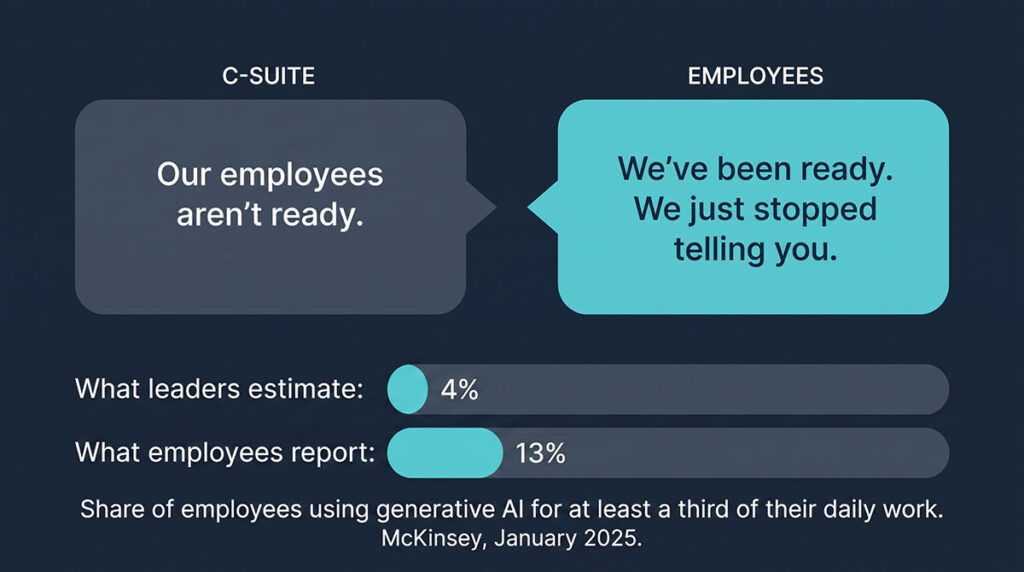
Leaders estimated that 4 percent of their people use generative AI for at least 30 percent of their daily work. Among employees, the real figure was 13 percent. More than three times the estimate. Look forward twelve months and the gap holds: 47 percent of employees expect to be using generative AI for 30 percent of their work within a year, against roughly 20 percent of leaders.
McKinsey’s own conclusion is written into the report. The biggest barrier to scaling is not employees, who are ready. It is leaders, who are not steering fast enough.
Sit with the shape of that for a moment. The people at the top of these companies were asked what was slowing AI down, and they named the one group the same survey found was already ahead of them. Your workforce is further along this road than you think. They are just not sending you updates.
One more number from that survey, and it needs handling with care. Only 1 percent of those executives rated their own company as mature on AI. That is 1 percent of 238 people, so roughly two individuals, self-assessing. It is not a measurement of how many companies have got there. It is a mood reading from a small room, and the mood is grim.
BCG surveyed 1,000 CxOs and senior executives across 59 countries and more than 20 sectors, and found that 74 percent of companies have yet to show tangible value from AI at scale. Seventy percent of the obstacles are people and process. Ten percent are algorithms. BCG’s own rule for the companies that manage it is 10-20-70: a tenth of the effort on algorithms, a fifth on technology, seventy percent on people and process.
None of these studies name the technology as the problem. Every one of them names people and process instead, which is the part of the business that has a manager’s name on it.
The Loop That Keeps It Hidden
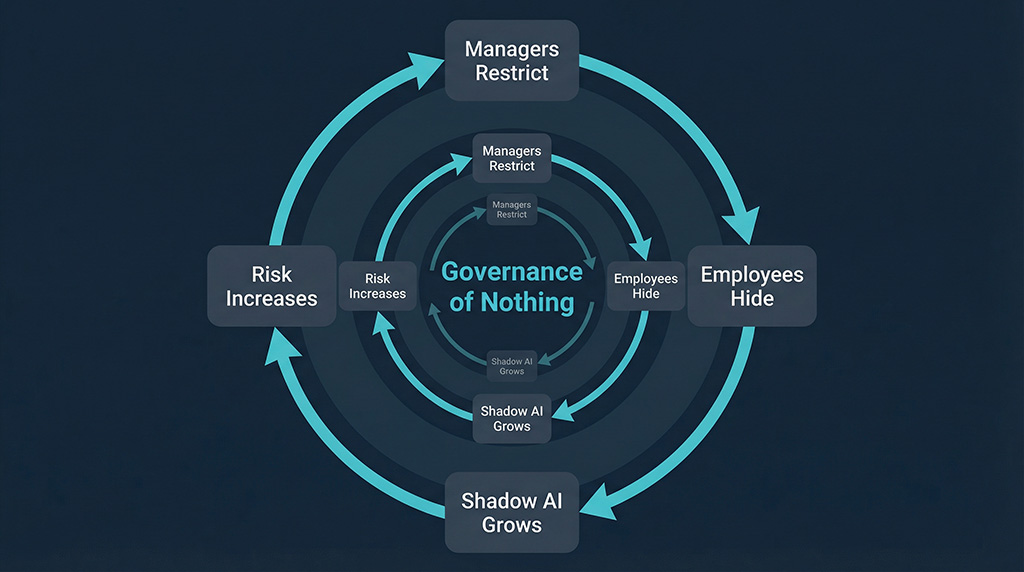
Managers restrict AI because they do not trust it. Employees hide their use because they do not trust the reaction. Hidden use is ungoverned use, which is the exact risk the restriction was meant to prevent. The risk then justifies more restriction, and the cycle tightens.
Every rotation pushes adoption further out of sight, where nobody can audit it, improve it, or learn from it.
David De Cremer, Dean of Northeastern University’s D’Amore-McKim School of Business, published a piece in Harvard Business Review in March 2025 under the title “Employees Won’t Trust AI If They Don’t Trust Their Leaders.” The title is the finding. You do not have a tool adoption problem underneath this. You have a trust problem wearing a tool adoption costume.
"But We're Being Responsible"
This is the objection, and it deserves a real answer rather than a wave of the hand.
Governance matters. Brand safety matters. Samsung, Verizon and J.P. Morgan Chase all restricted ChatGPT in 2023, and none of them did it out of timidity. Their reasons were not the same, though, and the difference is instructive. Samsung acted after engineers pasted sensitive source code into the tool, and even then the restriction covered generative AI on company machines inside one division rather than the whole company. Verizon acted before anything had happened, worried about losing control of customer information and code. J.P. Morgan acted on compliance and third-party software controls, and the reporting at the time was explicit that no particular incident prompted it.
Now look at what all three did next. They built or bought internally governed tools instead. J.P. Morgan rolled out its own OpenAI-powered assistant to tens of thousands of its employees in 2024. Samsung moved staff onto internal tooling. The three most-cited bans in this entire debate were holding positions, and every one of them ended in governance rather than prohibition.
The caution has data behind it too. MIT’s Project NANDA reported that 95 percent of the organisations it looked at saw no measurable return on their AI spending. That number gets repeated as “95 percent of AI pilots fail”, which is not what it found, and the sample was 52 interviews plus 153 survey responses gathered at a conference. Take it as a direction rather than a measurement, and the direction is real. Most of this money is not landing.
So caution is reasonable. But restriction is not governance.
Governance is a written policy naming what data can go where. It is an approved tool list somebody actually maintains. It is a route for a coordinator to ask a question and get an answer inside a week. Most companies have installed the restriction and none of the rest, and the result is not safety. It is the same usage as before, moved somewhere you cannot see it.
Gallup surveyed 19,043 US adults in May 2025 and found employees whose leadership had communicated a clear plan for AI were around nine times more likely to say they use it in their role. Both halves of that ratio are top-box “strongly agree” answers, which stretches it, and it shows correlation rather than cause. It still points one way. Clarity produces use. Silence produces secrecy.
What the Delay Actually Costs
The bill is not a one-off miss. It accumulates.
Gartner’s 2025 CMO Spend Survey put marketing budgets at 7.7 percent of company revenue across 402 respondents. That is not a slow slide from ten percent. Budgets crashed to 6.4 percent in 2021 and have moved sideways ever since. Fifty-nine percent of those CMOs say they do not have the budget to deliver their strategy, which is an improvement on 64 percent the year before. Slightly less pressure, applied to a much smaller number.
At the same time, work keeps moving in-house. The ANA found that 82 percent of its member companies now run an internal agency, up from 42 percent in 2008.
So the money is tight, the workload is arriving anyway, and the people who can close the gap are getting more expensive. PwC’s 2025 AI Jobs Barometer found roles asking for AI skills advertise 56 percent higher wages, up from 25 percent in 2023. That measures what employers post, not what staff are paid, but the direction of travel is not ambiguous.
The people already inside are looking too. In a survey run by Writer, 59 percent of executives said they were actively looking for jobs at more AI-capable companies, against 35 percent of employees. Writer sells enterprise AI software, so treat the absolute numbers with the caution any vendor survey deserves. The gap between the two is the interesting part. Your leadership team is more restless about this than your staff are.
BCG’s September 2025 data puts a figure on the other side of the ledger. The most AI-mature 5 percent of companies show 1.7 times the revenue growth, 3.6 times the total shareholder return and 1.6 times the EBIT margin of laggards. Fourteen percent of companies sit in that laggard band. Sixty percent report minimal revenue and cost gains.
The Layer That Is Already Being Removed
Here is the part your managers have not been told, and it explains more of their behaviour than any survey will.
Bloomberg, working from Live Data Technologies, found that middle managers made up 31.5 percent of everyone laid off in 2023. Roughly a third of the cuts landed on one layer.
Gartner published a forecast in October 2024: through 2026, 20 percent of organisations will use AI to flatten their organisational structure, eliminating more than half of their current middle management positions. Note the wording, because it matters. “Through 2026” is a window that is already open, not a deadline in the future. And the cuts follow the flattening rather than causing it.
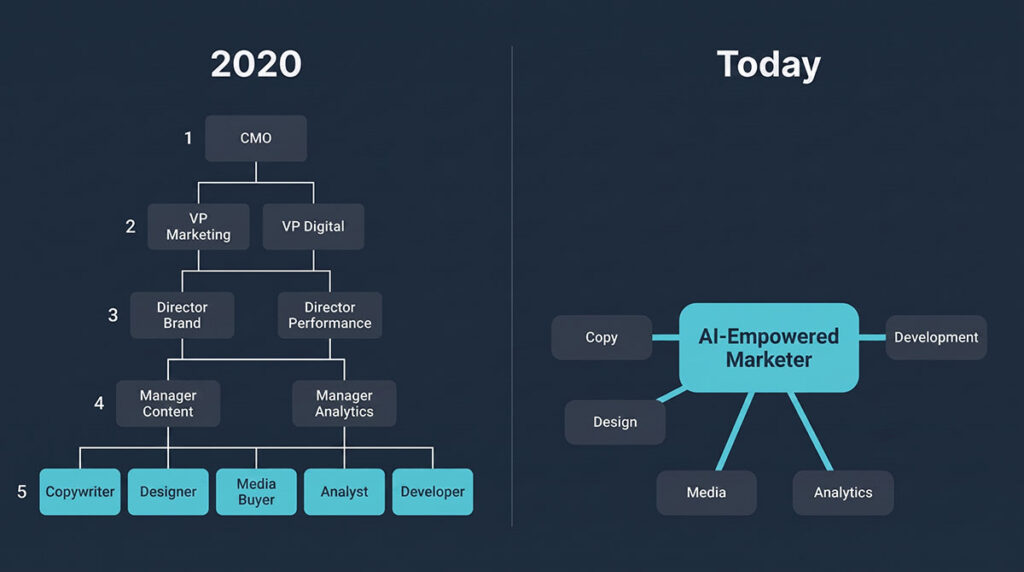
Now look again at the manager who told a coordinator to revert the landing page. He was not being obstructive for sport. He was watching a tool make his coordination work optional while his own layer absorbed a third of the industry’s redundancies. Restriction was the rational move for him personally, and the wrong one for the company. Until somebody above him changes what he is rewarded for, he will keep making it.
What It Looks Like When Somebody Goes First
Klarna is the case everybody cites, and almost everybody stops halfway through it.
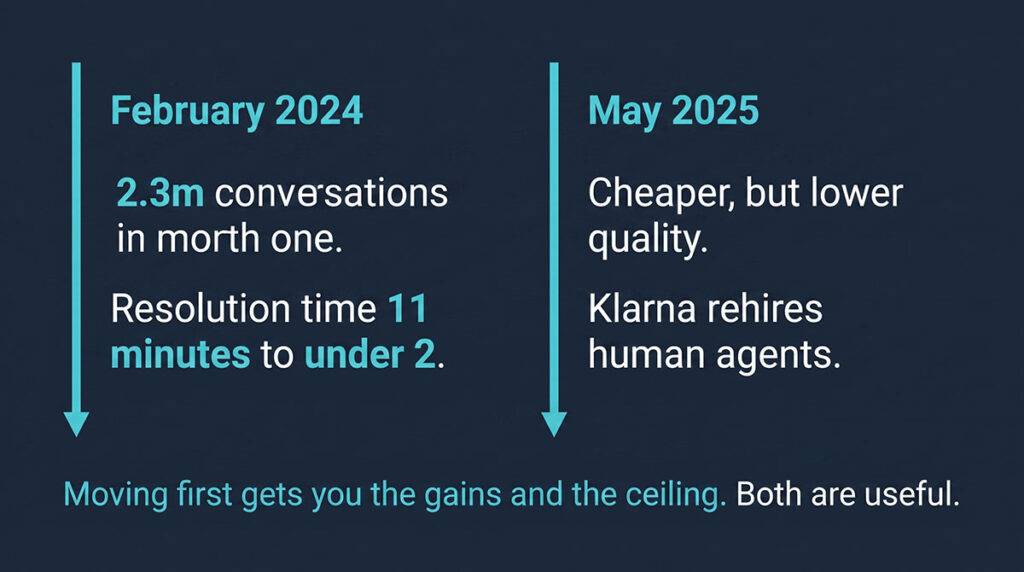
In February 2024 the company said its AI assistant had handled 2.3 million conversations in its first month and cut average resolution time from eleven minutes to under two. Revenue per employee rose 74 percent year on year, though a 22 percent fall in headcount through attrition did much of that work. Leadership did not wait for the middle of the company to volunteer.
Then in May 2025, CEO Sebastian Siemiatkowski told Bloomberg the AI service was cheaper but produced lower quality output. He said investing in the quality of human support was the way of the future for the company, and Klarna started hiring agents again.
Both halves are the lesson. Moving first produced real gains that a slower competitor did not get. Moving first also found the ceiling faster, and finding the ceiling early is worth something too. What Klarna did not do was spend eighteen months debating whether to be allowed to try.
IgniteTech went further and paid for it openly. CEO Eric Vaughan put 20 percent of payroll into AI training, made “AI Mondays” mandatory, and met sustained resistance from his own management team. He replaced close to 80 percent of staff inside a year. He told Fortune the company finished 2024 at roughly a 75 percent EBITDA margin.
His summary was this: changing minds was harder than adding skills.
That is one founder’s account of his own private company’s unaudited numbers, so weigh it accordingly. But the sentence is the point, and it matches everything above it. BCG’s seventy percent. McKinsey’s leaders who are not steering fast enough. Gallup’s nine times. The technology was never the hard part.
The Slack Message, Six Months On
The coordinator never did revert the landing page. She kept using the tool and stopped mentioning it. In every version of this I have watched, the same thing happens next. Six months on, her work is beating the rest of the department by a margin wide enough that people start asking why.
The manager notices the results before he notices the method. By then she has built a way of working that makes his approval step unnecessary. She is not briefing a copywriter, because there is no copywriter. She is not waiting on a designer or booking an analyst review, because she has the output and the numbers in front of her.
His role does not get automated. It gets routed around.
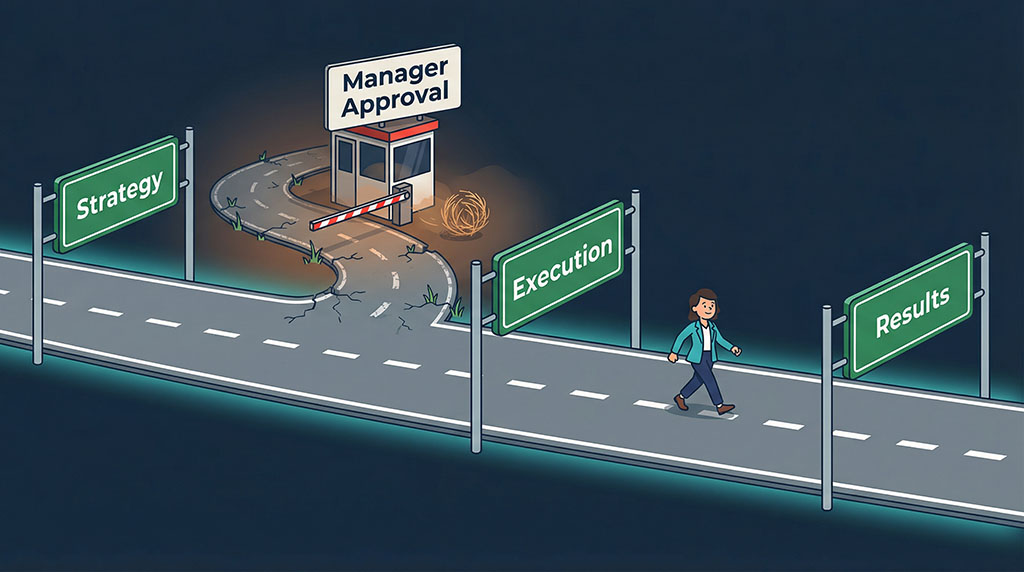
That is happening inside your organisation right now, whether your management layer has noticed or not. The people hiding their AI use are not waiting for permission. They are building the next version of their job while their managers debate whether it should be allowed.
The manager’s role does not disappear. It changes. It moves from approving work to removing obstacles, from coordinating specialists to designing how people and AI split the work, from the person who signs off the brief to the person who makes sure the team has direction, data access and enough trust to move at the speed the market is running.
That change needs one thing your managers have mostly not given.
Permission.
Your employees are ready. They have been ready for a while. The only thing in the way is the layer that is supposed to be leading them there.
Your marketing, looked at properly
Thirty minutes on your current setup — what’s working, what’s quietly leaking budget, and what I’d fix first. You’ll leave with a clearer picture whether we work together or not.
Got something specific bugging you? Flag it when you book and I’ll have it looked at before we talk.

AboutBruce Marjoribanks
Bruce Marjoribanks has spent 27 years in marketing, including building, running and selling his own agency before going independent. He now runs every channel - paid, organic, social, email, creative and automation - as one integrated system, with AI ehancing production and the judgment staying human.