
$131 is what a blog post costs now.
That is not a quote I was handed. It is the average 879 marketers reported paying per AI-generated blog post in the Ahrefs State of AI in Content Marketing survey, 18 June 2025. The same survey put human-written posts at $611.
Three caveats before that gap does any work. Ahrefs asked what people pay for a single blog post and let each respondent decide what that covered, so length, research depth and editing all sit unstated. The figures are weighted midpoints of bucketed spend ranges, not invoices. And Ahrefs sells AI content tooling.
What it compares is what one group of marketers pays against what another group pays. It is not a before-and-after on the same brief.
Discount it however you like. The gap is still 4.7 times.
That gap is not inflation running backward. It is a 30-year economic moat draining.
For three decades, marketing careers rested on one condition: execution was hard. Writing code required engineers. Video required videographers. Data required analysts. Those technical barriers worked as castle walls. They protected specialists, justified salaries, and created the illusion that knowing which buttons to click was the same as understanding why. If you could do the thing, you had leverage.
That leverage is draining. Not at the pace industries usually shift. Fast, the way water goes when someone pulls the plug.
The Inversion Nobody Saw Coming
The volume story is more complicated than the panic headlines suggested, and the complication is the interesting part.
Graphite, a growth agency, sampled 55,400 English-language URLs from Common Crawl and ran each through three separate AI detectors, averaging the results. Mostly AI-written articles reached 49.6% of new publishing by Q1 2025, against 50.4% human. They crossed 50% in Q4 2025, at 50.9%. Then the line came back down to 49.9% in Q1 2026. The flood rose, then stopped rising.
That is worth stating carefully, because Graphite’s earlier study said something different. Its October 2025 version used a single detector across a smaller sample and put the crossover in November 2024. The three-detector study revises those figures down by an average of 3.3 points and supersedes them. If you have seen the late-2024 date quoted, including in my own drafts, it came from the older method.
Graphite is candid about its limits, and so should we be. Detection is imperfect, and the line between AI-assisted and human-written blurs every month as writers draft with a machine and edit by hand.
But the shape holds. AI made publishing cheap. It did not make being read cheap. (More on that gap later, because it is where the money now sits.)
You can feel the shift in the silence of a Slack channel that used to ping with revision requests. In the speed at which “can you mock this up?” becomes “here are three options, which direction?” In the specific anxiety of a specialist watching their inbox thin.
The real change is not volume or cost. It is where value sits in the marketing supply chain.
Picture the old model. A strategist defines the campaign. Briefs a copywriter. The copywriter drafts, hands files to a designer, who finishes layouts, passes assets to a developer, who builds the landing page, then waits, always waiting, for an analyst to implement tracking. Five handoffs. Five chances for the original intent to degrade. A game of telephone where the message started as “bold and irreverent” and arrived as “blue button, sans-serif font.”
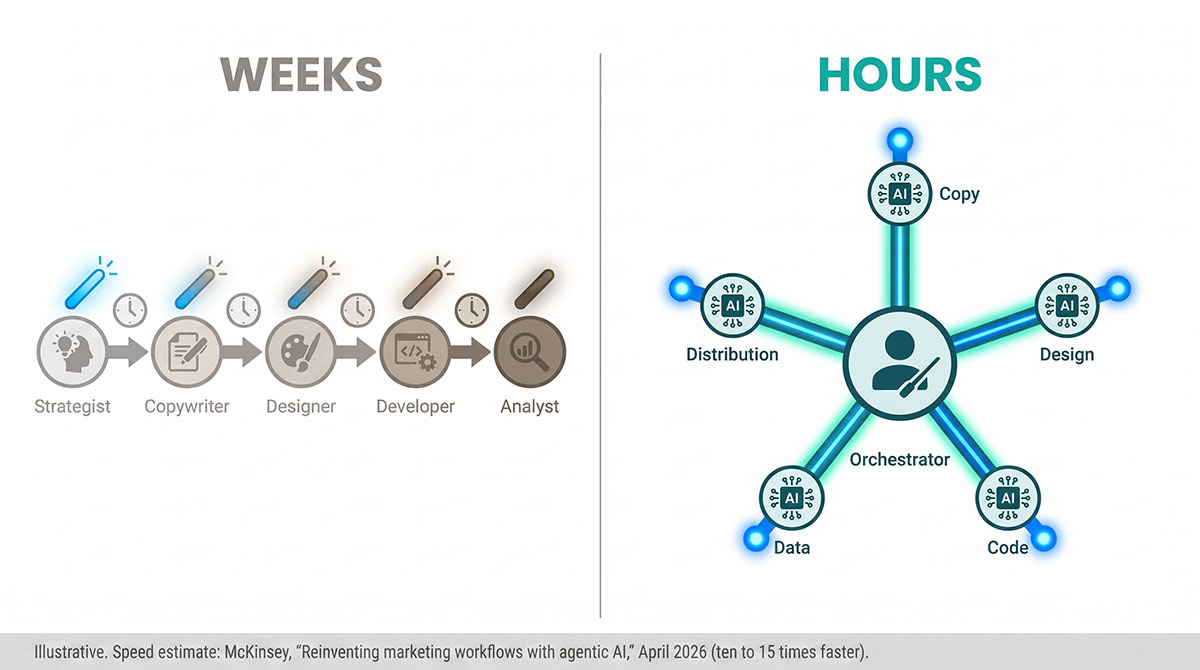
That relay race created jobs. Plenty of them. It also created the appearance of complexity that justified specialist billing rates. The open secret of agency work was that much of the “expertise” was knowing which buttons to click in software that redesigned its interface every six months.
Now the new model. One person sets the strategy, generates copy variations, produces design concepts, deploys with no-code tools, and reads the results. Not perfectly. We will get to that. But fast, cheap, and without four rounds of accumulated misinterpretation.
The specialist’s moat was never knowledge. It was execution difficulty. And execution difficulty just got cheap.
The Rise of the Orchestrator
If the specialist is threatened, the generalist is freed. Not the old jack-of-all-trades generalist. Someone else.
Emily Kramer, who built marketing at Asana as its 35th employee and later ran marketing at Carta, calls these people pi-shaped marketers. She did not invent the shape. It circulated in Scrum and consulting circles well before she applied it to marketing. What she added was the map.
These are not shallow generalists who know a little about everything. They hold deep expertise in two distinct areas, say growth marketing and product marketing, plus working fluency across the rest. They span what Kramer calls the Fuel and Engine divide. Fuel is content, brand and messaging: what you say. Engine is channels, processes, tools and metrics: the machinery that puts it in front of someone. Traditional specialists sit on one side. Pi-shaped marketers work both.
AI pushes this further, and here I am reporting what I watch rather than citing a study.
People are borrowing depth. A strategist who never learned to code can now direct a build by knowing what to ask for and how to judge what comes back. They do not master Python. They learn what Python should do.
Borrowed depth is real leverage. It is also brittle. It holds right up to the moment the machine is confidently wrong and nobody in the room knows enough to catch it.
This is the AI Generalist. Not a polymath. A polymath by proxy. Their skill is not execution, it is orchestration. The conductor who cannot play every instrument but knows how each section should sound, and catches the wrong note before the audience does.
The consulting forecasts have caught up to the pattern. McKinsey’s April 2026 work on agentic marketing workflows projects 10 to 30% revenue growth from hyperpersonalised marketing, and estimates agentic systems will speed campaign creation and execution by ten to 15 times. Read those as projections, not measured outcomes. And note the condition McKinsey attaches: the gains come from redesigning the work. Bolting agents onto the workflow you already run does not produce them.
The sharper proof is on the ground. Brett Williams built DesignJoy, a design subscription service, with no employees. Reported revenue varies by source and year: roughly $80,000 a month as of January 2023 per Noah Kagan, around $1.7M annual run rate per Starter Story. Either figure, one person. No project managers. No meetings. He productised the offer, then stripped out every administrative layer.
Before generative AI, that took top 1% talent and unusual discipline. It now looks closer to a structure other people can copy.
"But My Expertise Still Matters"
Here is where you push back. You spent a decade becoming the SEO person, the paid media person, the analytics person. You have seen the output. It hallucinates. It misses nuance. It produces slop.
Worth being precise about that word, since it gets passed around as though it were a technical finding. Slop is Merriam-Webster’s 2025 Word of the Year, defined there as “digital content of low quality that is produced usually in quantity by means of artificial intelligence.” That is a judgement, not a measurement. The one serious academic attempt to study it opens by admitting there is no agreed definition.
Your clients still call you when the campaign breaks. Surely that depth is worth something?
It is. Just not the way you think.
The threat is not AI replacing you. It is a generalist with AI getting close enough to your output at a fraction of your cost. Call it 80% of the work at 20% of the price. Those are round numbers for a shape, not a measurement. But for most business decisions, close enough and five times cheaper wins. Not for everything. Not for the highest-stakes work. For the broad middle of the market, which is where most specialists earn their living, the maths has flipped.
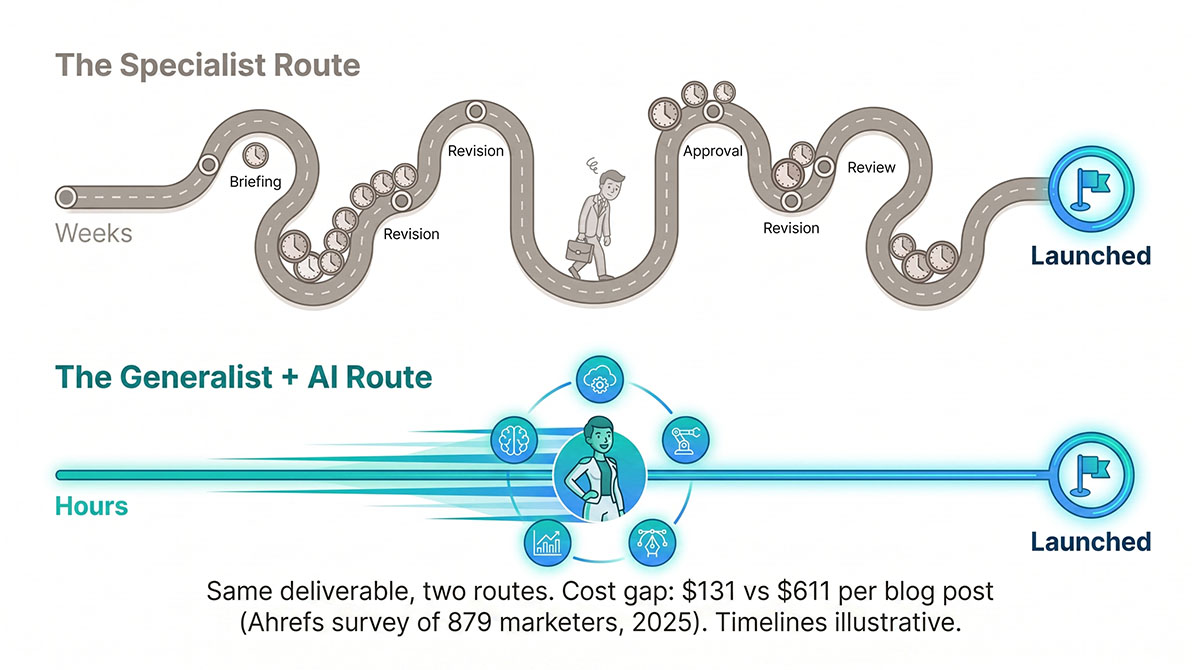
I have watched this happen. A client who used to need a full content team now runs their entire blog operation with one marketing manager and a Claude subscription. Nobody was fired. They stopped backfilling when people left. The work kept shipping. Nobody outside the team noticed.
There is a ceiling. AI content hits diminishing returns. It is trained on an enormous sample of what already exists, and it drifts toward the middle of that sample. It fumbles subtext, sarcasm and high-context humour, anything that needs cultural fluency. Lean on it entirely and your brand starts to sound like every other brand.
But here is the edge: the generalist who understands that ceiling and knows when to override the machine is more dangerous than the specialist who can only execute one discipline by hand. The generalist ships faster, iterates more, and calls in the specialist for the fifth of the work that genuinely needs mastery.
Your expertise still matters. It no longer justifies a full-time seat. It justifies a contractor rate for the moments when “good enough” would read as brand damage.
The Ladder That Disappeared
The structural problem runs past individual careers. The industry is eating its own seed corn.
Entry-level work is where automation lands first. Data entry, basic copywriting, junior research.
The strongest evidence here is not a marketing survey. Erik Brynjolfsson, Bharat Chandar and Ruyu Chen at the Stanford Digital Economy Lab tracked millions of US workers through ADP payroll records. In the two most AI-exposed quintiles of occupations, employment for workers aged 22 to 25 fell 6% between late 2022 and September 2025. Workers aged 35 to 49 in the same group grew by over 8%. The declines cluster where AI substitutes for the task rather than assisting it.
Marketing is in there by name. Marketing and sales managers sit in the fourth exposure quintile, and the paper reports that young workers in the occupation show a decline much like software developers and customer service, at smaller magnitudes. Not the sharp end. Not spared either. That is direct measurement rather than an analogy borrowed from software.
The authors are careful, and the care is worth repeating. In a February 2026 follow-up they note that under their strictest controls the decline only becomes statistically significant from 2024, and they decline to read their own numbers as proof AI caused it. Interest rates, post-pandemic overhiring and sector shocks all sit inside the same window.
The mechanism is what matters here. The jobs thinning out are the ones people used to learn in.
Those were not just jobs. They were apprenticeships. The grunt work built pattern recognition, sharpened instincts, and accumulated the tacit knowledge that eventually produces a senior strategist.
Take a logistics parallel. A dispatcher learns to sense a port clog before it happens by managing thousands of shipments across years. That instinct does not come from a training manual. It comes from reps. If the system manages the shipments, the dispatcher never builds the instinct.
Marketing works the same way. There is a kind of learning that only arrives at 11pm, three weeks into a failing campaign, when you finally see the pattern your manager tried to explain at kickoff. It requires failure. It requires reps. And we are automating the reps.

You learn to spot a bad campaign by running hundreds of them. You learn to recognise a winning headline by writing thousands of losing ones. If juniors do not do the grunt work, if AI handles the production that used to be the training ground, where does the next generation get its judgement?
The org chart is inverting. Traditional pyramids (CMO to VPs to Directors to Managers to Juniors) are flattening into hub-and-spoke networks: a small core of senior orchestrators running AI agents, and a flexible edge of specialist contractors for last-mile work. The middle takes the squeeze. Mid-level managers whose job was supervising juniors have no juniors to supervise.
Career growth used to mean climbing, which meant managing more people. Now it means widening, which means managing more complex workflows. The analyst becomes a strategist. The copywriter becomes a brand architect. Sideways into adjacencies replaces upward through hierarchy.
That path only opens for people who make the move. For anyone who defined their value by managing specialists nobody hires anymore, the route forward is unclear.
The New Scarcities
When execution becomes a commodity, what stays scarce?
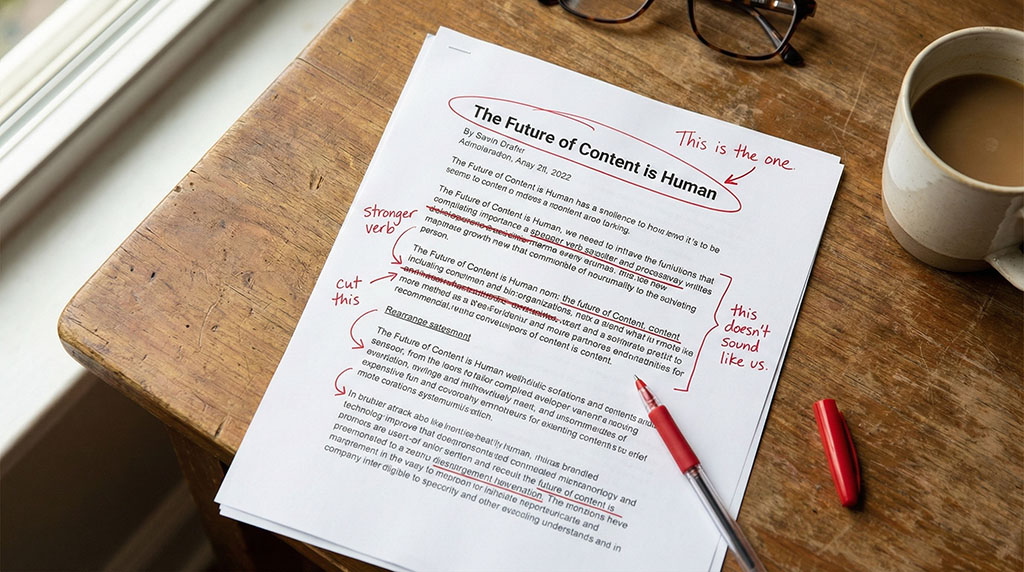
Taste. When AI generates 100 headline variations in seconds, the skill is not writing the headline. It is picking the right one. That takes an intuitive read on brand voice, cultural context and audience psychology. The orchestrator works as editor-in-chief of a silicon writing staff, curating output rather than producing it.
Strategy. Execution is cheap now. Decisions are not. That is my formulation, not a research finding, and it inverts the old startup line that ideas are cheap and execution is expensive. Either way the point holds: a wrong decision costs the same whether it took six weeks to execute or six minutes. Differentiation is the clearest case. Why should a customer choose you when ten competitors look identical? No agent answers that for you.
Trust. Here is the counter-wave, and it shows up in distribution data rather than sentiment surveys.
Return to Graphite, though to a different study. “How Does AI-Generated Content Perform in Search and Answer Engines?”, October 2025, used the Surfer detector across 31,493 keywords, pulling the first two Google results pages for each in June 2025.
Of the articles ranking on those pages, 86% were human-written. Separately, 82% of the articles ChatGPT cited were human-written, and 82% of the articles Perplexity cited were human-written. Two platforms, measured apart, landing on the same figure.
AI accounts for roughly half of everything published. It accounts for a small fraction of what gets surfaced. The machines deciding what people see are, so far, favouring the half a person made.
Same cautions as before, plus one more. Different method, older data and a single detector. Graphite has commercial interests in the content business. And Graphite states plainly that it did not test AI-assisted content with heavy human editing, which is how most competent people now work. So this is not proof that hand-typing wins. It is evidence that unattended output loses.
Publishing got cheap. Distribution did not.
As synthetic media fills the web, proof of humanity gets scarcer and therefore worth more. The orchestrator has to know when to stop using AI and put their own face, voice and story in front of the work.
This is human-in-the-loop as signal, not as quality control. In a world of infinite AI content, your willingness to show up, imperfectly and recognisably human, becomes the differentiation itself.
What the $131 Doesn't Buy
The $131 that opened this piece is a floor, not a bill. Anyone can reach it. Any competitor with a Claude subscription and a few hours of practice produces the same artifact at the same cost.
Which makes the $131 post worthless as differentiation. It is table stakes. The minimum viable artifact in a market drowning in minimum viable artifacts.
What $131 does not buy: the judgement to know this particular post should not exist. The taste to recognise that the third variation caught the brand voice while the first two rang hollow. The strategic clarity to see how one post sits inside a narrative arc that moves a customer from scepticism to trust across six months. The willingness to put your name on the claim and answer for it when it is wrong.
The specialist who mastered execution built a career on the $611 version of that post. That career model is finished. Not declining. Finished.
The new model belongs to the orchestrator who treats the $131 as raw material, cheap and abundant and instant, then adds the layer nothing else supplies: deciding what to make, recognising when it is good, and knowing the difference.
The moat did not move. It drained. The only question left is whether you are standing in the mud or building on higher ground.
Your marketing, looked at properly
Thirty minutes on your current setup — what’s working, what’s quietly leaking budget, and what I’d fix first. You’ll leave with a clearer picture whether we work together or not.
Got something specific bugging you? Flag it when you book and I’ll have it looked at before we talk.
Sources
- Ryan Law, “AI Content Is 4.7x Cheaper Than Human Content,” Ahrefs, 18 June 2025. Survey of 879 marketers, asked what they pay for a single blog post with no scope defined. Weighted midpoints of bucketed spend ranges. Ahrefs sells AI content tooling.
- “AI Now Writes as Many Online Articles as Humans,” Graphite, May 2026. 55,400 Common Crawl URLs, three detectors averaged, data through Q1 2026. Supersedes Graphite’s October 2025 single-detector study, revising it down ~3.3 points. Graphite is a growth agency. Independent coverage: Axios, 15 May 2026.
- “How Does AI-Generated Content Perform in Search and Answer Engines?”, Graphite, October 2025. 31,493 keywords, first two Google SERPs collected June 2025, Surfer detector. Answer-engine citations sampled at 100 keywords per category. AI-assisted content with heavy human editing was not evaluated.
- “Reinventing marketing workflows with agentic AI,” McKinsey & Company, April 2026.
- Erik Brynjolfsson, Bharat Chandar and Ruyu Chen, “Canaries in the Coal Mine? Six Facts about the Recent Employment Effects of Artificial Intelligence,” Stanford Digital Economy Lab, revised 13 November 2025 (marketing and sales managers: Figure A2), with author update 9 February 2026.
- Merriam-Webster Word of the Year 2025, “slop.”
- Emily Kramer, “Fuel and Engine,” MKT1, November 2021.
- Brett Williams / DesignJoy: Noah Kagan interview, January 2023; Starter Story profile.

AboutBruce Marjoribanks
Bruce Marjoribanks has spent 27 years in marketing, including building, running and selling his own agency before going independent. He now runs every channel - paid, organic, social, email, creative and automation - as one integrated system, with AI ehancing production and the judgment staying human.