
There were four mnemonics in the article. Three letters each, hyphenated, capitalised, with the word Sequence bolted on the end. Capital letters and hyphens doing the heavy lifting of making generic ideas sound like proprietary engineering.
None of them were.
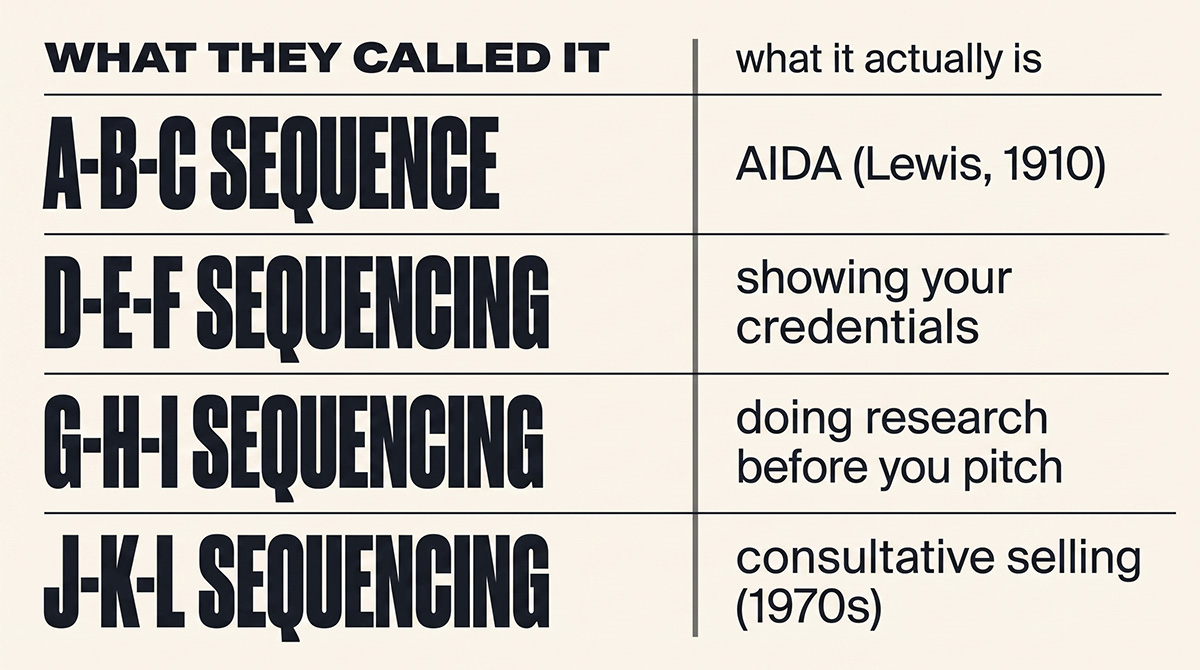
One was AIDA wearing a wig. One was show your credentials. One was do research before you pitch. One was consultative selling. Four hyphenated three-letter mnemonics in a single article, each presented as methodology extracted from a private neural network. There is no neural network. There is a naming convention.
I uploaded the document to Claude anyway. It had been sent to me as authoritative reading for a prospecting project I was building, and I wanted the useful bits. What came back was a list of things I could not check.
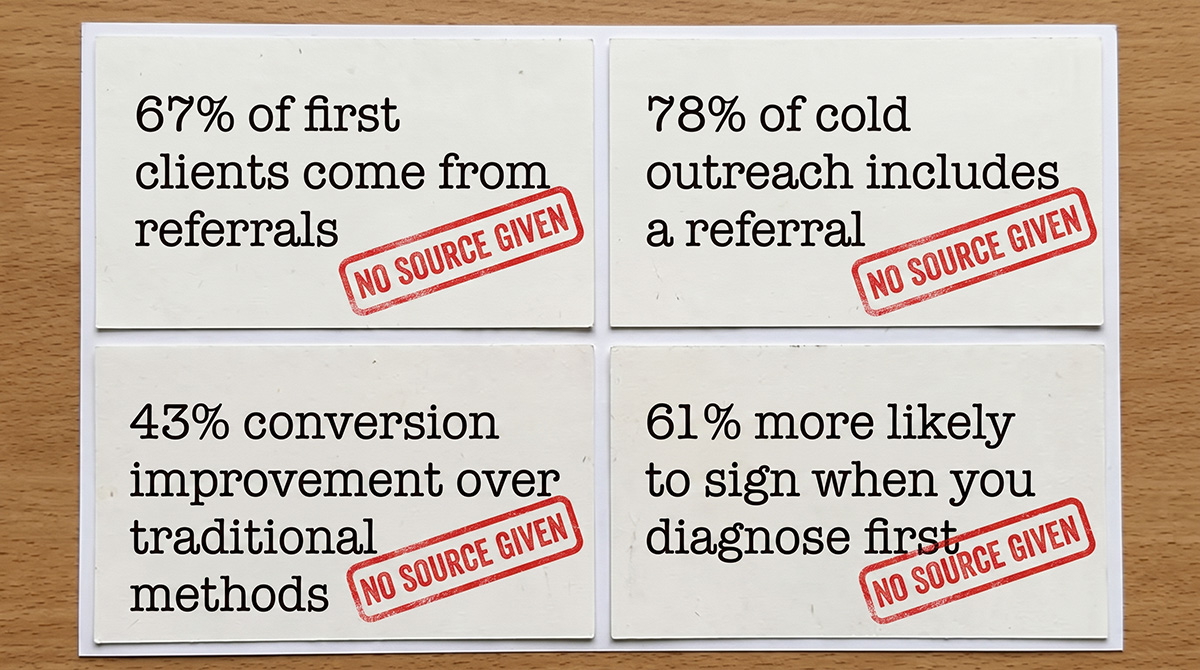
67% of first clients come from referrals. 78% of successful cold outreach includes a referral. 43% conversion improvement over traditional methods. 61% more likely to sign when you diagnose first. Four real-looking numbers. No study named. No sample size. No date. No link. A signature phrase, neural network confirms, ran through the piece attached to numbers with nothing behind them.
Sixty seconds to produce the list. Longer to check it, which is the part that matters.
What that does and doesn't prove
Here is the line I want to be careful about, because the rest of this article depends on it.
A model failing to find a source is not proof that no source exists. It is a model with no library card telling you it has no library card. So I went looking myself, in the places a marketing statistic usually lives, and found nothing for any of the four. That gets me to a claim I can defend: these numbers are uncited, and I could not trace them.
That claim is enough. It is also the only one I need. A number you cannot follow back to its origin cannot be used, argued with, or checked. Whether it was invented, half-remembered, or copied from a deck that copied it from a deck is a question about a person’s intent, and I have no evidence about intent. I have evidence about a document.
Keep that distinction and the rest of this is straightforward. Lose it and you are doing the thing the article does.
Then I had the thought that became this piece.
Most small business owners have just paid an agency to produce something that looks like this, and they have no idea.
You know the feeling. The deck arrives. It has frameworks. The frameworks have acronyms. The acronyms get explained with confident-sounding numbers. Somewhere on slide eleven there’s a chart called a strategic maturity model, with no source. You nod along because the people in the room are nodding along, and the agency seems to have done the homework, and you don’t want to be the person who asks the dumb question.
The dumb question is the only one that matters.
Where did that number come from?
The consensus says AI is the threat to expertise
The current consensus on AI is that it produces generic content, makes everyone sound the same, and floods the internet with confident-sounding nonsense. All of this is true. The article I uploaded was probably written with AI help. I say that on style alone, which is a weak basis, so treat it as a guess rather than a finding: rhythmic three-bullet structures, the same phrase recurring throughout, every paragraph landing on a punchy single-sentence conclusion.
The natural assumption follows. If AI produces this stuff, AI can’t be trusted to evaluate it. Same source, same bias.
That assumption is wrong, and the reason it’s wrong is the most important idea in this piece.
A model trained on the whole internet has seen ten thousand articles like the one I uploaded. It pattern-matches against its own default output. When you ask it whether a document is real expertise or manufactured authority, you’re really asking: does this match the baseline of confident-sounding nothing, or does it deviate from it in the direction of substance?
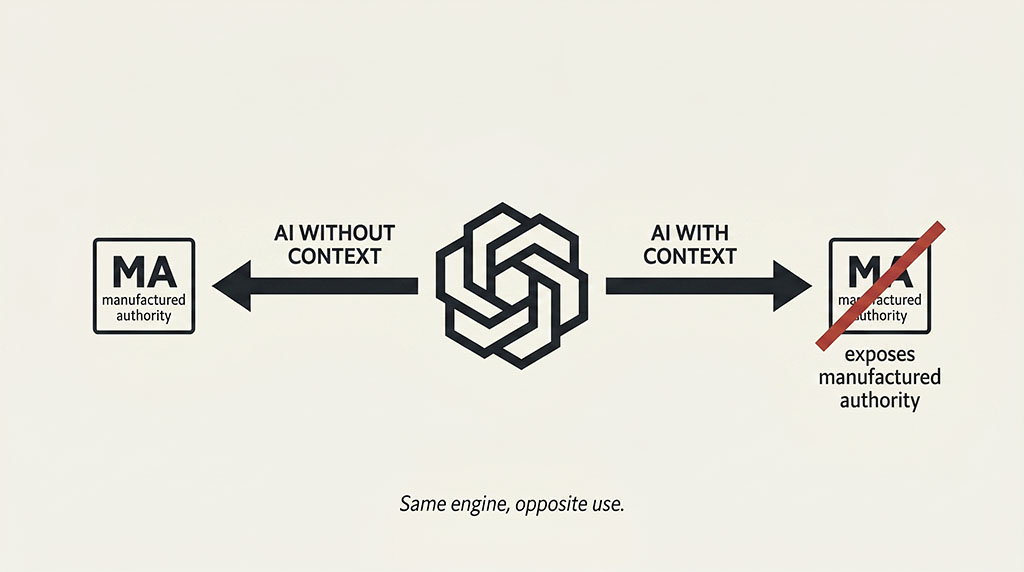
A model with no context produces manufactured authority because that’s the median of what it was trained on. A model with context, your business, your real numbers, your actual client work, your specific economics, has something to compare the incoming document against. It sees its own reflection when the document is hollow. It sees something else when the document is real.
Same engine, pointed in opposite directions. One produces the article I was sent. The other dissolves it.
Hold on
I know what you’re thinking.
If this works, if AI can reliably surface renamed frameworks, uncited statistics, and stencil strategy, then every agency in the world is about to start prompting their decks against this exact diagnostic. The tells get cleaned up. The acronyms get retired. The numbers get sourced, or at least sourced-looking. Manufactured authority just gets better at hiding.
You’re right. They will. I expect some already have.
Here’s why it doesn’t matter.
The four tells are surface artifacts of a deeper absence. An agency that swaps a three-letter mnemonic for a non-acronym name still doesn’t have proprietary methodology. An agency that adds footnotes to numbers it can’t trace still doesn’t have data. An agency that reshapes its strategy section for retainers instead of projects still doesn’t know your business. The wig comes off, and a different wig goes on. The head underneath stays bald.
This is where context does the work the tells can’t.
A surface audit catches manufactured authority in the obvious costume. A context-loaded audit catches it in any costume, because you’re not looking at whether the deck has acronyms. You’re asking whether the deck describes my actual business, my actual numbers, my actual constraints, in a way that could only come from someone who understood them. That question can’t be prompt-engineered around. The deck either has substance or it’s a stencil with better camouflage.
The four tells are how you learn to see the pattern. Context is how you keep seeing it after the pattern adapts. Once you know what real expertise feels like, specific, falsifiable, shaped to your situation, citing its sources, the costume stops mattering.
Now let me name the tells.
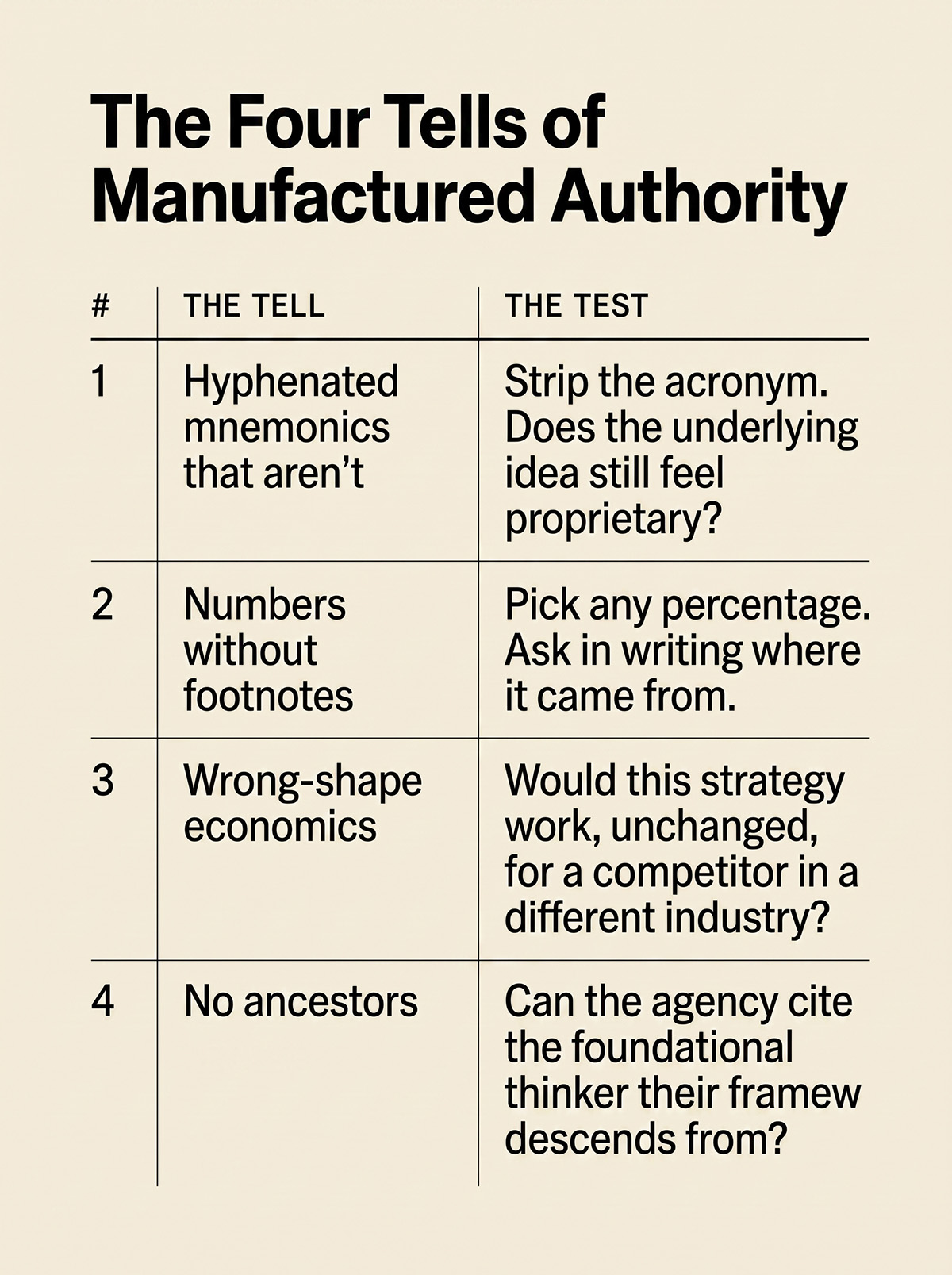
Tell #1: Hyphenated mnemonics that aren't
Real frameworks are named after what they do. Diagnostic phase. Information gain. Five-part formula. Manufactured frameworks are named after acronyms designed to sound like they were extracted from research. Three letters, two hyphens, four times in a single article. Not one of them described anything that doesn’t already exist under a less impressive name.
The hyphens are the wig.
The test: strip the acronym out and describe the idea in plain words. If it still feels proprietary, keep it. If it turns into “do research before you pitch,” the acronym was the whole product.
Tell #2: Numbers without footnotes
43% conversion improvement over traditional methods. 67% of first clients come from referrals. 61% more likely to sign when you diagnose first. Every one of these is a real-looking number with no source attached. No study cited. No data set described. No methodology shown. The numbers do rhetorical work, they make the surrounding sentence feel scientific, but they don’t do informational work, because you cannot follow them anywhere.
Real expertise is happy to tell you where its numbers came from. Manufactured expertise gets defensive when you ask.
The test: pick any percentage in the document. Ask the agency, in writing, where it came from. If the answer is industry research or our internal data with no citation attached, you’ve found a placeholder where evidence should be. Not a lie. A placeholder. Ask for the study.
Tell #3: Wrong-shape economics
The article prescribed a five-figure project fee, multiplied by four, as a universal path to a full-time copywriting business. I run a retainer business. The prescription wasn’t wrong because retainers beat projects. It was wrong because the article didn’t know which one I run. It was writing to a generic you that doesn’t exist. The numbers were calibrated for someone trying to escape a day job with zero clients, and they were being delivered to me, twenty-seven years in.
Strategy that fits anyone fits no one.
The test: does the strategy match the actual shape of your business? Or is it a template that would work just as well for a SaaS startup, a plumbing company, and a copywriter trying to leave their corporate job? If it’s the second one, the shape is a stencil, not a strategy.
Tell #4: No ancestors
Once you’ve spotted the wig, the next move is finding the head it’s sitting on. Manufactured frameworks are usually a rebrand of something older, citable, and freely available. One of the four here was AIDA, in use in one form or another since 1910. Another was consultative selling, codified in the 1970s. Both are free, both are older, and both are better explained by the people who built them.
This is the most useful AI move in the whole audit. Upload the framework. Ask what older idea it’s a rebrand of and who actually built it. Then verify what the model tells you.
That second instruction is not optional. Models invent attributions the same way an uncited document invents authority. If it names a thinker, a paper, or a date, go and find the paper and read it. If you can’t find it, the attribution doesn’t count and you don’t repeat it. An article that told you to trust the model’s answer would be committing Tell #2 in the act of explaining Tell #2.
The original is almost always shorter, sharper, and free.
The test: can they cite the foundational thinker their framework descends from? If they can, they’re standing on real shoulders and adapting honestly. If they get evasive, the framework is the whole product, and the product is hollow.
What this isn't saying
None of this means AI is bad, or that all frameworks are fake, or that confident writing is a red flag. Frameworks are useful. Structure is useful. Confident writing is how good consultants signal that they’ve thought it through.
Take AIDA, since it keeps coming up. The lineage runs back to an anonymous 1898 Printers’ Ink note about advertising needing to attract attention. The four-stage version we actually use is recorded from E. St. Elmo Lewis in 1910, and the acronym itself arrives with C. P. Russell in 1921. Whether it describes how advertising really works is contested. Vakratsas and Ambler’s 1999 review in the Journal of Marketing, covering more than 250 journal articles and books, found little support for any hierarchy of effects in the sense of a fixed temporal sequence.
So AIDA is a useful shape, not a proven law. Notice that I can tell you that. I can give you the dates, the names, and the paper that disputes it, and you can go and disagree with all three. That’s the difference. A framework you can trace is a different object from one that arrives with a trademark and no ancestors.
The problem isn’t structure. The problem is structure presented as discovery. Engineered presented as uncovered. Generic AI output dressed in lab coats and called neural network confirmation. There’s no neural network. There’s content marketing.
The work doesn’t get harder when you can name the tells. It gets cleaner. You stop being intimidated by the deck and start asking the dumb question.
This isn't only an agency test
I started this piece thinking it was about marketing. It isn’t. The same diagnostic works on anyone selling you complexity.
A software vendor pitches a six-figure platform with a proprietary engine, an opinionated architecture, and a methodology with capital letters. Run the four tells. Are the acronyms doing real work, or are they wigs? Are the performance numbers sourced, or are they placeholders? Does the architecture fit the actual shape of your business, or is it a stencil they pitch to everyone? And the one most software buyers never ask: could a competent developer build the equivalent in Claude Code over a weekend? Sometimes the answer is no, and the platform is real. Often the answer is yes, and what you’re being sold is a wig over a few hundred lines of code somebody else has already written.
A consultant arrives with a strategy deck. Same four tells. A vendor arrives with a methodology. Same four tells. Anyone whose moat depends on making something sound more sophisticated than it is gets audited the same way.
A diagnostic, widened
The same four tells, three different sellers
The examples below are composites. They illustrate the pattern. They are not quotations from any company or person.
Agency
Software vendor
Consultant
1Mnemonics that aren’t
AgencyA five-pillar growth engine — the marketing funnel with capital letters bolted on
Software vendorAn orchestration layer — a product name that describes no actual function
ConsultantA methodology named after the consultant — a SWOT analysis wearing a trademark
2Numbers without footnotes
AgencyClients see a 43% lift on average — no case study, no timeframe, no sample size
Software vendorReduce costs by 60% on the pricing page — no named customer, no methodology
ConsultantFirms that adopt this grow 3× faster — sourced to our research
3Wrong-shape economics
AgencyA campaign-deliverable retainer sold to a business that needs positioning, not posts
Software vendorPer-seat enterprise pricing and modules pitched to your four-person team
ConsultantA Fortune-500 transformation roadmap delivered to a $2M company
4No ancestors
AgencyThe framework is AIDA, or Cialdini’s principles, relabelled
Software vendorThe proprietary algorithm is an open-source library you could wire up in Claude Code over a weekend
ConsultantThe methodology is Porter’s Five Forces or the Balanced Scorecard, renamed
So here's the diagnostic
If you’re auditing the agency, vendor, or consultant you’ve already hired, pull their last deliverable. Count the acronyms. Find one number on any slide and ask, in writing, where it came from. Read the strategy section back to yourself and ask whether it would survive being delivered, unchanged, to a competitor of yours in a different industry. Then ask AI what older idea their framework is a rebrand of, go and find that original, and read it yourself.
If you’re hiring the next one, run the same test on their pitch deck before you sign, but don’t stop at the surface tells. I expect the smarter agencies are already cleaning those up. The deeper question is the one a context-loaded audit asks: does this deck describe my business, or does it describe a generic version of someone like me? The pitch is the cleanest specimen you’ll ever get of how they actually think, because they’ve spent more time engineering it than they’ll spend on anything they do for you afterwards.
The article that started this piece had four hyphenated mnemonics and four numbers I couldn’t trace. I uploaded it expecting useful raw material and got back a way of reading every deck I’ll see from now on, agency, software, consulting, all of it, without uploading anything.
The next time a capital-letter-hyphen-sequence lands in front of you, you’ll know what you’re looking at.
A wig.
Your marketing, looked at properly
Thirty minutes on your current setup — what’s working, what’s quietly leaking budget, and what I’d fix first. You’ll leave with a clearer picture whether we work together or not.
Got something specific bugging you? Flag it when you book and I’ll have it looked at before we talk.

AboutBruce Marjoribanks
Bruce Marjoribanks has spent 27 years in marketing, including building, running and selling his own agency before going independent. He now runs every channel - paid, organic, social, email, creative and automation - as one integrated system, with AI ehancing production and the judgment staying human.