
Two hundred and twenty-three people filled in a contact form on a pool company’s website in December and then heard nothing for a week. They had spent weeks on the research: comparing shell sizes, reading installation guides, measuring backyards on a Saturday morning. Then they waited. A day. Three days. A full week. By the time someone called, most had already spoken to a competitor. Some had signed.
They were close to a quarter of everyone who enquired that month, and they were not lost because the ads were wrong. They were lost because nobody picked up the phone.
The month the marketing worked too well
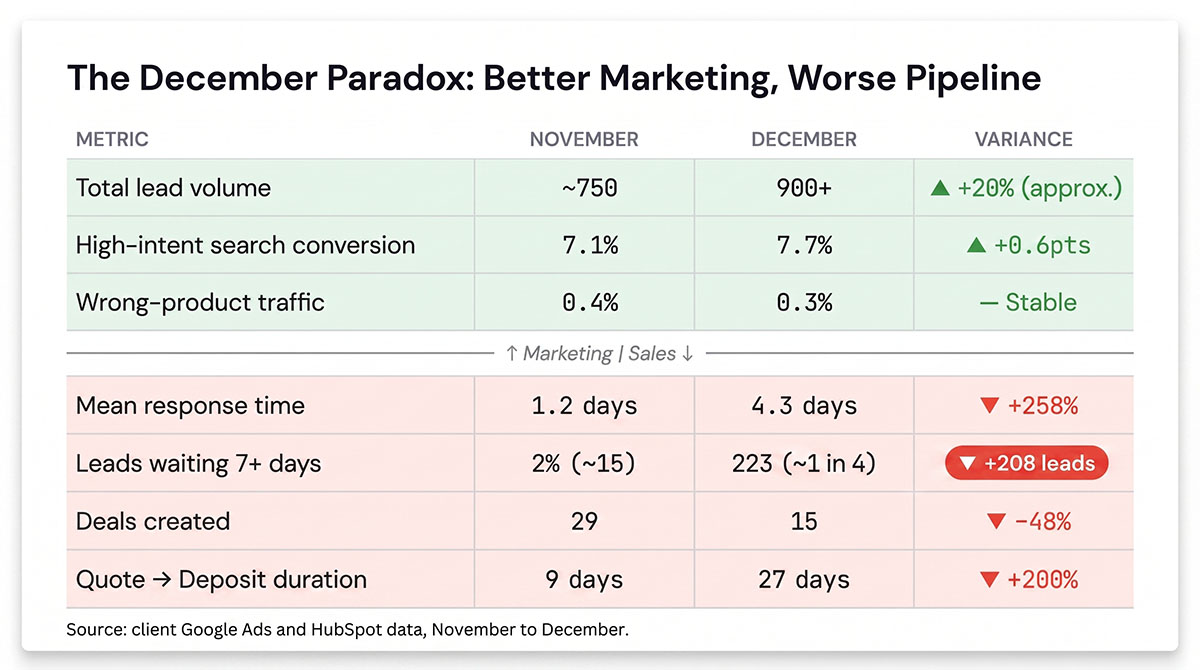
A client running Google Ads for fiberglass pool kits had a strong November. Around 750 leads, 29 deals created, mean response time of 1.2 days. Not perfect. But marketing sent leads, sales worked them, deposits landed.
Then December arrived. Search volume climbed. The campaigns, unchanged from November, delivered more than 900 leads. High-intent queries for pool kits and fiberglass shells converted better than the month before, rising from 7.1% to 7.7%. Wrong-product traffic fell from 0.4% to 0.3%. By every marketing metric, December was the best month of the year.
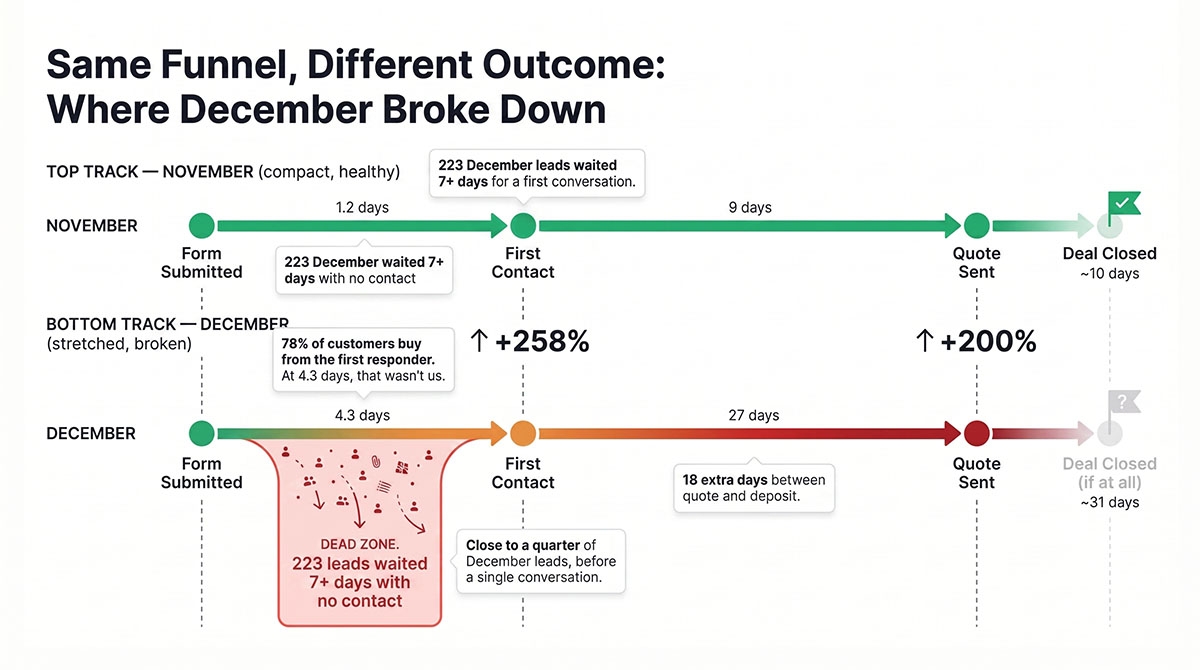
The pipeline told a different story. Deal creation fell 48%, from 29 to 15. The gap between sending a quote and collecting a deposit tripled, stretching from 9 days to 27. And the number that still sits with me: mean response time went from 1.2 days to 4.3 days.
More leads arrived than the team could work. Response times slipped. Fewer leads reached the pipeline. This was not a quality problem. It was a capacity problem wearing a quality mask.
Finding the fracture in two hours
The client’s first instinct was reasonable: the ads must be pulling the wrong people. December traffic feels different. Bored browsers. Holiday daydreamers. People with a spare ten minutes and a backyard. Most operators would land on the same theory.
So I ran the diagnostic. I pulled the Google Ads search term report and the full HubSpot lead pipeline into Claude and asked for two things: every search query classified by intent, and the lead-to-deposit journey mapped for both months.
Two hours. Intent classification, response time distributions, a stage-by-stage funnel comparison. The answer left no room to argue.
December’s search intent profile matched November’s. High-intent queries held. Conversion on those queries improved. The traffic was not the problem.
The problem sat downstream. In November, around 15 leads waited more than seven days for first contact, about 2% of the month. In December, 223 did, close to a quarter of everything that came in. A lead that has waited seven days in silence is worth about what a business card is worth in a jacket pocket.
Bain flagged the pattern in its 2025 Technology Report: sales teams have trailed other functions in adopting AI. The cost rarely arrives as a dramatic failure. It arrives as response times stretching, deals stalling, and pipeline velocity decaying while the marketing dashboard glows green.
Bain also reports that early deployments have produced 30% or better improvement in win rates. Read it with the caveat attached: Bain calls this early success and publishes no sample size or methodology, and says most companies are not seeing meaningful results from AI in sales yet. Its recommendation is to reimagine the sales process rather than automate the existing one.
That distinction matters. The answer to “we have too many leads” is almost never “hire more reps.” It should never be the first answer.
The three places leads stall
Once you stop blaming the traffic, the failure points come into focus. There are three, and they compound.
The first contact gap. The speed-to-lead research everyone quotes is old, so here it is with the dates and the ownership attached.
A 2011 Harvard Business Review article reported two separate studies. The first audited 2,241 US companies with test enquiries. Almost a quarter, 23%, never replied at all, and among the companies that did reply inside 30 days, the average first response took 42 hours. The second study tracked 1.25 million leads across 42 companies. It found that firms attempting contact within an hour were nearly seven times more likely to qualify a lead than firms that waited an hour longer, and more than 60 times more likely than firms that waited a day.
A third study, from 2007, covered six companies and more than 15,000 leads on the InsideSales.com platform. It found the odds of qualifying a lead drop 21 times between a five-minute callback and a thirty-minute one.
One name connects all three. David Elkington, a co-author of the HBR article, was the founder and chief executive of InsideSales.com, which sold software built to solve this exact problem. HBR discloses it in the author note. That does not make the findings wrong, but it does mean the entire speed-to-lead canon traces back to a single commercial beneficiary, and none of it has been repeated at that scale since. All of it measures qualifying, not closing. Treat it as direction, not gospel.
What I trust more is the client’s own file. Mean response time of 4.3 days. Two hundred and twenty-three people waiting more than a week for a first conversation, in a market where the next supplier is one search away. The sales team was not slow because it was lazy. It was slow because 900 leads landed on the desk of a team built for 750.
The post-quote vacuum. A prospect holding a quote sits at the most fragile point of the purchase. They compare. They second-guess. They Google “fiberglass pool problems” at 11pm. In November the team moved quotes to deposits in 9 days. In December that window stretched to 27. Whatever those buyers did with the 18 extra days, they did not spend them thinking about us.
The invisible triage problem. When volume outruns capacity, reps start making silent prioritisation calls. They work the leads that feel warmest. They push the maybes to tomorrow, and tomorrow becomes next week. The leads that needed one more touch settle into the grey part of the CRM. Never closed-lost. Just abandoned.
You have seen this. Maybe not with pool kits, but with whatever your team sells. A month where the dashboard looks good until someone asks where the deals are.
"But you can't automate a $50,000 sale"
Fair objection. These are not $29-a-month subscriptions. A fiberglass pool kit is often the largest home improvement a family will ever buy. The sale runs on trust, technical judgment, and site-specific advice. You cannot hand that to a chatbot.
Nobody should.
The misunderstanding about AI in sales is that it replaces the conversation. It replaces the silence.
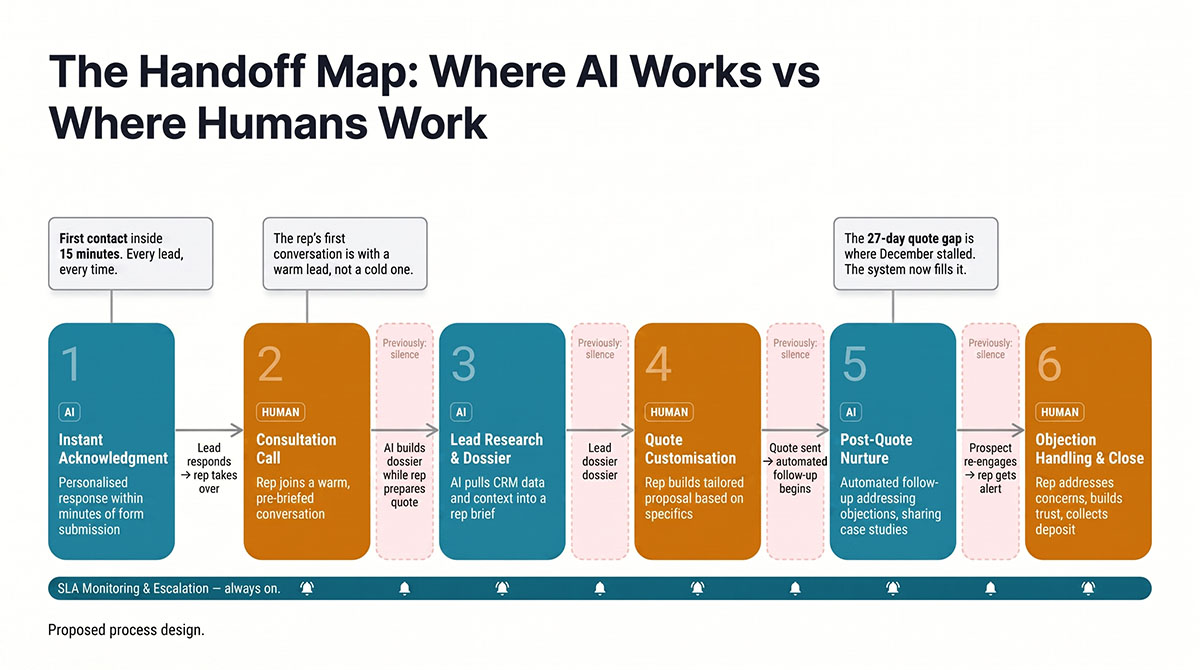
Look at where the December pipeline broke. Not during the consultation call. Not during the quote walkthrough. It broke in two windows: the hours between a form submission and first human contact, and the days between a sent quote and a signed deposit. In both, the prospect hears nothing. Doubt fills the gap.
An AI agent that sends a personalised acknowledgment within minutes of a form submission, referencing the pages that prospect actually read, does not replace the salesperson. It holds the door open until the salesperson can walk through it.
You also do not have to switch everything on at once. Most conversational AI platforms keep a human in the loop by default. HighLevel calls it suggestive mode. HubSpot’s Breeze agents can run semi-autonomously, drafting a response for a rep to review before it sends. Your rep approves every message. The AI removes the blank-page problem of the first reply, at any volume. Once the drafts earn your trust, you hand over the first contact window. One step at a time.
A follow-up sequence that fires the moment a quote goes out, addressing installation timelines, sharing similar backyards, pointing to a booking link, is not automating the sale. It prevents the silence that kills it.
This is where Bain’s numbers belong. The report puts sellers at about a quarter of their time spent selling to customers, with AI positioned to double that by clearing administrative work. The 30% win rate improvement Bain cites sits alongside that gap. The mechanism is not automating the sales call. It is giving the seller back the hours currently lost to admin, and closing the silence everywhere else.
Reducing the load before adding headcount
Our approach with this client follows a sequence, and the order matters. Step one: reduce the load on the salesperson already in the seat. Step two, only if it is still needed: hire.
Here is why that order holds. Hire into a broken process and you get two people doing broken work instead of one. Bain makes the same point about sequence, and puts it bluntly: “Automating mediocre processes only accelerates mediocre outcomes.” Fix the process first.
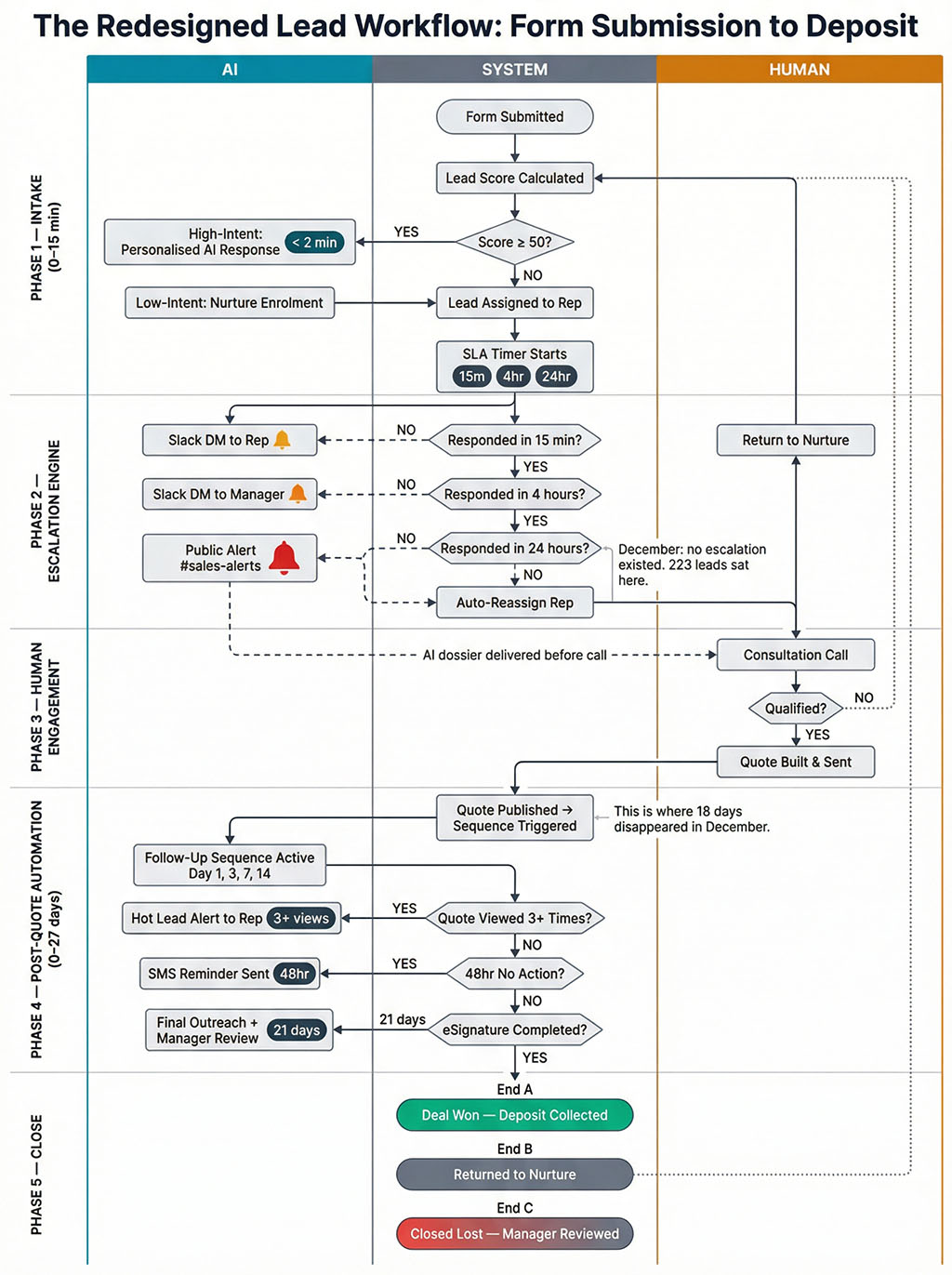
The first four hours, handled. The most immediate fix is an AI agent, in this case HubSpot’s Breeze prospecting agent, owning the 0 to 4 hour response window. When a lead submits a form, the agent pulls their browsing history from the CRM, which pages they read, how often they returned to pricing, which shell sizes they opened, then sends a personalised response. Not a generic thanks-for-your-enquiry autoresponder. A message that says: I noticed you have been looking at the 8-metre shells, so here is what most homeowners in your area need to know about council approval before ordering.
The human rep is looped in once the lead replies or books a meeting. Their first interaction is with a warm, acknowledged prospect, not a cold lead wondering whether anyone is home.
The quote-to-deposit gap, bridged. The 27-day gap is where the second automation layer sits. The moment a quote is published in HubSpot, a follow-up sequence starts: timed emails addressing the objections that surface at this stage, including installation complexity, seasonal timing, and financing. If the prospect opens the quote three or more times without signing, the system alerts the rep in real time. This person is ready to talk. Call them. If 48 hours pass with no action, an SMS nudges them back.
This does not remove the human. It makes sure the human arrives at the right moment with the right context, instead of spending the day working out who to chase.
SLA enforcement that holds. The December blowout could have been caught on day two if an escalation system existed. The fix is a tiered alert structure. A lead unassigned for 15 minutes pings the rep in Slack. At 4 hours, the sales manager is notified. At 24 hours, the alert hits a shared channel and the lead reassigns automatically. No lead sits in a queue hoping someone remembers.
Scoring that sorts the queue. Not all 900 leads deserve the same effort. A prospect who opened the pricing page four times and used the pool size calculator behaves differently from someone who clicked a Facebook ad and bounced. Lead scoring in HubSpot points finite human attention at the prospects showing genuine buying behaviour, while the AI handles first engagement for everyone else.
What this actually looks like when it works
Run the December numbers through the redesigned system and the arithmetic changes.
Those 223 leads that waited seven days or more? Each one gets a personalised response within 15 minutes. Not from the salesperson. From an agent that has read their browsing history and knows which product they care about. The rep’s phone rings when there is a qualified conversation waiting.
The 27-day quote-to-deposit stretch compresses, because follow-up no longer depends on one person remembering to check the pipeline on a Friday afternoon. The system nudges. The system reminds. The system flags the prospect who has opened the quote for a third time.
And the salesperson stops triaging a queue growing by more than forty leads a day and spends that time on the five conversations most likely to close. That is the shift Bain describes: less admin, more selling. Not more contact attempts. Better ones.
When volume outruns capacity, the instinct is to add people. Sometimes that is right. More often, the better first move is to strip out every task that does not need human judgment and let the humans build trust, answer hard questions, and close.
Two hundred and twenty-three people asked for a call in December. The system we are building now makes sure every one of them gets it.
Your marketing, looked at properly
Thirty minutes on your current setup — what’s working, what’s quietly leaking budget, and what I’d fix first. You’ll leave with a clearer picture whether we work together or not.
Got something specific bugging you? Flag it when you book and I’ll have it looked at before we talk.
Sources
Oldroyd, J., McElheran, K., and Elkington, D. “The Short Life of Online Sales Leads.” Harvard Business Review, March 2011. Two studies: an audit of 2,241 US companies (42-hour average among those responding within 30 days, 23% no response), and a separate study of 1.25 million leads across 42 companies (the 7x and 60x figures).
Lead Response Management Study, James Oldroyd with InsideSales.com, 2007. Six companies, 15,000+ leads. Vendor platform data with academic analysis.
Bain & Company. AI Is Transforming Productivity, but Sales Remains a New Frontier. Bain Technology Report 2025, 23 September 2025.
November and December figures are first-party client data from Google Ads and HubSpot.

AboutBruce Marjoribanks
Bruce Marjoribanks has spent 27 years in marketing, including building, running and selling his own agency before going independent. He now runs every channel - paid, organic, social, email, creative and automation - as one integrated system, with AI ehancing production and the judgment staying human.