
She clicked at 9:40 on a Tuesday night, from the couch, on a phone. The ad said her bathroom could be done in three weeks. She typed her name, her suburb and her mobile, and put the phone face down.
The quote arrived Friday afternoon. It opened with four paragraphs about the company’s heritage.
She never replied.
When every agency agrees the leads are unqualified, the fault is almost never in the leads. It sits in the sequence between the click and the follow-up – a promise the ad made that the page didn’t keep, and a follow-up that starts a different conversation.
Six weeks later she showed up in a report as an unqualified lead. And every provider who touched her was telling the truth about their own piece. The paid search account had her marked as a converted click – she filled the form, so the campaign worked. The web team had her among the one in ten visitors who completed the enquiry, comfortably above the target they were set. The follow-up went out inside the service-level agreement.
Three accurate reports. One woman who wanted a bathroom and bought one from somebody else in March.
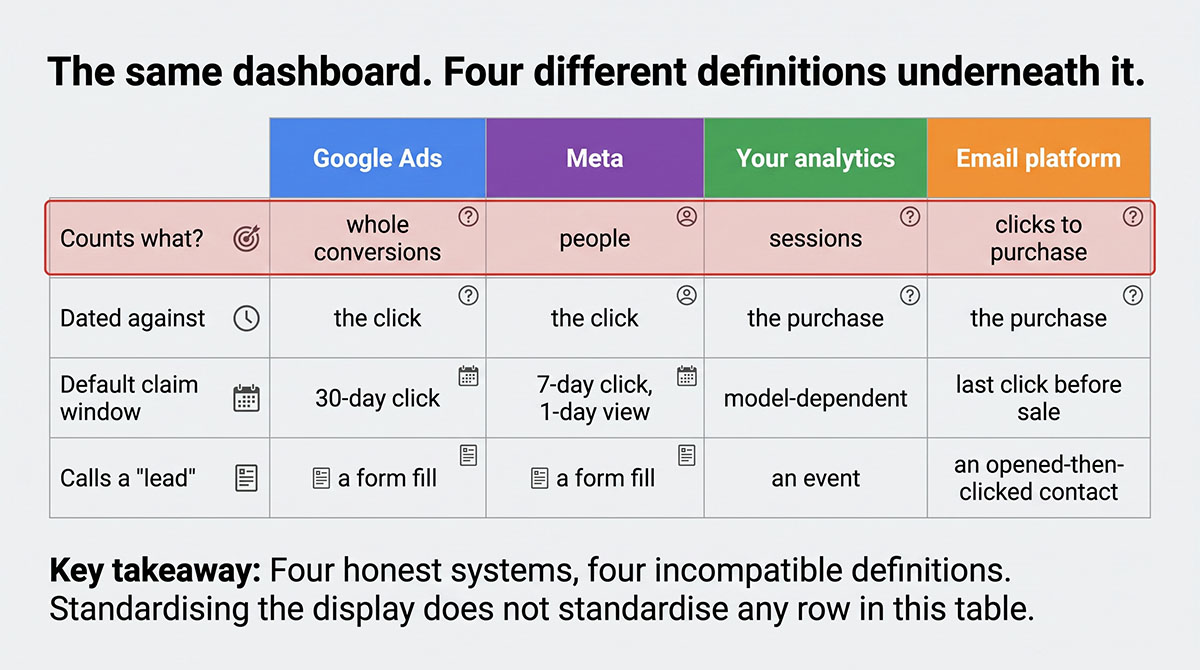
The lie the entire industry runs on
The default explanation is comfortable and clean: the leads were bad.
It’s the universal get-out. Missed the quarter? Lead quality. Pipeline thin? Weren’t qualified. Prospect ghosted after the first call? Tyre-kicker, shouldn’t have been in the funnel to begin with.
And the industry has built an infrastructure to hold the story up. Lead scoring. MQLs and SQLs. Qualification frameworks with acronyms — BANT, MEDDIC, CHAMP. All of it assumes the same premise: some leads are good, most are bad, and marketing’s job is sorting one from the other. Notice who benefits if that premise is true. An industry that has built its methodology around sorting has an interest in the sorting being the hard part.
The premise isn’t wrong. It’s incomplete in a way that costs you money every month.
Sometimes the leads really are the wrong people — you’re paying to reach an audience that was never going to buy. That’s a targeting problem, it has its own diagnosis, and I’ve written about it separately. This post is about the more common and more expensive case: the targeting was fine, the right person arrived, and the sequence lost her anyway.
Trust isn't a feeling. It's a sequence.
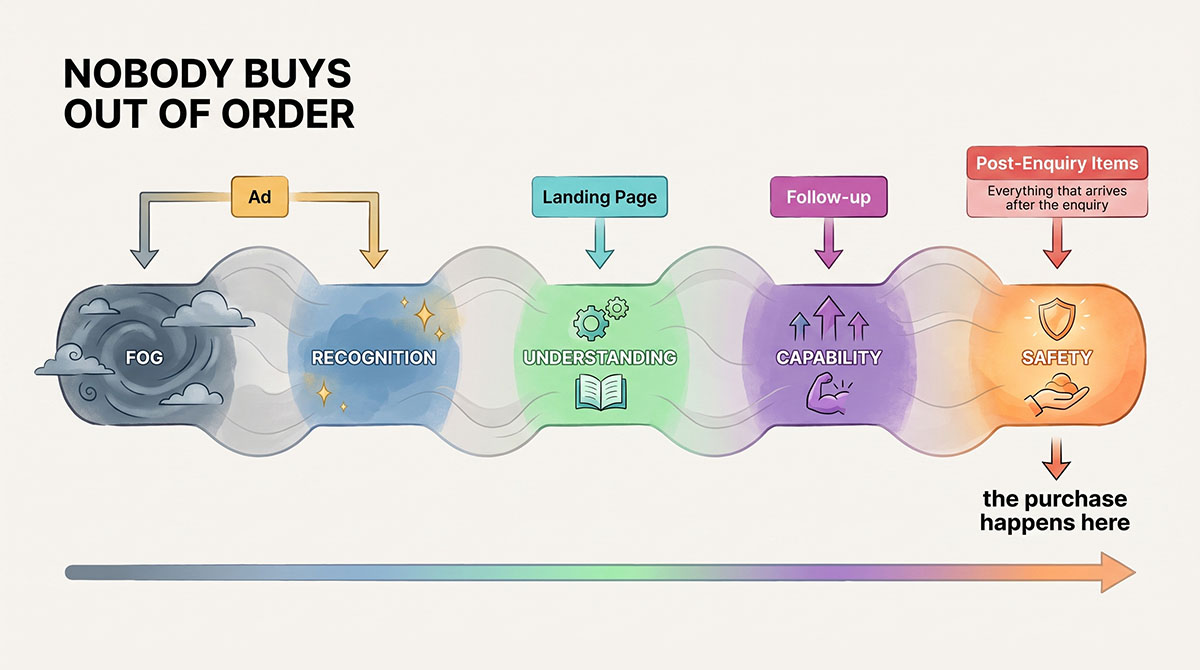
Watch enough enquiries die and the same progression shows up, in the same order, every time.
A stranger arrives in fog. She knows something isn’t working but she can’t name it precisely. Then something names it for her – better than she could name it herself – and that is the moment she starts paying real attention. Next she needs to believe you understand the problem, not merely that you sell a fix for it. Then that you can actually deliver. And last, that acting on it is safe.
Fog, recognition, understanding, capability, safety. Nobody buys out of order, and nobody skips a step because you were in a hurry.
You’ve felt this from the other side. A doctor who described your symptoms in thirty seconds more precisely than you could after living with them for months. You trusted her immediately, and not because of the certificate on the wall. Because she understood you.
Now hold that sequence up against a fragmented setup and ask whether it can survive the trip.
Can a search specialist name a stranger’s problem when he’s never read the landing page? Can a landing page prove it understood her when nobody told it what the ad promised? Can a follow-up make anything feel safe when it has never seen the retargeting creative that’s about to contradict it?
Each specialist optimises one step. Nobody owns the transitions between them. And the transitions are where trust is built or lost, because what stands between a person with a problem and a person who buys is rarely the price. It’s the fear of getting it wrong. Every contradiction between touchpoints is evidence that she might be about to.
Her ad promised speed. Her quote led with heritage. Somewhere between Tuesday night and Friday afternoon, the story changed, and she read the change as a reason to be careful.
Nobody’s report shows the seam. That isn’t dishonesty – it’s the structure. Each report is accurate about its own territory, and the territory ends exactly where the problem starts.
"But some of those leads really are garbage"
I know. And you’re not entirely wrong.
Mickey Mouse does fill in forms. People with no budget do request quotes. Competitors do download your material to see what you’re doing. These aren’t messaging failures. This is noise, and pretending otherwise would be insulting.
But if every unconverted lead were a spammer or a competitor, you’d have a lead quality problem. That’s never the ratio. In the accounts I audit it’s maybe five percent. Ten, on a bad month.
What about the rest?
Those are real people with a real problem. They saw an ad somebody wrote. They landed on a page somebody built. They got a follow-up somebody drafted. And somewhere across those handoffs, the story stopped being the same story.
Maybe the ad promised speed and the page led with craftsmanship. Maybe the page asked for a mobile number and the follow-up read like it came from a stranger who’d never seen the enquiry. Maybe the retargeting offered a discount to somebody who’d already been quoted at full price, and now she’s wondering what else was inflated.
These aren’t hypotheticals. They’re the fractures I find in the first week of almost every audit, usually with the ad and the landing page open in two tabs, side by side, saying different things. And they don’t happen because anyone is bad at their job — the search specialist is genuinely skilled, the social buyer knows her platform, the email writer builds solid sequences. The problem is that talented people working in isolation produce a fragmented experience, and a fragmented experience is exactly what a nervous buyer reads as risk.
The noise is real. The rest is a confession.
The accountability nobody wants to accept
Here’s the part that stings, and I’ll own it as my position rather than dressing it up as someone else’s: if a prospect with a real problem doesn’t buy, that’s on the system that spoke to them.
Not the lead. Not the market, the timing, the economy, or the competition. The system.
Somebody failed to communicate the value clearly enough, or demonstrate the outcome convincingly enough, or reduce the perceived risk far enough. The prospect had a problem. You had a solution. The gap between those two facts isn’t a lead quality issue — it’s a communication failure with a specific location, and that location is findable.
Sit with that for a second. It burns, and it should.
It burns because “the leads were bad” turns out to be a confession. It’s the system admitting, in real time, that it failed the one job it exists to do: take a stranger with a problem, name it back to her, and make acting on it feel safe.
And when five providers each own a fragment, nobody is positioned to make that admission. The search manager sees the click. The designer sees the bounce rate. The email team sees the open rate. Each optimises their fragment and calls it a good month. The woman who wanted a bathroom falls through the space between the dashboards, and the space between the dashboards belongs to nobody. That is the case for one brain across every channel.
The immediate question is narrower and more useful. If “the leads are bad” is a symptom, how do you read it?
What to check, in order, when someone tells you the leads are bad
The order matters more than the checks. Almost everyone starts at the source — search terms, audience settings, lead scoring — because that’s where the controls are. Start there and you’ll spend a month tightening targeting that was never the problem, while the actual break sits three steps downstream, unexamined.
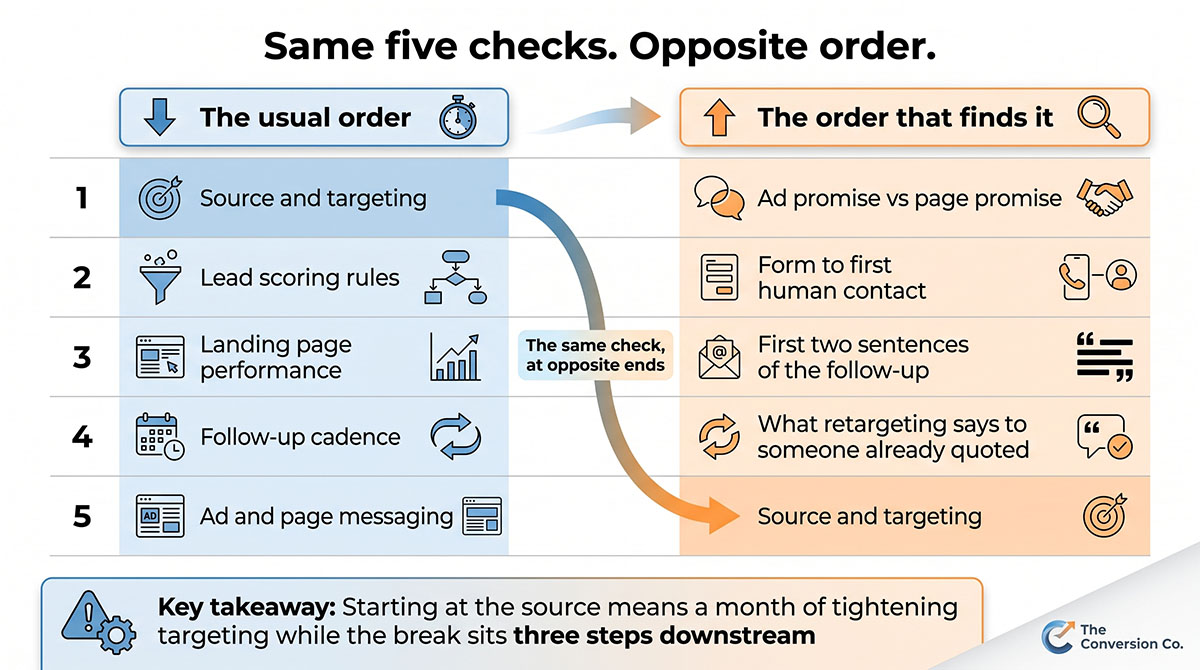
Work the sequence in the order the buyer experiences it.
First, read the ad’s promise and the page’s promise side by side. Not the design, not the load time. The promise. Write down the single sentence each one makes and put them next to each other. Her ad said three weeks. Her page said forty years of craftsmanship. Those are two different offers to two different people, and she only wanted one of them.
Second, measure the gap between the form and the first human contact. Not the service-level agreement – the actual time. Pull ten recent enquiries and check how fast anyone actually replied. Hers took until Friday. By Friday she’d already had two other conversations, and the first one to answer had framed the decision before anybody else arrived.
Third, read the first two sentences of the follow-up. Only the first two. Do they continue the conversation the ad started, or do they open a new one? Heritage is a fine thing to sell. It is not the thing she asked about, and a follow-up that answers a question nobody asked reads as a template.
Fourth, look at what your retargeting says to someone who has already been quoted. Most retargeting has no idea a person is mid-conversation. If it’s still pitching the introductory offer to someone holding a full-price quote, it isn’t recovering her. It’s giving her a reason to distrust the number she’s holding.
Fifth – and only fifth – question the source. Fifth is not never. It’s fifth. By now you’ve either found the break or you’ve genuinely ruled the sequence out. If the promise chain holds end to end, response times are tight, and the follow-up continues the conversation, then yes: look upstream. The leads may really be wrong. But you’ll be looking with evidence instead of a hunch, and you’ll have stopped paying for a targeting rebuild that was never going to fix a Friday afternoon quote about heritage.
Run those five on her thread and the break shows up at step one, before you’ve touched a single setting. The ad sold speed. Everything after it sold something else. She wasn’t a bad lead — she was a good lead who got a different answer to the question she asked, and then, reasonably, went and asked somebody else.
A note on the bathroom: she’s a composite. The details come from several audits rather than one. Nothing in the thread is unusual, which is why it didn’t need to be a single person.
Your marketing, looked at properly
Thirty minutes on your current setup — what’s working, what’s quietly leaking budget, and what I’d fix first. You’ll leave with a clearer picture whether we work together or not.
Got something specific bugging you? Flag it when you book and I’ll have it looked at before we talk.

AboutBruce Marjoribanks
Bruce Marjoribanks has spent 27 years in marketing, including building, running and selling his own agency before going independent. He now runs every channel - paid, organic, social, email, creative and automation - as one integrated system, with AI ehancing production and the judgment staying human.