
Every report your agencies send you is accurate. Put together, they describe a month that didn’t happen. Individually true, collectively fictional – not because anyone lied, but because nobody is responsible for the space between the reports.
Nobody had to hide anything for the picture to come out wrong.
You’ve sat through the review. Twenty slides, four agencies, every chart pointing the right way. Somebody’s screen share keeps dropping. Somewhere around slide fourteen, while a bar chart loads, you think: but is it working?
You don’t ask. The question feels stupid in a room where everyone has just finished showing you good news.
It isn’t stupid. It’s the only question in the room that nobody in the room can answer.
Access is not transparency
Ask any agency whether they’re transparent and they’ll say yes. Of course they will. They give you login access. They send monthly reports. They’ll hop on a call whenever you want.
But access isn’t transparency. You have access to your car’s engine. The hood opens. That doesn’t mean you can diagnose why it’s making that noise.
The industry spent a decade quietly redefining transparency to mean “we’ll show you the numbers,” rather than what it should mean: you can see what’s running, what’s working, what’s being tested, and why. The first version lets an agency bury you in data while technically keeping its promise. The second version requires making the data legible, and legible data makes recommendations accountable.
Some of the difficulty is new. A growing share of buying decisions now happens inside AI answers your analytics never sees, and the visit that follows lands in your reports as direct traffic with nothing attached to it. Underneath that, the conversion tracking producing these reports is a lot more fragile than the reports themselves ever suggest.
Both of those are real. Both are somebody else’s argument. Strip them out entirely – assume flawless tracking, assume every platform sees everything – and the picture is still wrong.
That part has nothing to do with technology.
One sale, three reports, three owners
Follow a single customer for a week.
Tuesday, she clicks your Facebook ad, has a look around, and leaves without buying. Thursday, your name half-remembered, she searches for you and clicks the Google ad sitting above your own listing. Friday morning your email lands, she clicks it, and she buys.
One customer. One sale.
Now count the reports. Meta records a conversion, because Tuesday’s click sits inside the seven-day click window it uses by default and it can see the purchase happened. Google Ads records a conversion, booked against Thursday’s click. Your email platform records a conversion, because the last click before the sale came from its link.
Three agencies, three reports, three conversions. Every one of them correct.
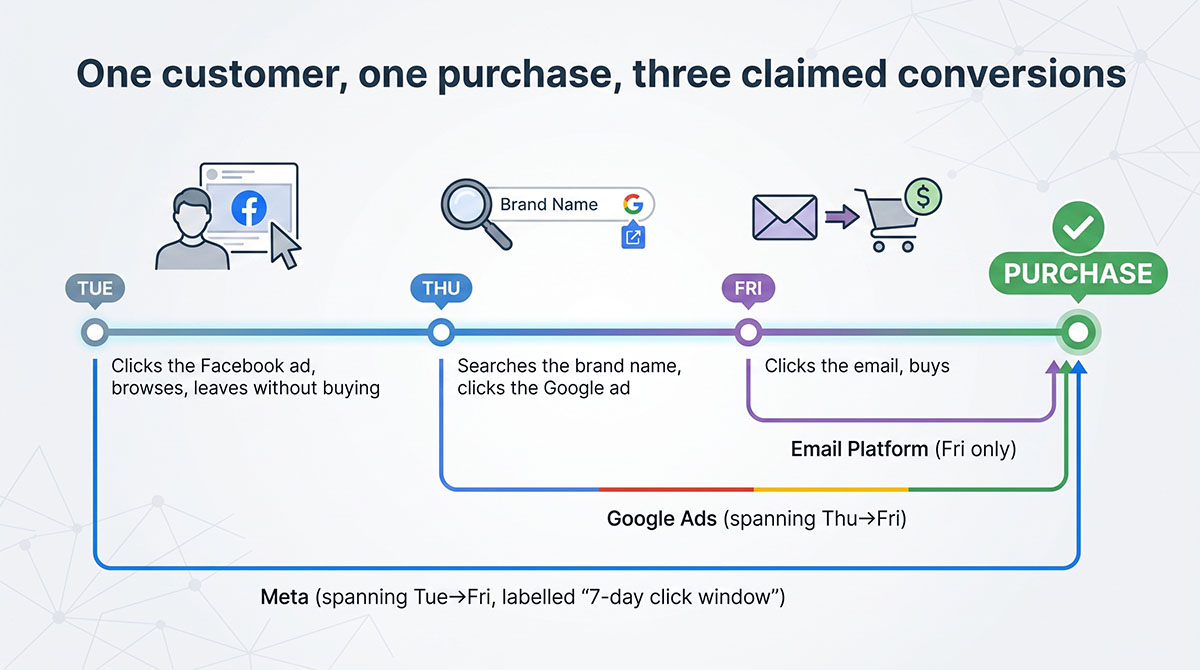
None of them is being generous with the truth. Each system saw a real interaction and a real purchase, and each applied its own rules honestly to what it could see. Ask any of the three to defend their number and they will, comfortably, and they’ll be right.
Then the reports land in your inbox and you do the only sensible thing available to you. You add them up.
Now your month contains three sales where there was one. Your cost per acquisition looks like a third of what you actually paid. And the decision that follows — more budget to whichever channel claimed the loudest — gets made on a number that no agency produced, no agency checked, and no agency is accountable for.
You already apply the opposite rule to money. If the same invoice turned up in three different account codes, each entry correct, you wouldn’t total them and conclude you’d bought the thing three times. You’d go and work out which one it was.
The fiction isn’t inside any report. It’s in the addition. And the addition is the only part of the process that nobody was hired to do.
"Our attribution is fine. Everything reports into one dashboard."
If you’ve already built the shared dashboard, this is the point where you stop reading.
Fair enough. You did the right thing, and you did it before most businesses your size get around to it. Everyone feeds the same system, the tagging is enforced, the numbers arrive in one place in one format. That is better than four PDFs and a phone call.
It fixes the display. It doesn’t touch the definitions.
Google Ads books a conversion against the date of the click. Your analytics books it against the date of the purchase. Meta counts a person, your analytics counts a session. One agency counts a form fill as a lead, another counts a lead as something the sales team agreed to call. Four systems, four definitions, four ideas of when something happened and what it was — all now rendered in the same typeface, in the same rows, on the same screen.
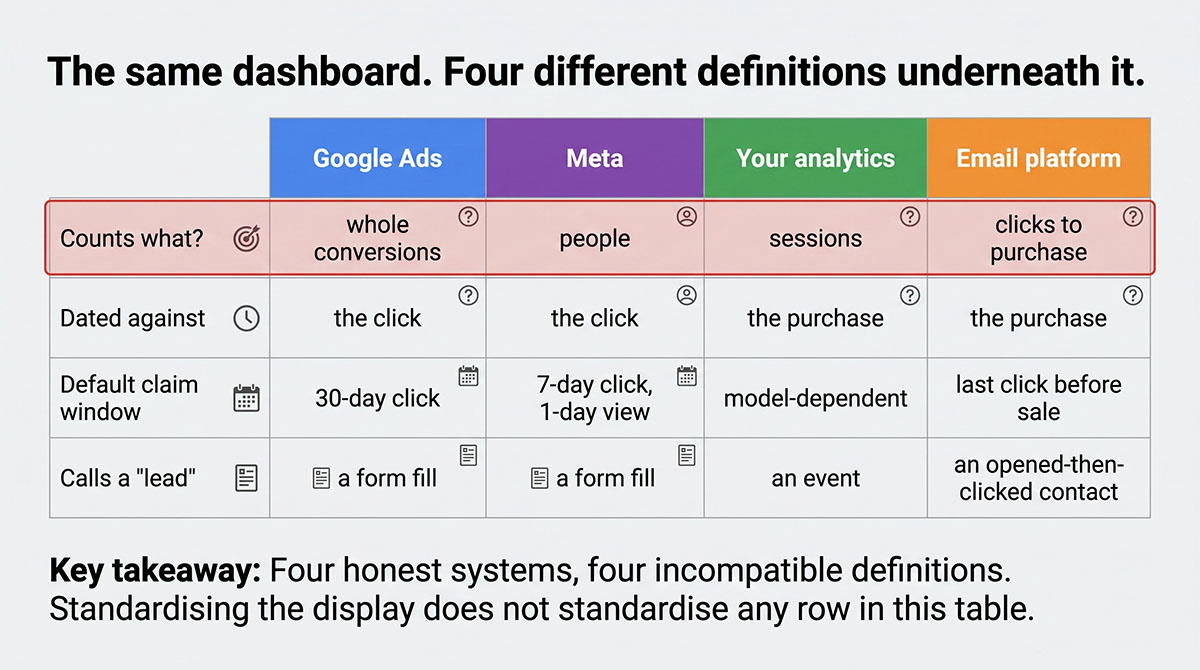
A shared dashboard standardises how the numbers look. It does nothing about what they mean. Four systems that disagree at the definition level don’t stop disagreeing because you put them in matching boxes; they just stop looking like they disagree.
Which makes it worse, not better. Four separate reports at least announce themselves as four separate things. One dashboard announces itself as a single picture, and a single picture invites you to read a total off the bottom of it. The tidier it looks, the more confidently the wrong sum gets acted on.
This is also why moving everything to a single full-service agency doesn’t resolve it. One invoice standardises the billing the same way one dashboard standardises the display.
Specialist bias isn't dishonesty. It's physics.
Here’s where it turns structural.
An agency paid a percentage of ad spend has a financial reason to recommend more ad spend. That isn’t dishonesty. It’s one channel, one lens, one revenue model. Ask a paid search specialist whether budget should shift to email and you’re asking them to argue for shrinking their own invoice. Most people can’t do that objectively. It isn’t a character flaw. It’s a design flaw in how the relationship is built.
Think about asking your surgeon whether you need surgery. They might be right. They probably believe they’re right. But they’re not the person you’d ask whether physiotherapy would work instead.
Now apply that to the counting problem, because this is where the two halves meet.
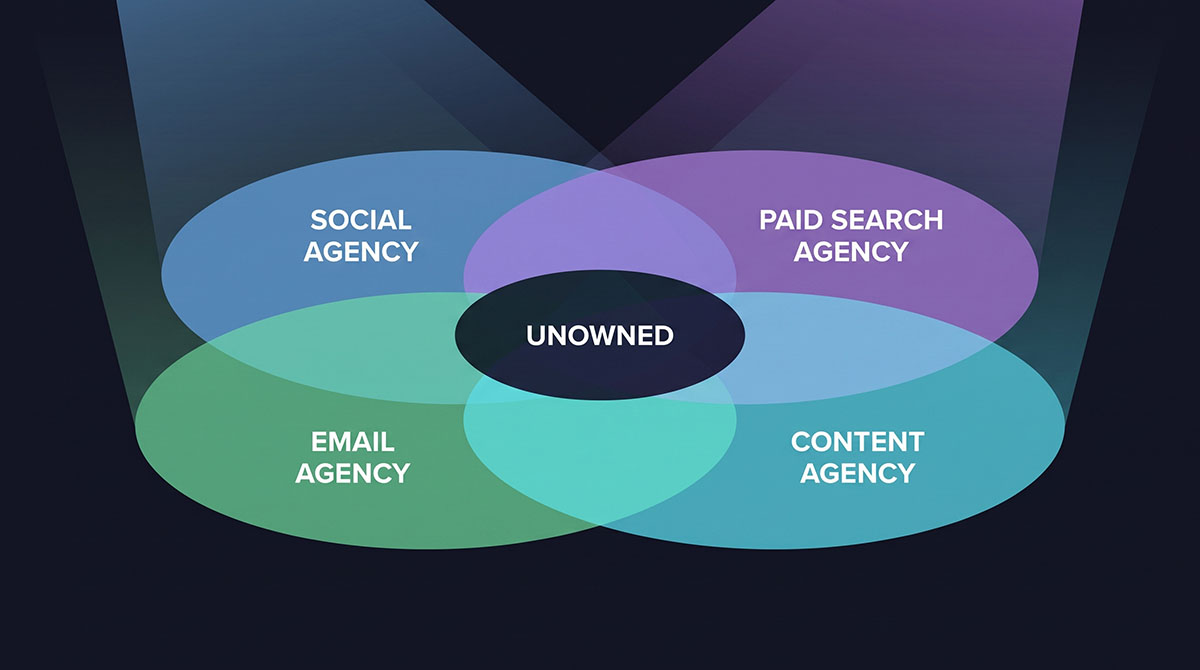
Somebody has to notice that one sale got claimed three times. Who? The agency whose number would shrink is the one best placed to see it and the least motivated to raise it. The others can’t see it at all — the overlap only exists in the space between their reports, and none of them has a window onto that space. Not one of the four people on the call is paid to look at the seams. They’re paid to be excellent inside their own boundary, and most of them are.
That is the whole mechanism. Not villainy. Geometry. Every agency’s field of view stops exactly where the problem begins, and the cost of that unowned space is a line item that never appears on any of the invoices.
Where this argument breaks
There’s a real limit here and it’s worth naming.
Past a certain scale, specialisation stops being avoidable. Multiple businesses, multiple markets, several hundred thousand a month across separate accounts running at once — at that point the decisions inside a single channel outrun what one person can hold, and dedicated specialists earn their place.
But people badly overestimate how early that line arrives. In my experience a single business putting $40,000 a month through Google Ads does not contain enough distinct decisions to justify a separate agency with a separate report and a separate incentive. There isn’t that much to decide.
And the deeper caveat cuts against my own argument. Consolidation doesn’t automatically fix this. Put four channel specialists on your own payroll. Give them one manager and one reporting template. If nobody’s job description includes the seams between their numbers, you will manufacture the same fiction in-house, for more money, with the added disadvantage that everyone involved likes each other.
The failure isn’t specialisation. It’s unclaimed ground.
Nobody's hiding anything. That's still the problem.
Your agencies will keep sending accurate reports. Every number will survive scrutiny. Everyone will keep doing their job well, hitting their metrics, telling you exactly what they did with your money.
And you’ll still be guessing.
The rule underneath all of it is simple enough to check against any setup, including one that has nothing to do with agencies: any reporting structure where nobody owns the gaps will produce individually true, collectively fictional numbers. It holds regardless of who the providers are, how honest they are, how expensive the software is, or how good the dashboard looks. Four honest agencies produce it. Four honest employees produce it. You and one freelancer produce a smaller version of it.
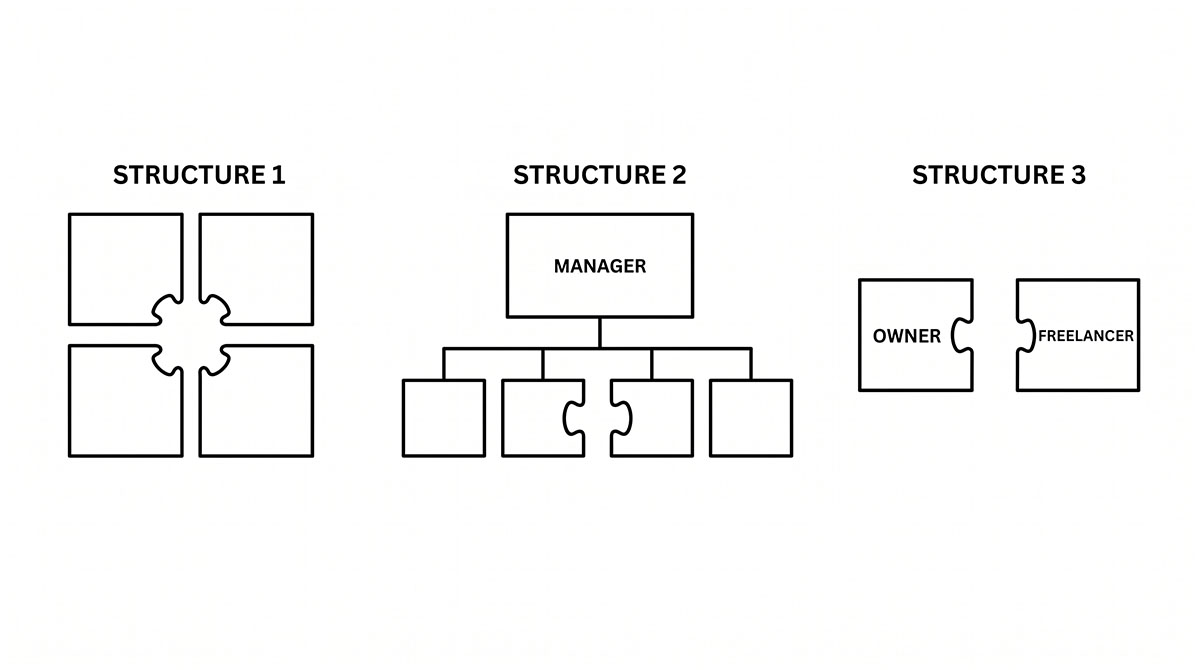
The variable was never integrity. It’s whether one person is accountable for the space between the reports, and whether they have the standing to say that three of these conversions are the same customer.
So the question you didn’t ask in that review wasn’t stupid. It was just aimed at the wrong room. “Is it working?” can only be answered from outside the channels, and every person at that table was standing inside one.
Your marketing, looked at properly
Thirty minutes on your current setup — what’s working, what’s quietly leaking budget, and what I’d fix first. You’ll leave with a clearer picture whether we work together or not.
Got something specific bugging you? Flag it when you book and I’ll have it looked at before we talk.

AboutBruce Marjoribanks
Bruce Marjoribanks has spent 27 years in marketing, including building, running and selling his own agency before going independent. He now runs every channel - paid, organic, social, email, creative and automation - as one integrated system, with AI ehancing production and the judgment staying human.