
Picture a relay race. Four runners, four handoffs. Each runner is fast. Genuinely talented. But every baton pass costs two seconds. The other lane has one runner and no handoffs. They crossed the line while your team was still passing the baton for the third time.
That is most marketing operations. The baton is your campaign.
It makes no difference whose payroll the runners are on.
Nobody invoices for the waiting
Nobody on your team is wasting your money on purpose. The delay sits in the structure.
Count the desks one piece of work crosses before a customer ever sees it.
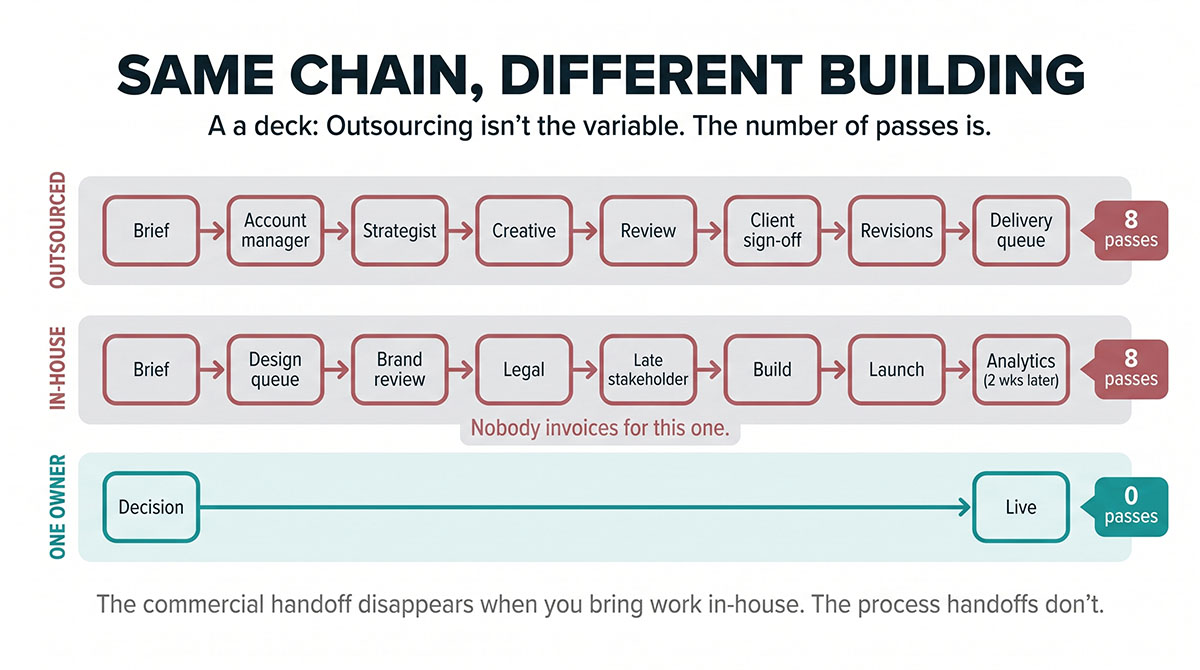
Outsourced: the brief goes to an account manager, who briefs a strategist, who briefs a creative team. The work goes back to the account manager, then to you for sign-off, then back for revisions, then into a delivery queue.
In-house: a brand manager writes the brief. It enters a design request queue. It comes back for brand review, then legal, then a stakeholder who wasn’t at kickoff and has opinions. Then the performance team builds it. Analytics reports on it a fortnight after launch.
Different buildings. Same number of passes. Every pass adds waiting time, and none of them adds value to the work itself.
The in-house version is the one nobody counts, because nobody invoices for it. There is no line item for four days waiting on legal. The cost surfaces as a launch date that slipped, and no one can say exactly where.
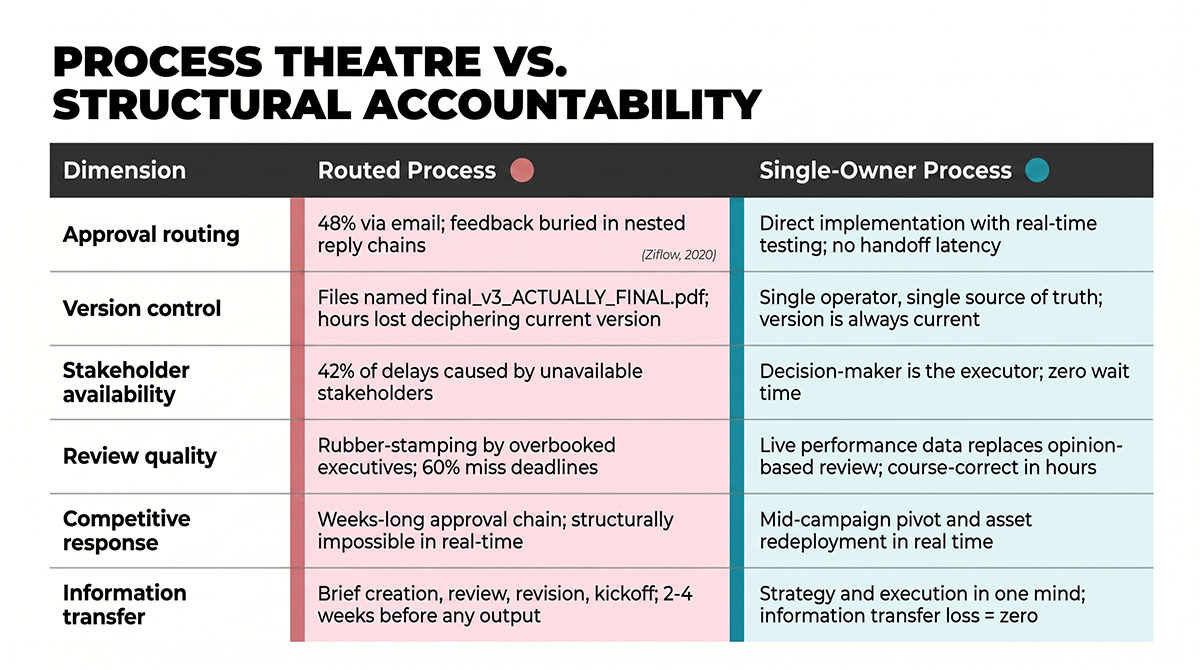
48% still approve by email
A 2020 survey by Ziflow, a proofing software company, found 48% of marketing teams still route approvals through email. Not agencies. Marketing teams. That means feedback buried in reply chains, files named final_v3_ACTUALLY_FINAL.pdf, and hours lost working out which version is current.
The rest of this I am not quoting a study for. I have watched it from inside both structures. The people are good. The structure inserts a queue between every decision and every action, and queues are where campaigns go to age.
92% want it. 31% get it.
The best numbers on this describe the outsourced relationship, for a dull reason: agencies get surveyed, internal teams do not.
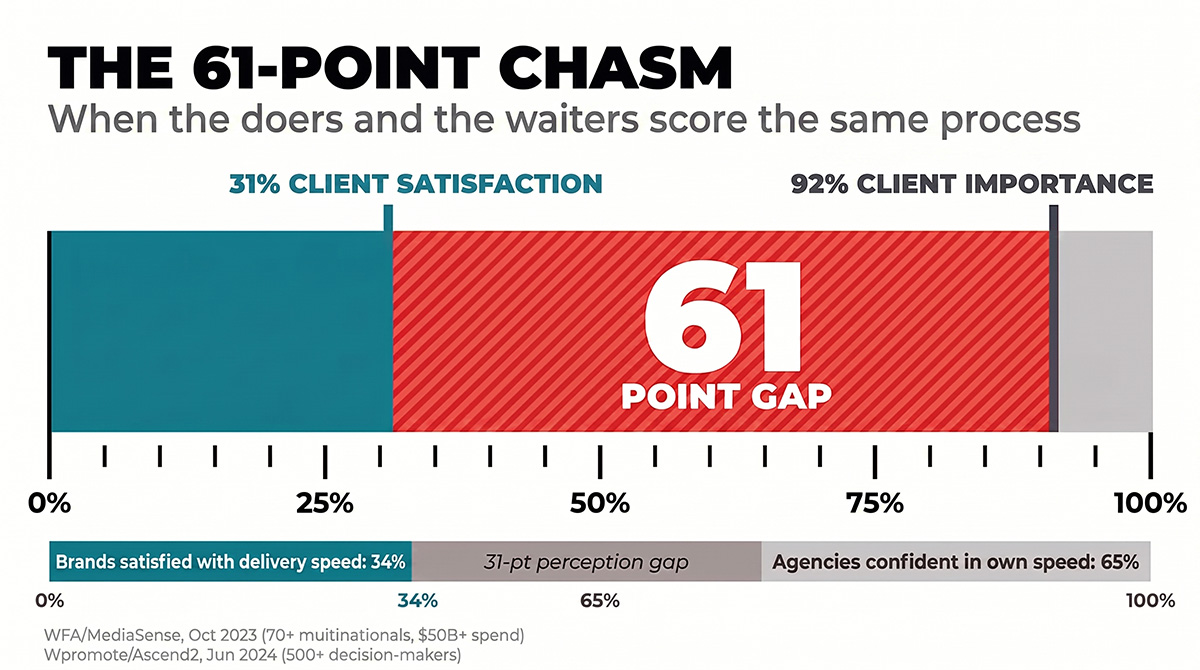
In 2023, WFA and MediaSense surveyed more than 70 multinational advertisers with over $50 billion in combined spend. 92% said speed and agility mattered. Only 31% were satisfied with what they got. A 61-point gap between what was wanted and what arrived.
A 2024 Wpromote and Ascend2 study of more than 500 decision-makers found 34% of brands report high satisfaction with delivery speed, while 65% of agencies are confident in their own speed. The people inside the process rate it higher than the people waiting on it.
That second pattern is not an agency disease. Ask a CMO how fast the internal creative team turns work around. Then ask the internal creative team what it’s like waiting on brand review. You will get two different scoreboards from the same building.
One more finding worth sitting with: brands reporting high satisfaction are 61% more likely to report substantial revenue growth. Satisfaction is not a soft metric. It travels with the money.
In-housing moves the queue. It doesn't delete it.
You would expect a 61-point gap to trigger a wave of switching. It mostly doesn’t, and the reason is cost. ANA and the 4A’s put a full agency search at $408,500, and over $1 million once transition is counted. So companies do something quieter. They restructure.
Gartner’s 2025 CMO Spend Survey found 22% of CMOs had reduced reliance on external agencies. Forrester forecasts 15% of agency jobs eliminated in 2026, after an 8% reduction in 2025, and reports that 85% of US B2C marketing executives plan to review their media agency contracts in 2026.
None of this is new. Back in 2018, Ford projected $150 million in annual savings from bringing marketing in-house, and P&G reported roughly $750 million in agency and production savings, a figure it later said reached $1 billion cumulatively. Those numbers predate the AI conversation entirely, which is the point.
Here is what in-housing fixes and what it doesn’t.
It removes the commercial handoff. No scope conversation, no change order, no “that’s outside the retainer.” Real money, real friction, gone.
It does not remove the process handoffs. Most teams rebuild those internally inside a year, and they rebuild them with the best intentions: a brief template so nothing gets missed, a request queue so work is prioritised fairly, a review committee so nothing embarrassing ships, a monthly planning cycle so everyone can plan. Every one of those is defensible. Together they are the same chain, in a different building, on fixed salaries.
If the work still crosses four desks, you bought a cheaper queue.
52 shots a year, or 12
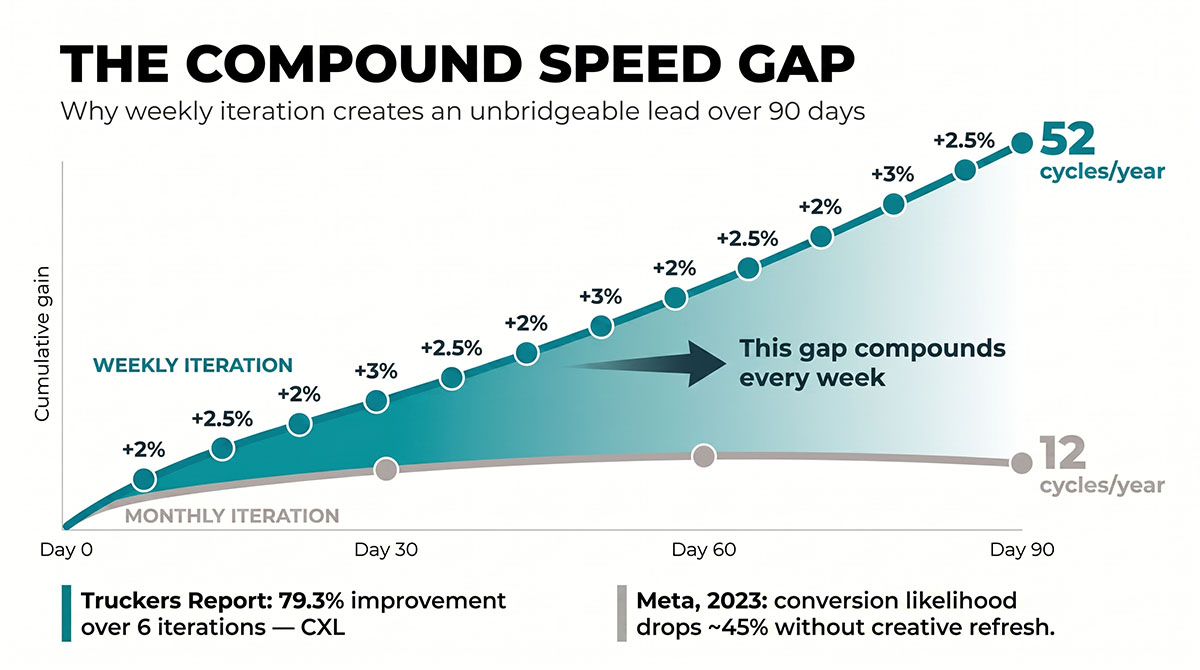
Speed is not only about launching sooner. It is about learning sooner, and learning stacks. The brand that learns fastest wins.
A team that ships and tests weekly gets 52 learning cycles a year. A team locked into monthly rounds gets 12. Small gains accumulate. Truckers Report, working with CXL, improved landing page conversion 79.3% across six rounds of testing. VWO’s published case studies show ArchiveSocial roughly doubling clicks on its homepage call-to-action, and Flos USA lifting checkout conversions 125% for an 18X return on the project. An older example: Conversion Rate Experts lifted Crazy Egg’s conversions 30%, with a further 64% from a single explainer video, in work done in the early 2010s. All of these are published by the optimisation firms involved, so treat them as showcase results. The pattern across them holds anyway.
None came from one brilliant idea. They came from many cycles, run quickly.
Creative behaves the same way. Meta’s own 2023 research found conversion likelihood drops about 45% when people see the same ad too many times without a refresh. Fatigue is measurable. The only answer is producing and rotating creative faster than it wears out — and a monthly approval cycle cannot outrun a weekly fatigue curve, whoever holds the pen.
McKinsey’s research on marketing “Integrators”, companies that merge data and creativity through agile operating models, found they grew revenue at twice the average rate of the S&P 500. That research dates from 2018. The pattern held before AI. AI raises the ceiling.
None of it was in the brief
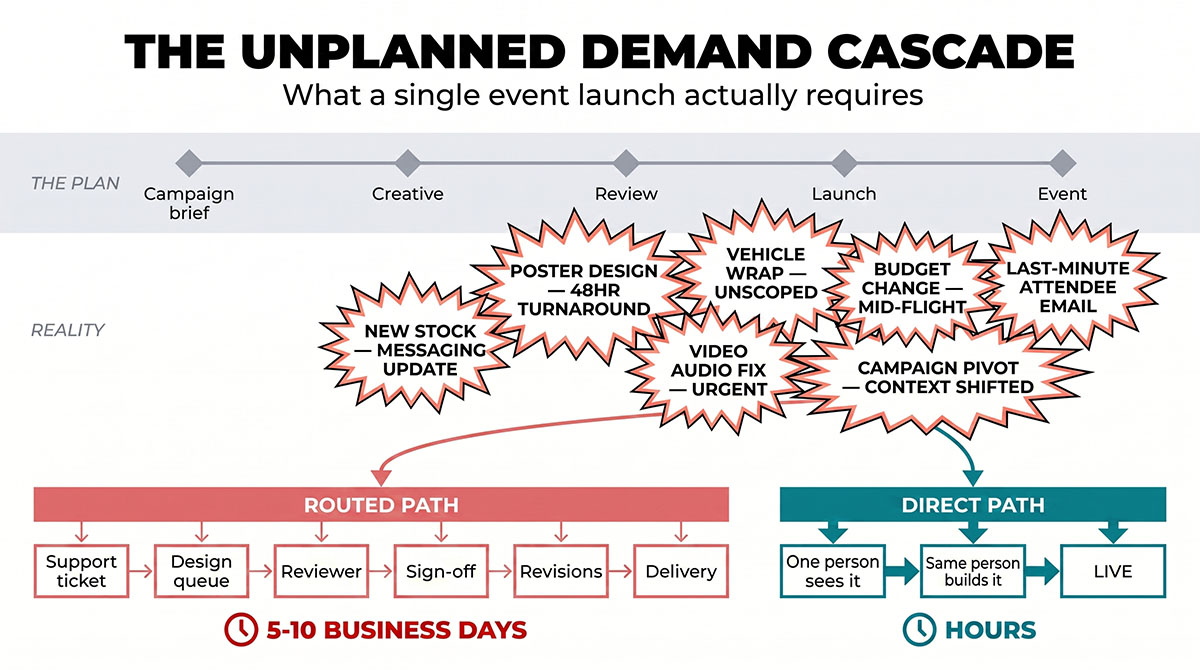
We were launching Sunday Drive, an event with a fixed date, zero flexibility, and the kind of public visibility that punishes mistakes. The campaign plan was solid. The timeline was mapped. Then the reality of live business did what it always does and ignored the plan completely.
Within days, requirements surfaced that nobody had anticipated. Posters needed designing. A full vehicle wrap for a car trailer materialised out of nowhere, scoped by no one. Campaign ideas that made sense on Monday needed rethinking by Wednesday because the context had shifted. Last-minute emails to attendees. New cars arriving in stock that needed folding into the messaging. Budget changes mid-flight. Video audio that needed fixing before it could go out.
None of it was in the brief. None of it could have been.
Now route each of those through a multi-desk process, and it barely matters whether the desks are internal or external. The poster enters a design queue with a five-day turnaround. The vehicle wrap needs its own brief, its own owner, its own approval. The email copy goes to a copywriter, then a reviewer, then a stakeholder, then back for revisions. The video fix becomes a ticket. Every unplanned need joins the back of a line behind someone else’s planned work. By the time the process catches up, the event is over.
One person with the full skill set does not file a ticket for the poster. They make the poster. They don’t brief a separate team on the vehicle wrap. They design it. The email, the video fix, the new stock: hours, not weeks, because nothing sits between recognising the need and meeting it. The person who sees the problem is the person who solves it.
That is not a theoretical advantage. It is the difference between a campaign that adapts to reality and a campaign that was perfect on paper and irrelevant by launch day.
"But speed without oversight is a liability"
This is where the reasonable objection lands, and it deserves a straight answer. Consumer trust in AI is under pressure, regulators are active, and the EU AI Act reaches full application in August 2026 with heavy fines attached. Moving fast without checks is genuinely dangerous.
But look at what the objection actually argues for. It argues for judgment and accountability. It does not argue for handoffs.
A six-step approval chain does not make work safer. It makes responsibility blurrier. Internal chains are often worse at this than external ones, because a reviewer who sees the asset and not the campaign catches wording and misses risk. One accountable person who sees the whole campaign, checks it against the rules, and answers for the outcome is a tighter control than a chain of six people each assuming somebody upstream caught it.
Your slowest gate sets the pace
Look at how quickly new tools actually reach the work.
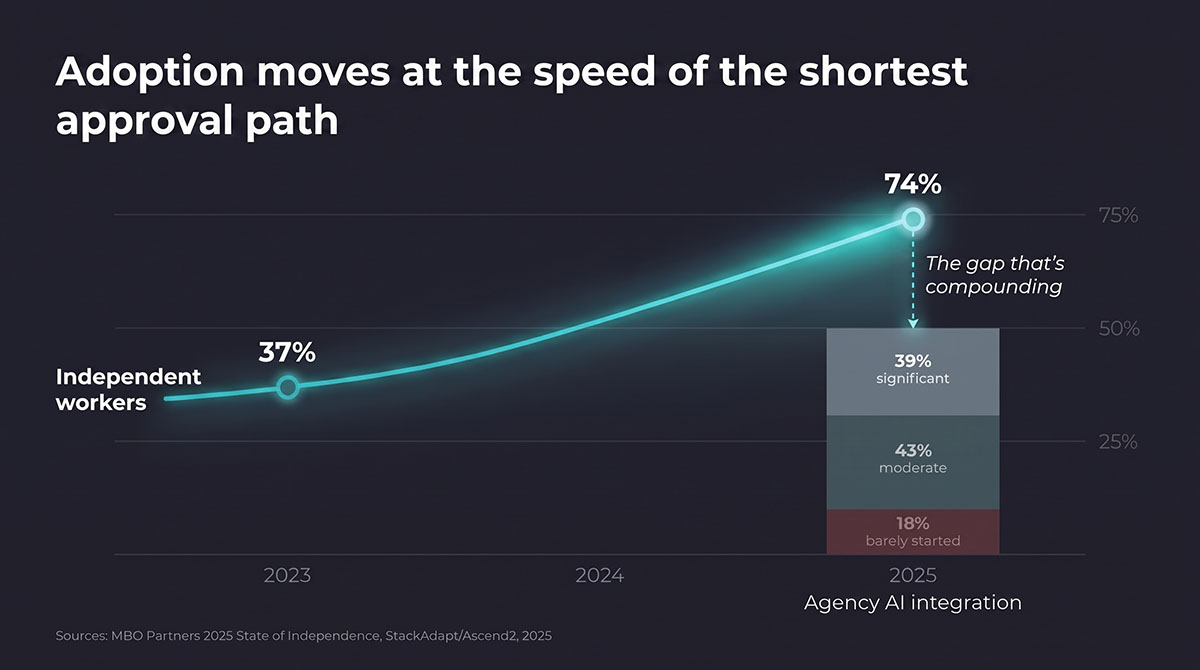
MBO Partners’ 2025 State of Independence study found 74% of independent workers now use generative AI, up from 37% two years earlier. Fiverr’s own research puts the payoff at 8.1 hours saved per week for freelancers using AI tools. StackAdapt and Ascend2 found only 39% of agencies had significantly integrated AI into their operations, and 18% had barely started.
Nobody has run the equivalent survey on in-house marketing teams, so I won’t pretend to know their number. The mechanism is not about the logo on the door. New tools spread at the speed of the shortest approval path. A team that needs procurement, IT security, and a legal review before trialling anything adopts at the speed of its slowest gate, whether that team sits in an agency or a head office. Usually the gate is a manager, not the tools.
The far end of this is dramatic. Superside reported in 2025 that custom AI image models cut time per image by 75% and cost per image by 85%. Those are a vendor’s numbers about its own work, so hold them loosely, but the direction matches everything else. McKinsey reports some Fortune 250 brands have already sped up campaign execution 15-fold.
The auction doesn't wait for your review cycle
Gartner predicts that by 2028, 90% of B2B buying interactions will be intermediated by AI agents, pushing $15 trillion through AI agent exchanges. Dentsu projects global ad spend will pass $1 trillion for the first time in 2026, with 71.6% of that spend algorithm-driven.
In a market that reprices by the auction, the queue is the cost. Your competitor’s bid moved while your brief was still in review.
And most marketing leaders are not moving. McKinsey’s State of Marketing Europe 2026 report, which surveyed 500 CMOs, found generative AI ranks 17th out of 20 in stated priorities. Meanwhile the 6% of marketing executives at mature AI deployment already see 22% efficiency gains. McKinsey calls this an “AI reckoning” risk: the gap between leaders and laggards compounds while most leaders aren’t watching it. Most companies get almost nothing from AI — the difference is structural, not technical.
Count your handoffs
Take the last thing you shipped. List every person who touched it between the decision to do it and the customer seeing it. Write the date beside each name.
The gaps between those dates are your real production time. The work itself probably took a day.
Picture the relay again. Four runners, four handoffs, two seconds lost at every exchange. Except the runner in the other lane isn’t just faster. They’re running a different race. Real-time data feeds their stride. They adjust mid-step. Every lap makes the next one quicker.
The 61-point gap is not a flaw in one delivery model. It is what any structure produces when the number of people between a decision and an action grows faster than the market’s patience.
The question was never in-house or outsourced. It is how many desks your work still crosses. If the answer is more than one, the full case for the alternative is in 12 reasons to hire an AI-powered generalist instead of an agency of specialists.
Your marketing, looked at properly
Thirty minutes on your current setup — what’s working, what’s quietly leaking budget, and what I’d fix first. You’ll leave with a clearer picture whether we work together or not.
Got something specific bugging you? Flag it when you book and I’ll have it looked at before we talk.

AboutBruce Marjoribanks
Bruce Marjoribanks has spent 27 years in marketing, including building, running and selling his own agency before going independent. He now runs every channel - paid, organic, social, email, creative and automation - as one integrated system, with AI ehancing production and the judgment staying human.