
Black background. White gothic type. A skull. No can, no water, not even the word “drink,” and you knew whose ad it was before your thumb finished the flick.
A count of the Meta Ad Library on 8 August 2026 returned 377 live Liquid Death ads worldwide. Pull it today and the number will have moved, because these counts always do. The three elements the brand locks won’t have: black, white, skulls.
Hold that skull in your head, because it breaks the advice your agency gave you at the last quarterly review: the algorithm punishes repetition, so we’re refreshing the creative.
The consensus deserves a fair hearing
Both halves of the standard advice are true, which is exactly why the standard conclusion is so seductive.
The first half comes from Meta’s engineering floor. Across 2024 and 2025, Meta rebuilt ad delivery around Andromeda, a retrieval engine I’ve pulled apart in detail elsewhere, which scans tens of millions of live ads and shortlists a few thousand candidates before the auction begins. It reads your creative directly: the visuals, the copy, the framing.
Be careful with what gets claimed on top of that. You will hear that Meta’s own position is that the performance lever has moved from targeting to creative. Meta has never published that. What Meta publishes is Performance 5, a list of five practices, one of which is diversifying your ad creative. Creative sits alongside the other levers on that list. It does not replace them. The stronger version is agency phrasing that got repeated until it sounded official.
The evidence Meta does publish is thinner than the rhetoric and worth reading properly:
- Meta Engineering reported a 22% lift in ROAS from Advantage+ creative in December 2024. Read the base before you spend against it. The advertisers measured were new to Advantage+ creative, which is a selection effect, the features measured were the AI-driven targeting ones specifically, and it is first-party reporting with no published methodology.
- You will also see “32% better media efficiency and 8% incremental reach” quoted everywhere, including by me, previously. The figures are real. The source is an Adweek partner post, which is paid Meta placement, written by a Meta sales director in August 2022. No sample size, no date range, no market, no metric definition, and it predates Andromeda by two years. That is sales content. Don’t build a strategy on it.
- The old “no more than six ads per ad set” guidance has been removed from Meta’s ad volume documentation and replaced with softer language. I can’t pin the removal date, so I won’t give you one.
The platform does want variety. The published proof that it pays for variety is weaker than the industry pretends.
The second half comes from the Ehrenberg-Bass Institute. Byron Sharp and Jenni Romaniuk’s work, settled science at this point rather than a school of thought, says brands grow through mental availability: the odds you come to mind when a buying moment arrives. That availability is built by distinctive assets, the colours and shapes and characters and sounds repeated so consistently they trigger the brand without the name.
Here the evidence is better, and it is usually quoted wrong.
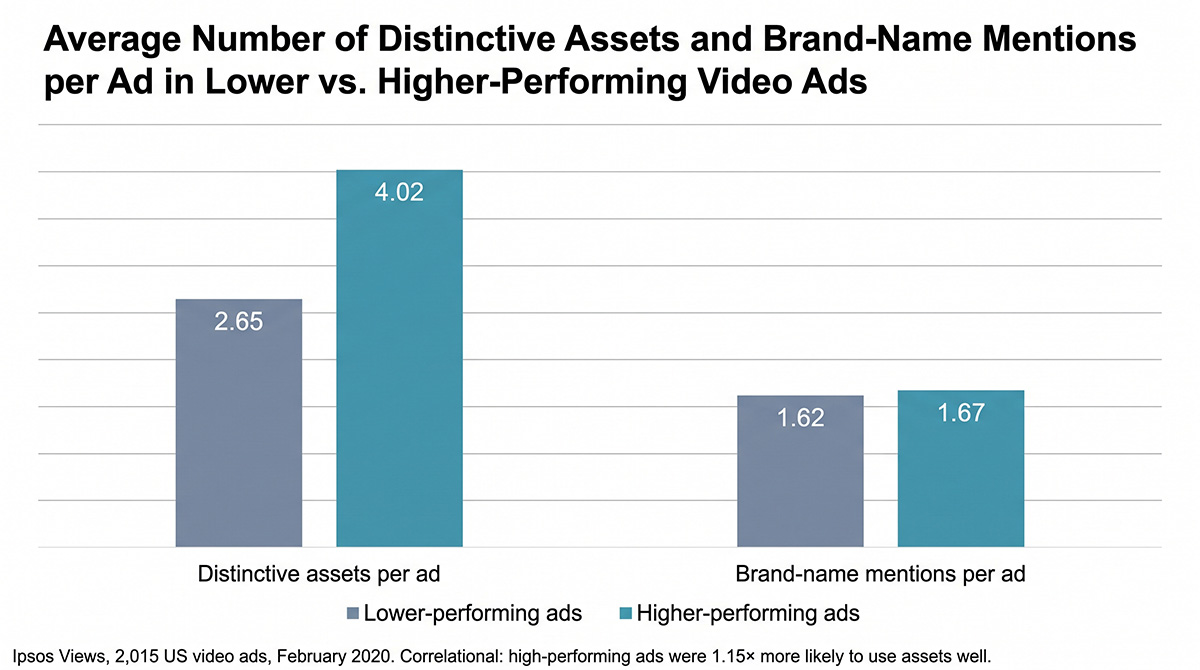
Ipsos analysed 2,015 US video ads (Ipsos Views, February 2020). The high-performing ads displayed distinctive brand assets 34% more often than the rest: 4.02 assets on average against 2.65. That 34% is a frequency gap, not an effectiveness lift, and it gets repeated as a lift constantly. The actual effect Ipsos reports is that ads using distinctive assets well were 1.15 times more likely to be high performing. Modest, real, correlational.
The finding that holds up cleanly is the one nobody quotes. Raw brand-name frequency barely separated winners from losers: 1.67 mentions against 1.62. The asset does the attribution work, not the logo count.
Cadbury spent roughly a century pouring money into one shade of purple and still couldn’t hold it easily. The litigation ran from 2004 to 2022 across three rounds, including a 2012 High Court win that the Court of Appeal overturned in 2013, and ended when Meade J allowed two of Cadbury’s three fresh applications in Nestlé v Cadbury [2022] EWHC 1671 (Ch). Eighteen years. Owning a memory structure is brutally expensive, which is exactly why you don’t discard one.
So you’re left holding two instructions pointing in opposite directions. The platform wants you to change everything constantly. The science of memory wants you to change nothing at all.
The industry resolved that tension the laziest way available, by splitting into camps. Performance shops strip the brand out of the creative because the hook rate told them to. Brand shops ration creative output to protect the identity and the account quietly starves. Both camps treat it as a single dial, where more diversity must cost you consistency and more consistency must cost you scale.
The algorithm counts concepts, not ads
That dial doesn’t exist, and here is where I need to be precise about what is known and what is inferred, because the rest of this piece depends on it.
The working model. Andromeda’s retrieval stage appears to treat semantically similar creatives as one thing. Same idea, same benefit, same style, one fingerprint. Practitioners call that fingerprint an “Entity ID.” Fifty recolours of one ad collapse into a single cluster and get a single shot at retrieval. A different segment, a different benefit or a different format each earn a separate entry, which means separate tickets to the auction.
The status of that model. Meta’s engineers don’t use the term “Entity ID,” and Meta has not published the mechanism. The Andromeda material describes hierarchical indexing, learned retrieval and inference efficiency. It contains no semantic clustering of creatives, no fingerprinting and no Entity ID. Those words are simply absent. If a vendor tells you the clustering is documented in Meta’s published architecture, they have not read it. I’ve made that claim myself and it was wrong.
So why run on it anyway. Because the model predicts what accounts actually do, and no published alternative predicts it better. Ship fifty recolours and you get roughly the delivery of one ad. Ship five genuinely different concepts and you get five distinct delivery patterns. That is a testable prediction, and you can test it in your own account inside a fortnight. Treat it as a working hypothesis that has earned its keep, not as documented fact. That distinction is the difference between a discipline and a superstition.
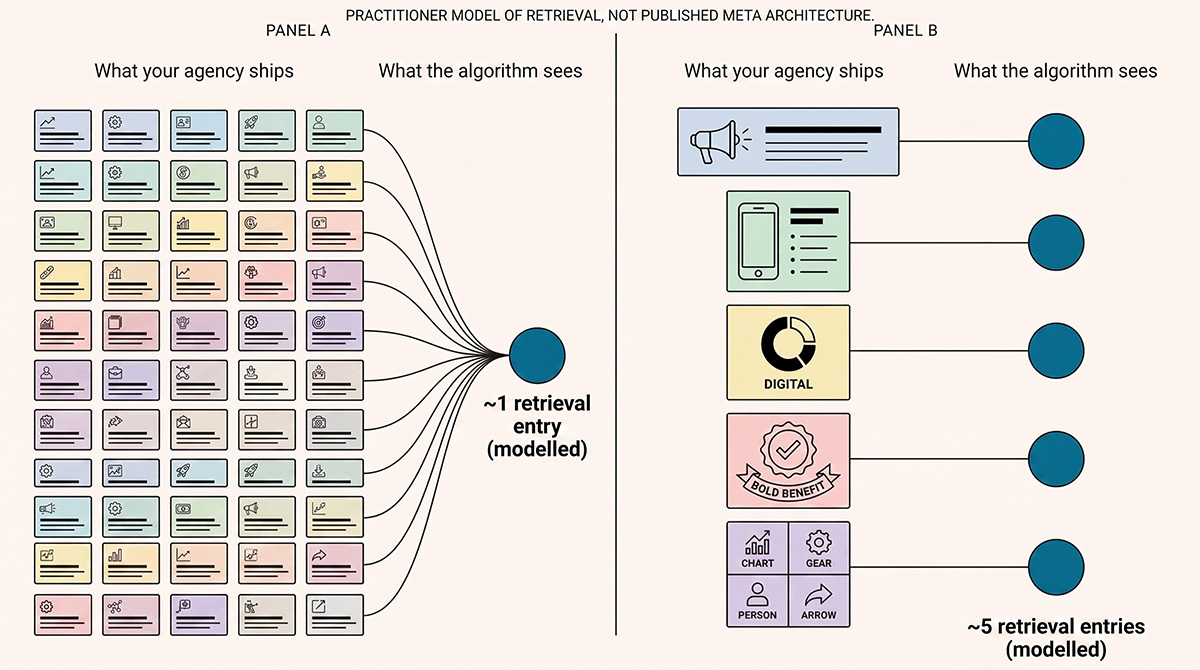
Now hold that against the list of things Sharp and Romaniuk tell you to lock: the palette, the mark, the character, the layout system. None of them is what the retrieval layer appears to measure diversity against. The machine judges diversity at the concept layer. Memory forms at the asset layer. They are different floors of the same building, and the entire trade-off debate has been an argument about which floor to live on, when you were always allowed both.
Look at what that permits in practice. An Ad Library count on 8 August 2026 returned 457 live ads in the US and 1,104 across all countries for The Ridge, the metal-wallet brand. Counts like that move weekly and include placement variants, which is why the date and the geography matter more than the number itself. Foreplay has reported the brand launching more than 500 ads inside a ten-day window, with 78 still live at the end of it. That is vendor-published, so treat it as directional rather than audited.
What The Ridge doesn’t vary is the wallet. Whatever the format, that slab of minimalist metal anchors the frame. The algorithm has never once objected that it looks familiar, because it was never looking at the wallet.
"But our agency showed us the fatigue curves"
Here’s the objection, and I’ve heard it in almost these exact words: the algorithm punishes repetition, we’ve seen the data, if we lock the look we’ll burn out faster.
Your agency isn’t lying to you. Fatigue is real. It is also badly measured, and the numbers that circulate as settled are not.
Effective ad lifespan on Meta is commonly put at two to four weeks (Accelerated Digital Media, August 2025). You will also hear that this compressed from six to eight weeks before Andromeda. There is no published before-and-after comparison, and the six-to-eight-week half has no published source at all. Take the two-to-four-week window as one agency’s estimate and discard the compression story.
The refresh triggers get quoted as industry consensus. They aren’t. A 7-day frequency above roughly 3.5 and a click-through decay past 25% appear together in one agency’s funnel-stage table, in the mid-funnel row (GoodMorning, May 2026). The “CPM up 35%” figure I can’t source anywhere. Practitioners publish materially different numbers, which is what you’d expect, because the right threshold is account-specific.
So use those as an opening position, then replace them within a quarter. Pull your own account’s history and find the point where your ads have historically stopped paying. That number is worth more than anyone’s published table.
There’s a newer trap inside the same misdiagnosis. Meta defaults Advantage+ creative enhancements to on for sales, leads and app campaigns: image animation, background generation, colour shifts, text variation. Left running, those features mutate the exact assets you’ve spent years locking.
I’ve previously dated that default to February 2026. I can’t source the date and standard enhancements have been default-on considerably longer than that, so the date is coming out. What is reported is a change in the opposite direction: since around March 2026, opting out is saved for future campaigns rather than reverting to opt-in each time (Marketing Brew, April 2026). Which is good news, and only useful if someone turns it off once.
Snag Tights publicly objected after Meta’s AI altered roughly 5% of the brand’s ads despite Snag having opted out, including replacing Black models with white women. Founder and chief executive Brie Read went on record with Glossy in February 2026 and had the feature disabled.
So ask who on your current roster is responsible for those switches. An agency graded on click-through has no incentive to turn off a feature that occasionally juices it, because protecting your purple isn’t in their KPI.
Lock the few, vary the rest
The working discipline runs in two moves, and the order matters.
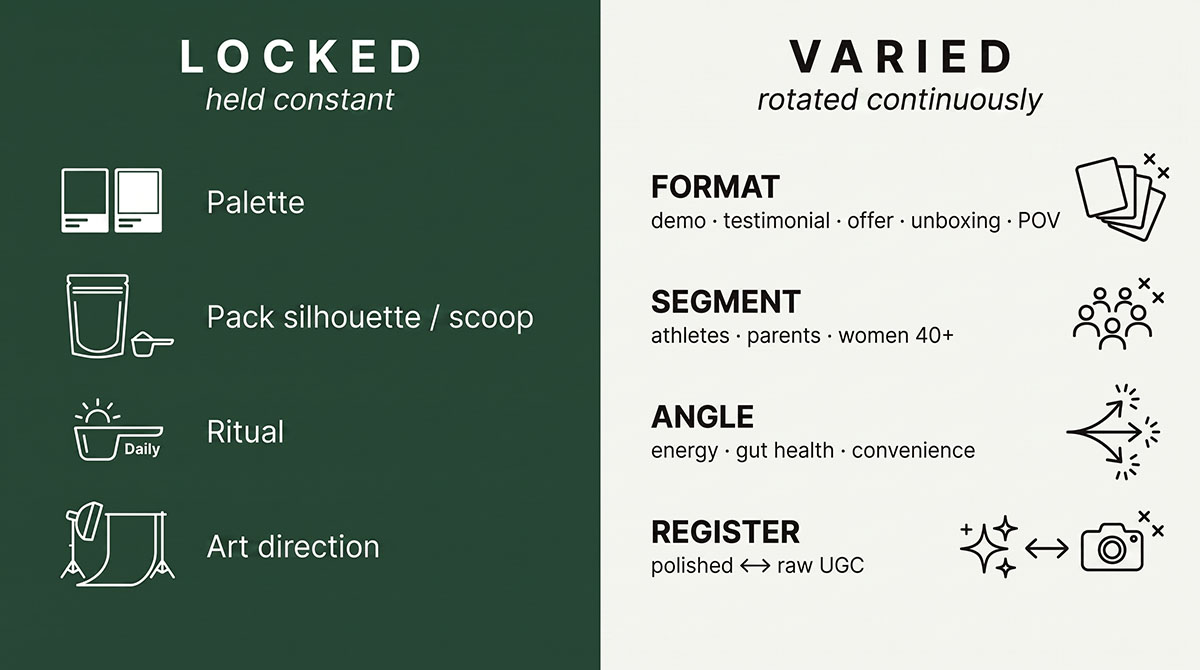
First, the codex. Test your brand elements for recognition, and test them properly, because gut feel fails here. Marketers live inside their own brands and misjudge what buyers actually recognise. Romaniuk’s grid plots every element on fame, meaning what share of category buyers link the asset to you, and uniqueness, meaning what share link it only to you. Both are measured by surveying category buyers. They are not scored around a table by the people who made the assets, and that distinction is the whole point of the method. Keep the three to five elements that score high on both axes, or that can plausibly get there. That’s the codex, and it’s sacred: every ad, every format, every shop, no exceptions.
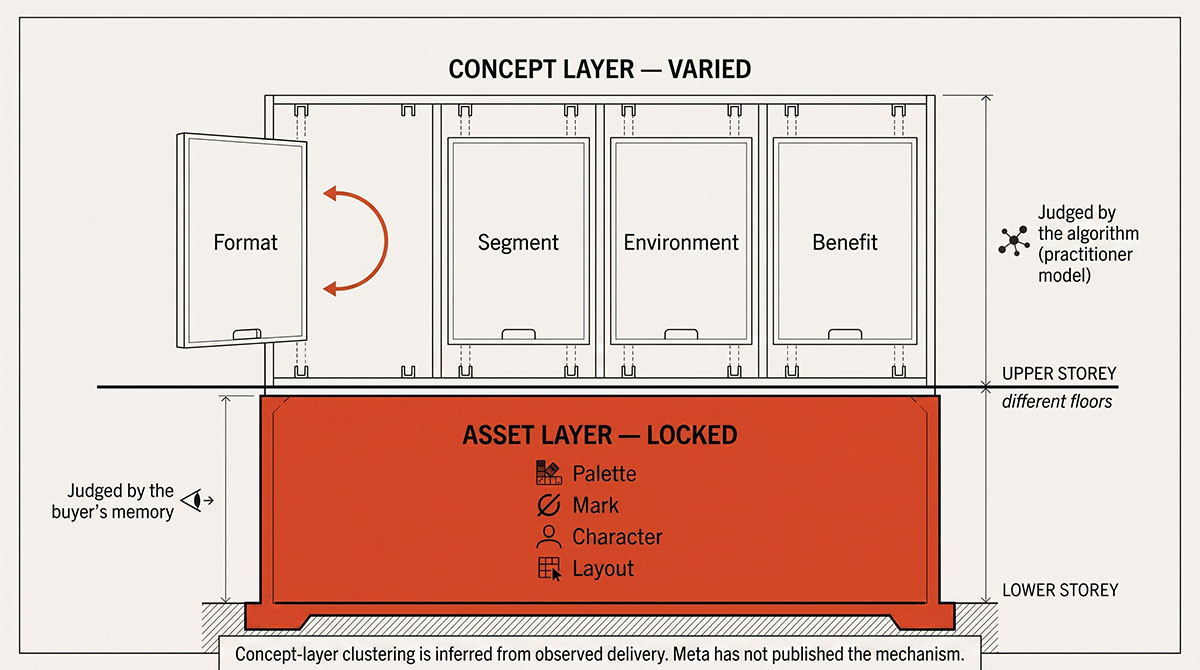
Second, the variation engine. With the codex locked, you manufacture concept diversity by rotating everything else across four dimensions: format (static, video, carousel, UGC), segment (which cut of the market the ad is arguing to, where the persona name is only the handle), environment (where it’s set), and benefit (which value proposition leads).
A founder-to-camera story and a motion-graphics product explainer register as two separate entries in retrieval. Because both carry the same scoop and the same green, they deposit into one memory structure. Two tickets to the auction, one brand in the mind.
Which raises the question this piece doesn’t answer: vary the segment according to what? Choose the cuts wrong and you’ll manufacture diversity the machine can see but no buyer can feel. Where those cuts come from is its own discipline.
Here’s the part the theory books skip. This discipline has a single point of failure, and it’s ownership. Split the work across a branding agency, a creative shop, a UGC house and a media buyer, and the codex has no enforcer.
Two failure modes follow, usually together. The first is fake diversity, where each shop’s output looks different to a human but clusters identically to the machine, so your own ads collapse into one entry and compete with each other for a single ticket. The second is dilution, where the media shop chases hooks, the assets get sanded off in the name of freshness, and a million impressions build nobody’s memory. Each agency hits its own KPI while the account loses.
The spec protects the brand. It can't protect the auction.
If you use several agencies, give them all one page. Exact hexes, mark treatments, the character, the layout system. Every shop signs it. That will hold your identity layer, and it’s the minimum a disciplined roster can maintain.
What a page can’t do is watch the account. Nobody in a split setup sees every live creative in one place. So nobody notices when two shops’ concepts cluster into one entry and cannibalise each other. Nobody owns the Advantage+ switches across every campaign. Nobody moves production toward the concept gaps the algorithm hasn’t seen yet.
The spec keeps the brand consistent. Winning the auction is a different job, and it needs one brain holding the codex in one hand and the media levers in the other. That’s structural, not a staffing preference. You can’t committee your way to it.
The Monday version
Run the recognition audit before you brief anything, and cap the codex at three to five assets on one page.
Go into Ads Manager and turn off every enhancement that can touch those assets: colour, background, text variation. Do it once per account and confirm it stuck.
Rebrief your creative pipeline for concepts rather than variations. Ten genuinely different angles beat thirty recolours, because thirty recolours is one ticket.
Set your own fatigue triggers from your own account history rather than borrowing a published table. Start at frequency 3.5 and a 25% click-through decay if you have nothing, then replace both inside a quarter.
When the triggers fire, retire the execution and ship the next concept. Never touch the asset.
Back to that skull. Meta’s retrieval engine has watched Liquid Death ship wave after wave of concepts, sketches and absurdist films and metal posters, and rewarded the variety with reach. Your brain watched the same feed and did something simpler. It filed every one of them under a single name it never had to read.
The algorithm saw hundreds of different ads. You saw one brand.
That isn’t a compromise between two mandates. That’s what obeying both looks like.
Your marketing, looked at properly
Thirty minutes on your current setup — what’s working, what’s quietly leaking budget, and what I’d fix first. You’ll leave with a clearer picture whether we work together or not.
Got something specific bugging you? Flag it when you book and I’ll have it looked at before we talk.

AboutBruce Marjoribanks
Bruce Marjoribanks has spent 27 years in marketing, including building, running and selling his own agency before going independent. He now runs every channel - paid, organic, social, email, creative and automation - as one integrated system, with AI ehancing production and the judgment staying human.