
“A creative strategist is just a copywriter with a LinkedIn-friendly title.”
You’ve either said that or thought it. And you’re half right.
The notification lands on a Tuesday morning. Someone you’ve worked with for years has a new role. Same face in the same grey headshot, same three case studies pinned to the profile, same person who was writing your ad copy last spring – and a job title that didn’t exist when you met them.
Copywriter in March. Creative strategist by April. New headline, higher day rate.
So the eye-roll is earned. But titles don’t inflate at random. They inflate the way currencies do – when the thing underneath them suddenly gets valuable. And this industry does it constantly. Webmasters. SEO specialists. Social media gurus. Growth hackers. Most of those were fashion. They came, they went, nobody misses them.
This one’s different. Nobody invented it to sell a new service.
It appeared because another job disappeared. And to understand that, you have to remember who used to run the room.
The highest-paid person never touched the creative
You remember the media buyer. Headphones on. Fourteen browser tabs of ad sets open at once. The one person in the building who “understood the algorithm” – which mostly meant nobody else could check their work. Performance dipped, everyone looked at them. Performance spiked, they took the credit.
And they barely touched the ads.
The creative was an afterthought. Brief a designer, get an image back, upload it, move on. The money was in the settings. Audience stacks. Lookalike percentages. Bid caps. Placement exclusions. Campaign structures named like military operations.
That wasn’t superstition. It was true. The gap between a sharp buyer and a sloppy one was worth serious money, because the platform handed you hundreds of levers and paid you for knowing which one to pull. Like the mechanic who listens to your engine for four seconds and tells you it’s the alternator. The skill was invisible, specific, and worth every dollar of it.
Then the platform started taking the levers away.
Meta took the levers back, one at a time
And every removal got announced as a feature.
Manual bidding lost to automated bidding – which, annoyingly, was better. Hand-built interest stacks lost to broad targeting. Placement micromanagement vanished into Advantage+. Each update shrank the ground where a human could out-think the machine on settings. The skill didn’t fade. The machine ate the job.
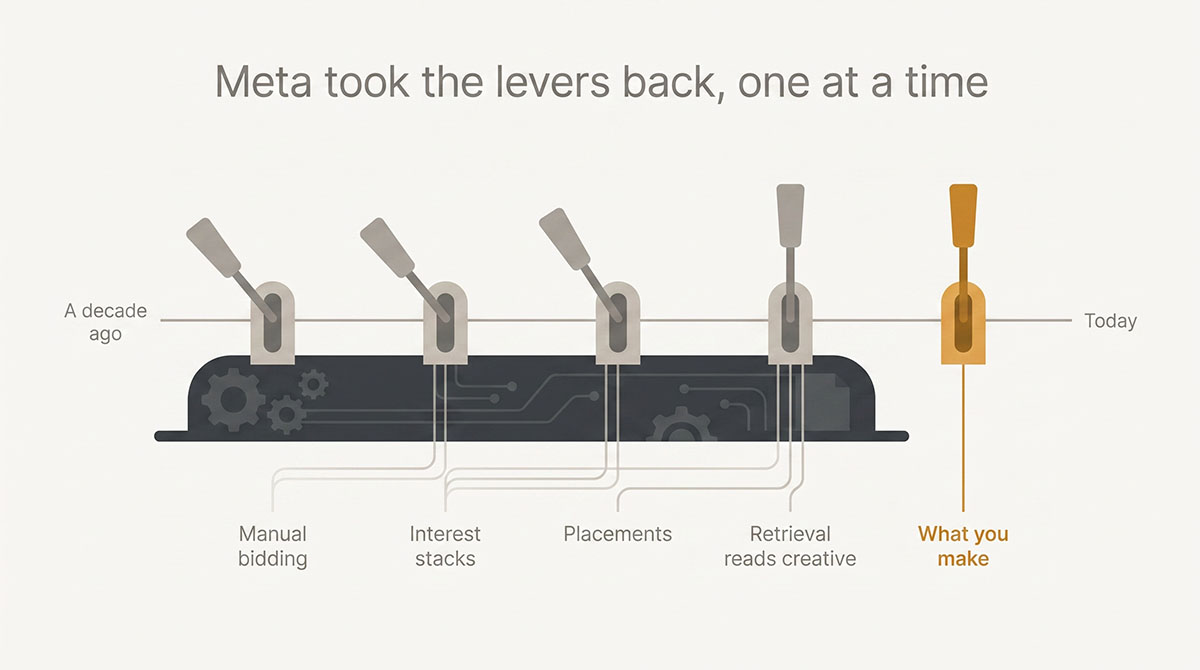
Then, in late 2024, Meta rebuilt the system that decides which ads even get considered. I’ve pulled that engine apart elsewhere. What matters here is what it did to the job.
The new engine reads the ad itself. Then it decides – before any auction your bid could win. Your creative stopped being the thing you target people with. It became the thing you target people by.
I watched that land in one of our own accounts recently. We scaled a winning video the textbook way – new hero product, new actor, new script, a full reshoot. The machine looked at it, decided it was the same idea as the ad already running, and starved it.
Both ads sat there marked Active. Only one was really in the game. And no setting in that account could have fixed it, because the decision got made on the creative, upstream of every lever we had.
So the settings expert woke up managing a machine that didn’t need managing. The best-paid skill in paid media had quietly turned into supervision.
Something was going to grow back in that space. The industry gave it a name.
"A great buyer still outperforms"
If you’ve got a good media buyer, you’re already arguing with me.
And you should. A great buyer still beats a bad one. Tracking, account structure, budget discipline, knowing when to leave the thing alone – none of that vanished. Bad tracking still wrecks accounts. And “creative is everything now” does sound suspiciously like something the creative industry would say about itself.
So don’t watch the buyers. Watch the gap.
Ten years ago, the distance between a competent operator and a brilliant one was enormous, because brilliance had hundreds of levers to show off through. Now? Everyone’s bidding is automated. Everyone’s audiences are broad. Everyone’s placements are algorithmic. Stand two competent operators side by side and their settings converge. The machine sees to that.
What won’t converge is what they made.
The variance didn’t shrink. It moved. Out of the settings, into the ideas.
And you don’t have to take my word for it – read the job market. Motion, the creative analytics platform half the industry runs its reporting through, now publishes a guide calling the creative strategist the most critical role in performance marketing today. But the louder signal is in the listings themselves: creative strategist roles asking for three or four years of media buying experience.
Read that again. The feeder stock for the new job is the old job.
Nobody’s hiring wordsmiths for this. They’re taking their settings people and retraining them to decide what gets made. The buyers followed the money, and the money followed the variance.
So what does a real one actually do?
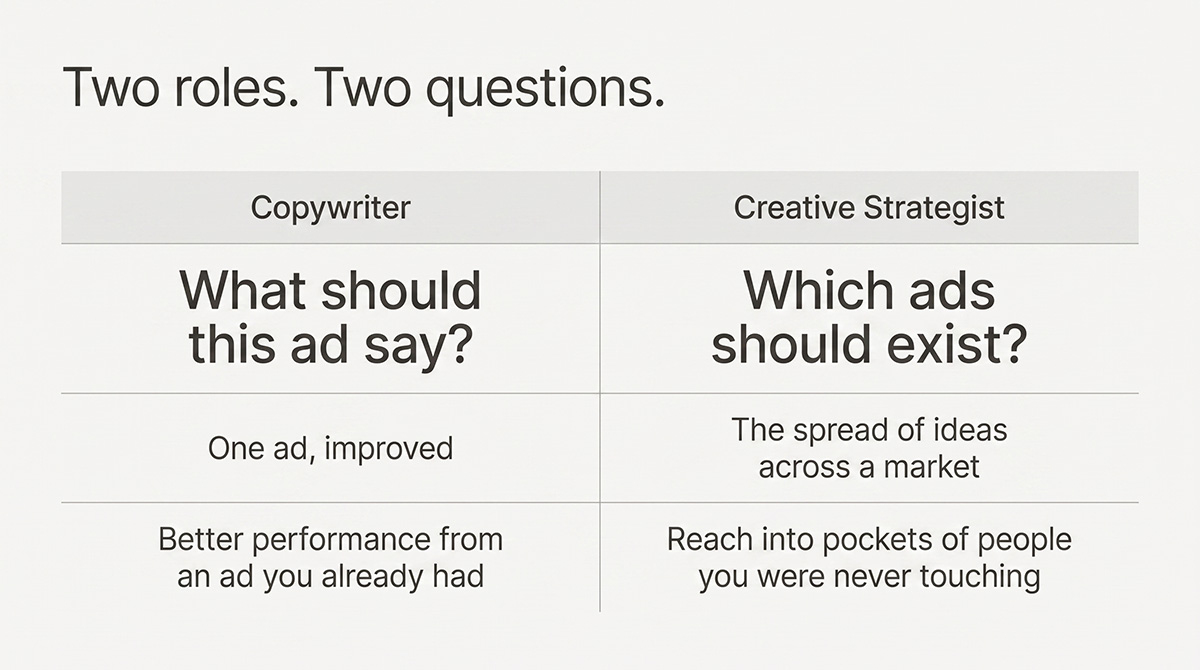
Two roles. Two questions.
A copywriter asks: what should this ad say?
A creative strategist asks: which ads should exist? Which arguments, aimed at which people, in which formats – so your account covers a market instead of crowding one corner of it.
That’s not a writing job. It’s territory.
Think about covering a sales patch. You don’t put five reps in the same postcode and call it coverage. You look at the whole map, work out which pockets are worth showing up in, send someone to each, and watch what comes back. Ads work the same way now – different arguments reach different pockets of people, and the ones you never make are the ones you never reach.
The writing is one input. The allocating is the job.
And it’s the last lever the platform left us. The machine picks who sees what – but it can only pick from what you handed it.
Which raises the question the title never answers: allocate across what? There’s a discipline that answers that, and almost nobody is running it.
Now, the rebranded ones. They’re out there in volume, and the title on the profile tells you nothing. So here’s a test that does.
Show them a winning ad. Ask what comes next.
A copywriter – whatever their headline says – hands you a better version of that ad. A strategist tells you which three different ideas should sit beside it, and who each one is for.
One improves ads. The other allocates them. Both useful. Only one of them is doing the job the algorithm now pays for.
The title changed because the game did
So the copywriter jibe stays half right. Plenty of these people read the room and changed a word on their profile. Titles inflate. That’s not in dispute.
But this one inflated for the oldest reason going: the thing underneath it became the scarcest input in the system.
Meta spent a decade taking back every lever the media buyer was paid to pull, then rebuilt its engine to read the one thing it can’t produce on its own – the spread of ideas you feed it. Strategy didn’t get more important because the industry voted for it. It got more important because everything else got automated out from under it.
So next time that notification lands on a Tuesday – copywriter one month, creative strategist the next – skip the eye-roll and ask them one question. Which ads should exist?
You’ll know inside a minute whether you’re looking at a new title, or a new job.
The title is everywhere now. The job is rare. Only one of them moves your account.
Your marketing, looked at properly
Thirty minutes on your current setup — what’s working, what’s quietly leaking budget, and what I’d fix first. You’ll leave with a clearer picture whether we work together or not.
Got something specific bugging you? Flag it when you book and I’ll have it looked at before we talk.

AboutBruce Marjoribanks
Bruce Marjoribanks has spent 27 years in marketing, including building, running and selling his own agency before going independent. He now runs every channel - paid, organic, social, email, creative and automation - as one integrated system, with AI ehancing production and the judgment staying human.