
The baton comes down. The orchestra swells. Somewhere in the second violins, a string slips flat — just enough to make a trained ear wince. The conductor doesn’t flinch. His arms keep carving the air, elegant and certain, because he has never once played a violin. He can’t hear it. He’s shaping a sound he has no way to judge.
Now swap the orchestra for your marketing.
The most flattering thing the industry is selling right now is that conductor — the senior strategist who sits above the work, baton raised, waving your agencies and freelancers into one harmonious whole while you get back to running the business. A whole category, the fractional CMO, has been built on the image. They’ll tell you they orchestrate your marketing symphony. They’ll cast themselves as the conductor and your specialists as the soloists. It sounds like exactly what a stretched owner wants: one sophisticated brain bringing order to the chaos.
Here’s the uncomfortable part. A conductor who has never played can’t hear when the section is flat. He can only wave the baton and trust the players are good. And “wave the baton and trust the players” is the precise thing you’re paying to escape.
Why the conductor pitch sounds right
Steel-man it, because the appeal is real. Orchestration is a genuine skill. A great conductor holds the whole score in their head, hears a hundred parts at once, and knows the difference between a performance that’s technically correct and one that’s alive. Bringing many moving pieces into one coherent result is hard, senior work. Nobody sensible thinks otherwise.
And the logic that flows from it feels airtight. You’re an owner, not a marketer. You don’t have time to learn paid media, copywriting, email, and analytics. So you hire someone senior to direct the people who do — and you buy yourself out of the weeds. Directing is the high-value work. Doing is for juniors and vendors. Pay for the baton, not the bow.
It’s a clean story. It’s also the most expensive way to keep delegating.
A conductor who's never played can't hear
Here’s what the metaphor quietly admits, if you sit with it. A conductor doesn’t play. That’s the whole definition. They stand above the orchestra and direct — which is fine in a concert hall, where every musician in front of them is a conservatory-trained professional who has already mastered their instrument.
Your marketing is not that concert hall.
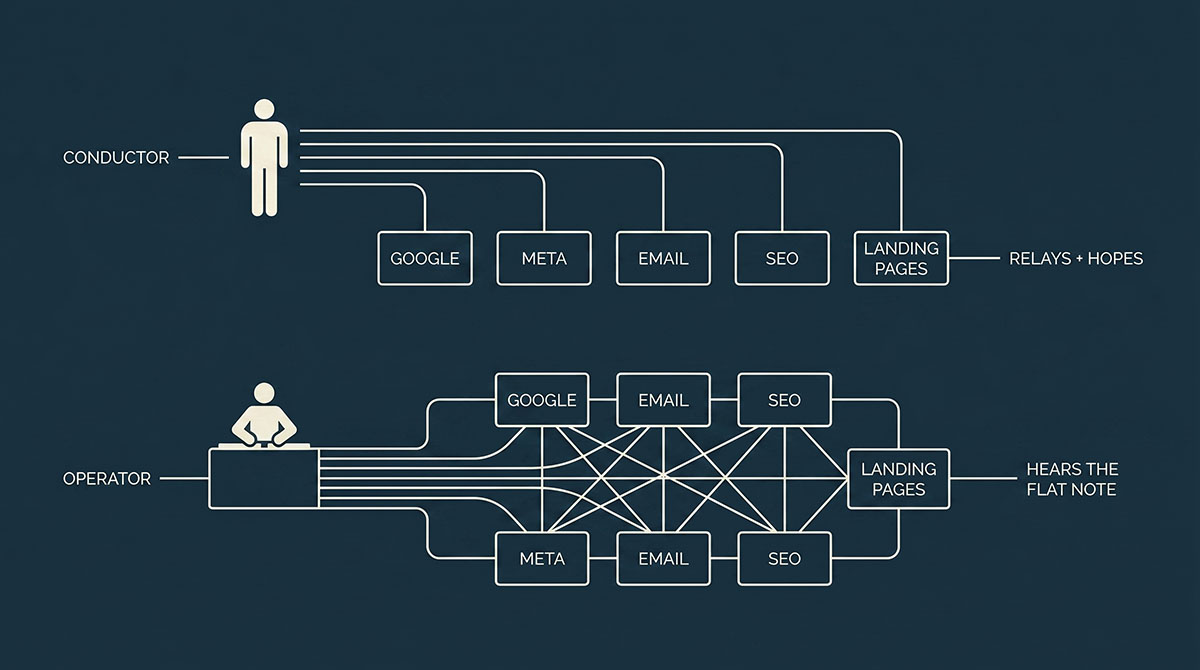
The “players” your conductor is directing are five disconnected agencies, each chasing its own number, none of them able to see the others. You already know how that sounds — you’ve sat in the meetings where the Google agency and the Facebook agency both report “strong results” while your actual revenue sits flat. A conductor who has only ever directed can’t fix that, because they can’t hear it. They’ve never run the campaign, never written the email that flopped, never sat in front of an analytics dashboard at 11pm trying to work out why the numbers won’t reconcile. They can relay the problem between players. They can’t diagnose it. So when the section goes flat, they do the only thing a non-player can do: wave the baton harder and hope.
That’s not leadership. It’s an expensive relay station with good posture.
The operator who still plays every instrument
The alternative isn’t “no direction.” It’s someone who directs and plays. An operator who’s done the work in every section — sat in the paid-media chair, written the email that converted and the one that bombed, built the landing page, read the analytics — and can therefore hear, instantly, when one channel is flat against the others.
That person integrates your marketing for a reason that has nothing to do with org charts. They integrate it because they can hear all of it at once. They know what good looks like in every section, so they can tell when a part is dragging the whole down — and reach in and fix it themselves, not file a ticket and wait.
Concrete version: your paid-search agency reports a glowing return on your own brand name. A conductor sees “strong ROAS” on the slide and nods — the section sounds fine. An operator who’s run search hears the flat note immediately: you’re paying for clicks you’d have gotten free, and the “return” is mostly theater. Same report. One of them can hear it. One can’t.

And this is where 2026 tilts the math toward the operator, not the conductor. The pitch you keep hearing is that AI lets you rise above the work — let the machine play the instruments while you wave the baton. It’s backward. AI doesn’t reward the person who only directs. It rewards the person who can judge the output. Ask a model to write the email, build the audience, draft the analysis, and you’ll get something plausible every time — and sometimes confidently wrong. You’ve seen this: the AI answer that reads beautifully and falls apart the second someone who actually knows the subject looks closely. The operator who’s done the work catches it. The conductor who hasn’t can’t — they can’t prompt it well, and they can’t tell when it’s lying to them. AI makes the player more dangerous and the baton-waver more redundant.
Nobody can be great at everything
Stop there, because you’re already objecting. Nobody can be world-class at strategy and copywriting and media buying and analytics all at once. That’s a unicorn. Try to play every instrument and you’ll play them all badly. The specialist exists for a reason. Right?
Half right. Nobody is elite at all six things at once — true, and anyone claiming otherwise is selling. But “elite at everything” was never the bar. The bar is competent across everything, from having actually done it: competent enough to hear the flat note, judge the work, and integrate the whole.
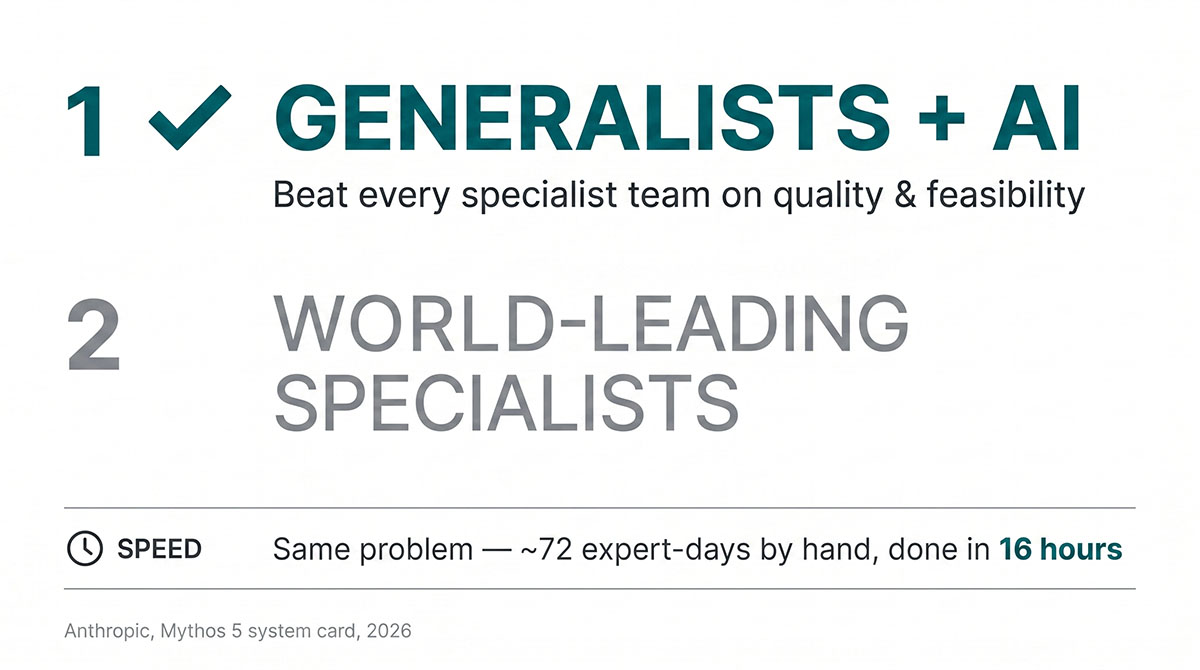
And there’s now hard evidence for how low that bar can sit and still win. In June 2026, Anthropic published the safety documentation for Mythos 5 (the unrestricted version of its public model) and buried a finding inside it that should reframe this whole debate. They split PhD biologists into teams to solve a hard problem — designing a defense against an engineered crop disease. Some teams included world-leading specialists in that exact disease. The others were general microbiologists who’d never specialized in it, armed with the AI. The generalists beat the specialists. Two of three generalist teams outscored every specialist team, on quality and feasibility, finishing in 16 hours what graders said should have taken a specialist 40 to 95 days.
Read that the way it applies to you. The generalists weren’t amateurs — they were competent scientists. They didn’t need to be the world’s foremost expert. They needed to be good enough to direct a powerful tool and judge what it handed back. That’s the operator, not the unicorn. The specialist’s deep-knowledge premium — the thing you’ve been paying five agencies for — is exactly what collapsed.
The unicorn was never the requirement. A competent operator with AI was. And a conductor competent at none of it is, by this evidence, the weakest hand at the table.
Where orchestration genuinely earns its place
The honest concession: there are rooms where the pure conductor is right. A global enterprise with a deep bench of in-house specialists needs someone above them coordinating — the players really are conservatory-trained, and the job really is direction. A genuinely new creative breakthrough, the kind that defines a brand for a decade, still needs a human master, not a competent generalist with a model. AI over-engineers. It states guesses as fact. Left alone, it produces plausible mediocrity. None of that is in dispute.
But that’s not your situation. You’re a growth-stage business spending $5K to $20K a month, scattered across vendors who don’t talk. You don’t have a conservatory orchestra that needs conducting. You have a pile of disconnected parts that needs someone who can play them into one thing. Direction without execution doesn’t fix that. Neither does execution without direction. You need both in one set of hands — which is the entire point.
How to tell which one you're buying
So when you’re weighing up marketing help, stop asking what they’ll oversee. Ask what they can do.
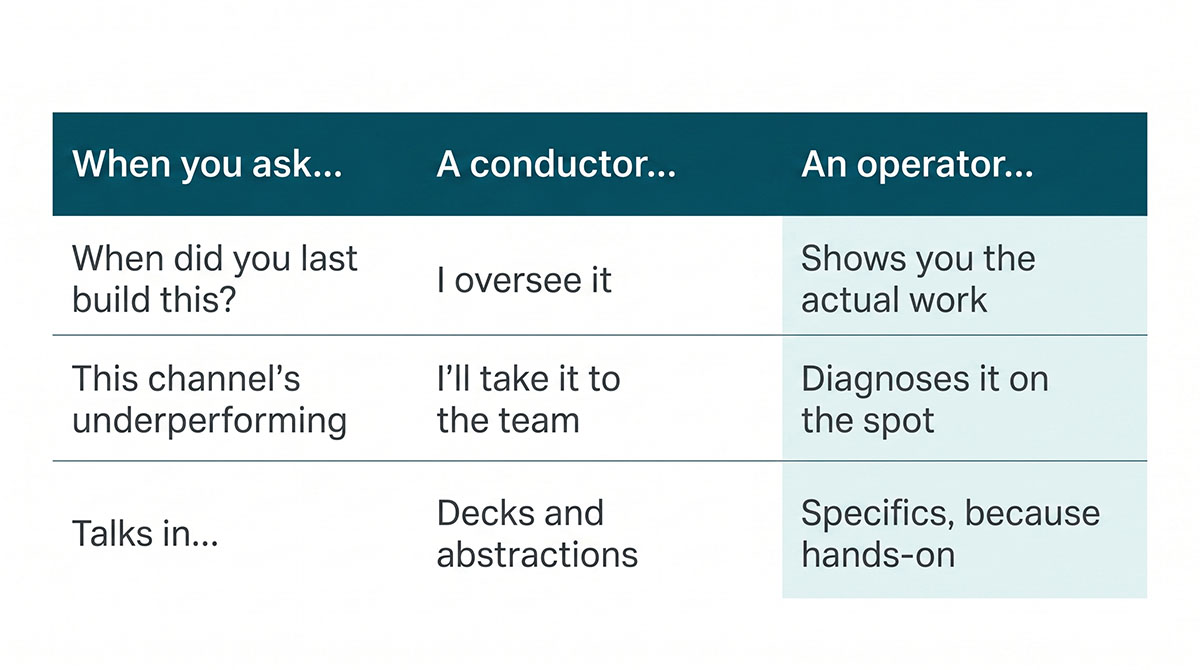
When did they last build the thing themselves — not brief it, build it? Can they show you the actual work, or only the strategy deck about the work? When you describe a channel that’s underperforming, do they diagnose it on the spot, or tell you they’ll “take it to the team”? A conductor answers in abstractions and handoffs. An operator answers in specifics, because they’ve had their hands on it.
It’s why the owners who find this person rarely let go. The ones I work with tended to arrive the same way — agency to agency, worn down, hunting for someone “passionate and capable” who could actually deliver instead of just direct. What they were looking for, without the words for it, was an operator. Someone on the tools.
And you don’t need to find that unicorn, hire them full-time, and pay two hundred grand for the privilege. You need one operator who plays and directs, pointed at your whole marketing — not a baton-waver above five agencies, and not a roster of soloists with nobody who can hear the whole.
The flat note is still playing. In a fragmented setup it plays for months — the duplicate audience, the channel quietly bleeding budget, the campaign that never quite reconciles — because the person you put in charge has never sat in the chair and literally cannot hear it.
Put someone on the podium who spent 10 years in that chair, and they catch it in the first bar. Not because they’re a genius. Because they’ve played the instrument — and you can’t unhear a flat note once you’ve made one yourself.
Your marketing, looked at properly
Thirty minutes on your current setup — what’s working, what’s quietly leaking budget, and what I’d fix first. You’ll leave with a clearer picture whether we work together or not.
Got something specific bugging you? Flag it when you book and I’ll have it looked at before we talk.

AboutBruce Marjoribanks
Bruce Marjoribanks has spent 27 years in marketing, including building, running and selling his own agency before going independent. He now runs every channel - paid, organic, social, email, creative and automation - as one integrated system, with AI ehancing production and the judgment staying human.