
There’s a building in every city you’ve driven past a hundred times. Old bones, new paint. Someone bolted a glass facade onto a 1970s concrete frame and called it “modern.” From the street, it almost works. But the elevators are slow, the wiring can’t handle the load, and the plumbing rattles every time someone turns on a tap. Renovation theatre.
That’s what most agencies did with AI in 2025.
They added ChatGPT seats. They ran prompt-engineering workshops. They plugged Jasper into their CMS and called it transformation. The press releases wrote themselves — ironic, given the subject matter. And on earnings calls, the word “AI” appeared more often than “revenue.”
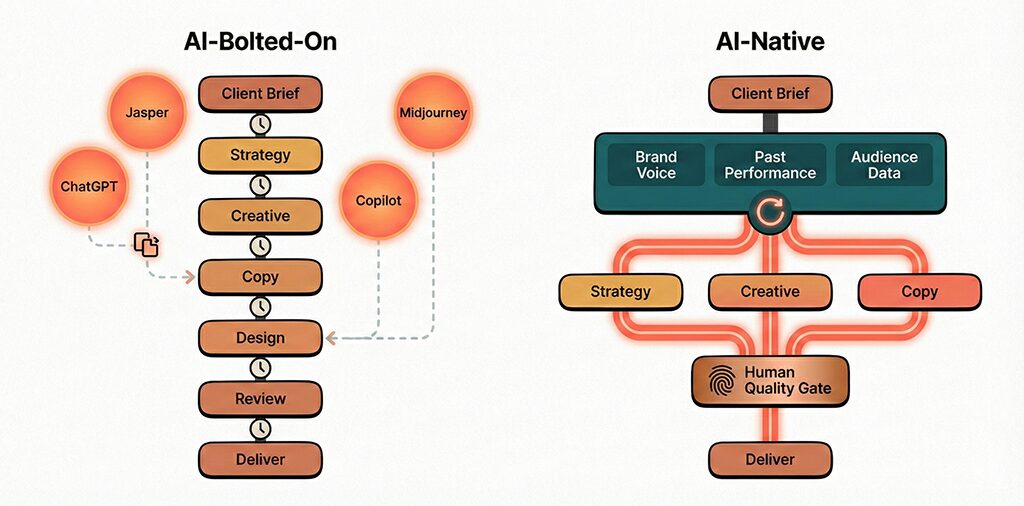
But here’s what happened underneath: nothing changed. The org chart stayed the same. The billing model stayed the same. The six-week production timeline compressed to five weeks, maybe four if nobody was on leave. The AI tools sat on top of the old structure like that glass facade — cosmetic, fragile, and fooling nobody who looked closely.
Meanwhile, Klarna rebuilt the building from scratch.
What "built on AI" actually looks like
Klarna didn’t adopt AI. It reorganised its marketing operation around it.
In the first quarter of 2024 the fintech took $1.5 million out of image production. Annualised, that is a run rate of roughly $6 million. Not by producing fewer images. By producing more of them, through a pipeline where AI generates and human craft refines. Over 1,000 images shipped in that single quarter, each one generated with Midjourney, DALL-E or Firefly.
Their image development cycle dropped from six weeks to seven days.
Klarna reported a further $4 million run rate saving on external suppliers, covering translation, production, CRM and social. That is a 25% cut in supplier costs. Read those two numbers as one story rather than two, because the image work was part of what came back in-house from those suppliers. AI now handles 80% of Klarna’s copywriting through an internal tool the team built called “Copy Assistant.”
Here is how Klarna itself totalled the quarter. AI was responsible for 37% of the sales and marketing cost savings, about $10 million on an annualised basis.
Pause on that. One quarter. One department. Ten million dollars a year of cost pulled out of the run rate while output went up. This isn’t a pilot programme or an innovation lab experiment. It is a company putting its name on its own numbers, in public, in May 2024, fifteen months before it listed on the New York Stock Exchange.
And the detail most people miss. In the same month, Klarna said 87% of its employees were using generative AI daily. They had built over 300 internal GPTs and launched more than 100 AI-driven projects across the organisation. AI isn’t a department at Klarna. It’s the operating system.
The holding companies already got the memo
If Klarna is the proof that AI-native works, the global agency holding companies are the proof that AI-bolted-on doesn’t.
WPP employed 111,000 people at 30 June 2024. A year later it employed 104,000. Seven thousand gone in twelve months, from a business that carried close to 134,000 in 2018. Severance costs hit £86 million. The company is now merging Ogilvy, VML and AKQA into a single “WPP Creative” banner and rebranding GroupM as “WPP Media” — consolidation moves that signal a structure too bloated to survive in its current form.
WPP also signed a $400 million, five-year deal with Google to embed Veo and Imagen models into its platform. They’re rebuilding the engine while the plane is in the air. That’s not confidence. That’s panic with a press strategy.
Now put the two houses side by side on the same basis. In the first half of 2025, WPP’s like-for-like revenue less pass-through costs — its equivalent of net revenue — fell 4.3%. Publicis, which restructured around AI early, grew 5.4% organically over exactly the same period. WPP’s reported revenue fell further, 7.8%, though that figure carries currency moves and disposals inside it. Its share price fell over 60% in a year and the company dropped out of the FTSE 100. Publicis gained. Same industry. Same macroeconomic conditions. Same access to the same AI tools. Radically different outcomes, because one company changed its architecture and the other changed its marketing copy.
The strategic implication is uncomfortable but clear: if WPP, with the resources of a Fortune 500 company, can’t make AI-bolted-on work, the mid-size agency running the same playbook at a tenth of the scale has no chance.
The knowledge base is the moat - not the tool
Here’s where the distinction gets technical, and where most commentary about AI in marketing goes wrong.
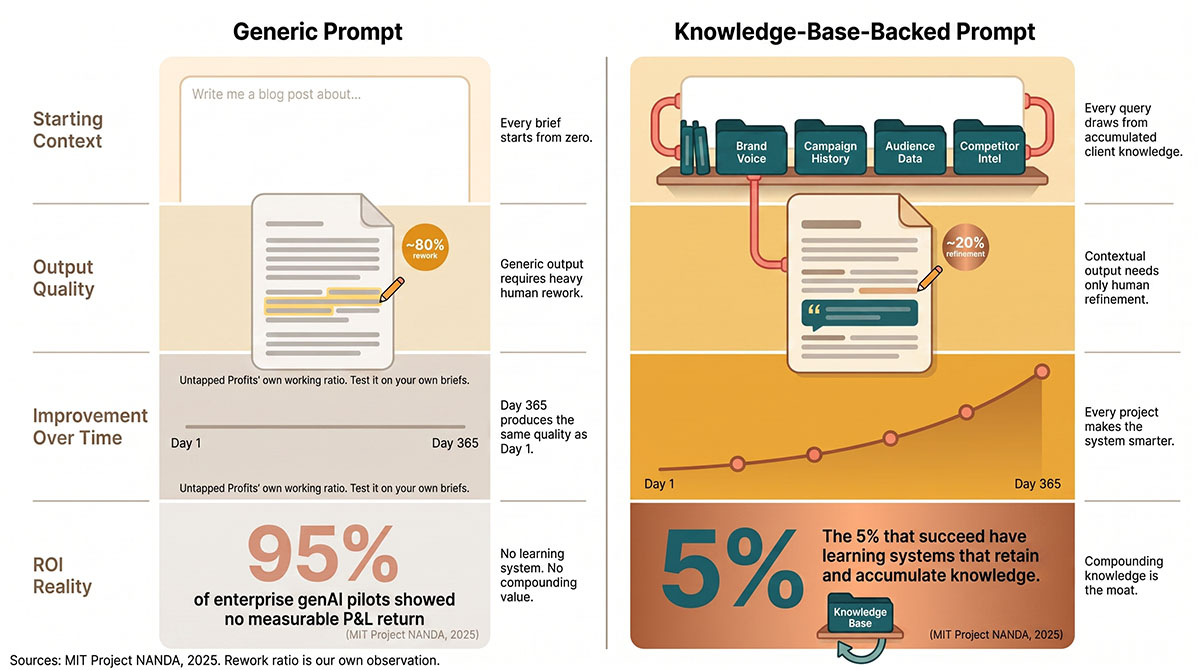
The standard AI workflow at most agencies looks like this: someone opens ChatGPT, types a prompt, gets a generic output, spends an hour rewriting it to sound like the brand, and ships it. Every query starts from zero. No memory. No context. No accumulated learning. Day 365 produces the same quality as day one.
The AI-native workflow is fundamentally different. Every prompt draws from a client-specific knowledge base — brand voice documentation, past campaign performance, audience research, competitor intelligence, creative guidelines. In technical terms, this is Retrieval-Augmented Generation. In practical terms, it means the AI operates as if it’s been on the account for years, because it has. Every campaign adds data. Every result refines the system. The knowledge compounds.
Now a word about the numbers you will see quoted on this, because they are worse than they look. The strongest published benchmark I can find for GraphRAG, which combines vector search with structured taxonomies, puts retrieval precision somewhere in the 80 to 90% range. It was published by Lettria, a company that sells GraphRAG, on an Amazon partner blog. Both parties sell the thing the number recommends. The 95% and 99% accuracy figures circulating in this corner of the market trace back to vendors, or to nobody at all.
You don’t need a benchmark to test the mechanism. You have the account. On our own desk the split runs about 80/20. Output from a cold prompt needs most of it rewritten. Output drawn from a client knowledge base needs a pass, not a rebuild. That is a rule of thumb from doing the work, not a measurement, and the honest version of this advice is to run it on your own briefs for a fortnight and see what your ratio is. The difference isn’t the model. It’s the data underneath it.
"But we're already using AI"
This is the objection that separates the curious from the committed. And it’s the most dangerous one, because it feels true.
Yes, your team has ChatGPT subscriptions. Yes, you’ve cut some production time. Yes, someone on your staff has become the unofficial “AI person” who runs prompts during brainstorms. That’s not AI-native. That’s AI-adjacent. The tools are in the room, but they haven’t changed the room.
Here’s the test. Ask yourself three questions.
Does your AI output improve automatically with every project you complete, or does each brief start from scratch? If it’s the latter, you don’t have a system — you have a subscription.
Could a new hire produce the same quality AI output on day one as your best prompt writer does on day one hundred? If no, your knowledge lives in people’s heads, not in a structured system. That’s fragile.
If you cancelled every AI tool tomorrow, would your org chart, your pricing model, or your delivery timeline need to change? If the answer is no — if the old structure works just fine without the AI — then AI was never structural. It was decorative.
Being AI-native means the business doesn’t function without AI, the same way it doesn’t function without electricity. Not because of dependency, but because every process was designed with AI as a foundational component — not a bolt-on enhancement.
Klarna can’t unwind back to the operation it had. The workflows for that structure don’t exist anymore. That’s what “built on” means.
The trust penalty nobody's talking about
There’s a trap at the other end of the spectrum that’s worth naming: going too AI.
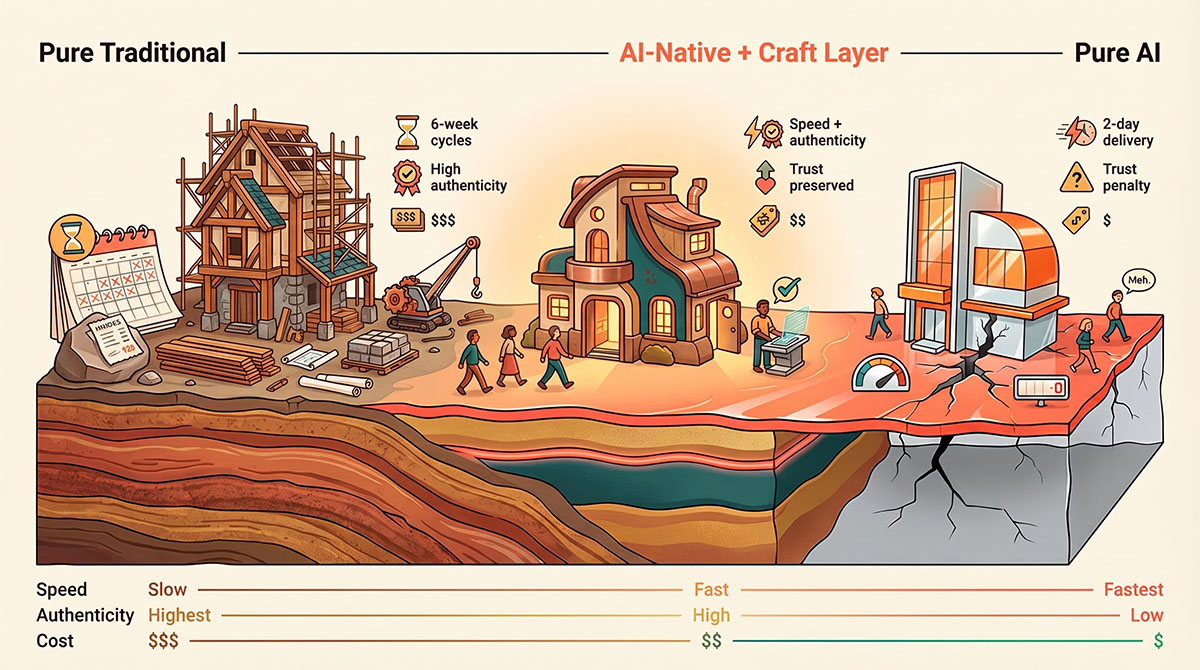
Coca-Cola released an AI-generated holiday ad in November 2024. Viewers called it soulless. McDonald’s took the same treatment for its own AI work more than a year later, in December 2025. Two brands with functionally unlimited creative budgets, a year apart, failing the same test. Authenticity.
The research backs the instinct, and it is better research than most of what gets quoted about AI. Germany’s Nuremberg Institute for Market Decisions surveyed a thousand people each in the United States, the United Kingdom and Germany. Only 20% said they trust AI itself. Only 21% said they trust AI companies and the promises those companies make. The institute then ran controlled experiments on disclosure. When people don’t know content is AI-generated, they may prefer it. The moment AI involvement is disclosed, trust drops.
Sit with the shape of that. The penalty isn’t attached to using AI. It’s attached to being seen to use it badly.
This is the “AI sameness” trap. As creation costs approach zero, “good enough” creative collapses in value. Every agency using AI to produce generic content faster will find themselves in a price war against every other agency doing the same thing. Speed becomes a commodity. Volume becomes noise.
The exit from this trap isn’t less AI. It’s AI with a craft layer.
The pipeline that works isn’t Midjourney → publish. It’s Midjourney → Magnific → Photoshop. Not VEO 3 → upload, but VEO 3 → Premiere Pro. Not ElevenLabs → auto-generate, but ElevenLabs → professional direction. The AI generates at speed. The human craft provides the quality gate that preserves authenticity. The trust layer isn’t a bottleneck — it’s the product.
The regulatory tailwind you're not ready for
One more structural advantage worth naming: governance.
The EU AI Act’s transparency rules took effect on 2 August 2026. They were not postponed, despite the lobbying, and the Digital Omnibus that followed pushed the high-risk obligations out to December 2027 and August 2028 while leaving these ones exactly where they were.
Most of what you have read about what those rules mean for marketers is wrong. Here is the version that survives a look at the text.
The watermarking duty is not yours. Article 50(2) puts it on providers of AI systems that generate synthetic audio, image, video or text, requiring them to mark the output in a machine-readable format. That is OpenAI, Adobe and Google. If you are prompting Midjourney or GPT, you are a deployer, and that obligation runs past you to the company that built the model.
Article 50(4) is the deployer’s article, and it does two things. The one everybody quotes is the text duty, and it is far narrower than the summaries suggest. It applies to text published to inform the public on matters of public interest, and it exempts anything where a natural or legal person holds editorial responsibility. Ad copy, product pages, email subject lines, SEO posts. Outside it on both gates. If someone has told you your blog needs an AI disclaimer to be legal in Europe, they read a summary rather than the Act.
The other half of Article 50(4) is the half that will reach you. Deepfakes must be disclosed. That means any AI-generated or manipulated image, audio or video depicting a real person. A cloned voice. A synthetic spokesperson. A face-swapped testimonial. If one of those is in a campaign, label it.
And under Article 50(3), if you run emotion recognition in an advertising context, creative testing that reads faces or voices, you have to notify the people exposed to it.
Note which way that last one cuts. Point the same technology at your own staff and you are not in disclosure territory at all. Emotion recognition in the workplace is a prohibited practice under Article 5(1)(f). Banned, not labelled.
That distinction is where the money sits. Breaching the Article 50 transparency duties carries up to €15 million or 3% of global annual turnover, whichever is higher. You will see €35 million and 7% quoted for this everywhere. That tier is real, but it belongs to the Article 5 prohibited practices, which is the staff-monitoring version rather than the ad-testing one. Same technology. Roughly two and a third times the exposure, depending entirely on where you point it.
One date gets misreported constantly, so take it off your list rather than adding it. The Digital Omnibus on AI, Regulation (EU) 2026/1744, in force from 27 July 2026, gives providers who had already placed generative systems on the market before 2 August 2026 a four-month transitional period, running to 2 December 2026. That is runway for the model companies to get their marking in place. It is not a grace period for you, and nothing you are running waits on it.
In the UK, the ASA’s Active Ad Monitoring System processed more than 60 million advertisements in 2025, up from 28 million in 2024. This isn’t complaint-based enforcement anymore. It’s proactive surveillance, and it is scaling faster than the agencies it is pointed at.
Agencies using AI informally – no documentation, no provenance tracking, no quality gates – face regulatory exposure they haven’t priced in. An AI-native operation with structured workflows has inherent compliance advantages: every output has a documented chain showing what knowledge base it drew from, what prompt generated it, and what human reviewed it. That’s governance by architecture, not governance by scramble.
The economics have flipped - permanently
The structural shift underneath all of this is simple enough to state in one sentence: headcount has been replaced by leverage as the measure of scale.
My own stack costs about $500 a month and covers work that used to need a small team. I’ll give you my number rather than a borrowed one, because the productivity multiples circulating on this topic almost all come from the people selling the tools that produce them.
Here is one that is independently reported. Kalshi, a financial prediction platform, produced a broadcast-quality NBA Finals video ad in two days for $2,000 in production costs, media not included. That’s a premium broadcast slot, competed for against billion-dollar advertisers, made by a team that would have needed six weeks and six figures under the old model.
The old agency model – lots of people billing lots of hours – is a building with beautiful paint on a crumbling frame. The new model isn’t about having fewer people for the sake of cost savings. It’s about building the operation so that every person is amplified by systems that learn, compound, and improve with every project.
The billion-dollar one-person company that Sam Altman speculated about in early 2024 may still be aspirational. But the million-dollar one-person operation is already here. And the ten-million-dollar lean team is being proven by companies willing to publish their own numbers.
That glass facade on the old concrete building? Drive past it in two years. The scaffolding will be up again. It always is. The buildings that last are the ones where someone bothered to pour a new foundation.
Your marketing, looked at properly
Thirty minutes on your current setup — what’s working, what’s quietly leaking budget, and what I’d fix first. You’ll leave with a clearer picture whether we work together or not.
Got something specific bugging you? Flag it when you book and I’ll have it looked at before we talk.

AboutBruce Marjoribanks
Bruce Marjoribanks has spent 27 years in marketing, including building, running and selling his own agency before going independent. He now runs every channel - paid, organic, social, email, creative and automation - as one integrated system, with AI ehancing production and the judgment staying human.