
The biggest hole in your AI strategy isn't the technology. It's the three-sentence Slack message you used to describe what you wanted.
A business owner walks into a meeting with their designer. The entire creative direction for a campaign that has to deliver the quarter’s leads is one sentence: “Make it pop.”
That is not an exaggeration for effect. In 2012, Irish designers Mark Shanley and Paddy Treacy collected real feedback from real clients, printed it as posters, and hung it in a Dublin exhibition called Sharp Suits. One poster: “I like it…but can the snow look a little warmer?” Another: “We feel that red just isn’t right for Christmas.” Proceeds went to Temple Street Children’s Hospital. Every creative who saw it recognised their own inbox.
Four years later, Digiday’s Copyranter column ran a satirical takedown of the creative brief, ranking it among the worst communication humans have ever produced. The examples in that column were invented for comic effect. The verdict was not. Mark Duffy’s actual thesis: “Briefs serve one purpose, and one purpose only: covering ass.”
You have said some version of “I’ll know it when I see it.” So has every business owner who has ever hired a freelancer or an agency. And until recently it mostly worked out. Not because the brief was any good. Because the person on the other end was experienced enough to fill the gaps. They asked follow-up questions. They interpreted. They presented options and used your reaction to work out what you actually meant.
That interpretation layer was doing the real work. The brief was broken. Nobody noticed, because humans were quietly repairing it in the background.
That layer is disappearing. AI is what replaces it.
The problem you already have, and what happens to it next
Let’s be honest about how briefs work in small businesses.
You are running the operation. You are across sales, fulfilment, staffing and cash flow. Marketing is the thing you know matters and can never give the attention it deserves. So when you need a campaign, an ad, a landing page or a batch of content, you fire off a message. It is quick. It is vague. It is written between meetings or from the back seat of a car.
“Can you do something for our winter sale? Similar vibe to what [competitor] is doing but more us.”
“Need some social posts for the new service. You know the audience.”
“Just make it look professional.”
This is not laziness. It is the reality of running a business with seventeen other fires burning.
Ed Tsue, who runs global strategy on the Google account at WPP Media, described the pattern in a 2023 essay: most briefs are recycled objectives from a conversation, vague audience definitions, and deadlines like “tomorrow.” That is a practitioner’s read rather than a study, and it is worth exactly what a good practitioner’s read is worth. It matches what everyone in the industry sees.
The BetterBriefs Project put numbers to it. Published in 2021 with the IPA, it surveyed 1,731 marketing professionals across 70 countries, and it remains the largest study of its kind. Three in five marketers admitted using the creative process itself to work out the strategy. The brief was so unclear they needed to produce actual work before they could discover what was wanted.
Respondents in that study also estimated that poor briefs and misdirected work could be wasting around a third of marketing budgets. Read that sentence carefully, because it is the one everybody hardens into a fact. It is a self-reported estimate from the people doing the work, not an audited figure, and BetterBriefs sells brief-writing training. Take it as a measure of how bad practitioners believe the problem is, which is still useful.
Run that estimate against a business spending $5,000 a month and you get $20,000 a year. Halve it, because it is an estimate and not an audit, and you still get $10,000. Either number buys a lot of the 30 minutes nobody spent defining what success looked like.
Here is the part that matters. When production was slow and human-driven, you could absorb that waste. It was built into the timeline. The freelancer asked questions. You had a call. They showed you a first draft that was wrong, and the conversation about why it was wrong became the real brief. Three weeks and two revisions later, you had something decent.
That process was slow, messy and inefficient. It was also, in secret, a correction mechanism. The friction was a feature.
AI removed the friction.
Faster, cheaper, and more wrong at scale
Here is what actually changed, using numbers that survive a source check.
CoSchedule surveyed 1,005 marketing professionals between December 2024 and 1 January 2025 for its State of AI in Marketing report. 85% use AI tools for content creation. 84% report that AI improved the speed of delivering high-quality content. That heading bundles two things, speed and quality, into one number, so it is weaker evidence for speed alone than it looks. Image generation returns results in seconds. A campaign’s worth of assets can come out of one afternoon for the price of a subscription.
The speed is real. You have felt it.
The cost of direction has not dropped at all. If anything it has climbed.
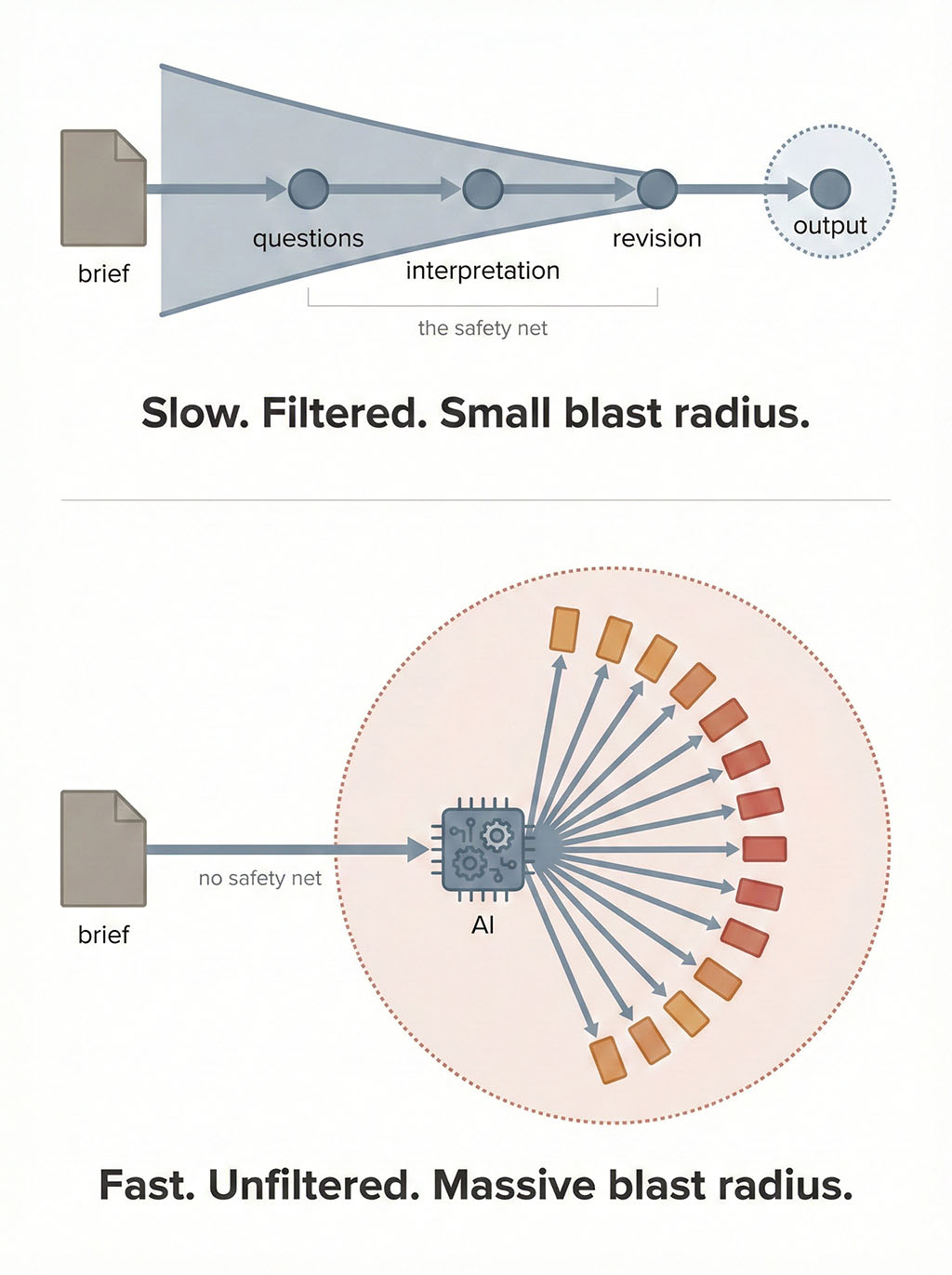
When you sent a vague brief to a human freelancer, the worst case was one wrong deliverable that took two weeks to produce. You saw it, you course-corrected, the next round came back closer. Slow and wasteful, and the blast radius was small.
Feed that same vague brief into an AI-accelerated workflow and you get ten wrong deliverables in two days. A full campaign. Social posts, ad variations, email sequences, landing page copy. All produced at speed. All confidently and precisely wrong. Not wrong in a way you would spot. Wrong in the way that looks professional but misses the audience, misframes the offer, or leads with the wrong benefit. The kind of wrong you do not catch until the campaign has been live a fortnight and the leads are not converting.
CodeRabbit analysed 470 GitHub pull requests, 320 with an AI co-author and 150 human-only, and found the AI-assisted code carried 1.7 times the overall issue density. Logic and correctness problems specifically were 75% more common. Not syntax errors. The code ran perfectly. It did the wrong thing, because the specification was flawed.
Two caveats, and the second one cuts in the article’s favour. CodeRabbit sells AI code review. And authorship was inferred from co-author mentions, which means the human-only set almost certainly contains unlabelled AI-assisted work. That contamination narrows the measured gap. The real one is wider.
The marketing equivalent writes itself: a polished, on-brand campaign that targets the wrong pain point. It looks great. It does not work. And because AI made it cheap to produce, you shipped it before anyone caught the problem.
Workday’s January 2026 global report found that nearly 40% of the time AI saves gets spent again on rework. Hanover Research fielded it in November 2025 across 3,200 full-time employees, all at organisations turning over $100M or more, and all of them already active AI users. So this is not a general population and it is emphatically not small business. It is the people furthest along the adoption curve, reporting on themselves.
The claim is also narrower than it first sounds, and the narrower version is the more useful one. It does not say 40% of your budget vanishes. It says the hours you win back get handed straight to fixing output that should never have been produced. Workday sells AI workforce tools.
Forrester made the same point without the hedging: “AI doesn’t fix bad processes, it amplifies them.” That line comes from a Forrester blog post promoting its own framework rather than from a research report. It is a good line, not a finding.
You did not save money. You spent less producing more of the wrong thing. The mistake is cheaper per unit and ten times bigger in total.
The evidence, with its limits
What the research measured.
And what it doesn’t say.
Every number in this article carries a caveat. Here they are side by side, so you can discount them yourself.
| Source | What it measured | What it does not say |
|---|---|---|
CoSchedule Dec 2024 – Jan 2025 n = 1,005 marketers |
85% use AI for content creation. 84% report faster delivery of high-quality content. | Speed alone. The 84% bundles speed and quality into a single number. |
CodeRabbit 470 pull requests 320 AI, 150 human |
AI-assisted code carried 1.7× the overall issue density. Logic errors 75% more common. | A clean comparison. Authorship was inferred, so the human-only set is likely contaminated.Sells AI code review |
Workday Nov 2025, Hanover Research n = 3,200 employees |
Nearly 40% of the time AI saves goes back into rework. | That 40% of budget is lost. Sample is $100M+ firms, all already active AI users.Sells AI workforce tools |
BetterBriefs 2021, with the IPA n = 1,731, 70 countries |
Three in five marketers use the creative process itself to work out the strategy. | That a third of budget is measurably wasted. That figure is a self-reported estimate.Sells brief training |
Berkeley Haas HBR, Feb 2026 In-progress research |
People using AI worked at a faster pace, took on broader scope, and worked longer hours. | How many hours. Single-site ethnography, roughly 200 people, no control group. |
Left: what was measured. Right, in grey: what the source does not claim. Flagged rows are published by companies selling a related product.
Untapped Profits
"But the whole point of AI is that I don't need to overthink this"
Stop here, because this is the objection that kills small businesses.
The AI sales pitch, the one on every SaaS landing page and in every LinkedIn feed, goes like this. AI handles the execution so you can focus on the big picture. Give it a direction and iterate. Speed wins. Don’t overthink it.
It sounds right. It feels right. It matches the way you already work: fast, intuitive, directional. And it is catastrophically wrong.
“Iterate fast” assumes you know what you are iterating toward. Without a clear brief, meaning a defined audience, a specific message and a measurable outcome, you are not iterating. You are wandering. Each round of output feels like progress because something got produced, but you are circling a target you never named.
The BetterIdeas Project, published in March 2025, surveyed 1,034 people across 54 countries. The average creative idea now takes five rounds of development to reach sign-off. The comparison point is UK-only IPA data from 2007, which makes the three-to-five trend indicative rather than a true time series. The direction holds regardless. Five rounds of rework. At AI speed, that is five wrong campaigns before lunch.
Scope creep is the older and better-documented version of the same disease. The Project Management Institute found that 52% of projects experienced it. That figure comes from Pulse of the Profession 2018, reporting on 2017 data. Nine years old, and still the number everybody quotes, which tells you how little has moved.
In February 2026, Harvard Business Review published in-progress research by Aruna Ranganathan and Xingqi Maggie Ye of Berkeley Haas under the title “AI Doesn’t Reduce Work, It Intensifies It.” Their finding: people using AI moved at a faster pace, absorbed a broader scope of tasks, and pushed work later into the day, often without anyone asking them to.
This is the newest source here and the least statistically robust one. It is an eight-month ethnography inside a single US tech company of roughly 200 people, built on about 40 interviews, with no control group. It cannot tell you how many hours. It can tell you what the pattern looks like from the inside, which is the part that should worry you. The speed does not free you up. It builds a faster rework loop that eats the time you thought you had banked.
Now the arithmetic. You have probably seen a version of this calculation with a tidy dollar figure attached to it. I had one here too, and it does not survive contact with its own source. Workday measured time, not money. Nobody has published a credible figure for what misdirected AI marketing costs a small business, and anyone who quotes you one has invented it.
So do it with your own numbers instead.
Count the campaigns you shipped in the last six months that you would not ship again. Add the hours spent briefing, reviewing, reworking and quietly shelving them. Multiply by what an hour of your attention is worth. That number is yours, it is specific, and it is larger than you expect. It is also the only version of this figure that will hold up when somebody asks where you got it.
What a real brief looks like, and it's shorter than you think
The fix is not a 20-page strategy document. Small businesses do not need more process. They need sharper thinking compressed into fewer words.
Graham Robertson has published worked examples that make the gap visible, built around a fictional cookie brand. His weak objective stacks three goals into one sentence: drive trial, take share from competitors, and get existing customers buying more often. Three objectives, fighting each other for the same budget. His strong version names one goal and one positioning: drive trial on the idea that this is the good-tasting healthy cookie. One objective. One position.
His audience example comes from a separate post written a decade earlier, so treat these as two demonstrations rather than one brief. The weak target: everyone from 18 to 65, including current customers, new customers and staff. That is everyone, which means it is nobody. The strong target: “Proactive Preventers,” suburban working mothers aged 35 to 40 who will do whatever it takes to stay healthy. That is a person. You can write for a person. You cannot write for a demographic bracket.
Richard Holman surveyed the staff of a single company, a TV network, ahead of a workshop in 2019. No sample size was published, and it was not a research programme, so hold the finding loosely. Hold it anyway, because it is the most useful thing in this section: zero percent of respondents thought the briefs they received were too short.
The problem is never too little information. It is too much information with no hierarchy, and no decision about what matters most.
Knowing what a good brief looks like and writing one are different skills. Here is the structure that closes the gap.
The five-part brief: the difference between a prompt and an assignment
A prompt is a question. A brief is an assignment. The distinction sounds semantic. It is not.
A prompt says: “Help me with my emails.”
A brief says: “Audit my 12-email welcome sequence stage by stage. Here is the performance data: open rates, click rates, revenue per send, unsubscribes. Here are three emails that represent our best voice. Identify the three highest-impact changes I can make this week, and draft rewrites for the weakest performers.”
Same person. Same tool. Radically different output.
Context. What is the business? What is the product? Who is the customer? What is the price point? What is working and what is not? The more context you supply, the less generic the output. This is the part most people skip, and it is the part that decides everything. An AI with no context about your business produces content that could belong to any business. That is not a tool failure. It is an input failure.
Objective. What do you actually need? Not “help me with marketing.” Something like “build a 30-day content calendar that drives trial signups, using only topic angles supported by our existing performance data.” Specific enough that you would know whether the output hit or missed.
Constraints. What are the rules? Match this brand voice. Stay under 500 words per email. Welcome sequence only. Constraints make output usable. Without them the tool guesses, and it guesses wide.
Reference material. Upload examples of what good looks like. Your best-performing content. A competitor page you admire. A template you want followed. This is the single biggest lever on quality. Software engineers formalised this decades ago and called it acceptance criteria: specific, testable conditions that define “done” before anything gets built. Not “make it user-friendly.” Instead: “a new visitor can complete a purchase in under three clicks with no account creation.” Your reference material does the same job. It shows the tool where the finish line is.
Deliverable format. Tell it what you want back. A document. A spreadsheet. A list of rewrites with before-and-after comparisons. A prioritised action list ranked by estimated impact. Be specific about the shape of the output and you will spend less time reformatting and more time refining.
Five parts. Fifteen to thirty minutes. Less time than a single round of revisions on a deliverable that missed.
The tools are already forcing the issue
Here is the part worth your attention even if you are sceptical about briefing discipline. The tools themselves are starting to demand it.
On 30 January 2026, Anthropic released a plugin system for Claude Cowork and open-sourced eleven starter plugins at launch, under Apache-2.0, covering sales, marketing, finance, legal, customer support and other business functions. The library has grown since. A plugin bundles skills, slash commands and connections to the tools a role already uses, which turns a generalist assistant into something closer to a specialist. They shipped as a research preview, and every one of them is a set of editable markdown and JSON files: a manifest, connector definitions, and plain-text instructions.
That last detail is the whole point. The plugins are designed to be filled in. What you sell, who you sell to, how your sales cycle runs, what your value propositions are, which objections you hear most. Install one and leave it empty and it produces the same generic output as any other AI query. The intelligence did not change. The brief did.
It feels like onboarding a new hire, which is exactly what it is.
The companies building these tools have arrived at the same conclusion this article is arguing. The bottleneck is not the model. It is the user’s ability to supply context.
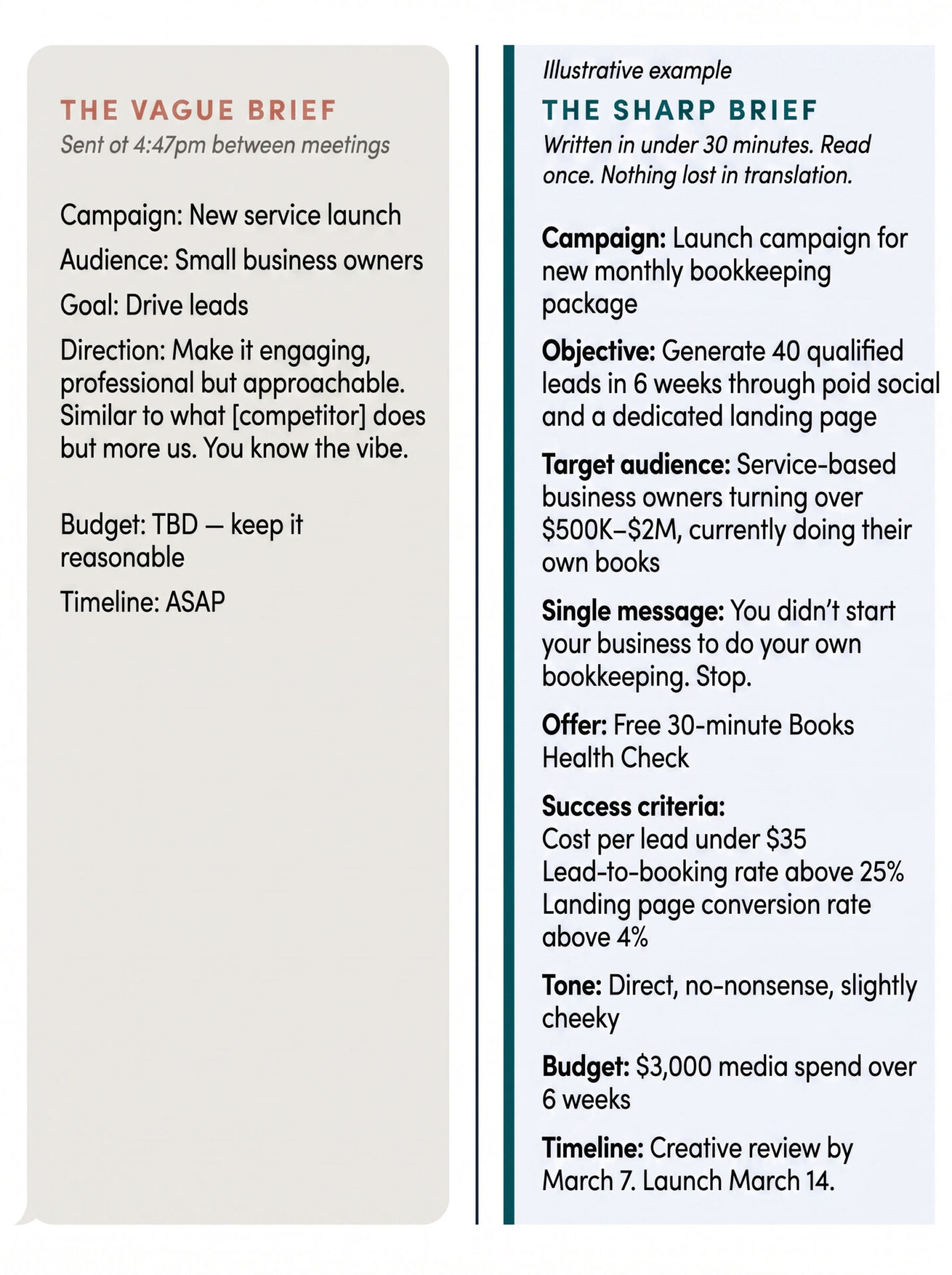
A marketing brief needs the same discipline. Not “make it engaging.” Instead: “Target owners of service businesses with 5 to 20 employees who are running Google Ads but not tracking conversions. One message: you are paying for clicks that never become customers. CTA: book a free audit.”
That is a brief an AI can execute correctly. It is also a brief a freelancer can execute correctly. The difference is that the AI will not ask you the clarifying questions the freelancer would. It will produce something that fits the words you gave it, which means the words have to be right the first time.
The strategist-implementer is the safest model in the room
This is where the real argument lands, and it is not about writing better briefs. It is about who holds the strategy.
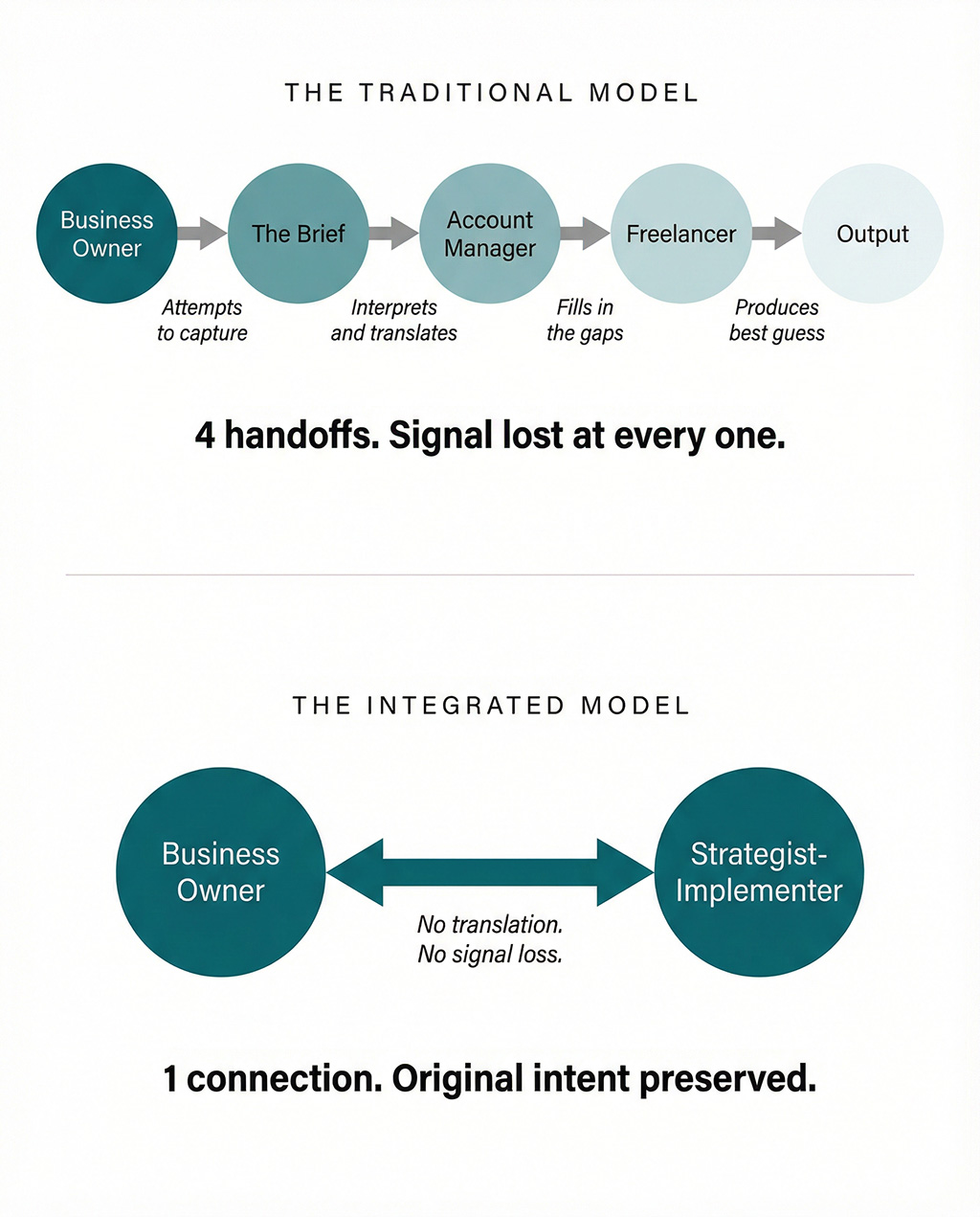
The traditional model works like a game of telephone. Business owner has a vision, writes a brief badly, sends it to an agency or freelancer, they interpret it, they produce work, the owner reacts, rework begins. Every handoff is a point of failure. Every translation loses signal. The brief is the weakest link in a chain with too many links.
AI makes every link faster. It does not fix the chain. It gets you to the wrong answer sooner. And the tools that now insist on onboarding you before they will produce anything are proving the same point from the other end. The model works when one brain holds the full picture.
The model that survives this shift is the one with the fewest handoffs. The person defining the audience, the message and the success criteria is the same person directing the execution, reviewing the output, reading the analytics and adjusting in real time. One brain, whole picture. No translation. No telephone. No brief lost in transit.
The software world worked this out first. Specification-driven development treats the written spec as the actual product and the code as an expression of it. Get the spec wrong and no amount of engineering talent saves you, because the machine will build exactly what you asked for.
Marketing works the same way now. The brief is the campaign. The strategy is the deliverable. And the person who can hold both, who knows the business well enough to define the target and has the craft to build the funnel, write the copy, launch the ads and read the data, is doing the highest-leverage work in marketing.
Everyone else is playing telephone. Faster.
The three-sentence Slack message, revisited
“Can you do something for our winter sale? Similar vibe to what [competitor] is doing but more us.”
That brief used to cost you two extra rounds of revisions and one frustrated freelancer. Now it costs you a full campaign. Ads, emails, social, landing pages. All built at speed, all missing the mark, all live before you had a chance to catch the problem. The tools got faster. The brief did not get better. The gap between those two things is where your budget goes to die.
AI did not make the brief less important. It made the brief the only thing that matters.
The question is not whether you can afford 30 minutes to write a proper one. It is whether you can afford not to, or whether you need to find the person who can hold that thinking for you. Someone who does not need a brief translated, because they sit close enough to the business to write it themselves. One brain. The whole picture. No signal lost.
That is not a luxury. In an AI-accelerated world it is the minimum viable strategy.
Your marketing, looked at properly
Thirty minutes on your current setup — what’s working, what’s quietly leaking budget, and what I’d fix first. You’ll leave with a clearer picture whether we work together or not.
Got something specific bugging you? Flag it when you book and I’ll have it looked at before we talk.
Sources
Listed in order of appearance, with the caveats that belong to them.
- Sharp Suits, Mark Shanley and Paddy Treacy, Dublin, 2012. Exhibition of real client feedback. Proceeds to Temple Street Children’s Hospital.
- Copyranter / Digiday, Mark Duffy, 2016. Satirical column. Examples invented for effect.
- Ed Tsue, Global Chief Strategy Officer, Google, at WPP Media. Personal Medium essay, May 2023. Practitioner opinion, not research.
- The BetterBriefs Project, 2021, with the IPA. n=1,731 across 70 countries. The budget-waste figure is a self-reported respondent estimate. BetterBriefs sells brief-writing training.
- CoSchedule State of AI in Marketing, fieldwork December 2024 to 1 January 2025, n=1,005. The 84% figure measures speed of delivering high-quality content, a bundled metric.
- CodeRabbit, 470 GitHub pull requests: 320 AI co-authored, 150 human-only. Authorship inferred from co-author mentions, so the human set is likely contaminated. Vendor of AI code review.
- Workday, global report, January 2026. Fielded by Hanover Research, November 2025. n=3,200 full-time employees at organisations with $100M+ revenue, all active AI users. Measures AI time savings lost to rework. Vendor of AI workforce tools.
- Forrester, blog post promoting a Forrester framework. Not a research report. Year unconfirmed.
- The BetterIdeas Project, 4 March 2025. n=1,034 across 54 countries. The three-round baseline is UK-only IPA data from 2007, so the comparison is indicative, not a time series. That limitation is mine, not one the publishers state.
- Project Management Institute, Pulse of the Profession 2018, reporting 2017 data.
- “AI Doesn’t Reduce Work, It Intensifies It,” Aruna Ranganathan and Xingqi Maggie Ye, Berkeley Haas. Harvard Business Review, 9 February 2026. Labelled in-progress research. Eight-month ethnography at one US tech company of roughly 200 people, about 40 interviews, no control group.
- Graham Robertson, Beloved Brands. Brief dissection, January 2022. “Proactive Preventers” audience example, May 2012. Two separate posts.
- Richard Holman, 2019. Survey of staff at one company ahead of a workshop. No sample size published.
- Anthropic, Cowork plugins, released 30 January 2026. Eleven open-source starter plugins at launch, Apache-2.0, since expanded. Research preview.

AboutBruce Marjoribanks
Bruce Marjoribanks has spent 27 years in marketing, including building, running and selling his own agency before going independent. He now runs every channel - paid, organic, social, email, creative and automation - as one integrated system, with AI ehancing production and the judgment staying human.