
He was twelve minutes into pitching me the new vertical.
A commercial fit-out firm doing roughly $4M a year, mostly office and retail refurbishments in a state capital. The owner had spent the last six months scoping a move into healthcare fit-outs. Clinics, allied health suites, small private hospitals. New brand, new website, new sales collateral, conversations with two industry consultants, a deposit paid on a trade-show booth for early next year.
He had the deck open. Slide eight was the addressable market. Slide nine was the projected revenue ramp. He was midway through slide ten when I asked one question.
“What’s your close rate on the work you already do?”
He paused. Said something like “yeah, I don’t actually know off the top of my head.” Pulled up his pipeline. Counted manually. The number, when he found it, was 18%.
He’s a client. Every number in this piece is his: the revenue, the close rate, the date on the proposal template. He counted that eighteen percent himself, off his own pipeline, while I sat there.
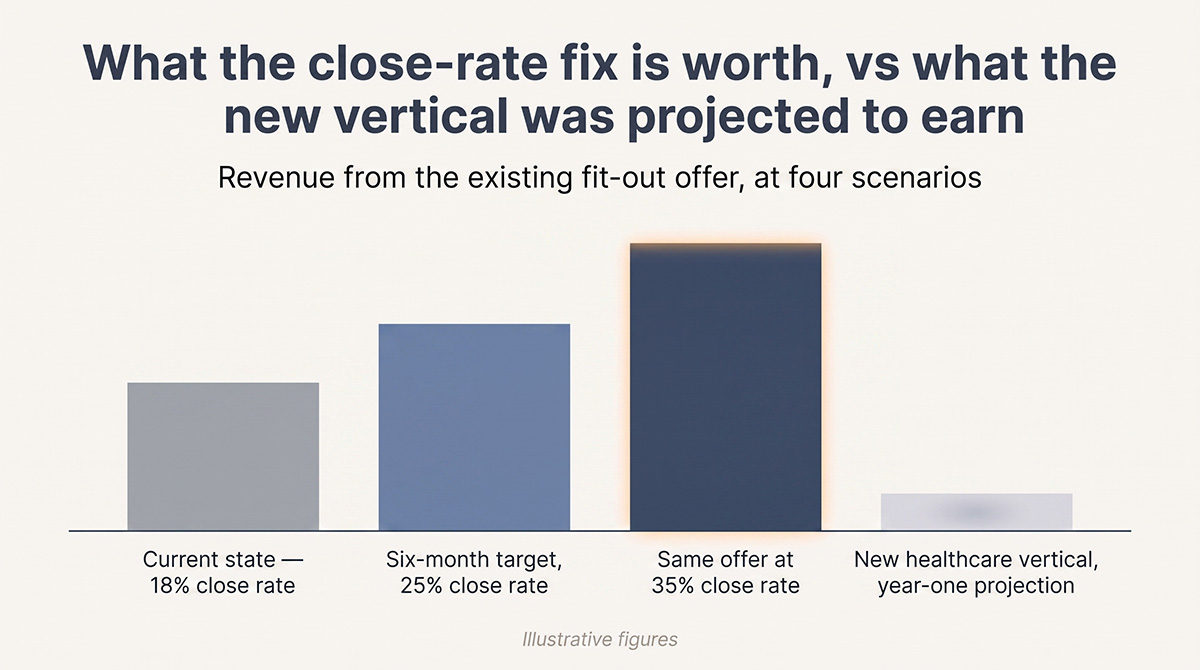
Eighteen percent. On qualified leads from a referral channel that was already producing them at no cost, feeding the same fit-out offer that brings in most of his revenue. For every job he won, he was losing more than four.
Lift that close rate to 35%, which is not a ceiling, just a competent middle, and that one stream produces close to twice what it produces now. Slide nine’s year-one projection for the entire healthcare vertical was a fraction of the difference. No new brand. No new website. No trade-show booth.
He stared at the number for a long time.
The thing in front of you stops being the answer
There’s a pattern I see often enough now that I no longer treat it as coincidence. Successful business owners, the ones with a real offer, real customers and real revenue, almost never bring me their bestseller to look at. They bring me the new thing. The expansion. The diversification play. The pivot.
The bestseller is handled. It’s working. They’ve moved on.
Except they haven’t moved on, because the bestseller is usually still the large majority of the revenue and a larger majority of the profit. They’ve just stopped looking at it. Which, if you think about how attention actually works, is the entire problem.
Unfinished work keeps pulling at you. Finished work stops asking. Maria Ovsiankina showed that in 1928 and the replications have held: people go back to an interrupted task around two thirds of the time, whether or not they remember it any better than a finished one. The new vertical is unfinished. Open loops, missing data, decisions still to make. So it keeps asking. The bestseller is finished. It runs. It produces. It stops asking.
The silence is what makes it invisible.
Unfinished → keeps pulling at you
- The new vertical
- The pivot still being scoped
- The launch you're prepping
- The hire you haven't made
Finished → stops asking
- The bestseller
- The referral channel that produces leads
- The pricing model that's "working fine"
- The pipeline you haven't reviewed in six months
And invisible offers don’t get optimised. They don’t get tested. They don’t get audited. They sit at whatever performance level they reached on the day they went quiet, sometimes for years, while the owner pours their best thinking into things that haven’t yet earned a fraction of what the quiet offer earned in its sleep.
There’s a second mechanism layered on top of the first. Robert Cialdini named it in Influence. Once a person publicly commits to a direction, the consistency drive makes them defend it. Reversing course doesn’t feel like adjusting a plan. It feels like admitting they were wrong about where to look.
Barry Staw put a name to the expensive version of that in 1976. He called it escalation of commitment: the tendency to keep funding a direction precisely because you have already funded it. In the owner’s head, the non-refundable trade-show deposit is not a sunk cost. It is an argument.
So the owner who has announced the healthcare pivot to his team, his accountant and three industry peers isn’t only filtering attention away from the bestseller. He’s filtering away from anything that would make the announcement look premature.
The blunt version: the better an offer performs, the more likely you are to stop seeing it. Success creates the blindness. The closer you are to your gold, the less likely you are to be looking at it.
The conversion math nobody runs on themselves
Here’s what makes this expensive.
When an offer is performing acceptably, the gap between acceptable and competent is almost always larger than the gap between no offer and acceptable offer. Call it half and half, and don’t hold me to the split. The first half of performance is the hard part. You had to build the thing, find the audience, prove the model. The second half is mostly mechanical. Better targeting, better qualifying, better follow-up, better pricing structure, better post-sale handling, plugging the leaks you stopped seeing.
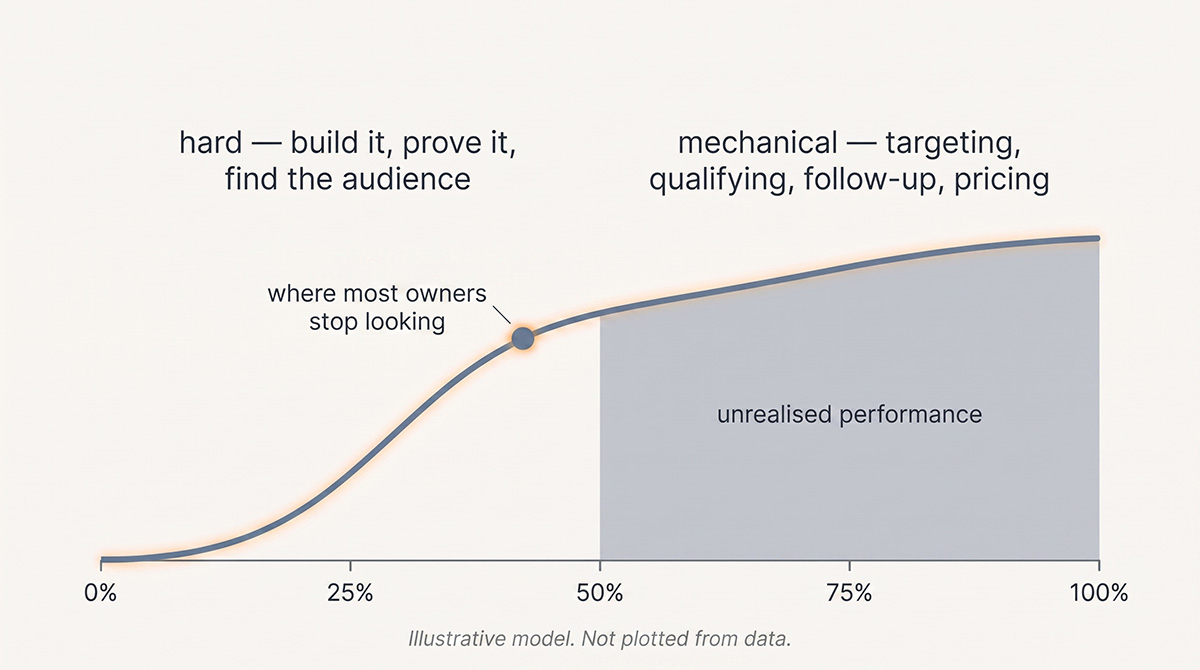
The fit-out owner’s 18% close rate wasn’t a sign of a tapped-out business. It was a sign of an un-audited business. Nobody had looked at it in eighteen months. The lead intake form asked nothing about budget. The proposal template hadn’t been touched since 2022. There was no follow-up sequence past the first quote, so leads that went quiet just disappeared.
None of that is a strategic problem. It’s a maintenance problem. But maintenance work doesn’t get done on offers that have gone quiet, because nobody schedules audits on things they aren’t thinking about.
You’ve experienced the equivalent in your own life. The car runs fine until the day it doesn’t, and the diagnostic reveals three small things that have been worsening quietly for a year, any one of which a five-minute check would have caught. The bestseller is the same. It runs. It produces. Until you actually look at it and find the eighteen percent.
The advice you're getting isn't neutral
Fine. Say the cognitive trap is real.
But you’re not making this decision in a vacuum. Your advisors are telling you to diversify. You’ve heard it from your accountant, your industry peers, the LinkedIn thought-leader whose content you actually respect. Your inbox is full of cold pitches about new channels, new markets, new technology stacks. Most of the business books you’ve read in the last five years have a chapter on the dangers of single-offer concentration.
If everyone outside your business is pointing the same direction, maybe they’re seeing something you can’t see from the inside.
This is the strongest objection to everything I’ve written above, and it deserves a real answer. So here it is.
Notice who benefits from each direction.
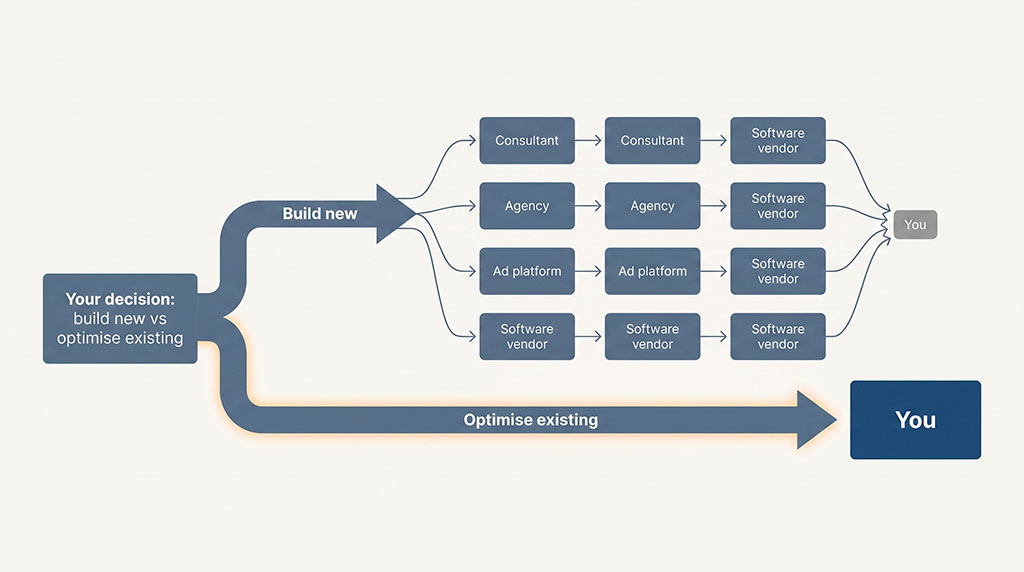
New verticals, new launches, new channels, new positioning, new tech stacks. These pay consultants, agencies, ad platforms, software vendors, course creators, and the entire LinkedIn-announcement economy that runs on owners building things. Optimising the offer you already have pays you. That doesn’t make the diversification advice wrong. It makes it non-neutral. The information environment you’re making decisions inside is shaped by one fact: almost no commercial actor has a financial reason to tell you the answer is sitting in a pipeline report you haven’t opened in eight months.
This is why your accountant, who genuinely has your interests at heart, still ends up nudging you toward diversification. That’s the conversation their professional culture has trained them to have. It’s why your peers ask what are you building? and never what are you scaling? The first question makes for better dinner conversation. It’s why every cold email pitches you on a thing you don’t yet have, never on a thing you already have. The market for new is enormous. The market for make what you already have better barely exists.
When the entire ecosystem around an owner is structured to surface one type of answer and suppress another, the consensus advice isn’t a sign that the consensus is correct. It’s a sign that the answer the consensus suppresses is the one that needs the most deliberate looking-for.
When the new thing is actually the answer
I want to be careful here, because the contrarian version of this argument, always optimise, never build, is just as wrong as the consensus version, and for similar reasons.
There are real situations where the new build is the right call. When the existing offer is in a structurally declining category and no amount of optimisation changes the trajectory. When you’ve genuinely done the audit work and the close-rate, retention, pricing and channel maths all point to a real ceiling rather than an unaudited middle. When the new offer extends the same audience and the same fulfilment capability, so the build cost is marginal rather than from-scratch. When the existing offer is a wedge into a larger problem and the diversification is vertical integration, not lateral leap.
What separates these from the trap isn’t the answer. It’s the order of the questions. Every owner I’ve watched do diversification well started by exhausting the optimisation case first. Every owner I’ve watched do it badly skipped that step because the existing offer was handled.
The order matters because if you haven’t audited the bestseller, you don’t actually know whether you have a ceiling problem or an attention problem. And those two have different fixes.
The diagnostic
If you want to know which one you’re in, three questions.
When was the last time you sat with the conversion data on your existing offer and asked where exactly does this leak? Not the headline number. The stage-by-stage breakdown. Leads to qualified, qualified to proposal, proposal to close, close to repeat. If the answer is not in the last six months, you don’t have a ceiling. You have an attention problem.
When did you last change the offer itself, not the marketing around it, but the offer? Pricing structure, what’s included, what’s guaranteed, the terms, the payment options, the post-sale experience? If nothing has moved in over a year and the offer is still performing, you almost certainly have unrealised performance sitting inside it.
And the question that catches almost everyone: if a competent operator dropped into your business tomorrow and was paid only on improvement to the existing offer, would they have anything to do? If you answered yes, which you almost always will, then so do you. The reason they would find work isn’t because they’re better than you. It’s because they’d be looking at it, and you’ve stopped.
The slide
The fit-out owner closed his deck without finishing slide ten.
We spent the rest of the meeting on the eighteen percent. The intake form. The proposal template. The follow-up sequence. The pricing structure that hadn’t been touched since 2022. The qualification step he’d never built because referrals felt warm enough not to need one. None of it was strategic. All of it was money.
He’s still planning to build the healthcare vertical, eventually. The trade-show deposit was non-refundable. But the order has changed. He’s spending the next six months on the offer he stopped looking at, the one that had been quietly producing most of his revenue while he was working on slide ten.
Thirty-five percent is the target, not the six-month number. Six months should get him to 25%. That’s a lift of about 40% on a channel that brings in something like seven dollars in every ten he earns, which puts the business roughly 30% ahead of where it started. Reach the full 35% and it’s closer to two thirds. The healthcare conversation moves to next year, and the build gets funded out of recovered margin instead of borrowed attention.
The advice nobody gave him was the cheapest advice in the room.
Your marketing, looked at properly
Thirty minutes on your current setup — what’s working, what’s quietly leaking budget, and what I’d fix first. You’ll leave with a clearer picture whether we work together or not.
Got something specific bugging you? Flag it when you book and I’ll have it looked at before we talk.

AboutBruce Marjoribanks
Bruce Marjoribanks has spent 27 years in marketing, including building, running and selling his own agency before going independent. He now runs every channel - paid, organic, social, email, creative and automation - as one integrated system, with AI ehancing production and the judgment staying human.