
I was at a marketing conference last year. Decent lineup, packed room. The presenter—sharp slides, great energy, one-hour slot—spent the first twenty minutes explaining why you should “position your product based on what makes it different, not what makes it similar.”
The audience was scribbling notes like they’d found the Dead Sea Scrolls.
I’d read that exact idea the week before. In an ad David Ogilvy ran in the New York Times. In 1972. The ad cost nothing to read then, and you can find it online in about four seconds now. It’s called “How to Create Advertising That Sells,” and it laid out 38 principles his agency had learned from creating over $1.48 billion worth of advertising. He didn’t hide these ideas behind a conference lanyard or a twelve-week drip sequence. He ran them as an ad. For his agency. And it worked so well that people were still requesting reprints a decade later.
That’s the bit that should make you uncomfortable. The most successful piece of content marketing in advertising history was written before the phrase “content marketing” existed. And the bloke on stage eating up twenty minutes of everyone’s time? He was paraphrasing it.
The plagiarism machine you're funding
Here’s the pattern, once you see it: Someone reads a classic advertising or persuasion book. They update the language, swap “direct mail” for “Facebook ads,” add a few screenshots, and sell it back to you as a proprietary system.
The books cost between $5 and $30. The courses cost between $500 and $5,000. The ideas are identical.
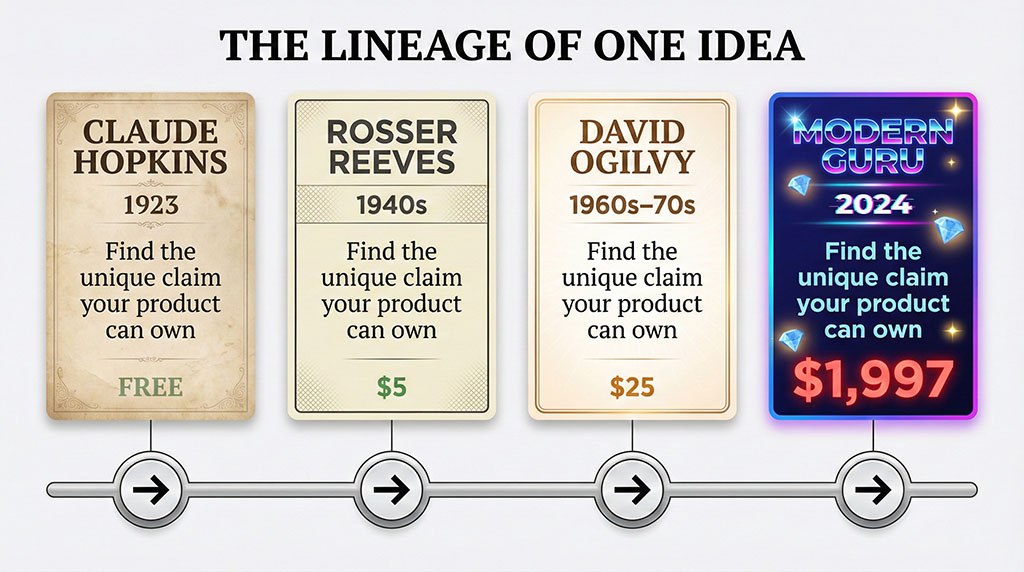
Take positioning. The conference presenter I mentioned was essentially rewording what Ogilvy had borrowed from Rosser Reeves, who coined the Unique Selling Proposition in the 1940s. Reeves got it from Claude Hopkins, who was writing about it in 1923. That’s four generations of the same idea, each one presented with more confidence and less attribution than the last.
Or take John Caples’ ad: “They Laughed When I Sat Down at the Piano… But When I Started to Play!” That ran in 1927. It’s the most famous ad in direct response history. The structure—public doubt, surprising triumph, reveal the secret method—is still running in Facebook feeds right now. It’s been adapted to sell guitar courses, fitness programmes, language apps, singing systems, and about a thousand other things. The framework even has a name in copywriting circles: “Silencing the Doubters.” Same skeleton, new skin, every single time.
Same story with Sherwin Cody’s “Do You Make These Mistakes in English?” from 1919. That ad ran continuously for forty years because the structure—embedded error, diagnosis, superior method—converts so reliably. Today you’ll see the identical framework selling freelance coaching, weight loss programmes, and marriage advice. The headline format barely changes: “Stop Making These [Thing]-Killing Mistakes.”
Or take the entire “info marketing” industry—courses, webinars, lead magnets, the whole ecosystem. Most people assume this started with the internet. It didn’t come close. Ogilvy’s “How to Create Advertising That Sells” was a 1,909-word ad that gave away every trade secret his agency had—and the result was a flood of new clients. He was running a content funnel in a newspaper. In the Nixon era. The format was different. The psychology was the same.
Drayton Bird—who ran Ogilvy & Mather Direct and has probably forgotten more about advertising than most gurus will ever learn—puts it bluntly. He says the definition of advertising hasn’t changed since 1904, when a man named John E. Kennedy walked into a Chicago office above a bar and told Albert Lasker: “Advertising is salesmanship in print.” Lasker hired him on the spot. Their agency became the largest in the world. And that six-word definition still destroys ninety percent of the marketing advice published this week.
What dead copywriters taught me about Facebook ads
I don’t just read this stuff for entertainment. I steal from it. Professionally.
One of the campaigns I’m proudest of started with Bill Bernbach’s Volkswagen ads from the late 1950s. If you’ve studied advertising at all, you know them—”Think Small,” “Lemon”—DDB’s work for VW was voted the greatest ad campaign of the twentieth century by Ad Age. Bernbach’s team took a small, ugly, foreign car with Nazi-era baggage and made it an American icon. They did it by being radically honest. While every other car brand was screaming about power and luxury, DDB leaned into the Beetle’s weaknesses and turned them into strengths.
I adapted that structure—the self-deprecating honesty, the “here’s why you’d think this is a bad idea, but actually” framework—for a client’s Sunday Drive campaign. Took the bones of a 1960s print ad and rebuilt it for paid social.
That campaign has been running for eight months. Still performing.
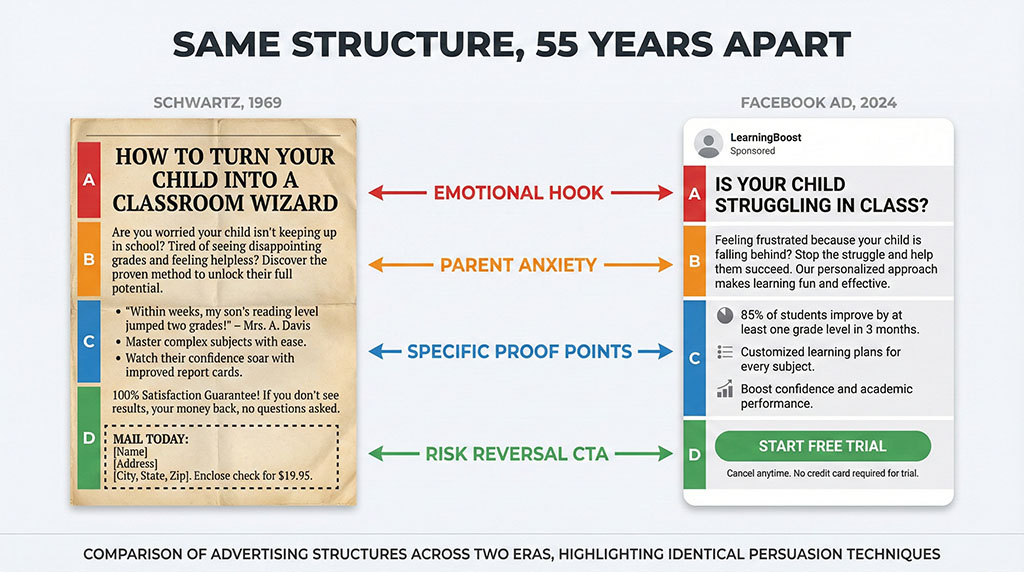
I’ve done the same thing with Eugene Schwartz. He wrote Breakthrough Advertising in 1966—a hardback copy sells for around $350 secondhand because copywriters treat it like a holy text. But Schwartz wasn’t just a theorist. He wrote some of the most successful direct response ads in history. One of them—”How to Turn Your Child Into a Classroom Wizard”—ran as a full-page newspaper ad selling a $5.98 book on study techniques. It opened by agitating every parent’s deepest anxiety about their child’s potential, stacked proof with testimonials and specific page-number promises, and closed with a risk-free offer.
I took that exact emotional architecture—the parent’s worry, the child’s untapped ability, the specific proof points, the risk reversal—and adapted it for a client running an online tutoring service. Different product, different era, different platform. Same psychological structure Schwartz perfected in a newspaper ad decades ago. The campaign ran on Facebook and converted consistently.
None of this is secret. The books are sitting there. The competitive advantage is simply that nobody reads them.
"I don't have time to read books from 1923"
I can hear you from here. You run a business. You’ve got payroll to make, customers to keep happy, and a marketing person who’s supposed to handle all this. You don’t have time to become a historian.
Fair point. Let me dismantle it.
Scientific Advertising by Claude Hopkins—the book David Ogilvy said nobody should be allowed to work in advertising without reading seven times—is 48 pages long. You don’t even need all 48. The chapter called “Just Salesmanship” is a few pages. Drayton Bird says that single chapter will teach you more about advertising than most people in the industry know.
A few pages. Shorter than the last marketing email sequence someone tried to sell you.
But here’s what changed the game for me: you don’t need to become a copywriter to benefit from this. You need to become someone who can spot when their copywriter is winging it. Someone who can recognise whether the expensive agency they’re paying is working from proven structures or just making things up with a nice font.
And now there’s a shortcut that didn’t exist five years ago.
The 10-minute method that replaces a $2,000 course
Here’s what I actually do—and what you can do starting today.
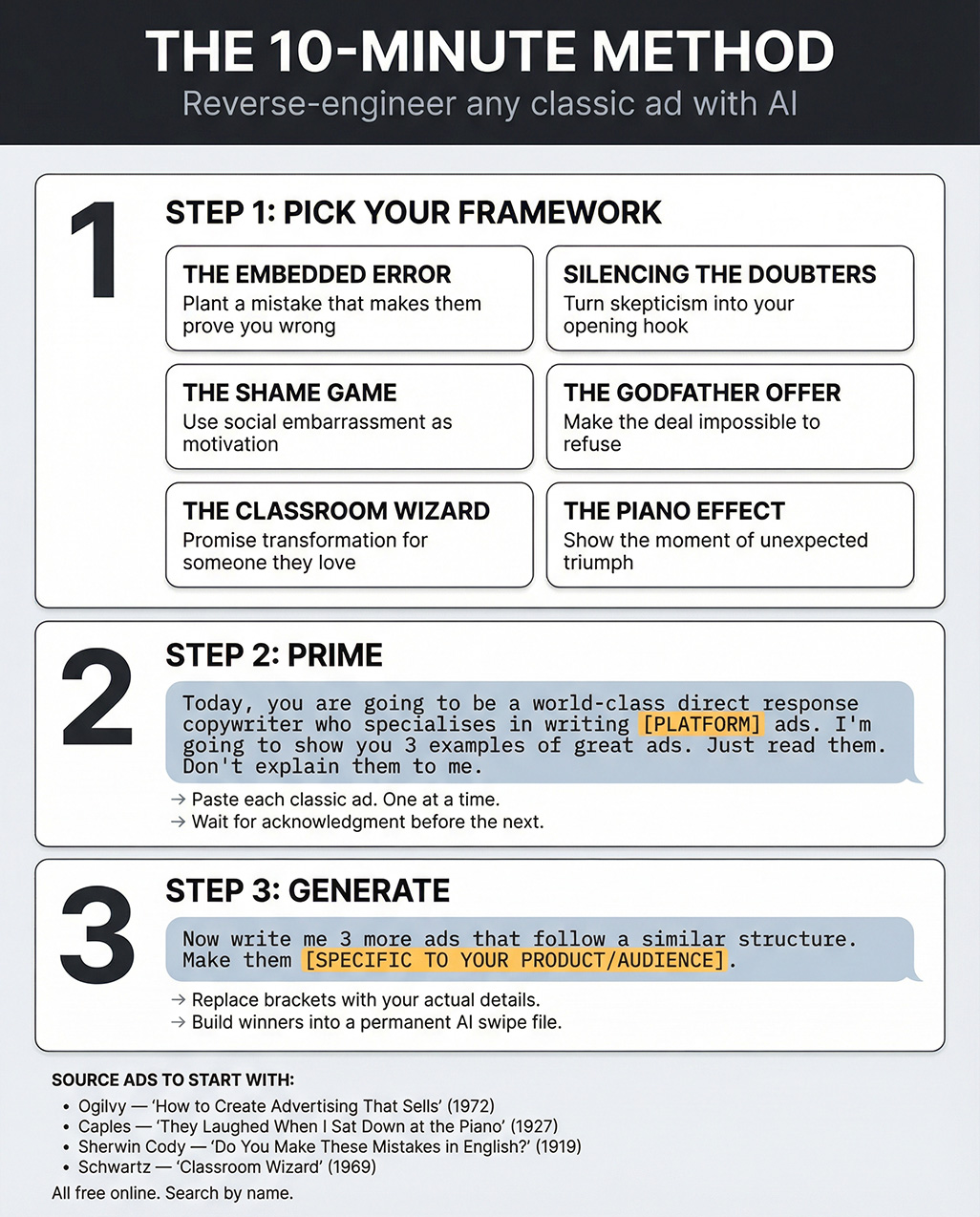
The classic ads aren’t random. Copywriters have catalogued them into named frameworks, each built around a specific psychological trigger. “The Embedded Error” uses the Sherwin Cody structure—provoke self-doubt, diagnose the mistake, offer the fix. “Silencing the Doubters” uses the Caples piano structure—public humiliation, surprising triumph, reveal the secret. “The Shame Game” uses guilt and social pressure. “The Damaging Admission” uses the Avis approach—own your weakness, turn it into an advantage.
There are at least twenty of these named frameworks, each with a different mechanism. And every one traces back to a classic ad that ran profitably for years or decades.
Here’s the method. Find a classic ad that matches your situation—are you trying to diagnose a problem your customers have? That’s The Embedded Error. Trying to make an offer so good it’s hard to refuse? That’s The Godfather Offer. Targeting people who’ve tried everything and failed? That’s The Can’t Get Started.
Then open your AI tool of choice and use this two-prompt structure:
Prompt 1 — Prime the AI:
“You are a world-class direct response copywriter who specialises in writing [your platform] ads. I’m going to show you 3 examples of great ads that follow a classic framework. Just read them. Don’t explain them to me.”
Paste each classic ad in. One at a time. Wait for acknowledgment before the next.
Prompt 2 — Generate:
“Now write me 3 more ads that follow the same structure. Make them [specific to your product, audience, and platform].”
What you’ll get back isn’t perfect. But it’s built on a framework that has been tested and proven across decades and billions of dollars in spend. You’re not starting from scratch. You’re not hoping your marketing person had a creative day. You’re running on structure.
You can go further. Build your best classic ads into an AI knowledge base—a permanent swipe file your tools draw from every time you need copy. Over time, you’re stacking frameworks: one for lead generation, one for objection handling, one for re-engagement. You’re essentially giving your AI the same education that cost agencies millions in trial and error over the last century—except you’re doing it in an afternoon.
This is the bit the course sellers don’t want you to figure out. The knowledge isn’t scarce. It never was. It’s just old, and old doesn’t sell webinars.
Where the gurus are actually right
I’ll give credit where it’s earned. Not every modern marketing course is a scam repackaging old ideas.
The good ones do something genuinely useful: they translate principles into current platforms. They show you where to click in Meta’s ad manager. They walk you through the specifics of a 2026 algorithm. That execution-level detail has real value, and you won’t find it in a book from 1923.
The problem isn’t modern education. The problem is paying $2,000 for strategy when the strategy was published for free decades ago—then another $2,000 next year when the same guru repackages the same strategy with a new name.
If you know the fundamentals, you can evaluate whether a course is teaching you execution (worth it) or just rewording Hopkins (not worth it). The old books aren’t a replacement for modern tactics. They’re your filter for separating the teachers from the plagiarists.
Your $15 insurance policy (or free, if you own a library card)
Here’s your reading list. Five books. Total cost: less than a single month of most marketing subscriptions.
Scientific Advertising by Claude Hopkins (1923). Read “Just Salesmanship.” Then read the rest. It’s 48 pages. No excuses.
Ogilvy on Advertising by David Ogilvy (1983). Every page has something you can use tomorrow. And search for his “How to Create Advertising That Sells” house ad—it’s the original content marketing playbook.
Breakthrough Advertising by Eugene Schwartz (1966). A secondhand hardback goes for around $350—copywriters have turned it into a collector’s item. But here’s what nobody tells you: your local library can order it for free. The concepts on awareness levels and market sophistication will change how you think about every ad you run or approve.
Tested Advertising Methods by John Caples (1932, updated). The man who wrote “They Laughed When I Sat Down at the Piano”—an ad so effective that its framework is still being adapted for Facebook nearly a hundred years later. The grandfather of split testing. Every A/B test your agency runs exists because of this man. Again—library. Free.
The Robert Collier Letter Book by Robert Collier (1931). The chapter on understanding your reader’s existing desires—before you try to sell them anything—is worth more than most customer research tools. And yes, the library.
Read these, and the next time someone tries to sell you a “revolutionary new framework,” you’ll recognise where they found it. That recognition is worth more than any course. You’ll keep the $2,000. And you’ll have something better than a guru—you’ll have the sources they’re copying from, a method to apply them using AI, and the ability to tell the difference between someone teaching you and someone plagiarising at you.
That conference presenter? I’m sure he’s a decent bloke. But I sat through twenty minutes of Ogilvy without attribution—and the audience thought it was brand new. I don’t blame him. I blame the fact that nobody in that room had read the original.
Don’t be that room.
Your marketing, looked at properly
Thirty minutes on your current setup — what’s working, what’s quietly leaking budget, and what I’d fix first. You’ll leave with a clearer picture whether we work together or not.
Got something specific bugging you? Flag it when you book and I’ll have it looked at before we talk.

AboutBruce Marjoribanks
Bruce Marjoribanks has spent 27 years in marketing, including building, running and selling his own agency before going independent. He now runs every channel - paid, organic, social, email, creative and automation - as one integrated system, with AI ehancing production and the judgment staying human.