
The quarterly report landed with a thud. Forty-seven slides. Impressions up 340%. Engagement rate: “industry-leading.” Blog traffic doubled.
The business owner sat quiet for a beat. Then asked the only question that mattered.
“How many of these people bought something?”
Silence. The kind that costs $8,000 a month.
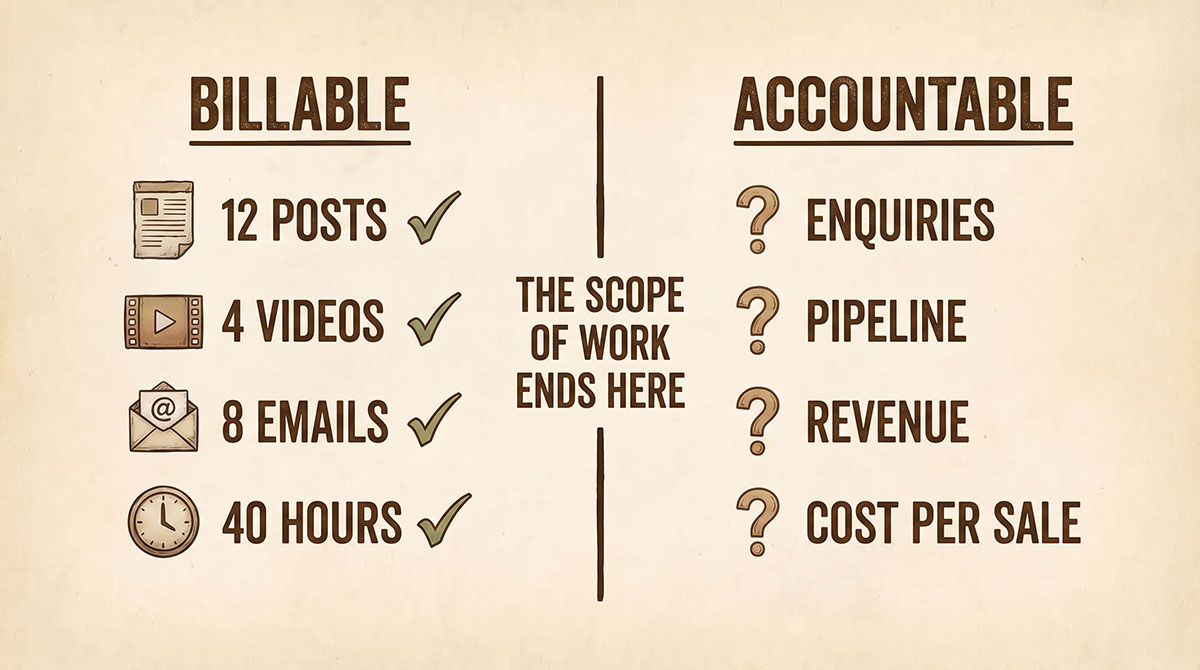
Here’s the part worth sitting with: nobody in that room was dodging. Every person on the call had done exactly what they were paid to do. Twelve posts. Four videos. A newsletter, twice a month. Delivered, on time, to spec. The buying question sat outside the scope of work, so nobody had prepared an answer.
That’s not a character problem. It’s an invoice problem.
What a marketing retainer actually buys
Open any content agreement — agency, freelancer, or the internal brief you wrote yourself. It’s a list of units. Posts per month. Videos per quarter. Emails per send. Hours.
Units get priced because units get counted. At the end of the month, both sides look at the same list and agree the work happened. No argument. No judgement call. The invoice matches the deliverables and everyone moves on.
Sales don’t arrive in units. They land late, from a mix of touches, in numbers that swing for reasons nobody fully controls — a competitor’s price change, a slow quarter, a salesperson on leave. Try writing that into a monthly scope of work. You can’t, so nobody does.
So the contract prices the one thing that can be counted, and the work follows the contract. That’s not cynicism. It’s arithmetic. Pay for output and you will receive output, from good people, in full, forever.
The one part of the job that can fail in public
Producing content that doesn’t ask for the sale is the safest work in marketing. There’s no rejection. No conversion rate staring back at you. Just a steady stream of posts, carousels, and “thought leadership” that looks busy, feels productive, and never has to prove it made the phone ring.
Adding the ask changes that. A call to action is the only element on the page with a number attached — it either moved people or it didn’t, and the report says which. Publishing has a 100% success rate. Asking doesn’t.
Now hold those two facts next to each other. The work is priced on output. The ask is the only component that can visibly miss. Removing it costs nothing and protects everyone. It disappears, replaced by a vague “follow us for more,” and not one person had to decide to do it.
Drayton Bird — of whom David Ogilvy said, “Drayton Bird knows more about direct marketing than anyone in the world” – has spent six decades on a single instruction: do a complete selling job. Every reason to act, stated. Every objection, answered. Then ask. Most published content does the first half beautifully and stops one step short of the point.
"But content marketing generates three times the leads for 62% less"
Push back here. You should.
You’ve seen that stat. It sits in almost every content pitch deck written since 2015. Follow it back and it lands on an infographic published by Demand Metric — and it has been recirculated so widely that outlets now credit the same numbers to different originators, sometimes HubSpot, sometimes the Content Marketing Institute.
The industry’s most-cited proof that content sells is a graphic, produced by a vendor, whose sales it was made to support.
That’s this whole problem in miniature. The stat was cheap to produce, impossible to fail at, and has never once had to demonstrate that it moved a customer. It got recited instead of tested. Ten years on, it’s still working — as content.
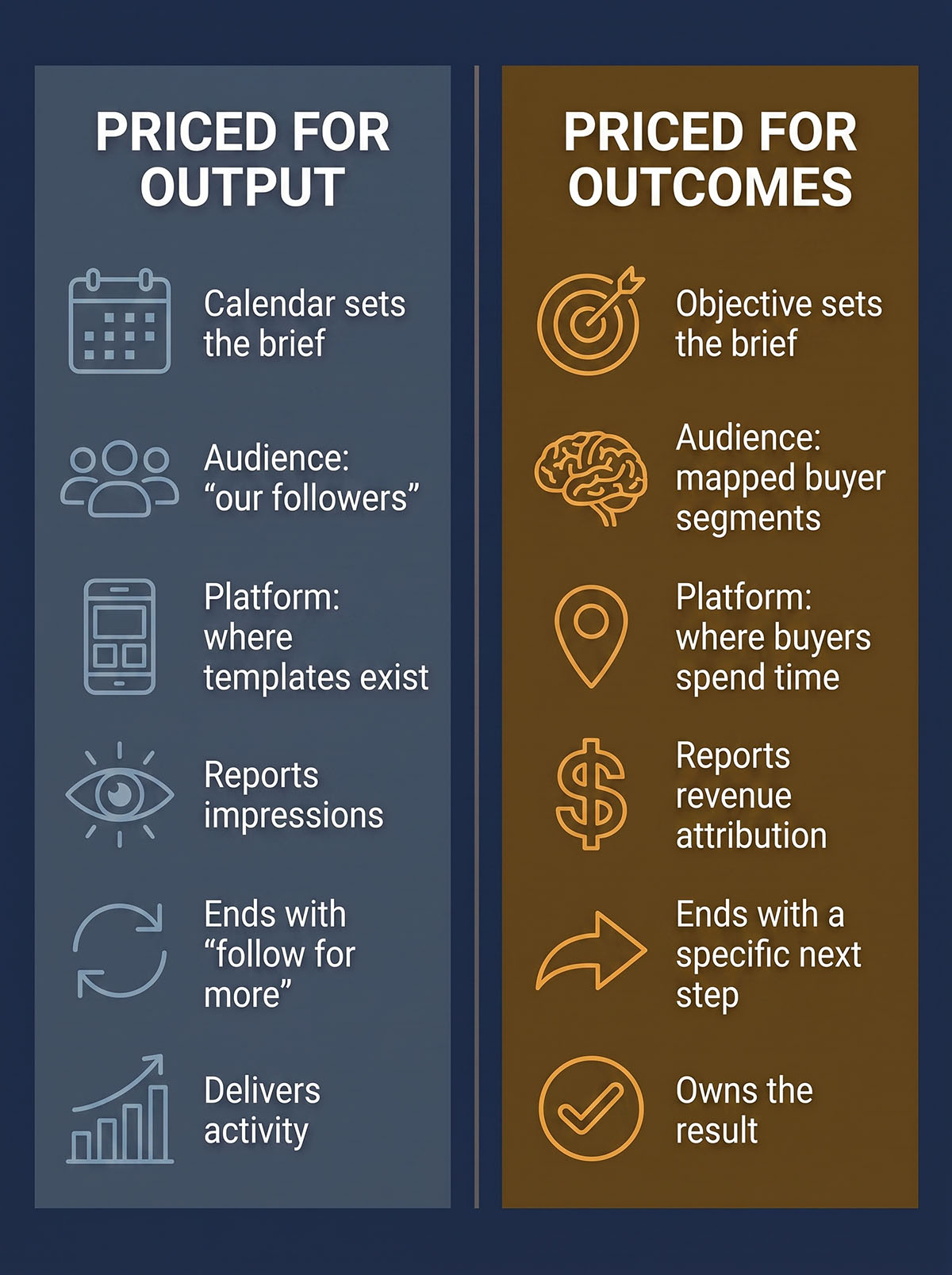
None of which makes helpful content wrong. It makes “we’re doing content marketing” an empty sentence. The businesses where content genuinely produces revenue aren’t creating content. They’re running a sales system that uses content as its medium. They know which objective each piece serves. They’ve mapped buyer pain to a stage of the buying cycle. They chose the platform because buyers are there, not because there’s a template ready to go. And they measure whether someone moved closer to purchase, not whether they liked something.
The businesses where it fails — most of them — are the ones where twelve blog posts a month get scheduled, a traffic report gets sent, and the arrangement is called a strategy. Activity dressed as strategy. It costs a fortune.
What content marketing that sells actually requires
Three layers. All three are harder to bill than a post count, which is exactly why they go missing.
An objective per piece. Before a word gets written: which business outcome does this serve – enquiries, pipeline, direct sale? Who specifically, and what makes them care this month? Which platform puts it in front of that person while they’re receptive? Without those answers you’re not planning. You’re filling a calendar.
A job description per piece. Not “raise awareness.” Something you can fail at: drive enquiries from mid-market operators reviewing their marketing spend. When the person writing is also accountable for whether it produced revenue, the copy sharpens and the fluff evaporates. The 2,000-word post that should have been a 400-word email with a booking link never gets commissioned.
Measurement that runs to money. Not impressions. Not engagement rate. At minimum you should be able to trace the path from a published piece to an enquiry. If your analytics can’t show that journey, you’re measuring the wrong things – and nothing in the arrangement makes anyone fix it, because vague metrics survive a slide deck and specific ones don’t.
Before your next content meeting, ask one question – of whoever produces the work, including yourself: which business objective does each piece this month serve, and what number tells us it worked? If the answer needs the words “awareness” or “engagement” to stay upright, you’ve found the problem.
Five contracts. Five scorecards. Nobody holding the outcome.
Most businesses don’t have one content arrangement. They have five — a Google Ads specialist, a Meta buyer, an SEO consultant, an email team, a freelance writer for the blog. Five scopes of work. Five sets of countable deliverables. Five invoices that can each be justified in isolation.
Not one of them is priced on the same outcome.
I’ve sat in those meetings. The Google Ads person blaming Meta for stealing conversions. The email team calling the ad traffic garbage. The landing page designer who hasn’t seen the ad creative. Everyone presenting their own metrics in their own format, nobody owning the result. After the fifth time you watch it — same dysfunction, different company — you stop calling it a coordination problem. It’s a pricing one.
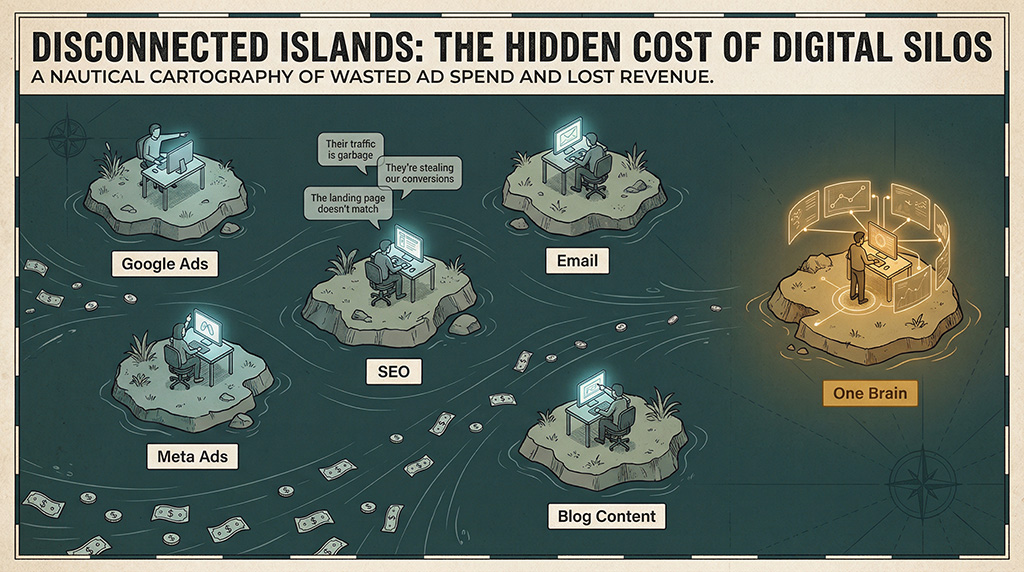
In that setup, “content strategy” becomes a scheduling document. The social posts don’t reference what the ads are running. The email sequence ignores what the blog just published. SEO chases traffic the landing page can’t convert because the message doesn’t match the creative.
Everyone’s producing. Nobody’s selling. And nobody’s breaking the deal — each one is delivering precisely what was bought.
Collapse that into one arrangement, priced on one commercial outcome, with one person accountable for the whole journey, and the work changes without anyone being asked to try harder. The ask reappears. The measurement gets specific. Content stops being an item on a schedule and becomes the medium the selling happens in. The full case for that structure is in 12 reasons to hire an AI-powered generalist instead of an agency of specialists.
Back in the conference room
Same quarterly meeting. Same business owner. Different report.
Four pages, not forty-seven. Which pieces generated enquiries. Which enquiries converted. Customer acquisition cost by channel. Where the funnel leaked and what got fixed.
The owner looks at the numbers. Nods slowly. Nobody needs to ask whether people bought something – the first page already answered it.
Nothing about the people changed. The line items did.
Your marketing, looked at properly
Thirty minutes on your current setup — what’s working, what’s quietly leaking budget, and what I’d fix first. You’ll leave with a clearer picture whether we work together or not.
Got something specific bugging you? Flag it when you book and I’ll have it looked at before we talk.

AboutBruce Marjoribanks
Bruce Marjoribanks has spent 27 years in marketing, including building, running and selling his own agency before going independent. He now runs every channel - paid, organic, social, email, creative and automation - as one integrated system, with AI ehancing production and the judgment staying human.