
It was 38 degrees outside and my house felt like a storage unit. I did what anyone would do — cranked the air conditioner to 16, jammed the fan to max, and stood in front of the vent like it owed me money.
Forty minutes later, the house was still warm. The unit was screaming. I was sweating through a shirt I’d already changed once.
Adding more to a system that isn’t set up properly doesn’t get you more. It gets you strain, noise, and a worse result than you were getting before. The fix is almost never another dial turned harder. It’s finding out which dial was wrong.
I did this for an entire summer. Every hot day, same routine. Crank it to 16. Max fan. Stand there wondering why a ducted system — covering every room in the house, more than enough capacity on paper — couldn’t do its one job. This wasn’t some cheap portable unit. It was a serious system with serious power. And it was barely cooling the hallway.
Then one afternoon, I just didn’t push it. Set it to 18 instead of 16. Dropped the fan to low. Maybe I was tired of the noise. Maybe I’d given up trying to force it. I walked away and forgot about it.
Half an hour later, the house was cool.
Not slightly cool. Properly cool. The kind of cool where the unit barely hums and you forget it’s running. Same machine. Same house. Same brutal Sydney afternoon. Half the effort, twice the result.
I wish I could tell you I understood immediately. I didn’t. It took a few more weeks of accidentally leaving it on the lower setting, noticing the house cooled faster each time, before the pattern became impossible to ignore. The realisation didn’t arrive like a lightning bolt. It crept up like a slow tide.
And when it finally landed, it hit somewhere deeper than the thermostat. The air conditioner wasn’t weaker at 18 degrees. It was better tuned. The difference between a cool house and a warm one wasn’t more power. It was understanding how the system actually worked.
The dial that did nothing and the dial that did damage
Here’s what was happening while I stood in front of that vent.
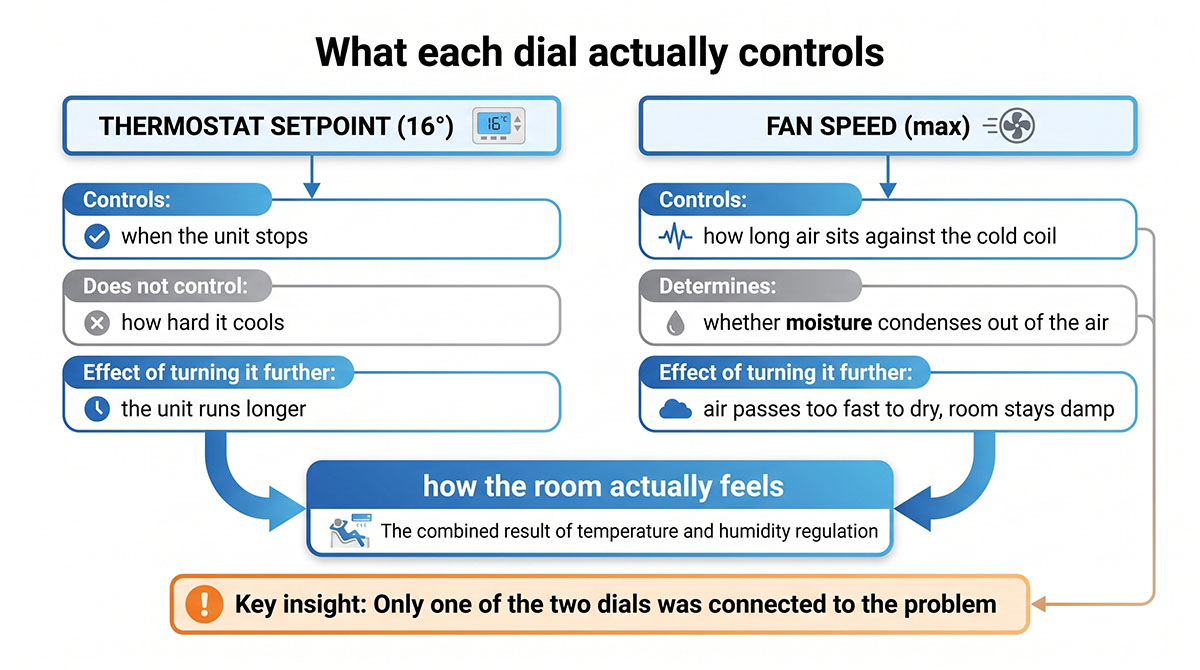
Air only gives up its moisture if it moves slowly enough across a cold coil to condense on it. On max fan, it doesn’t. It rushes past, gets chilled a few degrees, and arrives in the room carrying every bit of the water it started with. The thermometer drops. The house still feels like a wet towel, because damp air feels warmer than dry air at the very same reading, and your skin is a better judge of comfort than a number on a wall.
So the unit ran and ran, working hard, delivering air that felt warm. And I responded the only way I knew: more fan.
The 16 was doing almost nothing. A thermostat is a stopping instruction, not a throttle. It tells the unit when to quit, not how hard to work. Setting it lower didn’t make the machine cool faster. It just moved the finish line further away and guaranteed the thing would run longer.
Two dials. One of them was irrelevant to my problem. The other was actively causing it. And I had spent a summer turning both of them the wrong way, harder, on the theory that harder was the direction that helped.
Your marketing has the same two dials
Every marketing setup has dials that do nothing and dials that do damage. Almost nobody knows which is which, because almost nobody stops to find out.
You have had the conversation. Results are flat, somebody says the budget is too low, and by the end of the meeting the budget is higher. Nobody in the room asked whether the campaign was set up to use it.
What they do instead is add. More budget. Another channel. More posts. Another agency to run the channel they just added. Every one of those is a dial turned harder, chosen not because anyone diagnosed the system but because adding is the only move that feels like action.
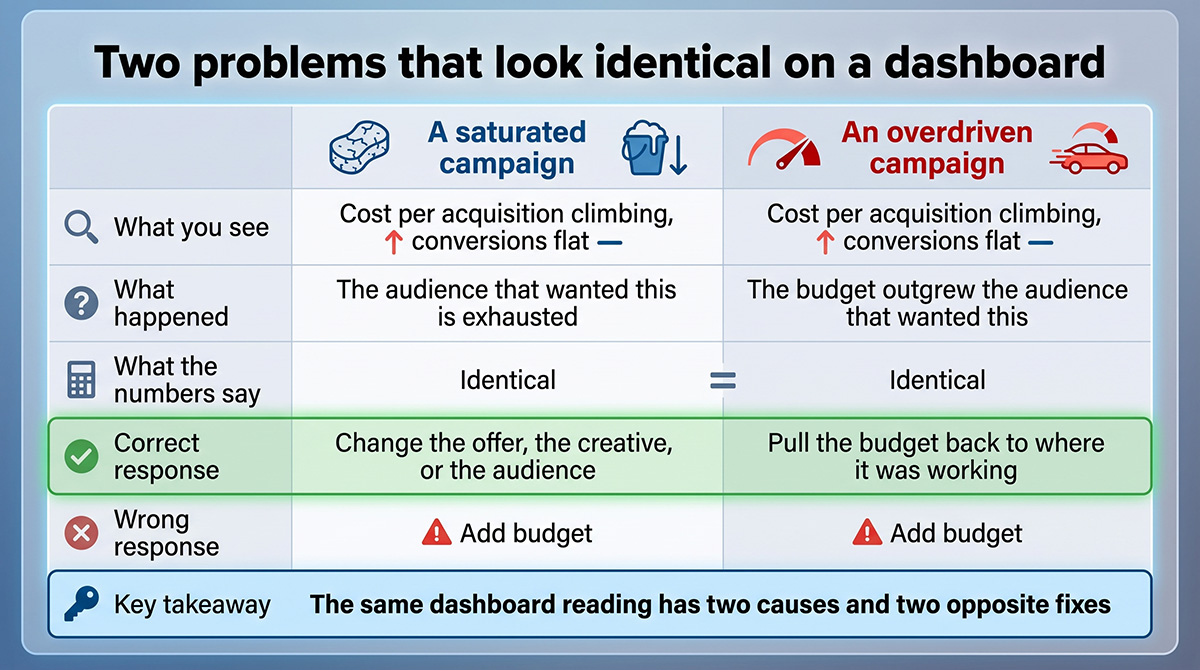
Say your ads are underperforming and you double the budget on the campaign that’s working. That campaign was working because it had found a specific pocket of people who wanted what you sell. That pocket has a size. The extra money doesn’t buy more of those people, because there aren’t any more of them. It buys the next-best group, and then the group after that, and your blended cost per acquisition climbs while your total conversions barely move.
Nothing broke. Nobody made a mistake. You overdrove a correctly configured campaign past the point where it could function, and the number went the wrong way — which looks identical, on a dashboard, to a campaign that has simply stopped working. Those two situations need opposite responses. Most owners can’t tell them apart, so they reach for the same lever either way.
"But we genuinely are under-resourced"
Sometimes this is true. It deserves a straight answer, not a clever one.
Plenty of businesses really are doing too little. One channel, no follow-up, a website nobody has touched in three years, an owner who does the marketing at 9pm when the invoicing is done. Telling that business to stop adding would be terrible advice. They need more. Of course they do.
But “we need more” and “more will help” are different claims, and only the first one is obviously true.
The test is narrow and you can run it this week: is anything currently running configured well enough to be producing? Not busy. Producing — you can name what it brought in and what it cost.
If one channel is genuinely working, adding a second is expansion, and you should get on with it. If nothing is working properly, adding a second is 16 degrees on max fan. You will have two things running badly instead of one, the same attention split across both, and a monthly number that has gone up while your results have not.
The reason this is hard to run on yourself is that the diagnosis crosses channels. The ad looks fine to the person who wrote it. The landing page looks fine to the person who built it. The fault sits in the join, and joins have no owner unless somebody is looking at every dial at once. That is the whole argument for one brain across every channel — not that one person is cheaper, but that a fault between two channels is invisible to anyone who only owns one of them.
So: diagnose first. Then add. Before you add anything, check what’s already broken.
The channel you added, and the content you published
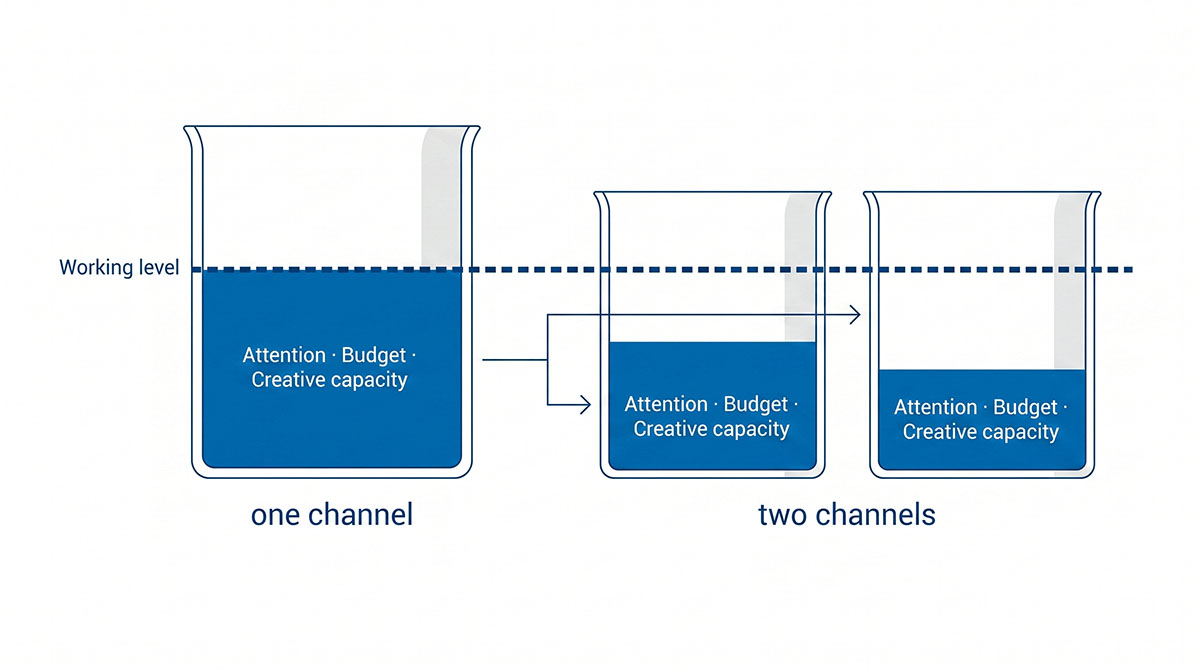
Adding a channel feels like addition. It doesn’t work that way. Your results don’t become channel one plus channel two. Attention, budget, and creative capacity get split two ways instead of one, and all three were already thin. The new channel launches at half strength because nobody had the hours to configure it properly, and the existing channel quietly degrades because the person who was watching it is now watching two things.
This is true at two channels and it is true at five. Every addition adds a queue — a new set of approvals, a new place for work to wait. And if you brought in an agency to run the new channel, there is a further bill that never arrives as an invoice: what the coordination actually costs.
The part nobody budgets for is the setup. Not the account build, which takes an afternoon. The weeks of learning what this particular audience responds to on this particular platform, which is the work that makes a channel produce and the work that gets skipped when it’s one more thing on a list. A channel that never got that attention isn’t a channel. It’s a line item that spends money.
Then there’s what you publish.
More posts, more topics, more pages, on the theory that volume is the input and traffic is the output. What happens instead is that the site starts saying twelve things. It ranks for none of them properly, because none of them got the depth that ranking requires. And a visitor who lands on it can’t tell in five seconds what you actually do, because the answer to that question is now spread across twelve pages that each make a different claim about you.
The count isn’t what hurt you. You published without deciding what the site was for, and volume turned one unmade decision into twelve versions of itself.

And the fix runs backwards from the instinct. It isn’t twelve more pages arguing the case harder. It’s deciding which one of the twelve things is the thing, then letting the other eleven go quiet. Almost nobody does this, because deleting work you paid for feels like admitting the money was wasted. It wasn’t wasted. It was spent in twelve directions at once, which is a configuration problem, not a volume one.
Different additions, same shape every time: more input, worse output, and a fault that was never about the amount.
Eighteen degrees, low fan
It’s late afternoon now. The sun has shifted off the windows and the house is comfortable. The air conditioner is so quiet I check to make sure it’s still running. It is. Low fan. 18 degrees. Barely working. Doing more than it ever did at 16 on max blast.
It took me a summer. Not a summer of trying things — a summer of trying one thing, over and over, harder each time, because the setting I was reaching for was the only setting I’d ever thought to reach for. The machine was never the problem. The machine was fine. It sat there the whole time, capable of doing exactly what I wanted, waiting for me to stop forcing it long enough to notice which dial was wrong.
The strange part is how little the fix cost. Two degrees warmer. One notch slower. No money, no new equipment, no expert. Thirty seconds of doing the opposite of my instinct, and the house finally did the thing it had refused to do all summer.
I still catch myself reaching for the fan on the hot days. The instinct doesn’t go away. It just gets easier to ignore.
Your marketing, looked at properly
Thirty minutes on your current setup — what’s working, what’s quietly leaking budget, and what I’d fix first. You’ll leave with a clearer picture whether we work together or not.
Got something specific bugging you? Flag it when you book and I’ll have it looked at before we talk.

AboutBruce Marjoribanks
Bruce Marjoribanks has spent 27 years in marketing, including building, running and selling his own agency before going independent. He now runs every channel - paid, organic, social, email, creative and automation - as one integrated system, with AI ehancing production and the judgment staying human.